
SMA Adapter Cable Selection & Routing Guide
Mar 04,2026
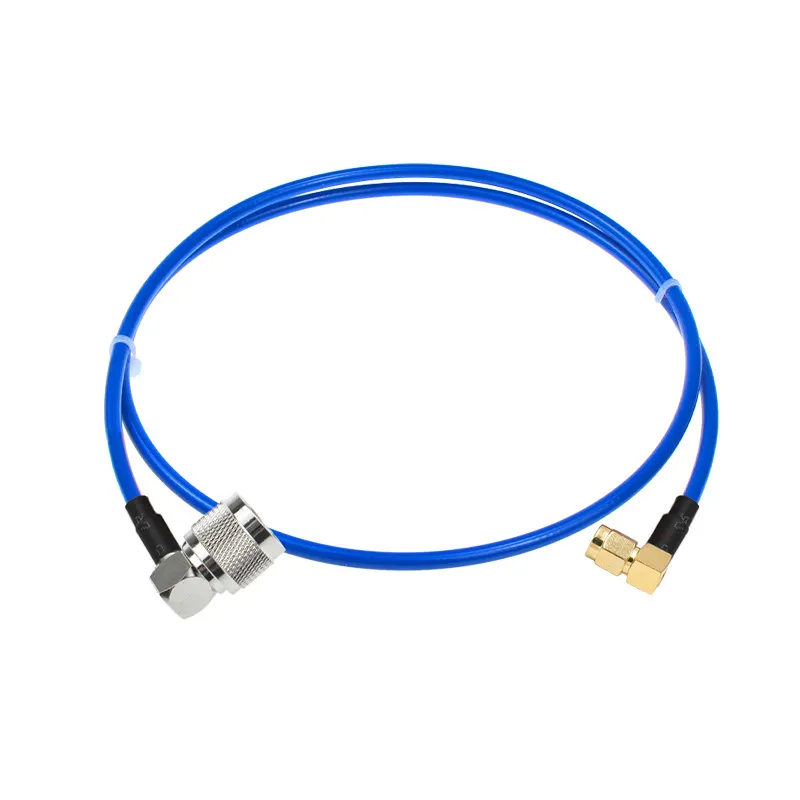
This figure illustrates the typical placement of an SMA adapter cable in a compact RF system. It connects an RF module (PCB) to a panel-mount SMA bulkhead, which then interfaces with an external antenna or test instrument. The cable serves as a mechanical buffer, isolating the PCB-mounted connector from enclosure stresses such as torque, cable pull, and vibration. Without this buffer, these forces would transfer directly to solder joints, leading to long-term reliability issues.
RF systems rarely collapse because of one dramatic mistake. More often, performance erodes quietly. A link that once had comfortable margin starts behaving inconsistently. A return loss curve shifts slightly after installation. Someone tightens a connector, and the numbers drift.
In many of those cases, the weak link isn’t the radio or the antenna. It’s the SMA adapter cable in between.
Engineers and procurement teams usually ask the same practical question:
Should this connection use a rigid adapter, a short adapter cable, or a full rf coaxial cable feeder?
This guide approaches that decision from a systems perspective—covering impedance continuity, routing stress, connector transitions, loss budgeting, and long-term serviceability. If you’ve already worked through a broader coax foundation like the RG Cable Guide (2025), this article zooms in on the short interface segment that often determines whether the rest of the chain performs as expected.
Where should an SMA adapter cable sit in your RF signal chain?
Map SMA adapter cables between modules, panels, and antennas
Start by drawing the entire signal chain—not just the visible connectors.
A typical compact system looks like this:
RF module (PCB) → SMA adapter cable → SMA bulkhead (panel-mounted) → external antenna or transition
In more infrastructure-oriented designs:
Device SMA port → short RG316 adapter → N bulkhead → outdoor feeder → antenna
The adapter cable acts as a mechanical buffer. It separates PCB-level tolerances from enclosure-level stresses. Without that buffer, torque and vibration travel directly into solder joints. And solder joints don’t forgive repetitive stress.
I’ve seen systems that passed every bench test fail in the field simply because the antenna was tightened against a board-mounted SMA. The RF design was fine. The mechanics weren’t.
Keep the whole path as 50 ohm coaxial cable
Most SMA ecosystems operate as 50 ohm coaxial cable systems. The impedance must remain consistent from source to antenna.
That means:
- Cable impedance: 50Ω
- Connector impedance: 50Ω
- Adapter transitions: minimized and accounted for
It’s surprisingly easy for a 75Ω component to sneak into a design—especially when sourcing parts under time pressure. The system may still function. But reflections increase, and link margin decreases. At 2.4 GHz or 5.8 GHz, those mismatches show up quickly.
Maintaining continuous 50Ω structure isn’t optional. It’s foundational.
Distinguish adapter cables from extension cables and rigid adapters
| Component Type | Flexibility | Primary Purpose |
|---|---|---|
| Rigid SMA adapter | None | Port alignment only |
| SMA extension cable | Moderate | Increase distance |
| SMA adapter cable | High | Offset + strain relief + routing |
A rigid adapter works when ports are aligned and stress-free. An extension cable works when you simply need more reach.
A true SMA adapter cable exists to solve mechanical problems without compromising electrical continuity. When stress exists, flexibility wins.
When should you choose an SMA adapter cable instead of a rigid adapter?
Replace connector stacking with one cable assembly
Each rigid interface adds:
- Another mechanical joint
- Another insertion loss contribution
- Another potential loosening point
As a working estimate, assume 0.1–0.3 dB per interface depending on quality and frequency.
Three stacked adapters may quietly cost close to 1 dB in a mid-GHz system. That’s not trivial in a tight link budget.
A single SMA adapter cable often reduces total transitions while adding flexibility. Fewer interfaces mean fewer unknowns.
Use adapter cables when routing offset or vibration exists
Consider these common cases:
- The enclosure hole doesn’t align perfectly with the PCB port
- The system operates in a vehicle
- The antenna cable may be bumped during service
Rigid stacking in these environments creates a lever arm. That lever arm transfers force into the PCB connector. Over time, intermittent contact appears.
A flexible segment of rf coaxial cable absorbs movement instead of amplifying it.
If vibration exists, use flexibility as a design tool.
Prefer continuous rf coaxial cable for long outdoor runs
An adapter cable is not a feeder. It’s an interface jumper.
If the required length extends beyond short internal routing—especially outdoors—move to a proper feeder cable designed for environmental exposure and lower attenuation.
If you’re deciding between jumper materials, a deeper comparison is covered in the Best Coaxial Cables 2025: RG & LMR Guide, which outlines where lighter jumpers stop making sense.
Short adapters solve alignment and stress problems. Long runs require transmission-grade solutions.
How do you pick the right coax for an SMA adapter cable?
Choose rg316 coaxial cable for durable, repeatable jumpers
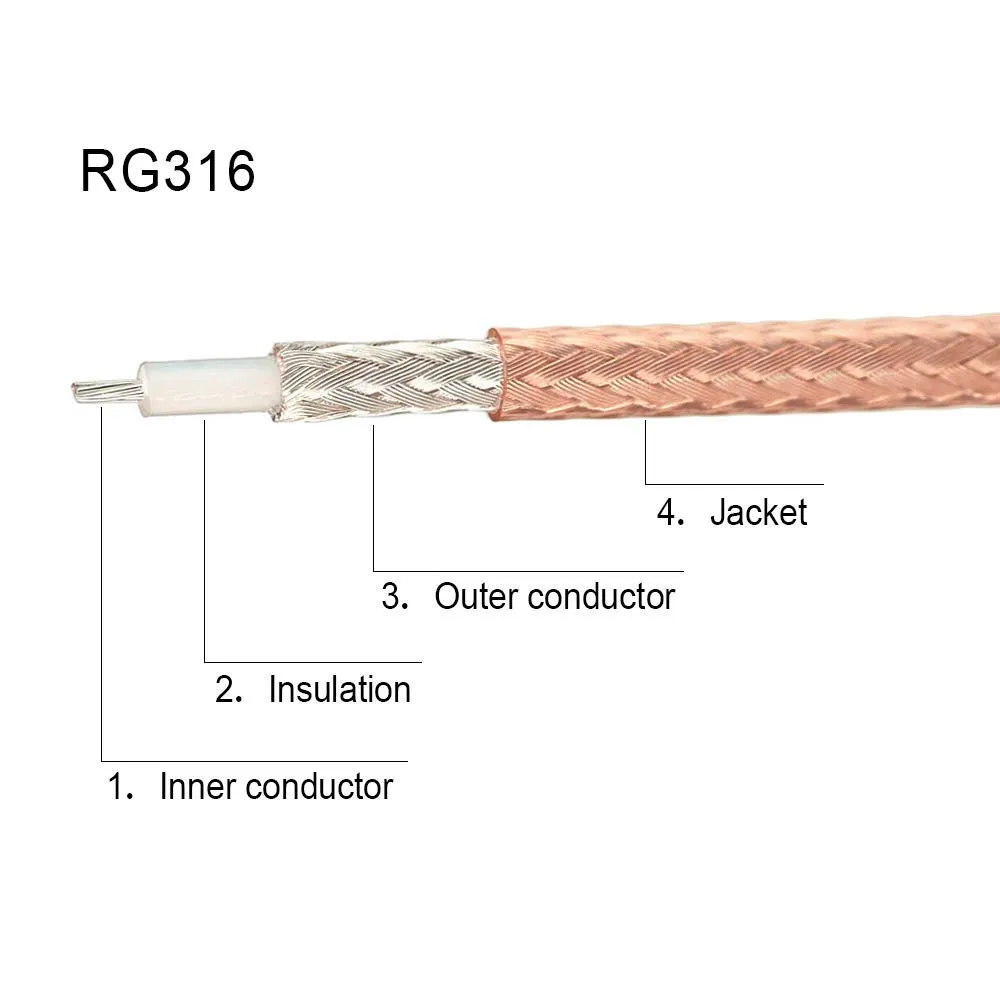
This image shows a detailed view of RG316 coaxial cable, likely with layers exposed to reveal construction: a silver-plated copper inner conductor, a PTFE dielectric (known for thermal stability and low loss), a braided shield (often silver-plated copper), and a protective outer jacket. With an outer diameter of approximately 2.5 mm, RG316 balances flexibility and durability, making it a common choice for short SMA adapter cables in lab equipment, industrial enclosures, and IoT hardware where predictable performance and heat tolerance are required.
RG316 coaxial cable is widely used in adapter assemblies for good reason:
- PTFE dielectric stability
- Solid 50Ω structure
- Moderate flexibility
- Consistent attenuation characteristics
It tolerates heat better than many miniature alternatives and handles repeated bending reasonably well.
For lab equipment, industrial enclosures, and most IoT hardware, rg316 cable strikes a strong balance between size and reliability.
It isn’t the lowest-loss option. It isn’t the thinnest. But it’s predictable—and predictability matters more than theoretical performance in most jumper applications.
If you want a deeper breakdown of its construction and performance profile, see the dedicated RG316 Coaxial Cable Guide.
Use micro-coax only when space forces it
Ultra-thin cables such as 0.81 mm or 1.13 mm micro-coax are appropriate when space constraints dominate:
- Internal antenna pigtails
- Hinged enclosures
- Ultra-compact radio modules
But tradeoffs are real:
- Higher attenuation per meter
- Smaller allowable bend radius
- Lower mechanical robustness
Use micro-coax when necessary—but shorten it as much as possible. Don’t default to it simply because it looks neat.
Match coax choice to frequency, bend radius, and service life
A practical rule of thumb:
- Higher frequency → lower loss cable becomes more valuable
- Longer length → attenuation matters more
- Frequent movement → stronger jacket preferred
- Tight routing → thinner cable may be unavoidable
There is no universal “best” SMA adapter cable construction. There is only the best compromise for that enclosure, that frequency band, and that expected service life.
Design decisions become clearer when you treat the adapter cable as part of the link budget—not an afterthought.
How do you plan length and loss for SMA adapter cables?
Loss planning sounds theoretical until you’re debugging a marginal link at 5.8 GHz and can’t explain where 1.5 dB disappeared.
A short SMA adapter cable may look harmless. Electrically, it isn’t invisible.
Estimate insertion loss using a simple dB budget
Start with published attenuation data for your chosen cable.
The working formula is straightforward:
Cable_loss_dB = (attenuation in dB per meter) × (length in meters)
For example, if your rg316 coaxial cable is specified at a certain loss per meter at 2.4 GHz, multiply that by your planned length. Even a 0.3–0.5 m jumper contributes measurable loss at microwave frequencies.
What engineers often forget is that loss scales with frequency. A cable that seems negligible at 900 MHz becomes far more relevant at 5.8 GHz.
If you need a refresher on attenuation behavior and coax structure, the overview on Coaxial cable provides foundational background on impedance and loss mechanisms.
The point isn’t to memorize numbers. It’s to quantify instead of guessing.
Add connector transitions into your link budget
Cable attenuation is only part of the story.
Each connector interface adds insertion loss. In practical engineering estimates, a commonly used working value is:
0.1–0.3 dB per interface
So a short adapter cable with two SMA ends introduces two interfaces. Add a bulkhead. Add a between-series transition. The cumulative effect grows.
A useful approximation:
Connector_loss_dB = Connector_count × 0.15
This middle-ground value keeps estimates conservative without exaggeration.
Total loss then becomes:
Total_loss_dB = Cable_loss_dB + Connector_loss_dB
It’s not perfect precision. But it prevents surprises.
Decide when an SMA adapter cable becomes “too long”
There’s no universal maximum length for an SMA adapter cable. The real limit depends on link margin.
Ask:
- How much allowable loss does the system tolerate?
- What frequency band dominates?
- Is there environmental fade margin?
If the adapter consumes a large portion of the available budget, the design is fragile.
At that point, switching to a lower-loss rf coaxial cable for part of the path—or redesigning the mechanical layout—may be smarter than trying to “optimize” a jumper that was never meant to carry distance.
How do you route an SMA adapter cable inside tight enclosures?
Respect bend radius and protect the first 20 mm near the connector
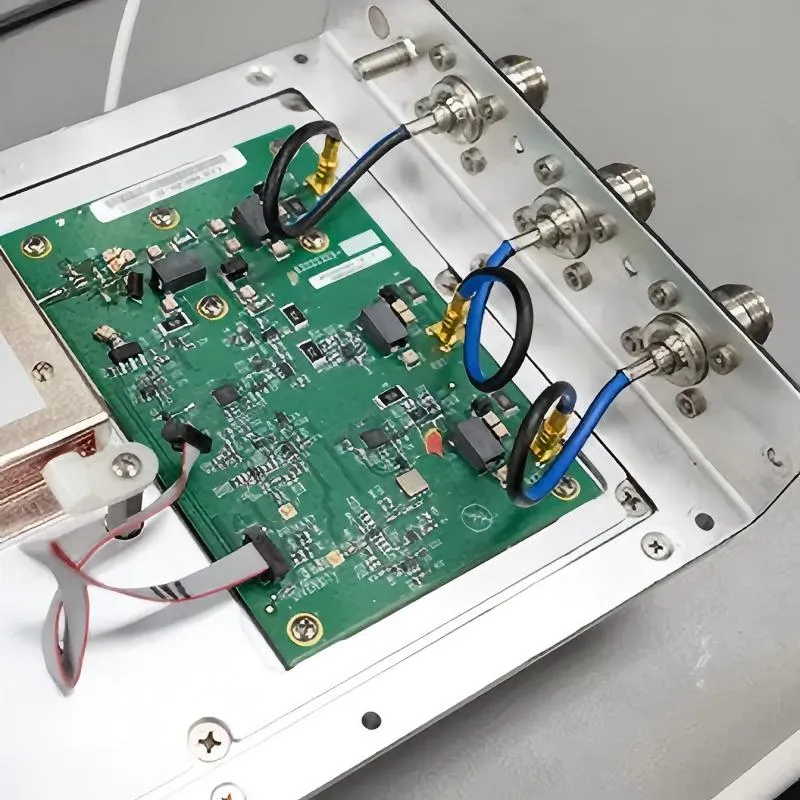
This figure highlights the most vulnerable section of an SMA adapter cable: the region immediately behind the connector body. It likely contrasts a correctly routed cable with a gentle radius against one with a sharp, forced bend near the connector. The image emphasizes that bending within this critical zone—typically the first 15-20 mm—concentrates mechanical stress, deforms the dielectric, and gradually degrades impedance continuity. Such damage may not cause immediate failure but leads to intermittent performance and reduced service life over time. Proper bend radius discipline is essential for long-term reliability.
The most common failure point is not mid-span. It’s right behind the connector body.
That first 15–20 mm experiences:
- Torque during installation
- Repeated bending
- Strain from enclosure alignment
Every cable type has a minimum bend radius. Exceeding it once may not cause immediate failure. Repeating it does.
Calculate bend margin:
Bend_margin_mm = Planned_min_bend_mm – Min_bend_radius_mm
If the margin is negative, redesign. Don’t hope.
Keep RF coaxial cable away from DC/DC and high-current paths
Electromagnetic interference isn’t theoretical. Switching regulators, motor drivers, and high-current traces generate fields that couple into nearby conductors.
While a properly shielded 50 ohm coaxial cable resists interference, routing it tightly against noisy power sections increases risk.
Practical routing guidance:
- Avoid parallel runs with high-current traces
- Maintain physical separation from inductors and transformers
- Keep distance from heat sources to prevent jacket aging
This isn’t about perfection. It’s about avoiding obvious stressors.
For broader EMI and RF interference fundamentals, the Federal Communications Commission (FCC) provides regulatory context under FCC RF Engineering. While focused on compliance, it reinforces how small layout decisions can influence radiated and conducted performance.
Use bulkhead mounting to move stress from PCB to the enclosure
If there’s one mechanical rule worth repeating:
Never let the PCB absorb enclosure torque if you can avoid it.
A panel-mounted SMA bulkhead transfers:
- Tightening torque
- Cable pull force
- External vibration
into the enclosure instead of the board.
The SMA adapter cable then becomes a stress isolator between panel and PCB.
In production environments, this also improves serviceability. Technicians can swap external antennas without risking internal solder joints.
Which connector forms should you specify for assembly and maintenance?
Choose straight vs right-angle based on strain, not RF spec
Electrically, straight and right-angle SMA connectors often perform similarly within rated frequency.
Mechanically, they behave very differently.
If a straight connector forces a sharp cable bend immediately behind the body, a right-angle version may:
- Reduce strain
- Increase bend margin
- Extend service life
Don’t select orientation based on appearance. Select it based on routing geometry.
Plan gender and RP-SMA risk controls before you buy
Ordering mistakes involving RP-SMA are common—especially in Wi-Fi hardware.
Before purchasing a SMA adapter cable, verify:
- Connector family (SMA vs RP-SMA)
- Gender (male/female)
- Center pin configuration
- Panel thread length
An RP-SMA mismatch won’t necessarily look wrong at first glance. It simply won’t mate electrically.
Teams often discover this only after assembly. By then, downtime costs more than the cable.
Reduce SKU chaos by standardizing a few cable templates
Procurement complexity grows quietly.
Instead of specifying custom lengths for every project, define a controlled set:
- 3–5 standard lengths
- 2 approved cable types (e.g., rg316 cable + micro-coax option)
- Pre-approved connector combinations
Standardization improves:
- Inventory control
- Replacement consistency
- Field maintenance efficiency
It also reduces the chance of mixing 50Ω and 75Ω components inadvertently.
How do SMA adapter cables interact with SMA-to-N systems?
Many compact systems eventually connect to infrastructure-grade antennas using N-type interfaces.
The transition between small device ports and robust outdoor connectors deserves attention.
Use sma adapter cable as the “interface jumper” before a feeder
A common architecture looks like this:
Device SMA → short SMA adapter cable (RG316) → N bulkhead → outdoor feeder → antenna
The adapter cable isolates the device from external torque and provides mechanical flexibility.
The feeder then handles distance and environmental exposure.
Decide between sma to n adapter and sma to n cable for each interface
There’s a difference between:
- sma to n adapter (rigid metal body)
- sma to n cable (flexible coax assembly)
- sma to n connector (panel-mounted interface component)
Use general logic:
- Perfect alignment, minimal stress → rigid adapter
- Offset or vibration → cable assembly
- Structural panel interface required → bulkhead connector
If you want a deeper mechanical comparison, the detailed breakdown in SMA to N Cable Selection & Application Guide expands on when flexibility becomes mandatory.
Build one end-to-end example from module to outdoor antenna
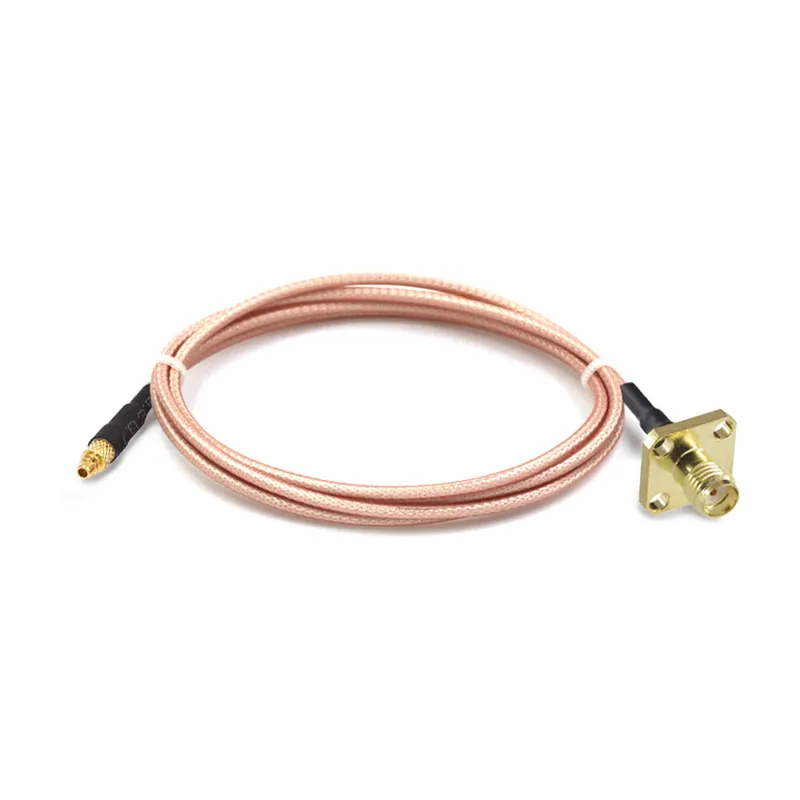
This diagram illustrates a practical end-to-end RF signal chain from a PCB-mounted module to an outdoor antenna. The path includes: a compact board-level MMCX connector, a short MMCX to SMA cable (providing strain isolation), an SMA bulkhead (transferring mechanical load to the enclosure), an SMA to N cable (flexible transition to infrastructure-grade N-type), and finally an N-type antenna. Each segment is chosen deliberately: MMCX for space, short cables for flexibility, bulkheads for structure, and N-type for outdoor robustness. The image reinforces that random substitution with rigid adapters would compromise reliability.
Consider a practical chain:
PCB → mmcx to sma cable → SMA bulkhead → sma to n cable → N-type antenna
Each segment exists for a reason:
- MMCX: compact board interface
- Short adapter cable: strain isolation
- Bulkhead: enclosure structure
- SMA-to-N transition: infrastructure compatibility
Randomly replacing one with a rigid adapter may simplify purchasing—but it often complicates reliability.
Can a scoring sheet standardize SMA adapter cable decisions?
In real projects, debates about cables rarely start with math. They start with preference.
One engineer trusts rg316 coaxial cable. Another prefers thinner micro-coax because “it fits better.” Purchasing pushes for cost reduction. Mechanical wants more bend slack.
Without structure, the decision becomes subjective.
A scoring sheet changes that.
Instead of asking “Which cable feels right?” you ask:
- Does it fit the loss budget?
- Does it respect bend radius?
- Will it survive field handling?
- Does it stay within cost constraints?
That shift—from opinion to evaluation—usually settles arguments quickly.
Define fields and formulas for the matrix
SMA Adapter Cable Selection Matrix
| Field | Purpose | Formula |
|---|---|---|
| Project_name | Track configuration | — |
| Use_case | Lab / IoT / Vehicle / Outdoor AP / Rack | — |
| Band_GHz | Operating frequency | — |
| Planned_length_m | Cable length | — |
| Coax_type | rg316 coaxial cable / micro-coax / other | — |
| Cable_loss_dB_per_m | From manufacturer spec | — |
| Cable_loss_dB | Cable attenuation | Cable_loss_dB_per_m × Planned_length_m |
| Connector_count | Number of RF interfaces | — |
| Connector_loss_dB | Transition estimate | Connector_count × 0.15 |
| Total_loss_dB | Combined contribution | Cable_loss_dB + Connector_loss_dB |
| Allowed_loss_dB | Budget from link analysis | — |
| Margin_dB | Remaining RF margin | Allowed_loss_dB − Total_loss_dB |
| Min_bend_radius_mm | Cable spec requirement | — |
| Planned_min_bend_mm | Actual enclosure constraint | — |
| Bend_margin_mm | Mechanical safety | Planned_min_bend_mm − Min_bend_radius_mm |
| Serviceability_score | 1–5 rating | — |
| Cost_score | 1–5 rating | — |
| Overall_score | Weighted evaluation | 0.4×Margin_score + 0.3×Bend_score + 0.2×Serviceability_score + 0.1×Cost_score |
A few notes from experience:
- Connector transitions often dominate loss in short SMA adapter cable runs.
- Bend margin is usually the hidden failure point.
- Serviceability matters more in field-repairable systems than lab prototypes.
This sheet makes those tradeoffs visible.
Walk through a real enclosure example (MMCX → SMA panel)
Let’s ground this in a practical case.
System:
- 2.4 GHz IoT gateway
- Internal 0.3 m jumper
- rg316 cable
- Two SMA interfaces
- Allowed internal loss: 1.0 dB
Step 1: Cable attenuation
Cable_loss_dB = (spec dB/m at 2.4 GHz) × 0.3
Even without exact numbers here, the calculation is straightforward once you insert manufacturer data.
Step 2: Connector estimate
Connector_loss_dB = 2 × 0.15
Short jumpers frequently lose more at connectors than in the cable itself. That surprises people the first time they quantify it.
Step 3: Margin check
Total_loss_dB = Cable_loss_dB + Connector_loss_dB
Margin_dB = 1.0 − Total_loss_dB
If the margin drops close to zero, consider:
- Reducing length
- Eliminating one interface
- Switching cable type
Notice how mechanical layout and RF math intersect here. You can’t evaluate one without the other.
Convert the matrix into an incoming inspection checklist
Design discipline means little if procurement delivers something slightly different.
An incoming inspection checklist for SMA adapter cable assemblies might include:
- Length verification
Confirm actual length matches the specified Planned_length_m.
- Connector orientation
Straight vs right-angle matches mechanical drawing.
- Connector type confirmation
Verify SMA vs RP-SMA and gender configuration.
- Visual integrity
No crushed jacket near crimp, no exposed braid.
- Bend compliance
No pre-installed bends below minimum radius.
- Impedance confirmation
Confirm all assemblies are 50 ohm coaxial cable, not 75Ω variants.
- Optional RF documentation
For higher-frequency systems, S-parameter data may be requested.
These checks are simple. Skipping them is what causes field headaches.
What’s new in SMA and RF interconnect components?
Ruggedized and sealed SMA assemblies
Outdoor and vehicle deployments now often combine:
- Panel-mounted SMA bulkheads
- Short internal adapter jumpers
- External N-type feeder transitions
This layered architecture isolates stress while maintaining impedance continuity.
If you’re transitioning from compact internal routing to infrastructure systems, reviewing feeder principles in a broader guide like 50 Ohm Coaxial Cable Selection Guide helps clarify when an adapter cable stops being sufficient.
The dividing line is usually distance and environment—not just frequency.
Answer common SMA adapter cable questions
When is an SMA adapter cable better than stacking adapters?
When mechanical offset, vibration, or torque exists.
Stacked rigid adapters increase interface count and amplify stress transfer into the PCB. A flexible SMA adapter cable reduces both mechanical leverage and cumulative insertion loss.
How long can an SMA adapter cable be at 2.4 GHz or 5.8 GHz before loss matters?
There is no fixed limit.
Calculate attenuation based on frequency and cable type. At higher frequencies, attenuation rises sharply.
If the jumper consumes a significant portion of available link budget, shorten it or move to a lower-loss rf coaxial cable.
Should I choose rg316 coaxial cable or micro-coax?
If space permits, rg316 coaxial cable generally offers better durability and consistent performance.
Micro-coax should be reserved for space-constrained layouts and kept short to minimize loss.
Do right-angle SMA ends improve reliability or just convenience?
They improve reliability when they reduce strain.
Electrically, differences are usually minor within rated frequency. Mechanically, reducing sharp bends near the connector body often extends service life.
How do I avoid RP-SMA ordering mistakes?
Confirm:
- Connector family
- Gender
- Center pin orientation
Document it clearly in drawings. Never rely solely on naming conventions.
When should I switch from an adapter cable to a full rf coaxial cable feeder?
When length increases beyond short internal routing, or when environmental durability becomes critical.
Adapter cables solve alignment and stress problems. Feeders solve transmission efficiency over distance.
Closing Perspective
A SMA adapter cable doesn’t look like a critical component. It’s short. It’s flexible. It often arrives late in the design process.
Yet it directly affects:
- Impedance continuity
- Insertion loss
- Mechanical stress transfer
- Service life
Treat it as part of the RF chain—not a placeholder between connectors.
Run the numbers. Check the bend radius. Limit unnecessary transitions. Standardize what you can.
RF systems reward discipline in small decisions.
And short cables are small decisions—until they aren’t.
Bonfon Office Building, Longgang District, Shenzhen City, Guangdong Province, China

A China-based OEM/ODM RF communications supplier
Table of Contents
Owning your OEM/ODM/Private Label for Electronic Devices andComponents is now easier than ever.