
RG316 Coaxial Cable Selection and Application Guide
Feb 28,2026
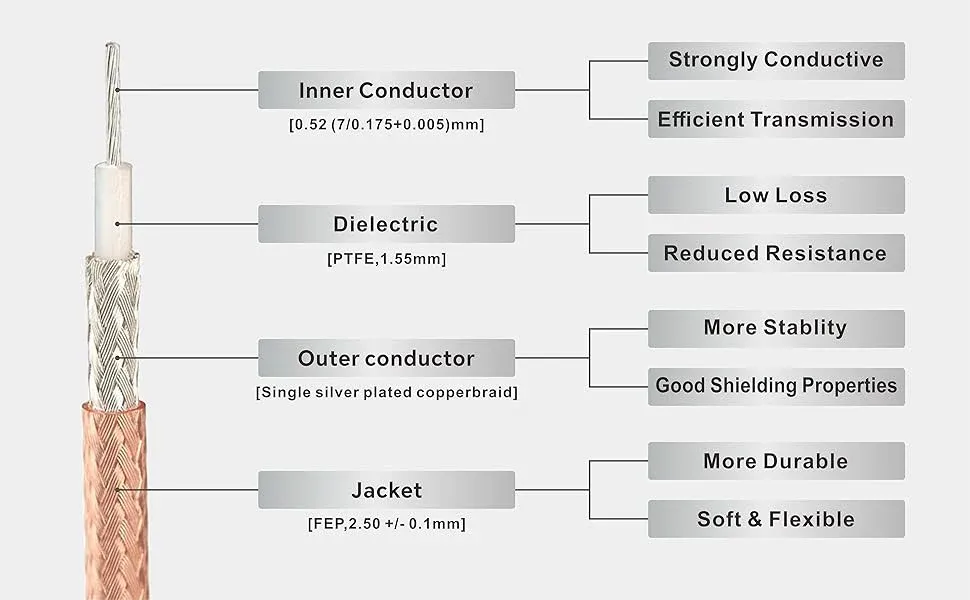
This image shows a typical RG316 coaxial cable, likely with a section of the outer jacket removed to reveal the inner conductor, PTFE dielectric, and braided shield. It represents the cable that engineers often treat as a passive component but which becomes critical once integrated into the RF path. Its small diameter (~2.5 mm) and temperature stability make it ideal for internal jumpers in enclosures.
Cables rarely get the spotlight in RF design reviews. Radios do. Antennas definitely do. Firmware sometimes steals the blame too. But the short jumper quietly linking a module to its panel connector? That’s usually assumed to “just work.”
In compact RF systems, that assumption can cost you margin.
RG316 coaxial cable sits in a narrow but critical niche. It’s thin enough to disappear inside tight enclosures. It tolerates higher temperatures than many miniature alternatives. And when used correctly, it behaves predictably in the multi-GHz range. Used casually, though, it can quietly chip away at link budget and measurement stability.
This guide focuses on engineering decisions — not marketing claims. If you’re an RF engineer, hardware designer, systems integrator, or procurement specialist working with rg316 cable, this is written with your constraints in mind.
Map RG316 coaxial cable into your RF system architecture
Trace RG316 cable from RF module ports to antennas and instruments
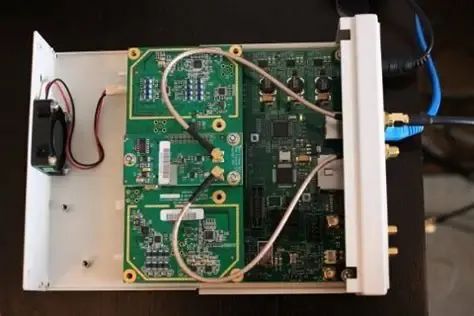
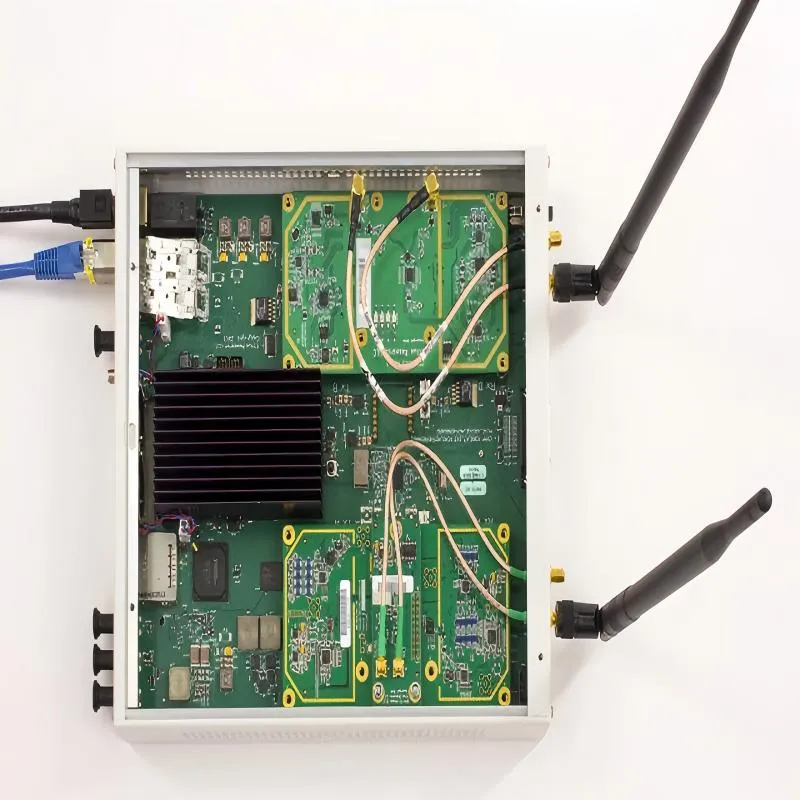
This diagram illustrates a common RF signal path: an RF SoC or module, a PCB launch transition, a short internal RG316 pigtail, a panel bulkhead connector, and finally an external antenna or test instrument. It emphasizes that RG316 acts as an intermediary, absorbing mechanical stress while maintaining 50-ohm integrity.
In real hardware, RG316 coaxial cable almost never serves as the main feeder. Instead, it plays an intermediary role:
- RF SoC or module
- PCB launch transition
- Short internal pigtail
- Panel bulkhead connector
- External antenna or test instrument
That small internal jumper often determines how gracefully your system transitions from board-level RF to mechanical reality.
Where issues tend to show up:
- Tight bends at panel exits
- Poor strain relief
- Excessive adapter stacking
- Improper connector crimp quality
The cable itself is stable. Integration is where mistakes happen.
If you’re building a broader understanding of 50-ohm infrastructure, our 50 Ohm Coaxial Cable Selection and Application Guide provides deeper background on impedance standards and RF system architecture.
Position RG316 as a 50 ohm coaxial cable in broader RF coax families
This figure places RG316 in context with other common 50-ohm coaxial cables such as RG58, RG213, and LMR-240. It likely shows side-by-side cross-sections or diameter comparisons, highlighting RG316's smaller size and suitability for tight spaces, while noting its higher attenuation compared to larger feeders.
RG316 belongs to the 50 ohm coaxial cable family — the impedance standard used across RF communications, Wi-Fi, GNSS, cellular infrastructure, and test equipment.
That puts it alongside:
- RG58
- RG142
- RG213
- LMR-240 / LMR-400
- Other 50 Ω rf coaxial cable families
The 50-ohm convention wasn’t chosen arbitrarily. It’s the historical compromise between maximum power handling (~30 Ω) and minimum attenuation (~77 Ω). RF system designers standardized on 50 Ω decades ago, and that decision still governs cable selection today.
If your project requires a connector-agnostic overview of RF cable families before narrowing down to RG316, see our broader RF Coaxial Cable Guide.
Separate RG316 RF use cases from 75 Ω TV or CATV coax
Not all coax is interchangeable. It may look similar. It may even connect physically. Electrically, though, it’s different.
RG316 coaxial cable is strictly a 50 Ω cable. It is not intended for:
- CATV distribution
- Satellite TV trunk lines
- 75 Ω broadcast video systems
Those systems typically use RG6 or RG11 (75 Ω). Mixing impedance families won’t always produce catastrophic failure — the signal may “work.” But reflections increase. VSWR shifts. Measurements drift subtly.
In RF systems, small mismatches accumulate. If your architecture is 50 Ω end-to-end, keep it consistent from PCB trace to antenna connector.
Decide when RG316 coaxial cable is the right choice
Use RG316 cable when space is tight but RF performance still matters
With an outer diameter of roughly 2.5 mm, rg316 cable qualifies as miniature coax.
That makes it ideal for:
- Compact IoT enclosures
- Embedded Wi-Fi modules
- GNSS antenna pigtails
- Router internal antenna routing
- RF test jumpers in dense benches
Its PTFE dielectric provides better temperature stability compared to PVC-based miniature alternatives. In industrial or automotive environments, that difference matters.
You’ll often see RG316 coaxial cable selected simply because nothing larger will fit without redesigning the enclosure.
Prefer RG316 over RG174 and RG178 when temperature or durability is critical
RG174 and RG178 are also miniature 50 Ω cables. On paper, they appear similar. In practice, there are differences worth noting.
RG316 advantages:
- Higher temperature tolerance (PTFE dielectric)
- Better mechanical durability under repeated flex
- Improved long-term stability in higher-heat environments
RG174 typically uses PVC dielectric, which lowers maximum operating temperature. RG178 is thinner and more delicate, optimized for extreme space constraints.
If your application involves:
- Frequent connector mating cycles
- Moderate RF power
- Elevated ambient temperature
RG316 coaxial cable is usually the safer long-term choice.
Avoid RG316 when long outdoor feeds or very low loss are required
There’s a point where miniature convenience becomes a liability.
RG316 is not designed for:
- Multi-meter outdoor mast feeds
- High-power base station runs
- Ultra-low-loss long links
Above 2 GHz, attenuation rises quickly. A few meters may be acceptable. Ten meters? That’s a different conversation.
In those cases, a hybrid strategy works best:
- Short internal RG316 jumper
- External low-loss feeder (LMR-240 or LMR-400)
If you’re weighing this transition point, our 50 Ohm Coaxial Cable Selection Guide discusses feeder tradeoffs in more depth.
Think of RG316 coaxial cable as a precision internal interconnect — not the backbone of your RF path.
Compare RG316 coaxial cable with other miniature RF cables
Benchmark RG316 cable against RG58 and LMR-240 in short runs
| Cable Type | Approx. OD | Flexibility | Typical Role |
|---|---|---|---|
| RG316 | ~2.5 mm | High | Internal jumper, pigtail |
| RG58 | ~5 mm | Moderate | Lab cable, medium runs |
| LMR-240 | ~6.1 mm | Lower | External antenna feed |
This image likely presents a graphical or tabular comparison of key parameters for RG316, RG58, and LMR-240, such as attenuation per meter at various frequencies, outer diameter, and minimum bend radius. It reinforces the idea that RG316 is optimized for short, flexible internal runs where mechanical constraints outweigh raw loss.
RG316 coaxial cable trades slightly higher attenuation for flexibility and temperature resilience.
In enclosure design, flexibility often outweighs raw attenuation — especially when the run is short.
From field experience, replacing an oversized cable with RG316 has saved more enclosure redesign cycles than most engineers would admit publicly.
Plan loss, power, and frequency limits for RG316 runs
Short cables create a false sense of safety.
“It’s only inside the box.”
“It’s barely 20 centimeters.”
Then someone measures the system six months later and wonders where 1 dB disappeared.
With RG316 coaxial cable, loss is rarely dramatic. It’s incremental. And incremental losses are exactly what erode link margin quietly.
Let’s break it down the way it actually shows up in design work.
Estimate RG316 attenuation at HF, UHF, and 2.4/5.8 GHz bands
All coaxial cables exhibit frequency-dependent attenuation. That’s not a flaw; it’s physics. Conductor resistance rises with frequency (skin effect), and dielectric loss increases as well.
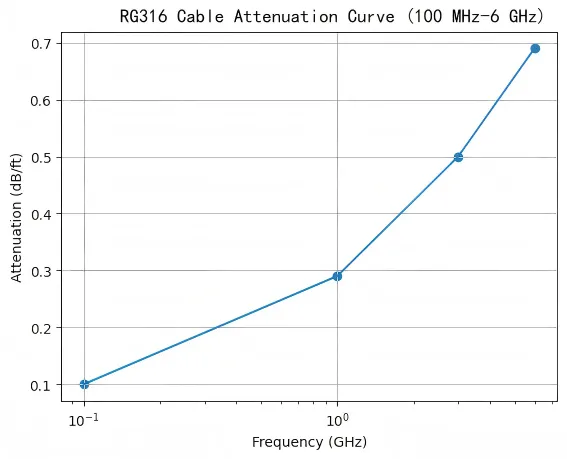
Typical representative attenuation values for rg316 cable look like this:
| Frequency | Approximate Loss |
|---|---|
| 100 MHz | ~0.1 dB/ft |
| 1 GHz | ~0.29 dB/ft |
| 3 GHz | ~0.5 dB/ft |
| 6 GHz | ~0.69 dB/ft |
These are ballpark figures — always verify with the specific manufacturer’s datasheet.
A practical rule engineers actually use on the bench:
Cable_loss_dB ≈ (specified dB/m at frequency) × length (m)
For example:
- 0.25 m at 2.4 GHz → roughly 0.25–0.35 dB
- 0.5 m at 5.8 GHz → could approach ~0.6 dB
In a Wi-Fi router with 3–4 dB link margin, that’s noticeable.
If you need a refresher on why attenuation behaves this way, the fundamental construction of a Coaxial cable explains the conductor/dielectric interaction that drives these losses.
In practice, most “mysterious” signal drops at high frequency are simply unbudgeted cable loss.
Check RG316 power handling and frequency ceiling before committing
Power handling is not fixed. It changes with frequency and environment.
At lower frequencies (hundreds of MHz to ~1 GHz), short runs of RG316 coaxial cable can handle substantial continuous power. Move toward several GHz, and safe continuous power decreases due to increased dielectric heating.
Important factors engineers sometimes overlook:
- Continuous vs pulsed transmission
- Mismatch conditions (high VSWR increases stress)
- Enclosure airflow
- Ambient temperature
A cable inside a sealed metal enclosure runs hotter than the same cable hanging freely in a lab.
If your transmitter operates at higher duty cycle, thermal margin becomes real — not theoretical.
For comparison with thicker 50 Ω feeders and how power scales with diameter, our broader 50 Ohm Coaxial Cable Selection and Application Guide discusses the relationship between impedance, diameter, and power capacity.
The short version? Thin cable doesn’t automatically mean “low power only,” but margin shrinks as frequency climbs.
Combine RG316 and connector loss into a realistic RF path budget
Engineers often calculate cable loss but forget transitions.
Every connector contributes small insertion loss. Small, yes. Negligible? Not always.
Typical insertion loss per mated RF connector pair:
- ~0.1–0.3 dB (frequency dependent)
That includes:
- SMA interfaces
- Panel bulkheads
- Adapter interfaces
- Pre-built sma adapter cable assemblies
- Board-level transitions such as mmcx to sma cable
In a modular system, you might have:
- 2 connectors on the cable
- 1 bulkhead
- 1 adapter
That’s potentially 4 transitions.
A conservative estimate:
Connector_loss_dB ≈ Connector_count × 0.15
Add it to cable loss:
Total_path_loss_dB = Cable_loss_dB + Connector_loss_dB
I’ve seen systems lose nearly 1 dB purely from accumulated connectors — without anyone realizing it until formal RF path auditing.
If you’re working heavily with connector transitions, our SMA Adapter Cable Selection and Routing Guide for RF Systems covers transition-related decision points in greater detail.
It’s not the single connector that hurts you. It’s the stack.
Route RG316 coaxial cable safely inside enclosures and vehicles
Respect bend radius — especially near connectors
A common engineering shortcut is bending the cable sharply right at the connector exit to “make it fit.”
That works. For a while.
A general rule:
Minimum bend radius ≥ 5× outer diameter
For RG316, that’s typically around 12–15 mm. Check the datasheet.
Failure points tend to appear:
- Immediately after the crimp sleeve
- At tight panel exits
- Where cable is forced against sharp chassis edges
Cables rarely fail mid-span. They fail where mechanical stress concentrates.
And once shielding degrades internally, attenuation increases gradually — not catastrophically.
Keep RG316 away from noisy harnesses
Shielding helps. It’s not magic.
Avoid long parallel runs with:
- Switching power supplies
- Motor drive lines
- High-speed digital harnesses
Cross at right angles where possible. Maintain physical spacing. Don’t bundle RF coax tightly with power wiring just because it looks clean.
Interference coupling is subtle at first. It shows up as increased noise floor or slightly worse return loss.
Engineers often blame firmware before checking routing.
Let bulkheads carry mechanical load — not the cable
If you’re pulling on the cable during assembly, something is wrong.
Use panel-mount connectors so:
- Torque is absorbed by the connector body
- Mechanical strain is transferred to the enclosure
- The rg316 cable handles signal only
In automotive or industrial equipment, vibration fatigue is cumulative. The failure may not appear for a year — but when it does, it’s rarely obvious.
Mechanical discipline extends electrical life.
Integrate RG316 into adapter, pigtail, and modular assemblies
Build SMA-based jumper assemblies on RG316
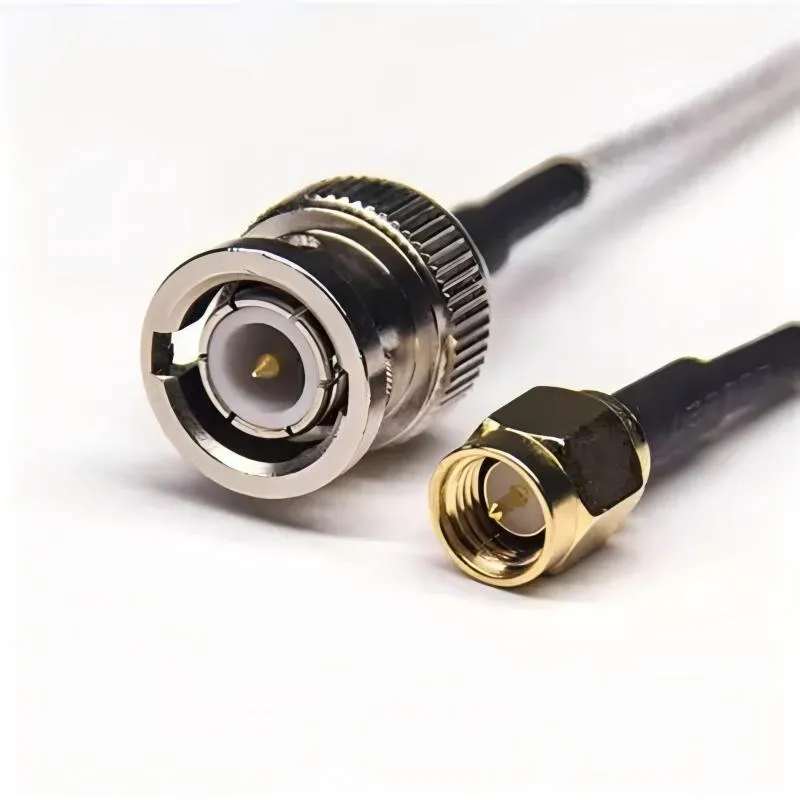
This photograph shows a pre-terminated SMA-to-SMA jumper cable built with RG316 coaxial cable. Both ends feature precision SMA connectors, and the flexible RG316 section allows easy routing in enclosures or test setups. Such assemblies are common as internal jumpers from board-level RF ports to panel bulkheads, or as short test leads in labs.
Many commercial sma adapter cable assemblies use RG316 coaxial cable internally for a reason:
- 50 Ω compliance
- Compact diameter
- Multi-GHz usability
- Reasonable cost
Typical transitions include:
- SMA to BNC
- SMA to TNC
- SMA male-to-female extensions
In compact RF devices, these jumpers act as controlled, flexible transitions rather than stacking rigid adapters directly onto panel connectors.
It’s cleaner mechanically. It’s safer electrically.
Use MMCX to SMA cable on RG316 for compact modules
Board-level RF modules frequently expose MMCX connectors.
Panel interfaces, however, are often SMA or RP-SMA.
A practical architecture:
MMCX (PCB) → mmcx to sma cable (RG316) → Panel SMA → External feeder
This configuration:
- Preserves compact PCB footprint
- Allows serviceable panel interface
- Keeps internal routing flexible
If your design begins with miniature board-level ports, our MMCX to SMA Cable Selection Guide dives deeper into retention force, tolerance, and transition loss.
In most of those assemblies, the cable in between is RG316.
Combine RG316 with low-loss feeders strategically
There’s no rule that says one cable family must handle the entire RF path.
Hybrid example:
- 15 cm internal RG316 coaxial cable
- Panel bulkhead
- 2–3 m LMR-240 external feeder
- Outdoor antenna
This balances:
- Internal routing flexibility
- External attenuation control
Design segmentation often produces better results than forcing a single cable type to do everything.
Introduce a structured RG316 selection matrix
At some point, intuition isn’t enough. Especially when procurement, QA, and compliance teams get involved.
A simple matrix can formalize selection logic and prevent silent substitutions.
Core selection matrix inputs and formulas
Recommended fields:
- Project_name
- Application_type
- Band_low_GHz / Band_high_GHz
- Target_power_W
- Max_path_loss_dB
- Cable_family
- Cable_loss_dB_per_m
- Planned_length_m
- Connector_count
- Impedance_scheme (Strict 50 Ω / Mixed)
- Min_bend_radius_mm
- Planned_min_bend_mm
- Environment
Core calculations:
Cable_loss_dB = Cable_loss_dB_per_m × Planned_length_m
Connector_loss_dB = Connector_count × 0.15
Total_path_loss_dB = Cable_loss_dB + Connector_loss_dB
Margin_dB = Max_path_loss_dB – Total_path_loss_dB
Bend_margin_mm = Planned_min_bend_mm – Min_bend_radius_mm
Optional composite scoring:
Overall_score = 0.4×Margin_score + 0.3×Bend_score + 0.2×Serviceability_score + 0.1×Cost_score
If Margin_dB remains positive and overall score exceeds your internal threshold, RG316 coaxial cable is defensible as an engineering choice — not just a convenient one.
Structured evaluation protects RF margin and procurement integrity.
Run the selection matrix on a real compact RF example
Theory is useful. A filled-out worksheet is better.
Let’s take a realistic case:
Application: Compact 2.4 GHz Wi-Fi gateway
Architecture:
- PCB radio module with MMCX port
- 15 cm internal mmcx to sma cable (using RG316 coaxial cable)
- Panel-mounted RP-SMA connector
- 1 m external LMR-240 to antenna
Now plug it into the matrix.
Step 1 — Define electrical inputs
- Band_high_GHz: 2.5
- Target_power_W: 1 W continuous
- Max_path_loss_dB (internal segment): 1.5 dB allowable
- Cable_loss_dB_per_m at 2.4 GHz: ~1.2–1.4 dB/m (manufacturer dependent)
- Planned_length_m: 0.15 m
- Connector_count (MMCX + SMA pair): 2
Step 2 — Calculate losses
Cable_loss_dB = 1.3 × 0.15 ≈ 0.20 dB
Connector_loss_dB = 2 × 0.15 ≈ 0.30 dB
Total_path_loss_dB ≈ 0.50 dB
Margin_dB = 1.5 – 0.5 = 1.0 dB
A full dB of margin remains for internal wiring. That’s comfortable.
Now check bend constraints:
- Minimum bend radius (example): 12 mm
- Planned minimum bend in enclosure: 18 mm
- Bend_margin_mm: +6 mm
Mechanically acceptable. Electrically acceptable.
For this application, RG316 coaxial cable is not just convenient — it’s defensible.
That’s the difference between intuition and documented engineering logic.
Use the matrix as an OEM cable assembly acceptance checklist
Once a design moves to production, cable substitutions become a risk.
Two assemblies may look identical. Internally, they might not be.
Turn your matrix into a supplier validation sheet:
Verify:
- Impedance: Strict 50 Ω
- Cable family: Confirm true RG316 construction (PTFE dielectric, silver-plated braid, etc.)
- Length tolerance
- Measured insertion loss at target frequency
- Connector crimp or solder quality
- Minimum bend radius compliance
- Shield continuity
- Labeling and traceability
In procurement audits, I’ve seen failures caused by “equivalent” miniature coax that wasn’t actually RG316-spec material.
Structured verification avoids that trap.
If you’re sourcing or evaluating assemblies at scale, aligning your documentation with a broader rf coaxial cable specification framework — such as outlined in our RF Coaxial Cable Guide — ensures consistency across product lines.
Track RG316 market and application trends in RF interconnects
Watch coaxial cable market growth trends
Industry analyses consistently project steady growth in global coaxial cable markets through 2030, driven by:
- Wireless infrastructure expansion
- Industrial IoT deployment
- Automotive connectivity
- Test and measurement equipment
Research organizations such as ResearchAndMarkets report multi-billion-dollar global market growth for coaxial cable categories over the coming years, with mid-to-high single-digit CAGR projections.
Miniature 50 Ω cables — including constructions similar to RG316 coaxial cable — benefit directly from this trend.
As devices shrink and RF density increases, flexible miniature interconnects become more common.
Link RG316 usage to micro-coax assembly growth
Modern electronics are more compact than ever.
That shift drives demand for:
- Miniature board-level RF connectors
- Flexible internal jumpers
- Modular antenna transitions
Micro-coax assemblies — often built on platforms like rg316 cable — are widely used in:
- GNSS receivers
- Embedded LTE gateways
- Industrial routers
- Aerospace communication subsystems
This isn’t speculation. It’s a mechanical reality of dense electronics packaging.
When enclosures shrink, thick cables don’t.
Answer practical RG316 coaxial cable design questions
How long can an RG316 cable run at 2.4 GHz or 5.8 GHz before attenuation becomes problematic?
There’s no universal number. It depends on allowable path loss.
At 2.4 GHz, short internal runs under 0.5 m are commonly acceptable. At 5.8 GHz, attenuation rises more quickly, and margin shrinks faster.
When total run length approaches 1–2 meters at multi-GHz frequencies, consider transitioning to a lower-loss feeder.
Always calculate — don’t guess.
What continuous power levels can RG316 handle safely?
Power capacity depends on:
- Frequency
- Duty cycle
- Cooling
- VSWR
At sub-GHz frequencies and short lengths, moderate continuous power is feasible. At higher GHz bands, allowable power decreases.
Consult manufacturer data and include conservative margin. Thin cable inside sealed metal enclosures heats differently than open-air test leads.
When should RG316 remain a short jumper rather than the main feeder?
When:
- Total path exceeds a few meters
- Operating frequency is above several GHz
- Link margin is tight
- Power levels are elevated
In those cases, use RG316 internally and transition to a low-loss cable externally.
Segmentation is often the cleanest solution.
How many connectors and adapters are reasonable in one RG316 path?
Each connector pair typically introduces small but measurable insertion loss.
Two to four transitions are common in modular systems. Beyond that, cumulative mismatch and loss can degrade repeatability.
If you’re stacking rigid adapters to “make it fit,” it may be time to design a dedicated sma adapter cable instead.
Connector discipline preserves RF integrity.
What symptoms suggest an RG316 coaxial cable assembly should be inspected?
Watch for:
- Return loss shifts when the cable is touched
- Intermittent signal dropouts
- Visible kinks near connector exits
- Gradual insertion loss increase over time
- Shield damage or loose crimp sleeves
Cables don’t usually fail dramatically. They degrade quietly.
In more than one troubleshooting session, replacing a suspect jumper restored margin that engineers had spent days chasing elsewhere.
Closing Perspective
RG316 coaxial cable is not glamorous hardware. It doesn’t amplify signals or improve antenna gain. It simply connects parts of the RF system.
But that connection determines:
- Loss
- Mechanical reliability
- Serviceability
- Measurement repeatability
In compact RF systems, small decisions compound.
Choose cable type intentionally.
Budget attenuation realistically.
Respect mechanical limits.
Verify assemblies systematically.
When treated as a controlled engineering component rather than an afterthought, RG316 coaxial cable performs exactly as expected — quietly, predictably, and without drama.
Bonfon Office Building, Longgang District, Shenzhen City, Guangdong Province, China

A China-based OEM/ODM RF communications supplier
Table of Contents
Owning your OEM/ODM/Private Label for Electronic Devices andComponents is now easier than ever.