
RG316 Coaxial Cable Selection and Application Guide
Mar 01,2026
Where does an SMA to N cable actually sit in a real RF system?
This figure illustrates a common RF system where a device with an SMA connector (e.g., a small cell, IoT gateway) connects to an outdoor antenna via an SMA to N cable. The cable acts as a transition between the device's SMA port and the N-type interface of the antenna or lightning arrestor, highlighting its role at the boundary between indoor electronics and outdoor infrastructure.
Most RF systems don’t start with a connector transition problem. They start with a radio and an antenna. The radio works. The antenna is specified. Early bench tests look fine.
Then someone notices the ports don’t match.
Compact radios, IoT gateways, and small-cell units commonly expose SMA ports. Outdoor antennas, lightning arrestors, and long feeder lines almost always terminate in N-type. That gap between “small device port” and “infrastructure port” is where the SMA to N cable enters the picture.
It’s easy to treat it as a small detail. It isn’t.
Once deployed, that short jumper becomes part of the RF chain just like a filter or amplifier. It adds loss. It introduces impedance transitions. It carries mechanical stress. And unlike active components, it rarely gets blamed first when performance slips.
That’s why it deserves deliberate selection.
Follow the signal path from device to antenna
In a typical installation, the path looks something like this:
- RF module or radio with SMA connector
- Short jumper inside enclosure
- Panel bulkhead or feed-through
- N-type transition
- Outdoor feeder
- Mast-mounted antenna
In lab environments, the direction reverses. Instruments often use SMA. High-power loads or test fixtures may use N-type. Either way, the transition cable becomes structural—not optional.
In small-cell deployments, this transition shows up almost every time. Device manufacturers favor SMA for compactness. Field hardware favors N-type for strength and power handling. The two ecosystems coexist. The cable between them carries the burden of compatibility.
If you zoom out and look at the entire RF chain, this jumper sits exactly at the boundary between electronics and infrastructure.
Stay strictly within 50 ohm coaxial cable systems
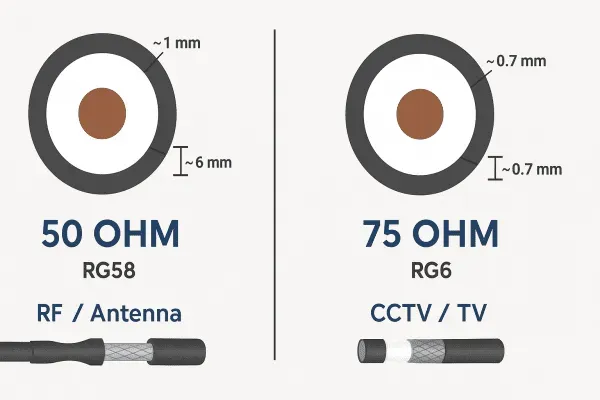
This image shows a direct comparison between common 50-ohm and 75-ohm coaxial components. On the left, 50-ohm products: an SMA connector, an N-type connector, and a section of RG316 coaxial cable. On the right, 75-ohm products: a BNC connector, an F-type connector, and a section of RG6 coaxial cable. The photograph highlights subtle differences in dielectric diameter, center pin size, and labeling. While both families may appear interchangeable at a glance, mixing them in a 50-ohm RF path introduces impedance discontinuities, reflections, and degraded VSWR—especially at higher frequencies. This visual reference helps engineers and procurement teams distinguish between the two standards and avoid costly mismatches.
Both SMA and N-type RF connectors used in communications systems are standardized at 50 Ω. That means every segment—including your transition jumper—must remain within the 50 ohm coaxial cable family.
Yes, 75 Ω cable like RG6 is everywhere. It’s inexpensive. It “fits.” But impedance mismatch increases reflection. Reflection increases VSWR. At Wi-Fi or LTE bands, those reflections aren’t theoretical—they show up as reduced link margin.
Engineers sometimes assume small mismatches don’t matter. In short runs, maybe they don’t. But in rooftop deployments with limited margin, they do.
If you want a deeper explanation of impedance consistency and why it matters, we break it down in our guide to 50 ohm coaxial cable selection and application.
The short version: don’t mix impedance families in production systems.
Understand that an assembly is more than “just coax”
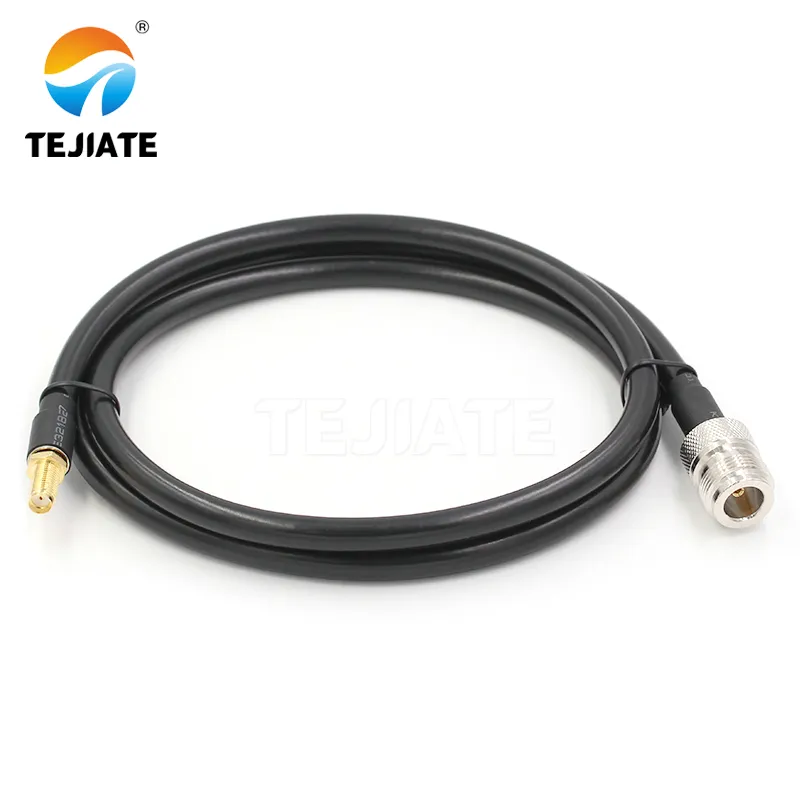
This image shows a finished SMA to N cable assembly, typically built with a flexible 50-ohm coaxial cable such as RG316 or RG58. One end has an SMA plug, the other an N-type plug or jack. The assembly includes molded or crimped strain relief at both connector ends, ensuring mechanical robustness and consistent electrical performance. Such assemblies are used as transition jumpers in labs, equipment racks, and outdoor installations.
An SMA to N cable is not simply a length of rf coaxial cable with connectors attached. It’s an assembly. And assemblies behave differently than raw cable on a reel.
The performance depends on:
- Cable type
- Connector quality
- Termination method
- Strain relief
- Environmental sealing
A high-quality cable terminated poorly becomes a weak link. Conversely, a well-terminated moderate-loss cable can outperform a sloppy “premium” build in real installations.
This is where experience shows. Many field issues blamed on radios eventually trace back to mechanical stress at connector backshells or improperly supported jumpers.
If you’re evaluating assembly-level considerations, our SMA adapter cable selection and routing guide covers routing and strain-relief decisions in more detail.
When is a cable better than an adapter?
Adapters feel efficient. You can solve a connector mismatch in seconds.
But that convenience hides tradeoffs.
Every time you stack an sma to n adapter, you introduce another electrical and mechanical interface. Each interface adds a small amount of insertion loss and a small amount of impedance discontinuity.
Individually, those numbers look harmless. In aggregate, they’re not.
Avoid stacking multiple adapters
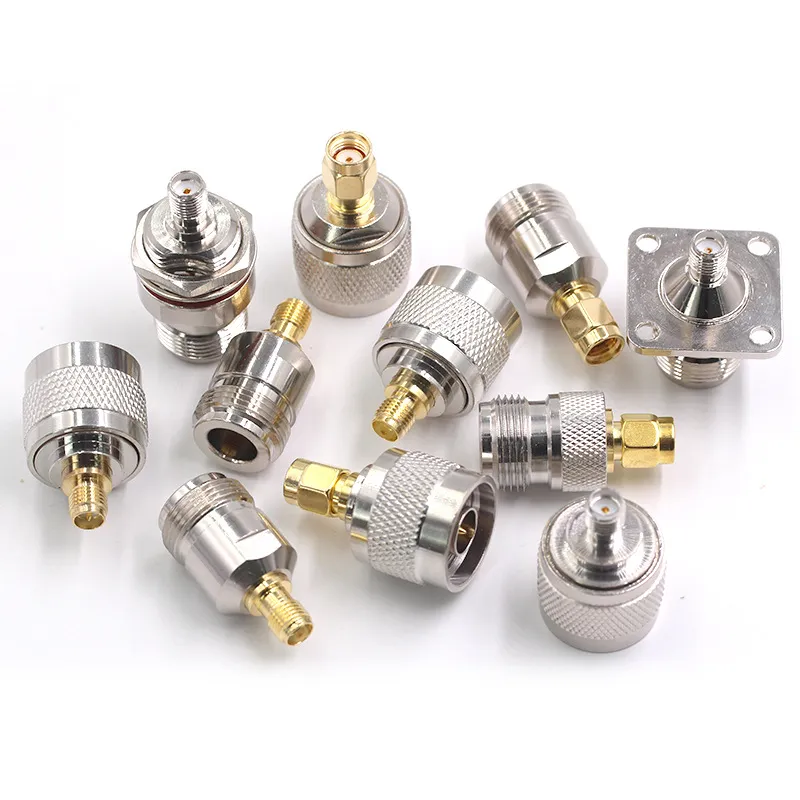
This photograph shows a rigid SMA to N adapter, a short metal component with an SMA connector on one end and an N-type connector on the other. It is used to directly mate devices with mismatched connector types in fixed, low-stress environments. However, because it lacks flexibility, any cable movement or vibration is transmitted to the device ports, which can lead to long-term reliability issues in mobile or outdoor applications.
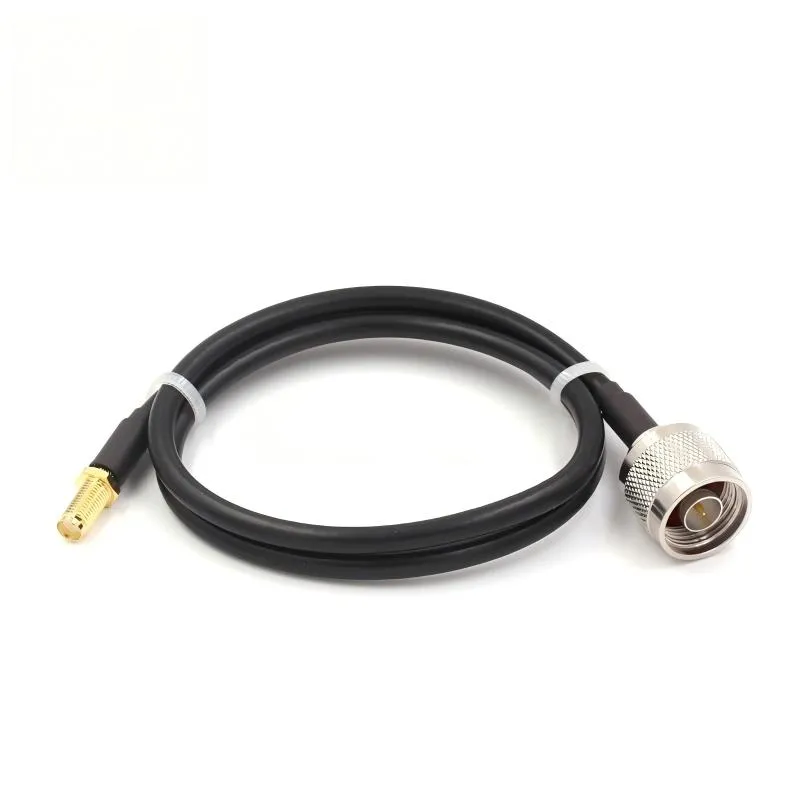
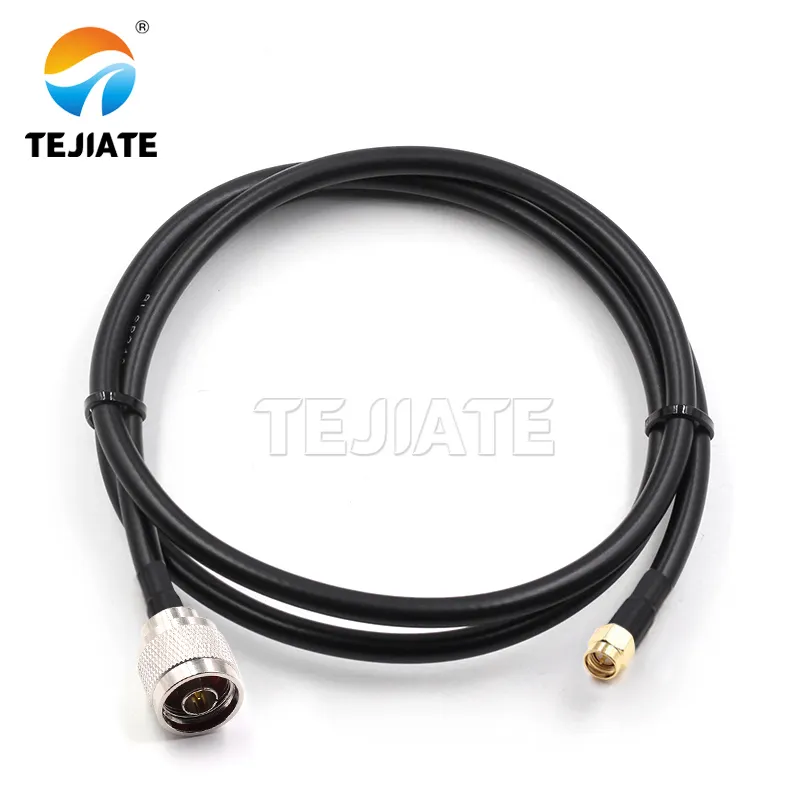
This image depicts a flexible N to SMA cable assembly, essentially the reverse orientation of Figure 3. It provides a controlled 50-ohm transition with mechanical flexibility, allowing it to accommodate slight misalignments between equipment and reduce strain on the connectors. Such cables are preferred over stacked rigid adapters in applications involving vibration, thermal expansion, or where the ports are not perfectly aligned.
A common prototype setup looks like this:
SMA port → SMA-to-N adapter → N barrel → N cable.
It works. Signals pass. No alarms.
But electrically, that chain adds:
- Multiple mating surfaces
- Incremental insertion loss
- Additional VSWR contributions
- Extra mechanical leverage
At 2.4 GHz or 5 GHz, the difference between “acceptable” and “tight” link margin can be less than 1 dB. Two unnecessary interfaces can consume half of that.
Replacing stacked adapters with a properly specified SMA to N cable removes those extra transitions. Fewer interfaces usually mean fewer surprises later.
Use cables when there’s any physical separation
Adapters are rigid. They don’t tolerate movement well.
If the SMA port and the N port are not perfectly aligned or are separated by distance—even a few inches—a cable is the safer choice. A cable introduces controlled flexibility and proper bend radius.
In vehicle installs, industrial enclosures, and outdoor cabinets, vibration is unavoidable. Rigid adapter stacks act like levers. Over time, that leverage stresses connector threads and solder joints.
A short jumper absorbs that movement.
There’s a simple decision rule that works in practice:
If there is distance, offset, or vibration, use a cable.
Reserve rigid transitions for fixed fixtures
Rigid SMA to N connector adapters still have a place:
- Permanent lab panels
- Rigidly mounted test racks
- Zero-motion environments
In those cases, mechanical stress is minimal and inspection is frequent.
Outside of that, cables tend to outlast adapters.
How do you choose the right coax type?
Cable selection isn’t about brand preference. It’s about loss, flexibility, diameter, and environment.
Let’s start with the most common jumper families.
RG316 vs RG58 for short runs
Two widely used options are rg316 coaxial cable and RG58.
A practical comparison:
| Cable | Diameter | Flexibility | Typical Application | Approx. Loss @2.4 GHz |
|---|---|---|---|---|
| RG316 cable | ~2.5 mm | Very flexible | Tight internal routing | ~1.0 dB/m |
| RG58 | ~5 mm | Moderate | General jumper | ~0.7 dB/m |
RG316 advantages:
- Small diameter
- High flexibility
- PTFE dielectric tolerates higher temperature
Tradeoff:
- Higher attenuation
RG58 advantages:
- Lower loss per meter
- Easier handling in mid-length runs
If your SMA to N cable is only 1–2 meters inside an enclosure, RG316 is often sufficient. Once you move toward longer rack-to-panel transitions, RG58 becomes more efficient.
We cover miniature jumper behavior in more depth in our RG316 coaxial cable guide.
Move to low-loss families for longer paths
When the transition cable extends toward outdoor feeders, loss quickly dominates.
Low-loss families such as LMR-240 or LMR-400 reduce attenuation significantly compared to RG-series cables.
At 2.4 GHz, approximate attenuation values:
| Cable | Approx. Loss |
|---|---|
| LMR-240 | ~0.4 dB/m |
| LMR-400 | ~0.22 dB/m |
For rooftop runs beyond 5–10 meters, LMR-400 often becomes the practical choice.
If you want a broader view of attenuation trends across cable families, our overview of RF coaxial cable selection walks through comparative loss behavior.
The key idea is simple: as length increases, low-loss cable quickly justifies its diameter and cost.
Hybrid layouts often work best
Many production systems use a hybrid approach:
- Internal miniature jumper (sometimes even mmcx to sma cable)
- Panel SMA
- Short SMA to N cable
- N bulkhead
- Outdoor low-loss feeder
This keeps flexibility where it’s needed and minimizes loss where distance dominates.
It also simplifies maintenance. Short jumpers are easy to replace. Long feeders stay fixed.
How do you really calculate loss in an SMA to N cable path?
Most link budgets look clean in Excel. Transmit power is clear. Antenna gain is clear. Free-space path loss is calculated down to tenths of a dB.
Then there’s the jumper.
It’s usually estimated. Rounded. Assumed.
That assumption works—until it doesn’t.
Above 1 GHz, small decisions around cable type and length start eating margin faster than many teams expect.
Start with the cable, not the connector
Attenuation in coaxial cable increases with frequency. That’s physics, not marketing. Dielectric loss and conductor loss both scale upward as frequency rises. At 2.4 GHz or 5 GHz, differences between cable families become noticeable.
The practical way to estimate attenuation is simple:
Take the datasheet value at your operating frequency. Multiply by length.
That’s it.
If RG58 is roughly 0.7 dB per meter at 2.4 GHz, then a 5-meter run is going to cost you around 3.5 dB. No surprises there.
Swap that for LMR-400 at roughly 0.22 dB per meter, and the same 5 meters drops to just over 1 dB.
That 2+ dB difference can be the margin between “stable” and “intermittent” in rooftop Wi-Fi or LTE systems.
| Cable Type | Loss (dB/m) | Length (m) | Total Loss (dB) |
|---|---|---|---|
| RG58 | 0.7 | 5 | 3.50 |
| LMR-400 | 0.22 | 5 | 1.10 |
| Difference | - | - | 2.40 dB |
Connectors add up faster than you think
Here’s where things quietly drift.
Each SMA or N interface typically adds somewhere around 0.05 to 0.2 dB of insertion loss. That doesn’t sound dramatic. It isn’t—once.
But let’s say your chain looks like this:
- SMA radio
- SMA-to-N adapter
- N barrel
- N jumper
You’ve now introduced multiple mating surfaces. Each interface slightly disrupts impedance continuity. Each contributes a fraction of a dB.
Three or four interfaces can easily approach half a dB total. That’s not catastrophic. But if your overall allowable loss is only 3–4 dB, that half dB suddenly matters.
This is why replacing stacked sma to n adapter elements with a single integrated SMA to N cable often produces measurable improvement—even though nothing “looked wrong” before.
Fewer interfaces. Fewer discontinuities. Cleaner chain.
Don’t ignore power handling
Loss gets attention. Power often doesn’t—until it’s too late.
N-type connectors are physically larger and generally support higher continuous power than SMA. That’s one reason they dominate outdoor feeder applications.
SMA connectors, especially at higher frequencies, have lower safe power limits. The cable dielectric also imposes limits. PTFE (as used in many rg316 coaxial cable constructions) tolerates high temperature but still has current and RF heating constraints.
In small cells or distributed antenna systems where transmit power is moderate but continuous, long-term heating can degrade connectors gradually.
Nothing fails instantly. Performance just degrades over time.
If your application pushes beyond modest power levels, it’s worth reviewing connector specifications against recognized RF standards. The IEEE Microwave Theory and Techniques Society publishes extensive technical resources that outline connector behavior and RF power considerations in microwave systems.
The takeaway isn’t complicated:
Match power expectations to connector and cable capability—before deployment.
What routing decisions protect long-term performance?
Many RF systems leave the lab working perfectly and arrive in the field behaving differently.
Often the culprit isn’t the radio. It’s installation.
Respect bend radius—especially near connectors
Every coaxial cable has a minimum bend radius. A common field guideline is five times the cable’s outer diameter.
That rule isn’t arbitrary.
Excessive bending deforms the dielectric and disturbs the concentric geometry that maintains impedance. Near the connector backshell, tight bends are particularly damaging. That’s where mechanical stress concentrates.
The failure mode isn’t dramatic. It’s subtle.
Months later, someone notices RSSI changes when the cabinet door is opened. Touch the cable—signal shifts. That’s mechanical deformation revealing itself electrically.
Avoid tight bends. Provide slack. Let the cable relax into its natural curve rather than forcing it into corners.
Keep RF away from high-current conductors
In industrial cabinets, RF lines sometimes run alongside AC mains or motor drives. It’s convenient. It’s compact.
It’s also risky.
Parallel routing increases the chance of coupling unwanted noise into the RF path. Even well-shielded rf coaxial cable can pick up interference under the right conditions.
The fix is simple: separation and thoughtful routing.
Cross power cables at right angles where possible. Avoid long parallel runs. Use grounded bulkheads to maintain shield continuity.
These small routing choices often eliminate hours of troubleshooting later.
Treat outdoor N transitions as structural elements
Outdoor N-type connectors aren’t just signal transitions. They carry mechanical load.
Wind moves antenna masts. Temperature cycles expand and contract metal. Moisture tries to find its way inside every joint.
If your SMA to N cable terminates outdoors, assume it will experience:
- Vibration
- UV exposure
- Thermal cycling
- Potential water ingress
Weatherproof boots help. So does self-amalgamating tape applied correctly. Strain relief near entry points prevents connector threads from bearing the full load.
Keep SMA terminations inside enclosures whenever possible. N-type connectors are simply better suited to external mechanical stress.
In field audits, degraded performance frequently traces back to incomplete sealing—not incorrect cable selection.
How can a structured selection matrix prevent expensive mistakes?
Most cable decisions happen late in projects. Deadlines approach. Installers are waiting. The jumper becomes a quick choice instead of a documented one.
That’s where mistakes creep in.
A simple evaluation matrix forces clarity.
Instead of asking “Will this work?” you ask:
- What is the operating band?
- What is the allowable loss?
- How long is the run including service slack?
- How many interfaces exist?
- What environment will this see?
When those inputs are written down, the right cable family usually becomes obvious.
For example, if your system budget allows only 3 dB for the entire transition path and your frequency is above 2 GHz, RG58 at 8 meters probably isn’t realistic. LMR-class cable becomes justified—even if it’s bulkier.
The matrix doesn’t need to be complicated. It just needs to exist.
It can also double as a receiving checklist. Before approving a delivered SMA to N cable, verify:
- Connector genders match drawings
- Orientation is correct
- Length matches specification
- Any requested test data is included
Catching a connector gender error before rooftop installation saves far more time than it costs to verify.
What trends are quietly increasing demand for SMA to N cable assemblies?
Connector transitions don’t make headlines. Radios do. Antennas do. Spectrum auctions do.
But behind every new deployment—5G densification, private LTE in factories, rural broadband expansion—there’s a lot of hardware that never gets press coverage. Cable assemblies are part of that invisible layer.
SMA continues to dominate compact RF devices. It’s small, familiar, and fits neatly onto radio boards. N-type, on the other hand, remains a preferred choice for outdoor hardware and higher-power feeder transitions. It’s physically stronger. It tolerates weather better. It handles power more comfortably.
Put those two realities together and you get something predictable: mixed-connector systems aren’t disappearing.
They’re increasing.
Industry research groups tracking RF interconnect and microwave component markets consistently show steady growth in cable assemblies as networks expand and densify. The reasons aren’t mysterious:
- More small cells
- More distributed antenna systems
- More industrial IoT nodes
- More private wireless networks
Every one of those systems creates more boundary points between compact devices and infrastructure-grade hardware.
And every boundary point needs a clean transition.
The SMA to N cable sits exactly at that boundary.
How do engineers actually diagnose problems in an SMA–N transition?
Cable-related issues are rarely obvious. The radio doesn’t throw an error message saying “your jumper is marginal.” Instead, you see secondary symptoms.
Sometimes subtle. Sometimes frustrating.
What behavior suggests the cable is the weak link?
If performance improves when the jumper is swapped—but nothing else changes—that’s a clue.
If signal strength shifts when someone touches the cable, that’s another.
If throughput drops on hot days but stabilizes at night, thermal expansion at connector interfaces may be involved.
A damaged dielectric inside a coax doesn’t scream. It whispers. Gradually.
Mechanical stress near the SMA backshell is one of the most common failure points. Tight bends during installation may not cause immediate issues. Months later, micro-deformation inside the cable shifts impedance just enough to reduce margin.
This is why visual inspection alone isn’t sufficient. Movement testing—gently flexing the cable while monitoring signal—often reveals hidden problems.
How long is “too long” at 2.4 GHz or 5 GHz?
There isn’t a universal number, and anyone who gives one without context is oversimplifying.
At 2.4 GHz:
- A few meters of RG316 cable may be acceptable.
- Ten meters probably isn’t—unless your link budget is generous.
At 5 GHz, the same length costs even more attenuation.
LMR-class cable shifts the equation dramatically. Ten meters of LMR-400 may be entirely reasonable where RG58 would consume too much loss.
The only honest answer is this: calculate it against your allowable loss.
If you haven’t calculated allowable loss, you’re guessing.
For a broader comparison of attenuation across cable families, our discussion in RF coaxial cable selection provides context without oversimplifying the tradeoffs.
Can 50 Ω and 75 Ω components coexist in this path?
Physically? Yes.
Electrically? Not cleanly.
A 50 Ω system that introduces a 75 Ω segment creates an impedance discontinuity. That discontinuity causes reflections. At lower frequencies, you might get away with it in non-critical scenarios. At microwave frequencies, the penalty becomes harder to ignore.
It may “work.” It won’t be optimal.
And in most telecom deployments, optimal isn’t a luxury—it’s a requirement.
If the system is designed around 50 ohm coaxial cable, stay there.
When do adapters become excessive?
There’s no hard ceiling, but patterns tell the story.
If your transition looks like:
SMA → adapter → adapter → barrel → cable
You’ve likely drifted into unnecessary complexity.
Each mating surface adds mechanical exposure and electrical discontinuity. None of those additions individually break a system. Collectively, they erode confidence.
A properly specified SMA to N cable consolidates those transitions into one continuous assembly.
Cleaner chain. Fewer variables.
And fewer questions when something goes wrong.
When should you upgrade from RG316 or RG58?
Two factors usually push that decision:
- Length
- Frequency
Once the run extends beyond a few meters at multi-gigahertz frequencies, attenuation accumulates quickly.
Add a tight link budget or a marginal antenna environment, and suddenly the smaller cable no longer makes sense.
Engineers sometimes hesitate because low-loss cable is thicker and harder to route. That’s true. But routing difficulty is usually easier to solve than missing 2 dB of signal margin.
In other words: choose the cable that protects performance first. Solve routing second.
How often should outdoor jumpers be inspected?
Outdoor RF hardware lives in a harsher world than lab equipment.
Sunlight. Temperature swings. Wind. Moisture.
An annual inspection cycle is a reasonable baseline. Look for:
- Corrosion at N-type threads
- Cracking or fading jackets
- Hardened sections near bends
- Signs of moisture ingress
The cost of replacing a suspect jumper is trivial compared to dispatching technicians repeatedly to troubleshoot degraded links.
Preventive replacement often saves more money than reactive diagnosis.
Final engineering perspective
It’s easy to underestimate small components.
A short SMA to N cable might represent less than one percent of the total hardware cost in a wireless deployment. But it occupies a critical structural position—right where device-level RF meets infrastructure-level hardware.
That boundary is where stress concentrates.
When selected casually, the jumper consumes margin quietly.
When selected deliberately—matched impedance, calculated attenuation, minimized interfaces, proper routing—it disappears from operational concerns.
And in RF engineering, disappearing from the problem list is the highest compliment a component can receive.
The connector types aren’t changing anytime soon. SMA remains practical for compact radios. N-type remains durable for outdoor transitions. The interface between them will continue to exist.
Specify it carefully once.
You won’t need to think about it again.
Bonfon Office Building, Longgang District, Shenzhen City, Guangdong Province, China

A China-based OEM/ODM RF communications supplier
Table of Contents
Owning your OEM/ODM/Private Label for Electronic Devices andComponents is now easier than ever.