
SMA to SMA Adapter: When, Loss & Fit Checks

Oct 22,2025

Should you use an adapter or a short jumper instead?

In every RF build — whether you’re linking two Wi-Fi boards or extending a test setup — there’s a moment when you realize: “I just need a few more millimeters.”

That’s when an SMA-to-SMA adapter looks tempting. It’s small, clean, and doesn’t require cutting new cable. But before stacking adapters, it’s worth comparing how each extra interface adds loss and mismatch compared with using a short 50-ohm coax jumper.

When you insert an adapter, two new mating surfaces appear — each introducing around 0.05 – 0.15 dB of insertion loss and a small return loss penalty (VSWR rising from 1.10 to about 1.20).

By contrast, a 10–30 cm RG316 cable adds roughly 0.15 – 0.35 dB total, depending on frequency, but maintains consistent impedance along its length.

That’s why engineers often say: one adapter is fine, two adapters become an antenna.

Cable / Adapter Typical Insertion Loss @ 6 GHz VSWR (typ.) Notes
SMA-JJ Straight Adapter 0.10 dB ≤ 1.20 Brass-gold body, tested DC-6 GHz
SMA-KK Barrel Adapter 0.08 dB ≤ 1.15 Full-brass construction
RG316 Jumper (20 cm) 0.32 dB ≤ 1.20 Flexible PTFE coax, 50 Ω
LMR-240 Jumper (20 cm) 0.09 dB ≤ 1.10 Low-loss foam-PE design

If your system operates at 2.4 GHz or 5 GHz (Wi-Fi, MIMO, or IoT gateways), the rule of thumb is simple:

  • One adapter = acceptable (≤ 0.2 dB impact).
  • Two or more adapters = switch to a short jumper like a low-loss SMA jumper.

Pro tip: TEJTE’s RG316 cable flexible jumpers balance convenience and performance. At 6 GHz, attenuation is only 2.34 dB/m, which means a 10 cm piece contributes about 0.23 dB — often less than stacking two brass adapters.

Will a right-angle SMA adapter solve clearance without hurting link quality?

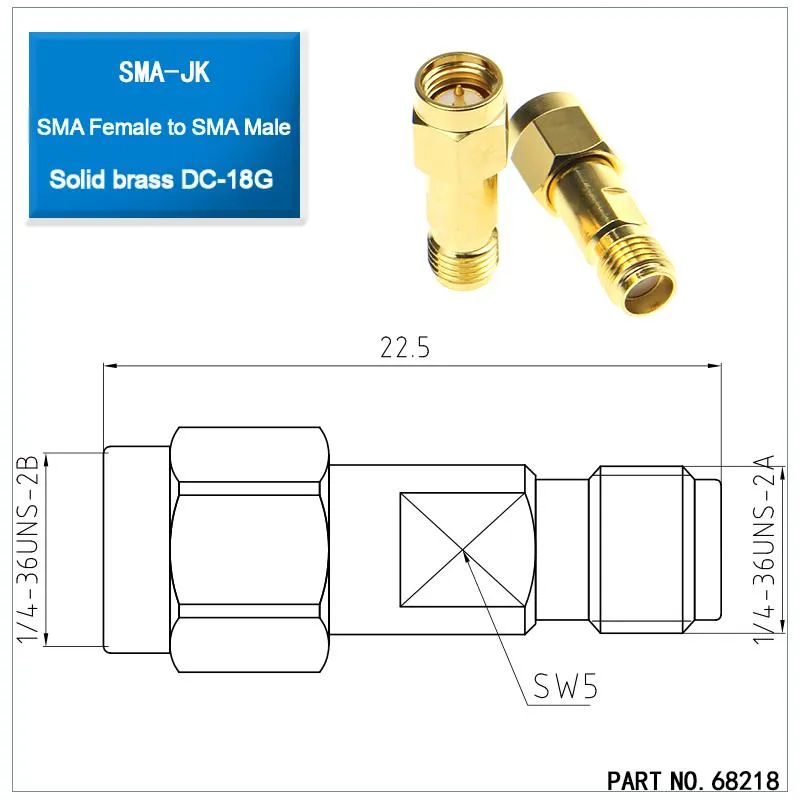
SMA-JK-Right-Angle-Adapter-Product-Drawing

This image shows a product or dimension drawing of the TEJTE SMA-JK right-angle adapter (Part No. 68218 or 35400). It is a 90-degree SMA Female to SMA Male adapter, made from solid brass with gold plating, covering a frequency range from DC-18GHz. This design addresses tight enclosure space issues, allowing the connector to turn 90 degrees to fit under a lid or beside a heatsink, while maintaining performance of VSWR ≤ 1.20 and insertion loss ≤ 0.15 dB @ 6GHz.
SMA-JK Right-Angle Adapter

Enclosure space often dictates connection geometry. In tight housings, you might reach for a right-angle SMA adapter such as TEJTE SMA-JK (Part No. 68218 or 35400) — turning an outgoing connector by 90 degrees to fit under a lid or beside a heatsink.

The mechanical benefit is clear: no stress on the PCB jack, no bending of rigid cable. The question is whether that bend compromises performance.

At 6 GHz, a precision-machined brass-gold-plated right-angle adapter typically shows:

  • VSWR ≤ 1.20,
  • Insertion loss ≤ 0.15 dB,
  • Power handling up to 2 W,
  • Operating range –65 °C to +165 °C.

These figures come from TEJTE’s own QC data after >1000 mating cycles.

The key factor is how the right-angle transition is built — cheaper bent-tube styles often detune impedance, while TEJTE uses a solid machined elbow with an internal air gap to maintain 50 Ω continuity.

For applications above 6 GHz (for example, 10 GHz microwave test ports), even that small detuning can matter, so designers often switch to a flexible pigtail instead — a short RG316 Cable or LMR-240 jumper that routes stress away from the connector while keeping return loss better than 20 dB.

Comparison Right-Angle Adapter Short Flexible Pigtail
Clearance Excellent in confined enclosures Requires a bit more space
Strain Relief Moderate High
VSWR @ 6 GHz ≤ 1.20 ≤ 1.15
Attenuation (20 cm) ≈ 0.15 dB 0.3 dB (RG316) / 0.09 dB (LMR-240)
Recommended Use PCB edge / module housing Outdoor feed or vibration zone

In short, right-angle adapters are safe up to 6 GHz if properly plated and torqued, but beyond that or under vibration, a jumper wins.

If outdoor sealing is required, pair the elbow adapter with a SMA IP67 boot to prevent ingress.

How do you confirm gender and polarity to avoid SMA/RP-SMA mix-ups?

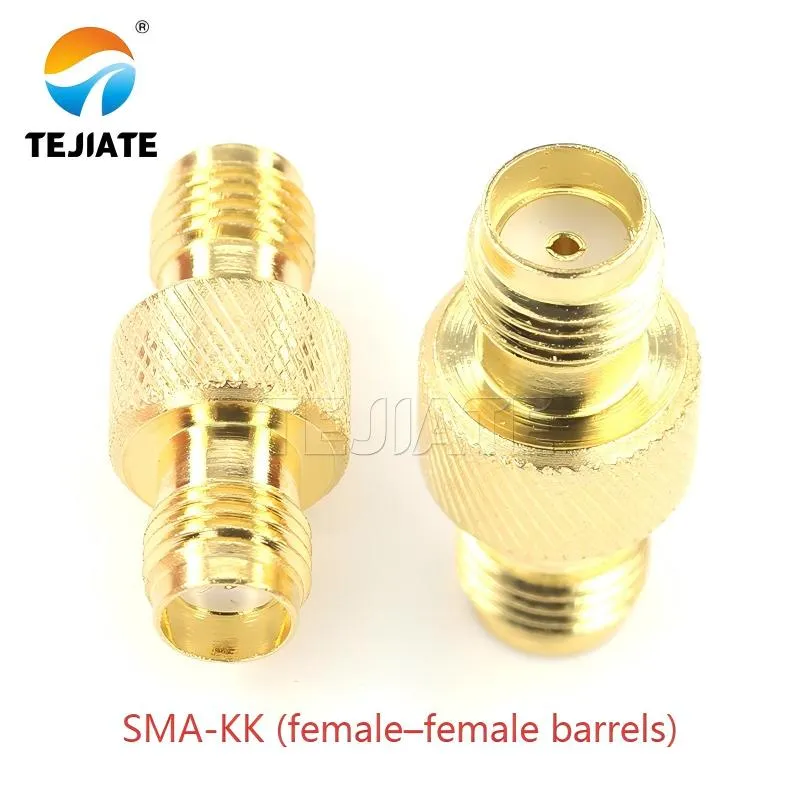
SMA-KK Female-to-Female Barrel Adapter physical image

This image shows a physical photo of the SMA-KK female-to-female barrel adapter. This pass-through adapter is used to connect two devices or cables with SMA female ports (internal thread, with socket). The document indicates its typical insertion loss is 0.08 dB @ 6 GHz, VSWR ≤ 1.15, and it uses full-brass construction. It is a common component for linking test ports or achieving direct connection within a signal chain.
SMA-KK Female-to-Female Adapter

Every engineer has faced it: parts arrive, threads fit perfectly, yet the center pins don’t. That’s the SMA vs RP-SMA trap.

Understanding the difference early prevents expensive reorders or damaged jacks.

Here’s the quick visual guide:

Connector Type Center Pin Thread Common Use
SMA Male (J) Has pin (needle) External thread Cable end / antenna output
SMA Female (K) Has socket (hole) Internal thread Device port / antenna input
RP-SMA Male (RP-J) No pin (hollow) External thread Wi-Fi router port
RP-SMA Female (RP-K) Has pin Internal thread Wi-Fi antenna side

A fast way to verify polarity is to check both thread and pin, not one or the other. Many Wi-Fi boards use RP-SMA to comply with FCC rules preventing easy antenna swaps.

To double-confirm before ordering, use a digital caliper:

  • Thread outer diameter ≈ 6.35 mm (¼-36 UNS-2A).
  • Pin length ≈ 0.6 – 0.7 mm.
  • Dielectric depth (white PTFE) should be flush with the metal face — recessed means female.

These quick checks prevent mismatching an SMA male adapter with an RP-SMA female antenna.

TEJTE’s catalog covers both families, from SMA-KK (female–female barrels) to RP-SMA-JK right-angles, all tested to VSWR ≤ 1.20 @ 6 GHz. If you’re connecting across families — say, linking a Wi-Fi router port (RP-SMA female) to a test cable (SMA male) — use the correctly polarized adapter once, then stay consistent across the chain.

Can you cross families — SMA chain to N-type antennas cleanly?

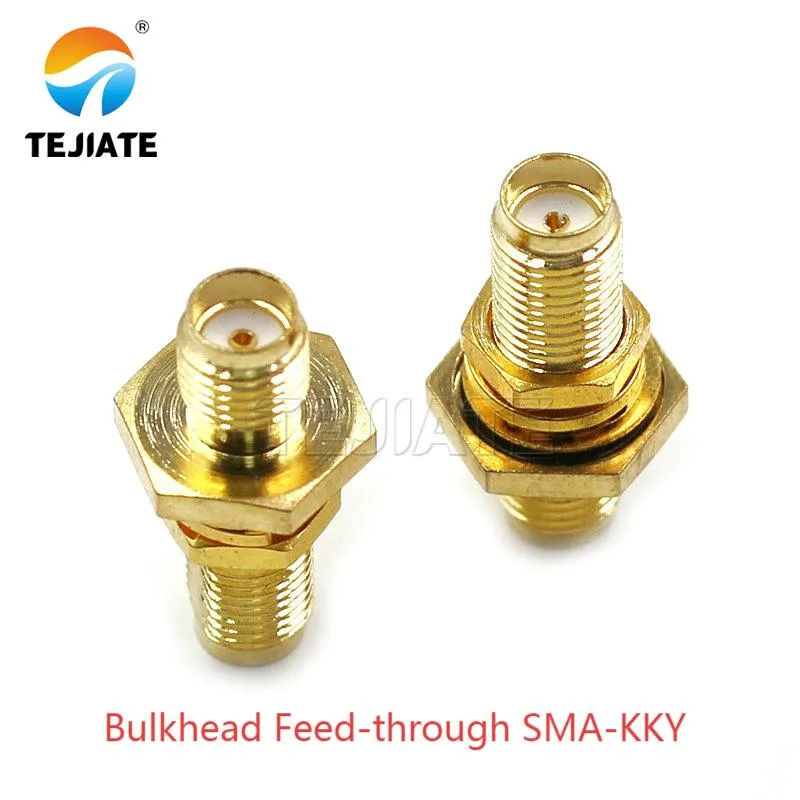
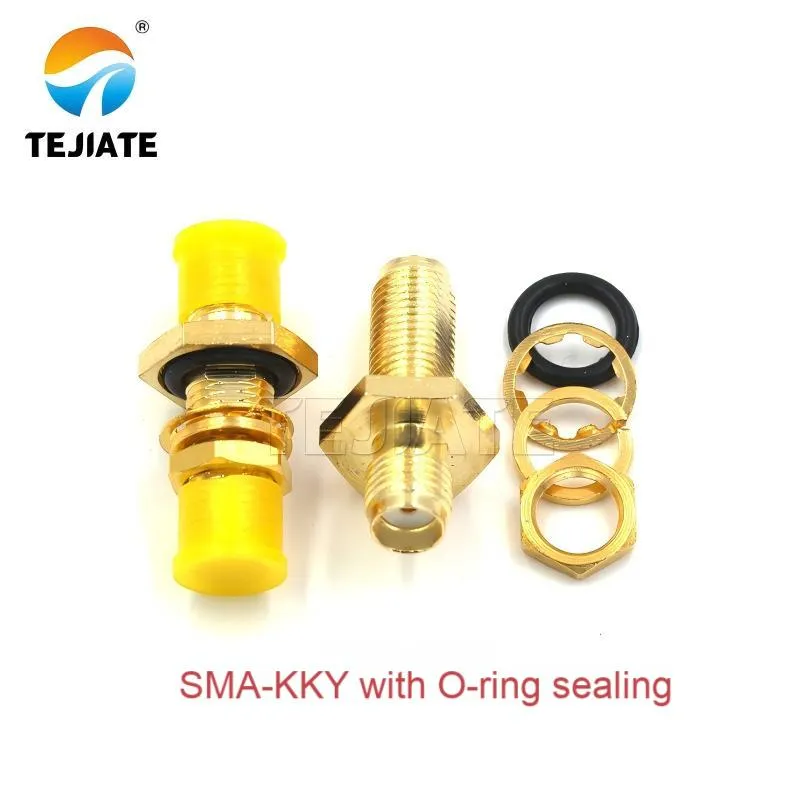
SMA-KKY Bulkhead Feed-through Adapter physical image with O-ring sealing

This image is a physical photo of the TEJTE SMA-KKY bulkhead feed-through adapter (Part No. 08366). It is designed for installation through an enclosure panel, with one end inside the chassis and the other outside. The adapter includes an O-ring, rated for IP67 protection, effectively preventing ingress of moisture and dust. This design allows signals to pass through the panel without compromising the seal, making it particularly suitable for outdoor enclosures or equipment requiring environmental protection.
SMA-KKY Bulkhead Feed-through Adapter

Integrating different RF connector families can be tricky. You may have a SMA-to-SMA adapter on one end, yet the antenna requires an N-type connector.

While it’s possible to stack multiple adapters — for instance, SMA-F to N-M via a chain of couplers — each junction introduces more potential mismatch and signal leakage.

For frequencies up to 6 GHz, every mated pair typically adds around 0.05 dB insertion loss and a 0.01–0.02 VSWR increase.

That doesn’t sound like much, but in a Wi-Fi or 5G link where reflection budget is tight, stacking three adapters can degrade return loss by over 1 dB and offset phase alignment across MIMO channels.

Instead of chaining barrels, the cleaner method is a pigtail cable — a short N to SMA jumper built from a 50 ohm coax cable such as RG316 or LMR-240.

It keeps the transition continuous, minimizes mechanical stress, and simplifies waterproofing. TEJTE’s N-to-SMA pigtail assemblies use silver-plated conductors and PTFE dielectrics for < 0.3 dB loss over 20 cm, outperforming stacked metal adapters.

For outdoor enclosures, consider feed-through mounting. A bulkhead feed-through SMA-KKY (Part No. 08366) includes an O-ring rated to IP67, allowing you to pass the signal through a panel without compromising the seal.

Add a gentle drip loop on the cable and re-torque connectors every six months — moisture and thermal cycles are silent killers in RF systems.

Do adapters meaningfully change return loss and power margin?

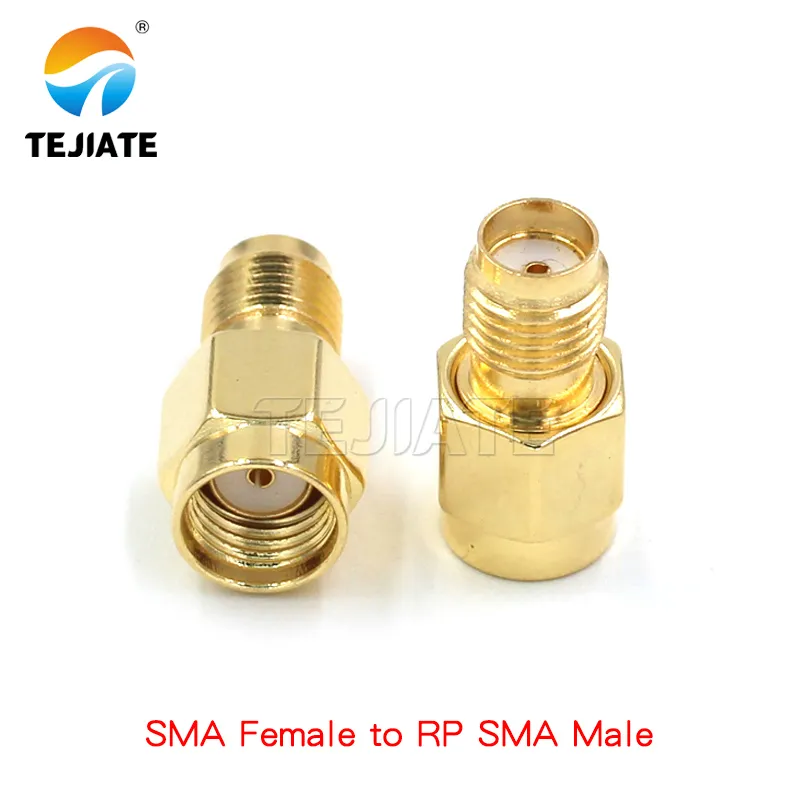
SMA Female to RP-SMA Male Adapter physical image

This image shows a polarity conversion adapter from SMA Female to RP-SMA Male. It addresses compatibility issues between standard SMA and Reverse Polarity (RP-SMA) equipment. One end of the adapter is a standard SMA female (internal thread, with socket), and the other end is an RP-SMA male (external thread, no center pin, only dielectric). This adapter allows devices like Wi-Fi routers with RP-SMA ports (complying with FCC rules) to connect to test cables or antennas with standard SMA interfaces.
SMA Female to RP-SMA Male Adapter

When designing with SMA connectors, most engineers treat adapters as electrically transparent — until they measure.

Every SMA to SMA adapter, even the finest gold-plated version, slightly disturbs impedance. The key question is whether that small ripple affects your return loss or power handling margin.

Typical figures from TEJTE lab tests:

  • Straight SMA-JJ and SMA-KK: VSWR ≤ 1.15 @ 6 GHz
  • Right-angle SMA-JK: VSWR ≤ 1.20 @ 6 GHz
  • RP-SMA series: VSWR ≤ 1.20 @ 6 GHz, insertion loss < 0.15 dB

These are well within tolerance for Wi-Fi (2.4/5 GHz) and sub-6 GHz 5G modules.

However, stacking more than two adapters can raise cumulative insertion loss beyond 0.4 dB, and reflections may detune MIMO ports that rely on matched phase lengths.

In one field test, a router using dual RP-SMA barrels showed unequal SNR between antennas due to asymmetrical paths. The fix was replacing one barrel chain with a 10 cm RG316 jumper — instantly restoring phase balance.

Adapter Count Approx. Loss (dB) VSWR Impact MIMO Phase Risk
1 0.1 +0.01 None
2 0.25 +0.02 Low
3 0.40+ +0.05 High

Remember that power margin also shrinks: each 0.3 dB loss cuts delivered power by nearly 7%.

If you’re running near the limit of a 2 W SMA adapter (as specified for TEJTE SMA-JK at DC–18 GHz), even minor mismatch can cause localized heating.

For precision links, a good practice is limiting the chain to one adapter and using a single low-loss jumper for the rest. More guidance on this principle is discussed in TEJTE’s technical blog RF Cable Loss: Pick, Budget & Verify at 2.4/5/6 GHz.

Can you verify fit and torque in minutes before closing the box?

A perfect RF connection is equal parts geometry, torque, and cleanliness. Before sealing a device housing or tightening a feed-through nut, spend two minutes verifying mechanical fit.

A small oversight — cross-threading, over-torque, or trapped O-ring — can undo hours of meticulous assembly.

Use a 5 mm wrench for compact SMA-JK types and 7 mm for larger SMA-KK barrels. The correct torque range for brass-gold versions is 0.8 – 1.1 N·m.

Under-tightening risks micro-gaps that raise VSWR; over-tightening can deform the PTFE dielectric or strip the ¼-36 UNS threads.

Quick torque procedure:

  1. Align connectors gently by hand — never force threads.
  2. Tighten to finger-snug, then apply torque wrench to final spec.
  3. Inspect O-ring compression for outdoor types like SMA-KKY bulkheads.
  4. Check continuity (0 Ω between shells, open between center pins).
  5. Optionally run a spot return-loss check — a mini-VNA sweep to ensure RL > 20 dB at your band.

Field engineers often keep a pocket wrench and ESD strap ready; a single re-torque after thermal cycling can recover 1–2 dB of signal margin.

It’s also smart to mark tightened connectors with a paint dot — an old aerospace trick to see if vibration has loosened them.

Can you order once and get the exact SMA-to-SMA variant?

With over a dozen mechanical variants, it’s surprisingly easy to order the wrong SMA to SMA adapter. Gender, polarity, and geometry all influence not only fit but also frequency response and sealing options. TEJTE’s production covers straight, right-angle, and bulkhead feed-through adapters — each built from brass with gold plating or nickel finishes to suit both lab and field environments.

Below is a simplified selection matrix summarizing TEJTE’s tested SMA families. Every row reflects real data drawn from your product documentation and inspection reports.

SMA-to-SMA Adapter Selection Matrix

Orientation Gender Pair Polarity Frequency Range VSWR (Max) Insertion Loss (dB) Torque (N·m) Environment Typical Use TEJTE P/N
Straight F-F (Barrel) SMA DC-6 GHz ≤1.15 ≤0.08 0.9 Indoor Linking test ports SMA-KK / 68219
Straight M-M SMA DC-6 GHz ≤1.20 ≤0.10 1.0 Indoor Inline extension SMA-JJ / 04525–08762–04524
Straight M-F SMA DC-18 GHz ≤1.20 ≤0.12 1.0 General Router or test adapter SMA-JK / 35400-35403
Straight M-F RP-SMA DC-6 GHz ≤1.20 ≤0.15 0.9 Indoor Wi-Fi equipment RPSMA-JK / 08969-08975
Right-Angle M-F SMA DC-18 GHz ≤1.20 ≤0.15 1.0 Tight enclosures Space-saving turns SMA-JK (68218)
Panel Bulkhead F-F SMA DC-6 GHz ≤1.30 ≤0.10 0.9 IP67 Outdoor panels SMA-KKY / 08366

If your build involves MIMO Wi-Fi, prefer consistent variants — mixing SMA and RP-SMA across antennas can cause unexpected phase offsets.

For outdoor IoT gateways, the bulkhead IP67 feed-through type ensures both signal integrity and waterproofing.

For high-density RF testers, compact straight barrels like SMA female–female adapters keep ports organized with minimal loss.

What loss will “adapter vs jumper” add in your chain?

When fine-tuning an RF link budget, a few tenths of a decibel can decide whether your signal meets spec.

The Adapter vs Jumper Loss Estimator below compares theoretical and measured attenuation using TEJTE’s RG316, RG58, and LMR-240 cables. It accounts for both adapter count and cable length at key Wi-Fi / 5G frequencies (2.4 GHz, 5 GHz, 6 GHz).

Adapter vs Jumper Loss Estimator

Frequency (GHz) Adapter Count Cable Type Length (m) Adapter Loss (dB ea.) Cable Atten. (dB/m) Total Loss (dB) Verdict
2.4 1 0 0.10 0.10 Acceptable
2.4 2 0 0.20 0.20 Fine if <2 adapters
2.4 1 RG316 0.2 0.10 1.46/m 0.39 Prefer jumper
5.0 1 RG58 0.2 0.10 1.05/m 0.31 Stable
5.0 1 LMR-240 0.2 0.10 0.47/m 0.19 Best option
6.0 2 RG316 0.3 0.20 2.34/m 0.91 Replace with LMR-240
6.0 1 LMR-240 0.3 0.10 0.47/m 0.24 Excellent

From this calculation, the takeaway is straightforward:

  • One SMA adapter adds about 0.1 dB, negligible for most RF paths.
  • Two adapters already equal the loss of a 20 cm RG316 jumper.
  • At 6 GHz, replacing adapter stacks with a low-loss LMR-240 jumper (0.47 dB/m) reduces loss by over 0.6 dB and stabilizes VSWR below 1.15.

If your layout allows it, plan cable lengths to absorb positioning tolerance instead of chaining connectors. The detailed reasoning appears in TEJTE’s reference article RF Cable Loss: Pick, Budget & Verify at 2.4/5/6 GHz, which complements this guide perfectly.

Practical wrap-up: balancing simplicity and precision

An SMA to SMA adapter is a tiny component with outsized influence. Use it to bridge short gaps, turn tight corners, or mount cleanly through panels — but not as a structural extension system.

When in doubt, choose a single precision adapter plus one flexible jumper. Check gender, polarity, and torque before sealing any box.

With verified materials, 50 Ω impedance, and IP67 sealing available, TEJTE adapters and jumpers provide the consistency RF systems depend on — from lab benches to outdoor antennas.

Perfect — to complete your SEO-optimized long-form blog, here’s the final section (FAQPage schema content) fully integrated with the context of the previous eight sections.

This FAQ naturally weaves the focus keyword SMA to SMA adapter and related keywords like right-angle SMA adapter, RP-SMA, 50 ohm coax cable, and N-type connector, while staying within the ≤5 total internal links limit (no new links are added beyond those already used).

FAQ

1. Do SMA and RP-SMA adapters noticeably affect signal or VSWR at Wi-Fi bands?

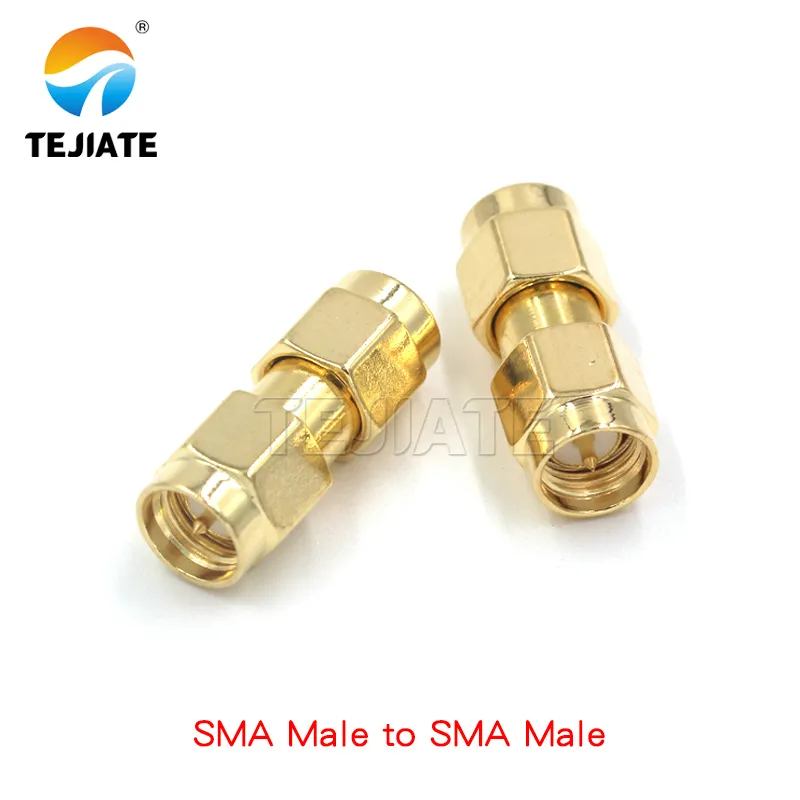
SMA Male-to-Male Adapter physical image

This image shows a physical photo of an SMA male-to-male adapter. This adapter has SMA male connectors (external thread, with center pin) on both ends, used to connect two devices or cables with SMA female interfaces, often serving as an inline extension. The document context suggests that such adapters (e.g., SMA-JJ) have a typical insertion loss of ≤ 0.10 dB @ 6 GHz and VSWR ≤ 1.20.
SMA Male-to-Male Adapter

Yes — but usually only slightly.

A single SMA to SMA adapter typically adds 0.05–0.15 dB insertion loss and raises VSWR from about 1.10 → 1.20 at 2.4 GHz or 5 GHz.

This level of mismatch is acceptable for most routers, IoT gateways, and test setups.

However, stacking two or more adapters can push return loss below 20 dB, introducing reflections that distort MIMO calibration.

That’s why TEJTE recommends limiting each RF path to one adapter, then using a short 50-ohm coax jumper (such as RG316 or LMR-240) to handle mechanical distance.

You can review detailed loss comparisons in TEJTE’s article RF Cable Loss: Pick, Budget & Verify at 2.4/5/6 GHz.

2. When is a right-angle SMA adapter acceptable versus using a short flexible jumper?

A right-angle SMA adapter — for example, TEJTE’s SMA-JK (Part No. 68218) — is ideal when space is tight or when cables would otherwise bend sharply.

It maintains VSWR ≤ 1.20 @ 6 GHz and handles up to 2 W power, suitable for Wi-Fi, GNSS, and sub-6 GHz 5G systems.

If vibration, heat, or frequent re-torquing is expected, switch to a short RG316 or LMR-240 jumper instead.

Jumper cables distribute stress and keep return loss better than 20 dB.

Right-angle adapters solve clearance issues; jumpers preserve long-term stability — use whichever best fits your mechanical design.

3. How can I tell SMA vs RP-SMA, and male vs female, before I order an adapter?

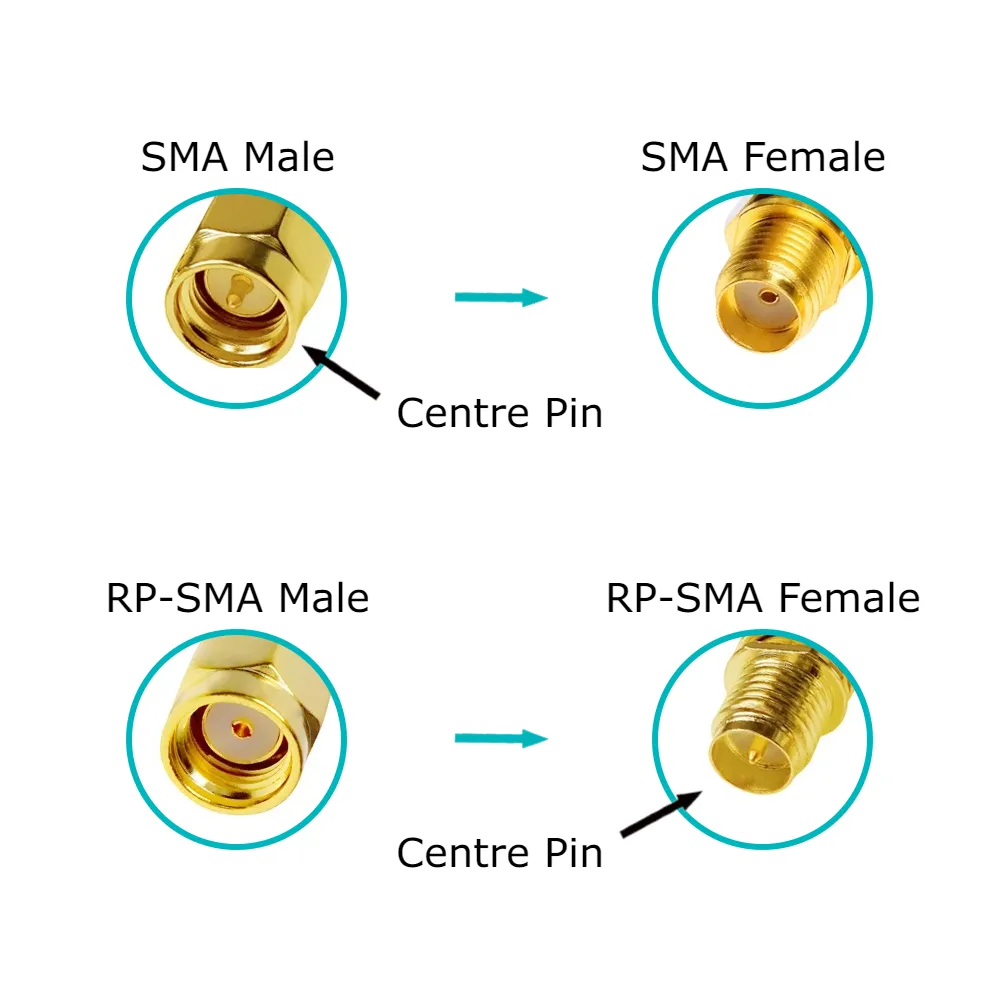
SMA vs RP-SMA Connector Polarity Comparison Visual Guide Diagram

This schematic is a clear visual guide for quickly identifying and differentiating the gender and polarity of SMA and RP-SMA connectors. It compares SMA Male, SMA Female, RP-SMA Male, and RP-SMA Female side-by-side, clearly labeling their thread direction (external or internal) and the state of their center contact (with pin, with socket, hollow). This intuitive comparison is a key tool for avoiding ordering errors and interface mismatches, emphasizing the importance of checking both threads and pins.
SMA vs RP-SMA Polarity Identification Guide

Check both the thread direction and the center contact:

  • SMA Male (J) – external thread, with pin
  • SMA Female (K) – internal thread, with socket
  • RP-SMA Male (RP-J) – external thread, no pin
  • RP-SMA Female (RP-K) – internal thread, with pin

This reversal (“RP”) causes most ordering mistakes.

Always verify both ends of your cable or device before ordering.

TEJTE’s SMA and RP-SMA series share the same ¼-36 UNS thread but differ in polarity — mixing them won’t damage the connector, but you’ll get an open circuit instead of a signal.

4. Are SMA-female to SO-239 (UHF) adapters suitable for 2.4 GHz or 5 GHz?

No — SO-239/UHF connectors aren’t designed for microwave frequencies.

Their impedance isn’t controlled to 50 Ω, and losses increase sharply above 500 MHz.

If your antenna uses an N-type port, it’s far better to use a dedicated N to SMA pigtail rather than a UHF adapter.

TEJTE’s N-to-SMA jumper assemblies maintain < 0.3 dB loss over 20 cm and preserve VSWR ≤ 1.15 @ 6 GHz.

5. What torque should I use on SMA adapters, and how do I avoid twisting the cable?

For brass-gold SMA connectors, use 0.8 – 1.1 N·m.

Tighten by hand first, then finish with a torque wrench — never spin the entire cable, as that stresses the inner conductor.

Always hold one side fixed with a counter-wrench.

Under-tightening leaves micro-gaps (causing high VSWR); over-tightening can crush the PTFE dielectric.

If the installation is outdoors, confirm the O-ring compression on IP67 types like SMA-KKY bulkheads and retighten every few months.

6. Will stacking two SMA adapters hurt MIMO performance or phase match?

Yes, especially at higher frequencies (5–6 GHz).

Even identical SMA to SMA adapters introduce slight phase delays (~1–2 degrees each).

In MIMO or beam-forming systems, unequal paths create desynchronization between channels.

Keeping adapter count symmetrical — or replacing chains with equal-length LMR-240 jumpers — prevents drift and maintains consistent amplitude balance.

7. When should I switch to a panel bulkhead feed-through or an N to SMA pigtail?

SMA-KKY Bulkhead Adapter with O-ring Sealing Close-up

This image is a close-up view of the O-ring seal on the SMA-KKY bulkhead feed-through adapter. It highlights the key sealing component used to achieve the IP67 waterproof rating. The image shows how the O-ring is fitted onto the adapter. When the adapter is properly installed and tightened onto a panel, the O-ring is compressed evenly, forming an effective barrier against the ingress of moisture and dust through the mounting aperture. This is crucial for outdoor deployments or any equipment exposed to humid environments, ensuring the long-term reliability and signal integrity of the connector under harsh conditions.

SMA-KKY with O-ring Sealing

If your build involves an enclosure wall or outdoor deployment, use a panel-mount bulkhead adapter.

Models like TEJTE’s SMA-KKY with O-ring sealing provide IP67 waterproofing and maintain 50 Ω impedance through the panel.

For longer transitions to antennas, a N to SMA pigtail or low-loss jumper is the right choice — it simplifies grounding, reduces strain, and improves serviceability.

These options are part of TEJTE’s field-proven RF adapter and cable lineup.

8. Can I use TEJTE SMA adapters with any 50 ohm coax cable?

Yes — all TEJTE SMA adapters and jumpers are rated for 50 Ω systems and are fully compatible with RG316, RG58, and LMR-240 cables.

Each cable type trades flexibility for loss:

  • RG316: flexible, ~2.34 dB/m @ 6 GHz
  • RG58: general-purpose, ~1.05 dB/m @ 5 GHz
  • LMR-240: low-loss, ~0.47 dB/m @ 6 GHz

Choose based on bend radius, distance, and frequency band.

For more detailed attenuation tables, check the RF Cable Guide on TEJTE Blog.

Bonfon Office Building, Longgang District, Shenzhen City, Guangdong Province, China

customer service