
SMA to N Adapter Selection and Installation Guide
Mar 02,2026
This figure illustrates a common RF system where a device with an SMA connector (e.g., a small cell, IoT gateway) connects to an outdoor antenna via an SMA to N cable. The cable acts as a transition between the device's SMA port and the N-type interface of the antenna or lightning arrestor, highlighting its role at the boundary between indoor electronics and outdoor infrastructure.
In RF work, small hardware decisions tend to hide in plain sight. The radio gets attention. The antenna certainly does. The feedline specs are debated. And then someone orders an SMA to N adapter almost as an afterthought.
That’s usually fine—until it isn’t.
An adapter sits directly in the RF path. It affects impedance continuity, insertion loss, mechanical stress, long-term reliability, and sometimes even compliance margins. If your system runs close to its link budget limits, that tiny metal piece can quietly push you over the edge.
This guide is written for engineers and technical buyers who want to:
- Choose the correct SMA to N adapter
- Avoid gender and impedance mistakes
- Decide when an SMA to N cable is the better solution
- Install without damaging PCB-mounted SMA jacks
- Budget adapter loss properly inside a 50 ohm coaxial cable system
If you’ve ever had to re-climb a rooftop because of a “simple connector issue,” you already know why this matters.
Where does an SMA to N adapter belong in an RF path?
Map SMA-side devices to N-type-side infrastructure
In modern RF systems, connector ecosystems often split along functional lines.
Inside enclosures, embedded radios, modules, and compact devices frequently expose SMA ports. Outside the enclosure—on masts, lightning arrestors, long feeders, or weather-sealed panels—you’ll often see N-type connectors.
An SMA to N adapter exists to bridge those two mechanical standards.
A typical transition might look like this:
Device (SMA female jack)
→ SMA to N adapter
→ N-type feeder
→ Outdoor antenna
The adapter’s job is short and direct. It should not compensate for misalignment, offset, or vibration. When it starts doing that, it’s being misused.
In practice, adapters work best when:
- The two ports align naturally
- There is no mechanical strain
- The installation is stable and fixed
When those conditions disappear, a cable assembly becomes the safer choice.
Keep the whole chain as 50 ohm coaxial cable
Most RF systems operating in Wi-Fi, LTE, sub-6 GHz 5G, industrial telemetry, or GNSS use 50 ohm coaxial cable architecture. SMA and standard N-type connectors are designed around that impedance.
Problems begin when someone introduces a 75-ohm component—sometimes unintentionally.
The system might still “work.” But impedance discontinuities create reflections. Return loss degrades. VSWR increases. And in marginal links, that can shave precious dB off your link budget.
If you’re already running close to sensitivity limits, those extra tenths of a decibel matter.
If you need a refresher on how impedance uniformity affects cable selection, our internal guide on how adapters impact a 50-ohm RF chain walks through the broader system view.
The takeaway is simple: once you commit to 50 Ω, stay consistent across adapters, connectors, and rf coaxial cable segments.
Separate adapters from cable assemblies
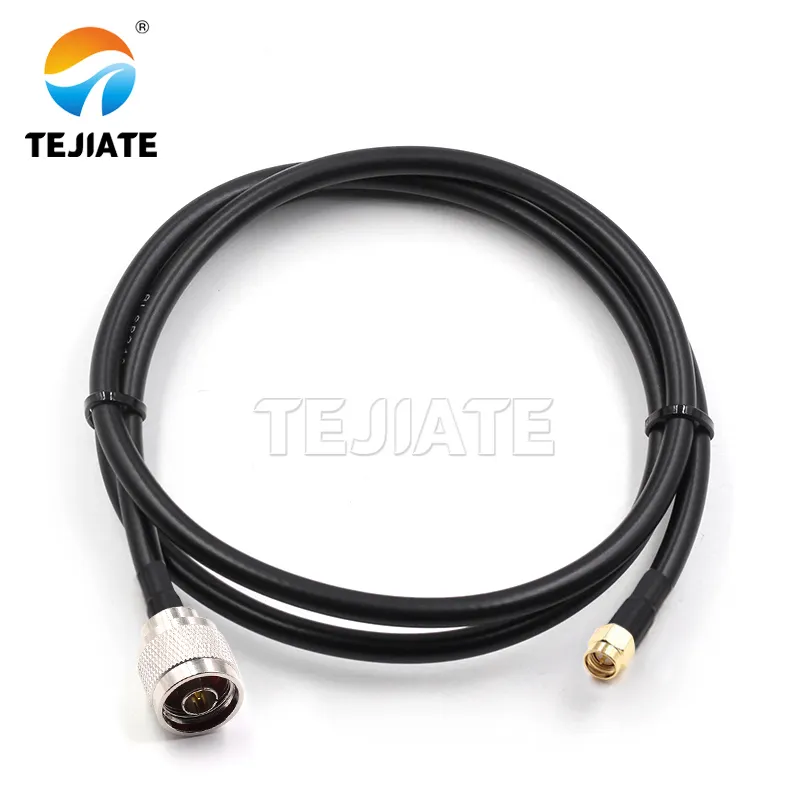
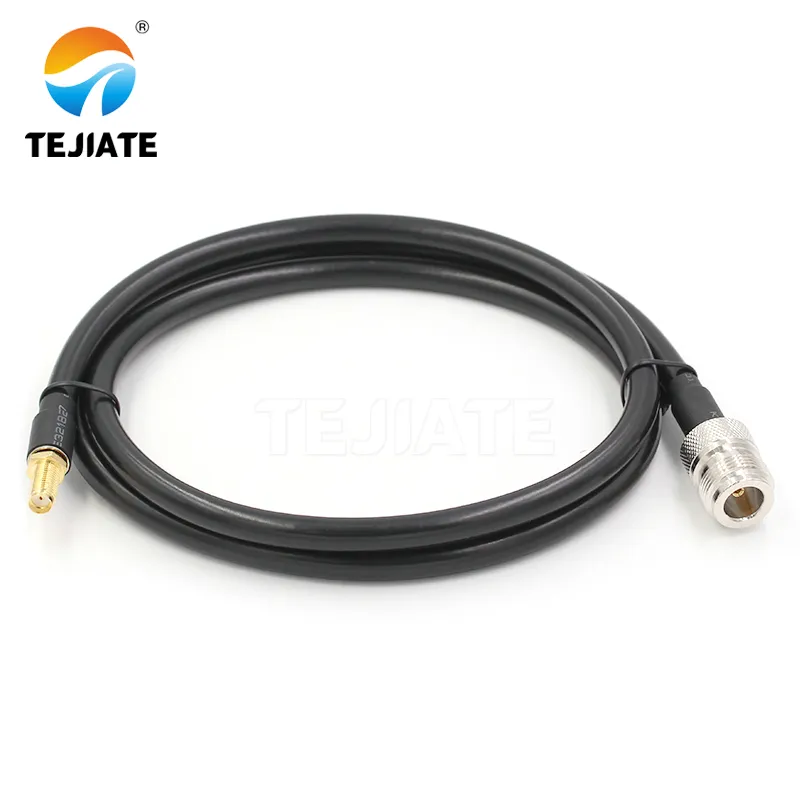
This image shows a finished SMA to N cable assembly, typically built with a flexible 50-ohm coaxial cable such as RG316 or RG58. One end has an SMA plug, the other an N-type plug or jack. The assembly includes molded or crimped strain relief at both connector ends, ensuring mechanical robustness and consistent electrical performance. Such assemblies are used as transition jumpers in labs, equipment racks, and outdoor installations.
This image shows a finished SMA to N cable assembly, typically built with a flexible 50-ohm coaxial cable such as RG316 or RG58. One end has an SMA plug, the other an N-type plug or jack. The assembly includes molded or crimped strain relief at both connector ends, ensuring mechanical robustness and consistent electrical performance. Such assemblies are used as transition jumpers in labs, equipment racks, and outdoor installations.
An SMA to N adapter is rigid. It’s a metal transition body. No flexibility. No strain relief.
An SMA to N cable, by contrast, includes a coaxial segment—often RG316 coaxial cable, sometimes lower-loss options. That flexible section absorbs:
- Offset between ports
- Cabinet tolerances
- Vibration
- Thermal expansion
Confusing these two products leads to common ordering errors.
If your SMA and N ports sit directly face-to-face and mechanically aligned, an adapter is appropriate.
If you’re spanning even a few inches with offset—or installing in a vibrating environment—a cable assembly is almost always safer.
We’ll quantify that decision in detail shortly.
Should you choose an adapter or a cable for SMA–N transitions?
Use an adapter when the connection is rigid and strain-free
An SMA to N adapter is ideal when:
- The ports are coaxially aligned
- There is no bending load
- The assembly is static
- It’s a rack-mounted or lab environment
For example, in a test bench where a signal generator (SMA) feeds a panel N connector, the mechanical geometry is controlled. An adapter works cleanly.
In that scenario, using a cable actually adds unnecessary interfaces.
Switch to an SMA to N cable when routing, vibration, or offset exists
Now imagine a back-panel SMA port sitting 2–3 inches away from a bulkhead N feedthrough.
You can force an adapter into place.
You probably shouldn’t.
Rigid adapters transmit torque and bending forces directly into the SMA jack—often PCB-mounted. That’s how center pins get stressed and solder joints crack.
In those situations, an SMA to N cable provides mechanical decoupling. The coax segment absorbs motion. The connector sees axial load only.
This becomes even more important in:
- Vehicle installations
- Outdoor mast setups
- Industrial cabinets with vibration
- Installations subject to wind load
If you’re unsure, it’s usually better to follow the rule described in our routing guide: when an SMA to N cable is better than an adapter.
Adapters solve connector transitions. Cables solve geometry.
Avoid stacking multiple adapters
Stacking adapters often happens in field fixes:
SMA → adapter → adapter → N
Each additional adapter introduces:
- Additional insertion loss (commonly 0.1–0.3 dB per unit)
- Additional mismatch
- Additional mechanical looseness
- Additional failure points
Individually, those numbers look small. But stack three or four together and the system becomes fragile.
A practical engineering boundary:
- 1 adapter: normal
- 2 adapters: acceptable
- 3+: redesign
If you see more than two rigid transitions in series, it’s time to rethink the connector strategy or move to a properly designed sma adapter cable assembly.
How do you pick the correct SMA and N genders without guessing?
Ordering the wrong gender is still one of the most common procurement errors in RF hardware.
It happens because thread gender and center conductor gender aren’t always intuitive.
Verify SMA thread and pin before ordering
This image shows a finished SMA to N cable assembly, typically built with a flexible 50-ohm coaxial cable such as RG316 or RG58. One end has an SMA plug, the other an N-type plug or jack. The assembly includes molded or crimped strain relief at both connector ends, ensuring mechanical robustness and consistent electrical performance. Such assemblies are used as transition jumpers in labs, equipment racks, and outdoor installations.
For standard SMA:
- SMA male: external threads + center pin
- SMA female: internal threads + center socket
Always confirm both thread and center conductor.
In real projects, I’ve seen teams rely on “it screws on” as a validation step. That’s not validation. That’s luck.
Before placing a PO, visually inspect the center conductor.
Identify N-type variants used in outdoor RF hardware
This image shows a finished SMA to N cable assembly, typically built with a flexible 50-ohm coaxial cable such as RG316 or RG58. One end has an SMA plug, the other an N-type plug or jack. The assembly includes molded or crimped strain relief at both connector ends, ensuring mechanical robustness and consistent electrical performance. Such assemblies are used as transition jumpers in labs, equipment racks, and outdoor installations.
N-type connectors follow similar logic:
- N male: center pin
- N female: center socket
But mechanical styles vary:
- Inline
- Bulkhead
- Panel-mount
- Weather-sealed
Lightning arrestors and rooftop feedthroughs frequently use N female bulkhead connectors.
When drawings are available, trust them. When they’re not, inspect physically.
Prevent RP-SMA confusion in Wi-Fi gear
Wi-Fi hardware complicates things further with RP-SMA (Reverse Polarity SMA).
RP-SMA swaps the center conductor gender relative to the thread orientation. The connector may look like standard SMA from a distance.
Many consumer Wi-Fi devices use RP-SMA. Industrial gear usually does not—but assumptions are dangerous.
If you’re working with Wi-Fi equipment, double-check before ordering an SMA to N connector variant. RP mistakes lead to expensive returns and wasted installation time.
What electrical specs matter for an SMA to N adapter at 6 GHz and below?
Set a realistic frequency target and VSWR expectation
Most commercial SMA to N adapter models are rated from DC up to 6 GHz. Some extend higher.
Typical performance values:
- VSWR: ≤1.2–1.3 across rated band
- Insertion loss: ~0.1–0.2 dB
At sub-6 GHz wireless frequencies (2.4 GHz, 5 GHz, LTE bands), a single high-quality adapter contributes minimal additional loss.
But precision applications are different.
If you’re building calibration chains, measurement setups, or VNA reference paths, standard adapters aren’t interchangeable with precision-grade parts.
Metrology adapters are built to tighter mechanical tolerances and stricter return loss specs.
Mixing grades compromises measurement accuracy.
Choose materials and plating that survive repeated mating
Common construction materials include:
- Brass body with nickel plating
- Gold-plated center contacts
- Stainless steel body variants
Gold improves corrosion resistance and contact consistency. Nickel increases surface durability.
If your adapter will be mated hundreds of times in a lab environment, plating choice matters more than it does in a one-time installation.
It’s easy to overlook material specs. But over time, oxidation and wear show up as unstable return loss readings.
Treat precision adapters differently in calibration chains
There’s a practical dividing line:
- System interconnect adapters
- Calibration / metrology adapters
They are not interchangeable.
In lab environments, always use precision-rated connectors for calibration references. Saving a few dollars on a standard adapter can distort high-frequency measurement results in subtle but persistent ways.
How do you install an SMA to N adapter without damaging the SMA side?
Installation errors don’t usually fail immediately. They fail later—after vibration, thermal cycling, or repeated mating.
Most damaged SMA jacks I’ve seen weren’t defective parts. They were over-torqued or side-loaded.
Apply correct torque on the SMA side
SMA connectors are small. That makes them easy to over-tighten.
The recommended torque range for standard SMA connectors is:
0.56–0.79 N·m (5–7 in-lb)
Less than that, and the electrical contact may not seat consistently. More than that, and you risk:
- Deforming the dielectric
- Damaging the center pin
- Stressing PCB-mounted jacks
- Cracking solder joints
A calibrated torque wrench is not excessive in professional environments—it’s insurance.
In lab environments where connectors are mated frequently, consistent torque also improves measurement repeatability.
If your organization documents assembly procedures, include torque values explicitly. Don’t leave it to “hand tight.”
Prevent twisting the cable or PCB jack
Here’s a small field lesson that saves boards:
Always use two wrenches.
- One wrench holds the adapter body.
- The other tightens the SMA coupling nut.
Without counter-holding, torque transfers into the PCB jack or cable assembly. That rotational stress accumulates.
This becomes especially important when connecting rigid adapters directly to PCB-mounted SMA connectors. The board sees every bit of mechanical load.
If alignment is imperfect, step back and reconsider whether an SMA to N cable would be safer than forcing geometry with a rigid part.
Weatherproof N-side connections outdoors
N-type connectors are physically robust and widely used in outdoor RF infrastructure. That’s one reason they remain common in base stations and rooftop systems.
Still, the thread itself isn’t the primary failure point outdoors. Moisture ingress and strain are.
For outdoor installations:
- Use self-amalgamating (self-fusing) tape
- Apply UV-resistant overwrap
- Add strain relief where cable weight is significant
- Avoid unsupported hanging mass
Environmental sealing matters more than tightening “just a little extra.”
For background on how coaxial systems handle impedance and shielding, see the general overview of Coaxial cable on Wikipedia. It’s a useful refresher on how shielding and dielectric integrity directly affect RF performance.
How do you minimize loss when converting SMA to N?
Loss budgeting is where small decisions compound.
Engineers often calculate cable attenuation carefully—then forget to account for adapters.
That oversight can erase margin.
Budget adapter, connector, and jumper loss together
An RF link budget should include:
- Cable loss
- Adapter loss
- Connector interface loss
- Environmental margin
A practical approximation:
- Adapter insertion loss: ~0.1–0.2 dB per unit
- Connector interface loss: small but non-zero
- Cable loss: frequency- and length-dependent
In short links (for example, 2–3 meters), the adapter’s proportional contribution becomes significant.
If your allowed path loss is tight, that extra 0.2–0.3 dB may matter.
This is why adapters should be treated as part of the rf coaxial cable system—not accessories.
Use RG316 jumpers for short flexible segments
Inside enclosures or between modules, RG316 coaxial cable is frequently used.
Why RG316?
- Small diameter
- High temperature tolerance (PTFE dielectric)
- Good flexibility
- Acceptable attenuation for short runs
Typical attenuation at 2.4 GHz is roughly 1.5–2 dB per meter (varies by manufacturer). That makes it ideal for short jumpers, not long feeders.
In many cabinet builds, you’ll see:
Device (SMA)
→ RG316 cable jumper
→ Bulkhead
→ N-type feeder
Segmenting the system this way isolates flexibility where needed while keeping long runs low-loss.
If you’re comparing small-diameter cable options, the discussion in our RG316 jumper vs RG58 jumper guide explains why diameter and dielectric matter in compact assemblies.
Use low-loss feeders when distance grows
Once cable length increases, feeder selection dominates loss.
For example:
- LMR-240
- LMR-400
- Other low-loss 50 Ω feeders
These cables dramatically reduce attenuation compared to smaller-diameter options like RG316.
At longer distances, switching to low-loss feeder often yields greater improvement than obsessing over tiny adapter differences.
Adapters don’t fix feeder inefficiency.
In fact, adding unnecessary adapters on long runs only compounds cumulative loss.
When reviewing system design, always ask:
- Is the adapter necessary?
- Is the feeder optimized?
- Is the jumper length minimized?
The weakest link tends to hide in plain sight.
Can a selection matrix prevent ordering mistakes?
Procurement errors happen when connector type, gender, environment, and loss expectations aren’t evaluated together.
A structured matrix forces clarity.
Below is a simplified SMA to N Adapter Selection & Acceptance Matrix framework.
Define the matrix fields and formulas
| Field | Example Value |
|---|---|
| Use_case | Outdoor antenna |
| SMA_side | SMA male |
| N_side | N female bulkhead |
| Frequency_GHz | 2.4 |
| Target_VSWR | 1.3 |
| Adapter_count_in_chain | 1 |
| Cable_type_after_adapter | LMR-400 |
| Cable_length_m | 10 |
| Cable_loss_dB_per_m | 0.22 |
| Allowed_loss_dB | 3 |
| Torque_plan_SMA_Nm | 0.6 |
Now define calculations:
Cable_loss_dB = Cable_loss_dB_per_m × Cable_length_m
Adapter_loss_dB = Adapter_count_in_chain × 0.15
Total_loss_dB = Cable_loss_dB + Adapter_loss_dB
Margin_dB = Allowed_loss_dB – Total_loss_dB
Pass condition:
- Margin_dB ≥ 0
- Torque within 0.56–0.79 N·m
- Gender verified
- Frequency rating ≥ system requirement
This isn’t overengineering. It’s structured thinking.
What’s new in SMA and RF adapter components?
Track PFAS-free material trends in RF connectors
Traditional SMA and other RF connectors often use PTFE as dielectric material. PTFE belongs to the broader PFAS chemical family, which is increasingly scrutinized for environmental impact.
Major manufacturers—including companies such as Amphenol RF—have announced PFAS-free connector alternatives in recent product lines.
For engineers working in regulated industries or sustainability-driven sectors, dielectric material selection may become a procurement factor—not just performance.
The electrical behavior must remain consistent. But compliance considerations are now entering connector selection discussions.
Answer common SMA to N adapter questions
Engineers rarely search for theory. They search when something isn’t working—or when they’re trying to prevent that situation.
Below are practical, field-driven questions that come up repeatedly.
When should I use an SMA to N adapter instead of an SMA to N cable?
Use an SMA to N adapter when:
- Ports align directly
- The installation is static
- There’s no bending or vibration load
- The mechanical geometry is controlled
Use an SMA to N cable when:
- There is offset between ports
- The environment includes vibration
- Cable routing is required
- Strain relief is needed
A rigid adapter transmits force. A cable assembly absorbs it.
If you’re designing enclosures and unsure which approach reduces stress long-term, our routing-focused breakdown in SMA adapter cable routing rules shows how mechanical load propagates through connector systems.
Adapters solve connector standards. Cables solve mechanical geometry.
Does an SMA to N adapter meaningfully change RF range or RSSI?
In most real-world systems, one high-quality adapter introduces about 0.1–0.2 dB insertion loss.
That is typically negligible.
However, context matters.
If your link margin is already tight—say, 1–2 dB of headroom—then cumulative losses from adapters, connectors, and suboptimal feeders can become noticeable.
The adapter alone rarely causes range collapse. The combination of small inefficiencies does.
If RSSI drops after adding an adapter, review:
- Total chain loss
- VSWR at frequency
- Feeder type
- Number of interfaces
Often, the adapter simply exposed an already marginal design.
How can I confirm SMA/N gender quickly when documentation is missing?
Use this quick rule:
- Center pin = male
- Center socket = female
Ignore assumptions based on thread appearance alone.
For Wi-Fi gear, verify whether the connector is RP-SMA before ordering. RP variants swap center conductor gender relative to thread gender.
If there’s uncertainty, physically inspect before placing an order. Guessing costs time.
Practical field guidance: how engineers avoid repeat mistakes
After enough installations, patterns emerge.
Here are a few practical habits that reduce failure rates:
- Never use adapters to correct mechanical misalignment.
- Never over-tighten SMA connectors “just to be safe.”
- Never ignore adapter count in link budget calculations.
- Never assume Wi-Fi connectors are standard SMA.
- Always separate flexible and rigid segments deliberately.
A good rule of thumb:
Rigid transitions handle standard changes.
Flexible segments handle geometry.
Blurring those roles causes stress—electrical and mechanical.
Integrating SMA to N adapters into broader RF system strategy
An SMA to N adapter is rarely a standalone design decision. It sits inside a larger interconnect strategy.
Consider the full chain:
Module → jumper → bulkhead → feeder → lightning arrestor → antenna
Each segment has a purpose.
For example:
- RG316 coaxial cable handles short internal runs.
- Low-loss feeder handles long distance.
- Bulkhead connectors isolate enclosure stress.
- Adapters bridge connector standards.
- Arrestors protect against surge events.
When these roles are clearly defined, the system becomes predictable.
When they’re improvised, field failures become more likely.
If you’re designing transitions between miniature connectors and larger infrastructure—such as moving from MMCX-based modules toward SMA or N—our related analysis on MMCX to SMA cable considerations illustrates how connector transitions should be planned rather than patched.
RF systems reward deliberate architecture.
Why small connector decisions scale in large deployments
In single installations, a 0.2 dB difference seems trivial.
In multi-site deployments—cellular repeaters, distributed antennas, industrial IoT networks—that small difference scales.
Multiply:
- 0.2 dB × 3 adapters × 1,000 installations
The cumulative impact on margin, troubleshooting time, and long-term maintenance becomes real.
Adapters don’t usually cause catastrophic failure. They create drift.
Drift consumes engineering hours.
That’s why disciplined selection—using structured matrices and torque controls—isn’t bureaucracy. It’s efficiency.
Final Thoughts
An SMA to N adapter is a small component with disproportionate influence.
Used correctly, it cleanly bridges connector ecosystems inside a consistent 50 ohm coaxial cable system.
Used casually, it introduces:
- Hidden loss
- Mechanical stress
- Impedance discontinuity
- Installation variability
The difference lies in intent.
Choose an adapter when geometry supports it.
Choose an SMA to N cable when flexibility is required.
Torque correctly.
Budget realistically.
Seal appropriately outdoors.
RF design often feels dominated by radios and antennas. Yet the interconnect chain—quiet, metallic, unremarkable—often determines whether performance remains stable six months later.
That’s why connector discipline isn’t optional.
It’s part of engineering.
Bonfon Office Building, Longgang District, Shenzhen City, Guangdong Province, China

A China-based OEM/ODM RF communications supplier
Table of Contents
Owning your OEM/ODM/Private Label for Electronic Devices andComponents is now easier than ever.