
SMA to BNC Cable Selection & Use Guide
Mar 07,2026
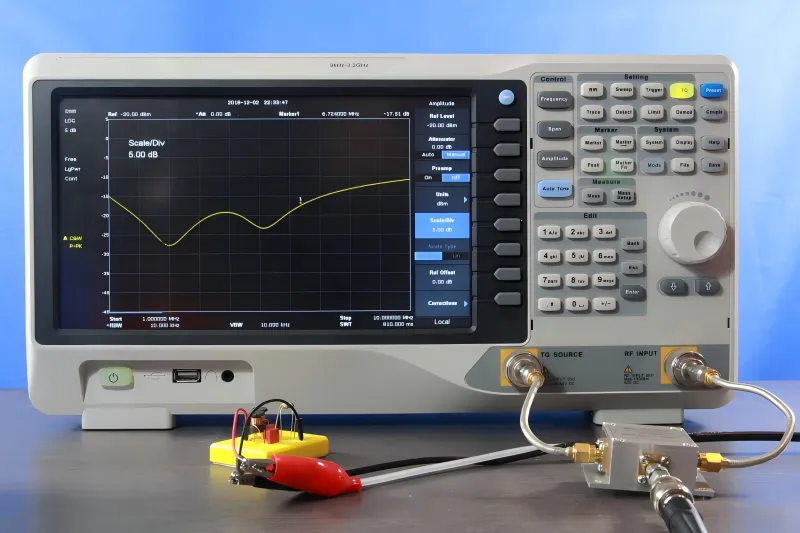
This figure illustrates a common lab scenario where a device with an SMA connector (such as a compact radio or development board) needs to connect to test equipment with a BNC input (like an oscilloscope or older spectrum analyzer). The SMA to BNC cable serves as the bridge between these two connector ecosystems. Once installed, it contributes insertion loss and mechanical interface transitions that must be accounted for, especially at higher frequencies.
An SMA to BNC cable usually shows up at the very end of a setup. The radio works. The antenna is chosen. The instrument is powered. Then someone notices the connectors don’t match. That small mismatch—SMA on the device, BNC on the instrument—gets solved with a short jumper. Problem fixed.
Except it’s not always that simple.
Once installed, that cable becomes part of the RF path just like any filter, attenuator, or connector launch. It introduces measurable loss. It adds mechanical leverage. It changes how the system behaves under repeated handling. In low-frequency work, those details may not matter much. At microwave frequencies, they do.
Most people searching for a sma to bnc cable aren’t looking for theory. They want to avoid ordering the wrong gender, mixing 50 Ω with 75 Ω, or choosing a cable that quietly eats 1 dB of margin. That’s what this guide focuses on.
Where this transition actually happens in practice
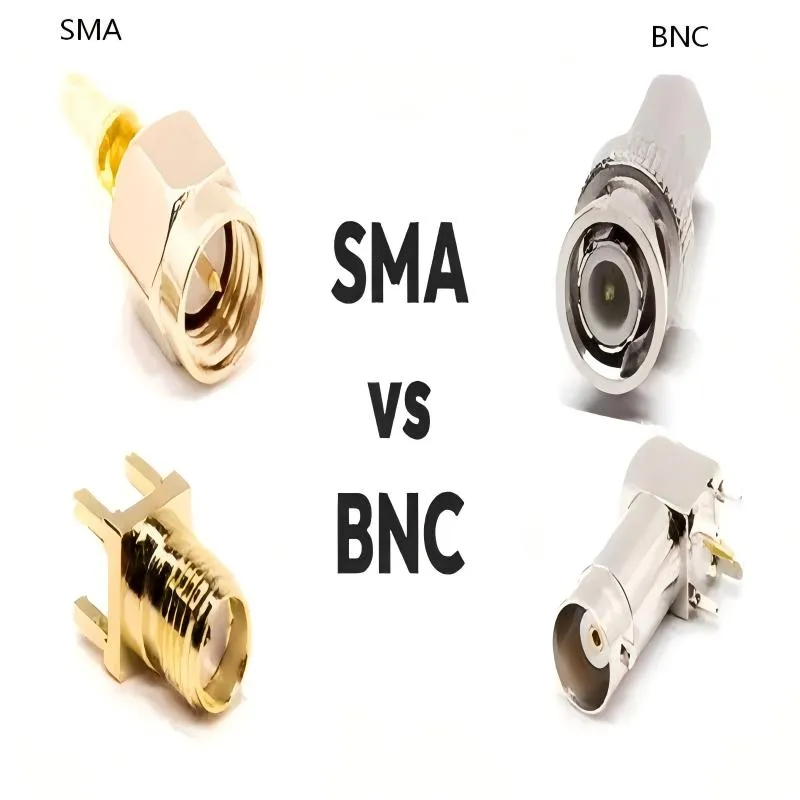
This image provides a visual comparison between SMA and BNC connectors. The SMA connector (likely shown on one side) features threaded coupling nuts for secure, vibration-resistant connections, making it dominant in modern RF modules. The BNC connector (on the other side) uses a bayonet-style locking mechanism for quick disconnect, common on test equipment. The figure emphasizes that while physically different, both must maintain impedance consistency—either 50 ohms for RF or 75 ohms for video—to avoid mismatch in mixed systems.
Modern RF hardware overwhelmingly uses SMA. Development boards, compact radios, embedded transmitters, spectrum modules—SMA is small, threaded, and well suited to 50-ohm environments. It’s predictable.
Bench instruments tell a different story. Oscilloscopes, legacy signal generators, RF distribution panels, older spectrum analyzers—many still use BNC. The connector has been in lab environments for decades, and installed infrastructure doesn’t disappear overnight.
So the bnc to sma cable becomes a bridge between generations. It’s common in validation labs, education facilities, retrofit projects, and mixed-ecosystem benches where new modules coexist with older instruments. There’s nothing unusual about that. But routine hardware deserves deliberate selection.
Staying inside the 50-ohm world
Here’s where mistakes creep in. BNC connectors exist in both 50-ohm and 75-ohm versions. In RF measurement chains, 50 ohm is standard. In video systems, BNC is often 75 ohm. The two can look similar enough to confuse even experienced technicians.
Insert a 75-ohm component into a 50-ohm RF path and you’ve created mismatch. At 100 MHz, the impact might be subtle. At 2.4 GHz or higher, it becomes visible in return loss and amplitude stability. Reflections increase. Readings shift slightly. The system may still “work,” but confidence in the measurement decreases.
For RF testing, keep the entire chain consistent within a 50 ohm coaxial cable architecture—cable, connector, instrument input. Mixing standards rarely helps.
If you need a neutral technical reference on impedance structure, the background explanation in Coaxial cable outlines the fundamentals without bias.
Adapter or cable? The decision is mechanical
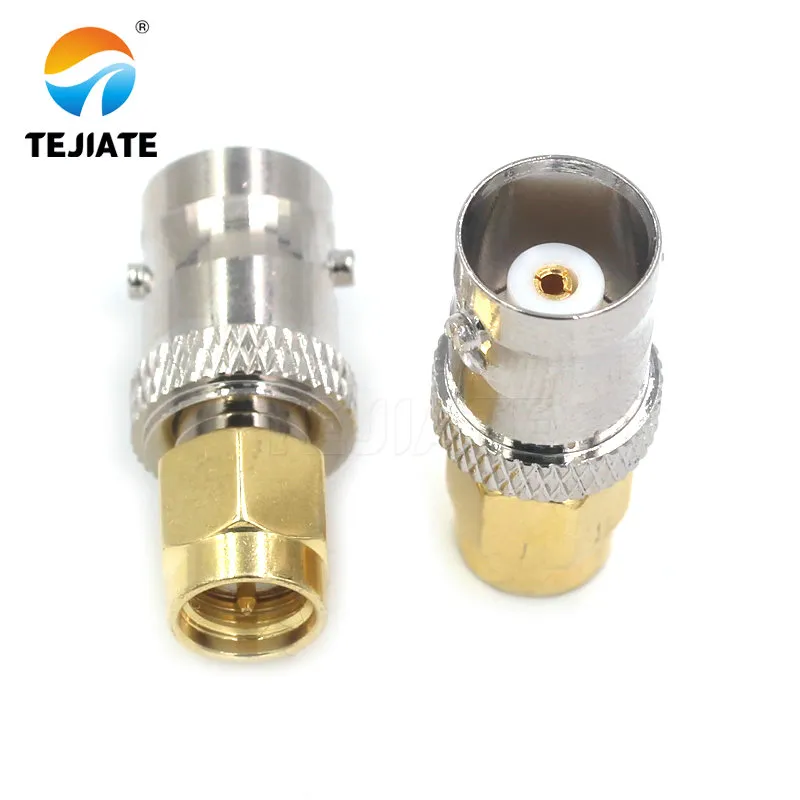
This photograph shows a rigid SMA to BNC adapter, a short metal component with an SMA connector on one end and a BNC connector on the other. It is used to directly mate devices with mismatched connector types in fixed, low-stress environments where ports are perfectly aligned. However, because it lacks flexibility, any cable movement, vibration, or misalignment is transmitted directly to the connector interfaces, which can lead to long-term reliability issues, especially with PCB-mounted SMA jacks.
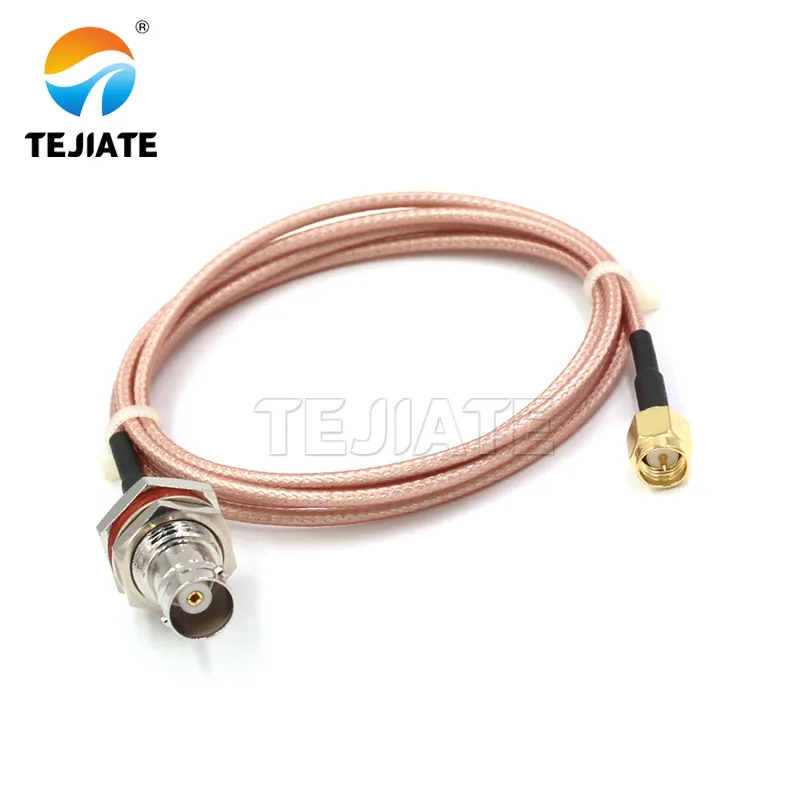
This image depicts a flexible SMA to BNC cable assembly. It consists of a length of coaxial cable (often RG316 for short runs) terminated with an SMA plug on one end and a BNC plug on the other. The flexible section allows it to accommodate slight offsets between ports, absorb vibration, and relieve strain on the connectors. Such cables are preferred over rigid adapters in lab environments where equipment is frequently rearranged or where ports are not perfectly aligned.
On paper, a rigid sma to bnc adapter seems cleaner. It’s compact. It removes the flexible section. In a perfectly aligned setup with no movement, it works well.
The real world is rarely perfectly aligned.
Even a small offset between ports forces a rigid adapter to carry bending stress. That stress transfers into connector threads and center contacts. Over time, repeated side loading can loosen or damage an SMA interface. A short rf coaxial cable assembly absorbs that stress instead of transferring it.
Use a rigid bnc to sma adapter when alignment is exact and the setup is stable. Choose an SMA to BNC cable when there’s offset, frequent reconnection, or vibration. The electrical difference is minimal; the mechanical difference is not.
Why stacked adapters are rarely the best answer
In fast-paced labs, adapters get stacked out of convenience. One solves gender. Another solves angle. A third fixes orientation. The chain grows.
Each interface adds a small insertion loss—often only a few tenths of a decibel depending on frequency and quality. Individually minor. Together noticeable. More importantly, stacked adapters create leverage. The longer the rigid column, the greater the torque on the base connector.
A single sma adapter cable built with the correct ends usually provides a cleaner solution. Fewer transitions. Lower cumulative loss. Better mechanical stability.
Adapters are useful tools. They just shouldn’t become structural extensions.
Confirming SMA correctly before ordering
SMA identification is straightforward once you know what to check. Look at the threads and the center conductor. A standard SMA male connector has internal threads and a center pin. A standard SMA female has external threads and a center socket. Reverse polarity variants swap the center conductor type while keeping similar threading, which is why Wi-Fi equipment often causes confusion.
Before ordering an SMA to BNC cable, inspect the actual device port. Assumptions lead to returns. A quick visual check prevents delays.
Confirming BNC type without guesswork
BNC is simpler. A BNC plug includes a center pin and rotating bayonet collar. A BNC jack typically presents a center socket and is frequently panel-mounted. Most instruments expose a BNC jack, meaning the cable side should be a plug.
If you want structural terminology clarification, the overview in BNC connector describes the mechanical features clearly.
When writing a purchase request, specify SMA side (male, female, or RP), BNC side (plug or jack), and whether either end should be straight or right-angle. Precision in description avoids back-and-forth emails.
Straight or right-angle isn’t an electrical upgrade
Right-angle connectors exist to solve routing constraints. They don’t inherently improve RF performance. Choose them when clearance behind a panel is tight or when a straight connector would force a sharp bend within the first few centimeters of the cable. That region—right at the connector exit—is where small coax assemblies fail most often.
The decision should follow stress geometry, not aesthetics.
Choosing the right coax for the job
For short bench jumpers, RG316 coaxial cable is widely used. It employs a PTFE dielectric and braided shield, offering moderate thermal tolerance and good flexibility. In runs under roughly a meter or two, rg316 cable works well for most lab applications.
If you need more detail on construction and selection considerations, the analysis in our RG316 Cable Selection & Buying Guide explores its mechanical and electrical trade-offs.
As run length increases, attenuation becomes more significant. At multi-GHz frequencies, a few meters of small-diameter coax can add noticeable loss. In those cases, thicker 50-ohm cables such as RG58 or other lower-loss options may preserve margin better. The trade-off is flexibility versus attenuation.
It helps to think of rf coaxial cable in functional categories: short measurement jumpers, internal integration leads, and longer feeder lines. Most SMA to BNC cable use cases fall into the first two. For broader system-level context, our RF Coaxial Cable Selection & Application Guide discusses how cable choice influences the overall RF chain.
How do you estimate loss for an SMA to BNC cable before it becomes a problem?
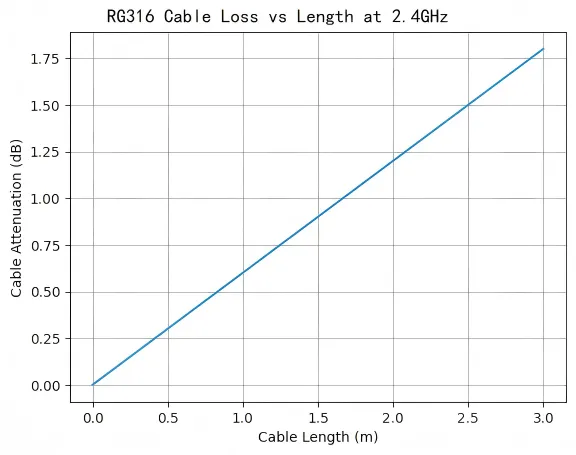
This figure illustrates the concept of loss budgeting for an SMA to BNC cable. It likely shows a diagram of the cable with callouts indicating the cable section (with attenuation per meter) and the two connector interfaces (SMA and BNC), each contributing a small insertion loss (typically 0.1-0.3 dB). The total path loss is the sum of cable loss and connector losses. This visual reinforces the need to account for all transitions in the RF path, especially at microwave frequencies where even short jumpers can consume measurable margin.
Loss is rarely dramatic in short jumpers, which is exactly why it’s easy to ignore. But even half a decibel can matter when you’re validating sensitivity, calibrating gain stages, or working close to a link budget limit. The goal isn’t to panic about every tenth of a dB. It’s to understand what you’re adding.
Start with the cable itself. Manufacturers publish attenuation in dB per meter at specific frequencies. The relationship is linear with length. A simple working estimate looks like this:
Cable loss (dB) ≈ Attenuation (dB/m) × Length (m)
That’s it. No mystery. If an RG316 coaxial cable is specified at a certain attenuation at 2.4 GHz, multiply by your planned length. For a 0.5 m jumper, divide the per-meter value by two. Engineers often skip this step because the cable is short. Don’t. At microwave frequencies, even short lengths add up.
Now add transitions. Each connector interface—SMA to cable, cable to BNC—introduces a small additional loss. Exact numbers depend on quality and frequency, but it’s reasonable in many lab environments to budget roughly 0.1 to 0.3 dB per interface as a planning estimate. If you add a rigid sma to bnc adapter into the path, count that interface too.
The total estimate becomes:
Total loss ≈ Cable loss + (Transition count × transition allowance)
For example, a short sma to bnc cable with two connectors has at least two transitions. Add an adapter somewhere and the count increases. In low-frequency testing, that may not change your conclusions. At several gigahertz, it absolutely can.
If your work involves formal measurement accuracy, it’s worth reviewing how insertion loss and mismatch interact. The technical background in Insertion loss provides neutral context for how attenuation is defined and measured.
How much length is “too long” at 2.4 GHz or 5.8 GHz?
There isn’t a universal cutoff. The right question is: how much loss can your system tolerate?
At 2.4 GHz, small-diameter cables like rg316 cable can introduce noticeable attenuation per meter. At 5.8 GHz, that number increases further. A 20 cm jumper is rarely an issue. A 3 m run might be. The math decides, not instinct.
If you’re characterizing a receiver’s sensitivity, an extra 1 dB of unaccounted loss can skew results. If you’re driving a power amplifier, added attenuation may reduce measured output at the instrument, leading to incorrect conclusions about performance.
When runs grow beyond a couple of meters, it’s often time to reconsider the coax type. Thicker 50-ohm options reduce attenuation at the cost of flexibility. That’s the tradeoff.
And if your work falls under regulated test procedures—FCC measurements in the U.S., for example—small inaccuracies can become compliance issues. The Federal Communications Commission provides measurement guidance through its engineering resources, and those procedures assume controlled, known interconnect loss. If you’re operating in regulated domains, your interconnect decisions aren’t trivial.
Don’t forget mismatch and VSWR
Attenuation isn’t the only variable. Impedance mismatch creates reflections. Those reflections are expressed as return loss or VSWR (Voltage Standing Wave Ratio). A properly constructed 50 ohm coaxial cable assembly with correct connectors should maintain good impedance continuity. But stacking mismatched components—mixing 50 Ω and 75 Ω BNC hardware, for example—degrades that continuity.
You don’t need to overcomplicate it. Keep the system consistent. Avoid mixing video-grade 75 Ω BNC components into RF chains unless the entire system is 75 Ω by design.
If you want a neutral explanation of VSWR and how it relates to mismatch, the overview in Standing wave ratio breaks it down without marketing language.
Routing discipline: where most failures really begin
Electrical specifications get attention. Mechanical routing often doesn’t. Yet most premature failures in small coax assemblies occur within the first few centimeters behind the connector.
The weak point isn’t the braid. It’s the transition area where the cable exits the connector body. Tight bends in that region create stress concentration. Repeated movement amplifies it.
A simple rule: protect the first 20–30 mm behind each connector. Avoid sharp bends immediately at the backshell. If the cable must turn quickly, give it space before the bend. That small change dramatically improves longevity.
Inside enclosures, keep the cable away from hot components. PTFE-based constructions such as RG316 coaxial cable tolerate higher temperatures than some alternatives, but heat still accelerates material aging. Avoid routing near heat sinks or power resistors when possible.
Also watch for sharp metal edges. A braided shield can survive moderate friction, but repeated contact with burrs or chassis cutouts eventually damages the jacket.
Panel-mounted BNC connectors need structural support
Many BNC connectors in lab equipment are panel-mounted jacks. The chassis carries mechanical load. That’s good—if the connection is used properly.
If you connect a rigid bnc to sma adapter and then hang a heavy cable from it, the torque transfers into the panel connector. Over time, repeated side loading can loosen internal hardware. A short SMA to BNC cable relieves that stress because the flexible section absorbs movement instead of transferring it directly into the bayonet interface.
It’s a small decision that protects expensive equipment.
How this transition fits within broader adapter workflows
It helps to see an SMA to BNC cable as one case within a larger family of adapter cables. An sma adapter cable might convert SMA to N-type, SMA to TNC, or SMA to BNC depending on system architecture. The logic behind choosing cable versus rigid adapter remains consistent across these transitions.
If you’re comparing multiple connector ecosystems in your lab or deployment workflow, understanding that broader context prevents ad-hoc decisions. Transitions shouldn’t be improvised every time. They should follow a consistent mechanical and electrical rule set.
A structured way to prevent ordering mistakes
At this point, most errors fall into predictable categories: wrong gender, wrong impedance, excessive length, or under-budgeted loss. Instead of relying on memory, it’s useful to define a short checklist before placing an order.
Here’s a practical matrix structure many engineers use internally:
- Use case (lab test, rack patch, device integration, video or RF)
- SMA side (male, female, or RP; straight or right-angle)
- BNC side (plug or jack; straight or right-angle; panel or cable end)
- System impedance (50 Ω RF or 75 Ω video)
- Operating band (GHz)
- Planned length (m)
- Coax type (rg316 cable, RG58, or other rf coaxial cable)
- Published attenuation (dB/m at frequency)
- Estimated cable loss
- Transition count
- Estimated transition loss
- Total estimated loss
- Acceptable loss budget
- Mechanical constraints (minimum bend radius, handling frequency)
Writing those down takes less than two minutes. It eliminates most purchasing mistakes.
In regulated or audited environments, having that documentation also supports traceability. Agencies such as the National Institute of Standards and Technology emphasize measurement traceability and known uncertainty. Your interconnect hardware contributes to that uncertainty, whether acknowledged or not.
Walking through a real lab example
Let’s make this concrete.
Suppose you’re validating a compact RF transmitter module that exposes an SMA female port. The instrument on your bench—a spectrum analyzer—uses a BNC female input. The operating frequency is 2.4 GHz. You need a 0.6 meter jumper to comfortably route between the device and the instrument without tension.
Start with connector selection. The module has SMA female. That means your cable needs SMA male. The instrument presents BNC female, so the cable needs BNC plug. Straight or right-angle? Look at geometry. If the analyzer’s BNC sits flush against a rack surface with limited clearance, a right-angle BNC plug may reduce stress. Otherwise, straight is fine.
Next, choose coax. For a 0.6 m bench jumper, RG316 coaxial cable is reasonable. It’s flexible, common in lab environments, and easy to route. Now estimate loss. If the attenuation at 2.4 GHz is specified in the datasheet, multiply by 0.6. Add two transition interfaces (SMA and BNC). Even with conservative assumptions, total insertion loss will likely remain under 1 dB for such a short assembly.
Is that acceptable? For general spectral observation or relative comparisons, yes. For precision power calibration, maybe not. That’s where context matters.
The key point is this: the decision wasn’t guesswork. It followed a defined process.
When an adapter would have worked instead
Now change the scenario slightly. The transmitter module and the spectrum analyzer are mounted directly adjacent on a test fixture, with their ports aligned and separated by only a few centimeters. There’s no movement, no vibration, and no repeated plugging.
In that case, a rigid sma to bnc adapter may be perfectly appropriate. It shortens the path and removes the flexible section entirely. Electrically, the transition count remains similar—SMA interface to adapter, adapter to BNC—but mechanical strain is negligible because alignment is exact.
The mistake would be using that same rigid adapter in a loosely arranged development bench where cables are constantly moved. Context determines the correct hardware.
Turning the selection matrix into an inspection checklist
Choosing correctly is only half the process. Receiving the correct product is the other half.
When an SMA to BNC cable arrives, verify:
- Connector genders match the purchase specification.
- Straight vs right-angle orientation matches the mechanical plan.
- Cable length is within tolerance.
- Jacket integrity is intact—no cuts, kinks, or crushed sections.
- Center conductors are properly aligned and not recessed or protruding excessively.
If the application involves tighter tolerances, you may add insertion loss spot checks or continuity testing. Even a simple network analyzer sweep can confirm that return loss behaves as expected.
Precision measurement labs often treat interconnects as controlled components rather than consumables. That mindset prevents surprises later.
Using an SMA to BNC cable in calibration chains
One question that comes up frequently: can a bnc to sma cable be used in calibration or metrology environments?
The answer depends on required accuracy. For routine validation, yes—provided the cable is characterized or its loss is accounted for. For high-precision calibration chains, labs often use specifically rated assemblies with documented performance data. In those environments, the interconnect becomes part of the traceable measurement system.
Organizations such as NIST emphasize traceability and uncertainty management in measurement systems. If your work falls into that category, your interconnect choice must align with documented calibration procedures rather than convenience.
For background on measurement traceability concepts, resources from the National Institute of Standards and Technology offer neutral guidance on uncertainty and calibration frameworks.
How long can you realistically go at microwave frequencies?
Engineers often ask for a fixed number. There isn’t one.
At 2.4 GHz, short jumpers under one meter are typically manageable with rg316 cable, assuming the loss fits within budget. At 5.8 GHz, attenuation increases further. Beyond a few meters, small-diameter coax may no longer be appropriate.
The smarter question isn’t “What’s the maximum length?” It’s “How much loss can my system tolerate?” Once you know that, the math tells you whether the chosen cable is acceptable.
When loss budget becomes tight, switching to thicker 50-ohm options reduces attenuation per meter. That comes at the expense of flexibility and bend radius, which may or may not be acceptable depending on routing constraints.
Do right-angle connectors improve reliability?
Not automatically.
Right-angle connectors reduce bending stress when geometry demands it. If a straight connector would force a sharp bend immediately behind the backshell, a right-angle version distributes stress more evenly.
But if clearance is abundant, straight connectors are mechanically simpler and sometimes more robust. Choose orientation based on actual physical layout, not preference.
The highest failure rates in small coax assemblies occur at the connector-to-cable transition. Minimizing sharp bends in that region matters more than the specific orientation chosen.
When 75-ohm BNC actually makes sense
It’s worth acknowledging that 75-ohm BNC connectors are entirely valid—in video systems and specific RF architectures designed around 75-ohm impedance. If your entire signal path is 75 ohm by design, then mixing 50-ohm hardware would be equally problematic.
The rule isn’t “50 ohm is always correct.” The rule is “keep the system consistent.”
If you’re unsure about impedance matching fundamentals, the explanation of impedance continuity in Coaxial cable provides technical grounding without oversimplification.
Frequently asked questions
When should I use an SMA to BNC cable instead of an adapter?
Use a cable when ports are offset, when repeated handling occurs, or when mechanical strain could damage connectors. Use a rigid adapter when alignment is exact and the setup is stable.
Is an SMA to BNC cable 50 ohm or 75 ohm?
For RF testing, it should be 50 ohm. Verify before ordering. Mixing impedance standards increases mismatch and reflection.
What coax should I choose—RG316 or something thicker?
For short bench jumpers, RG316 coaxial cable is common and flexible. For longer runs or tighter loss budgets, thicker 50-ohm coax may be preferable.
How long can an SMA to BNC cable be at 2.4 or 5.8 GHz?
There is no universal limit. Calculate attenuation using published dB/m data and compare against your allowable loss budget.
Do right-angle connectors reduce failure rates?
They help when routing constraints would otherwise force tight bends near the connector. They do not inherently improve electrical performance.
Can I use a bnc to sma cable for calibration measurements?
Yes, provided its loss and characteristics are known and accounted for. High-precision environments may require specifically characterized assemblies.
Final perspective
Bonfon Office Building, Longgang District, Shenzhen City, Guangdong Province, China

A China-based OEM/ODM RF communications supplier
Table of Contents
Owning your OEM/ODM/Private Label for Electronic Devices andComponents is now easier than ever.