
RF Coaxial Cable Selection and Application Guide
Feb 27,2026
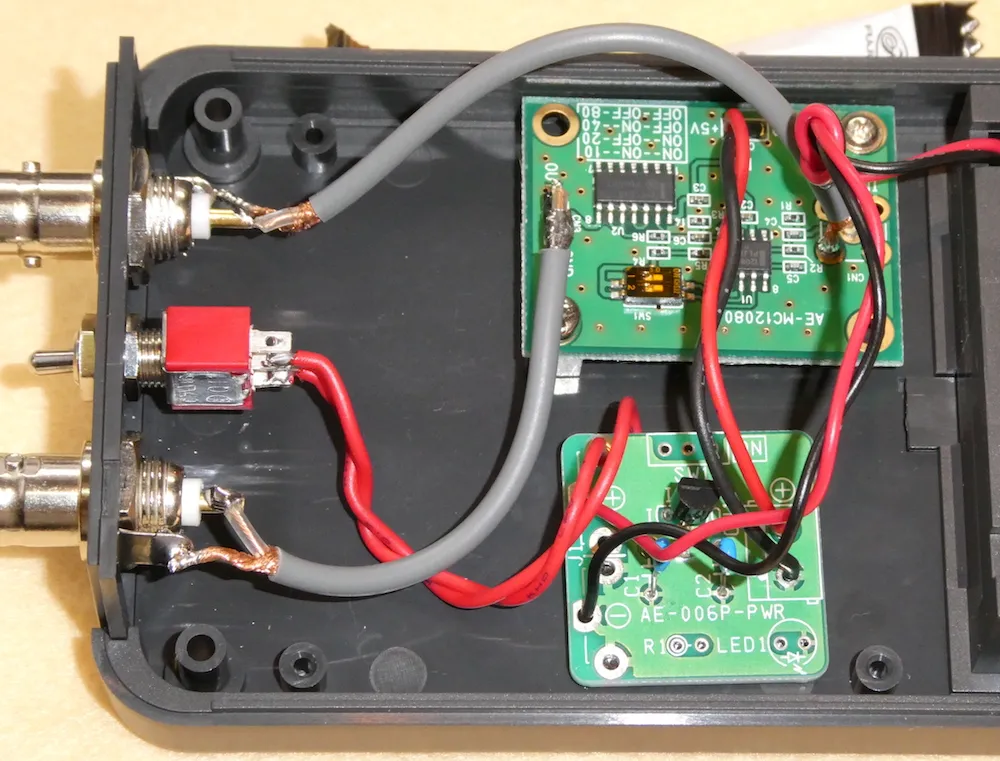
This image shows a typical RF coaxial cable, possibly with visible layers or connectors. It represents the component that engineers often add late in the design process, assuming it will not affect performance. However, as the document explains, the cable becomes part of the RF signal path and influences loss, impedance, and long-term reliability.
In most RF projects, the coaxial cable shows up late.
The radio is chosen first. The antenna gets tuned. Early bench tests pass using whatever jumper happens to be on hand. At that point, nobody is worried about the rf coaxial cable. It “works,” so it fades into the background.
That confidence usually survives until something changes. The enclosure closes. The antenna moves off the bench. The system goes outside, into a vehicle, onto a mast, or into a rack that nobody involved in the original design will ever see again.
Only then does the cable stop behaving like a neutral part.
Loss creeps up. Measurements drift when the cable is touched. A link that once had margin suddenly feels fragile. None of this looks dramatic enough to count as a failure, but it is exactly where many RF systems quietly lose reliability.
An RF coaxial cable is not a passive accessory. Once installed, it becomes part of the RF transmission line in the same sense as the PCB launch or the antenna feed point. Treating it as an afterthought is convenient early on—and expensive later.
Map RF coaxial cables into your RF signal chain
Trace RF coaxial cable from radio front ends to antennas
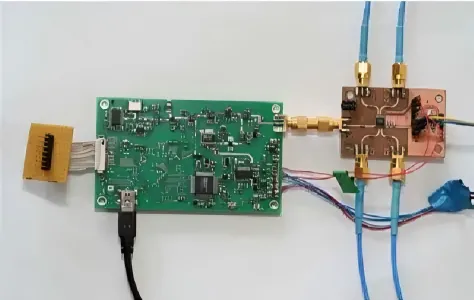
This diagram illustrates the continuous electrical path from the radio's output pin, through PCB launch, board connector, RF coaxial cable, panel bulkhead, and finally to the antenna or test port. It emphasizes that the cable is an integral part of the transmission line, not an afterthought.
RF does not care about boundaries.
From the radio’s output pin to the antenna connector, the signal sees one continuous electrical path. It does not “reset” at the board edge or at a connector. That idea is useful for block diagrams, but misleading in practice.
A more realistic way to think about the system is to trace the entire path without breaks:
radio front end → PCB trace and launch → board connector → rf coaxial cable → panel or bulkhead → antenna or test port.
Once that full path is visible, design trade-offs become clearer. A clean RF module feeding a compromised cable run will still lose margin. A low-loss cable will not save a poorly matched launch.
This system-level view is the same mindset used when comparing RG families in the broader context of RF cabling, as outlined in the RG Cable Guide. The cable is not a separate decision—it is part of the chain.
Distinguish RF coaxial cable from generic or 75 Ω video coax
One of the easiest mistakes to make is assuming that “coax is coax.”
Most RF hardware expects 50 ohm coaxial cable. That includes radios, antennas, filters, amplifiers, and nearly all RF test equipment. Video systems, on the other hand, are built around 75 Ω coax.
At low frequencies, mixing the two often appears harmless. Signals pass. Power shows up where expected. Nothing fails hard enough to trigger alarms. The penalty shows up gradually as frequency increases.
Reflections grow. Return loss worsens. VSWR edges upward. Link margin disappears without a single obvious failure point.
Connector compatibility does not protect you here. A cable that fits mechanically can still be wrong electrically. In RF systems, impedance consistency matters more than convenience. If the system is designed around 50 Ω, every segment should behave as 50 ohm coaxial cable, including jumpers and adapter assemblies.
If you want the deeper historical and practical reasoning behind this standard—and where exceptions actually make sense—the 50 Ohm Coaxial Cable Guide covers it without the usual textbook framing.
Relate RF coaxial cable to RG and LMR cable families
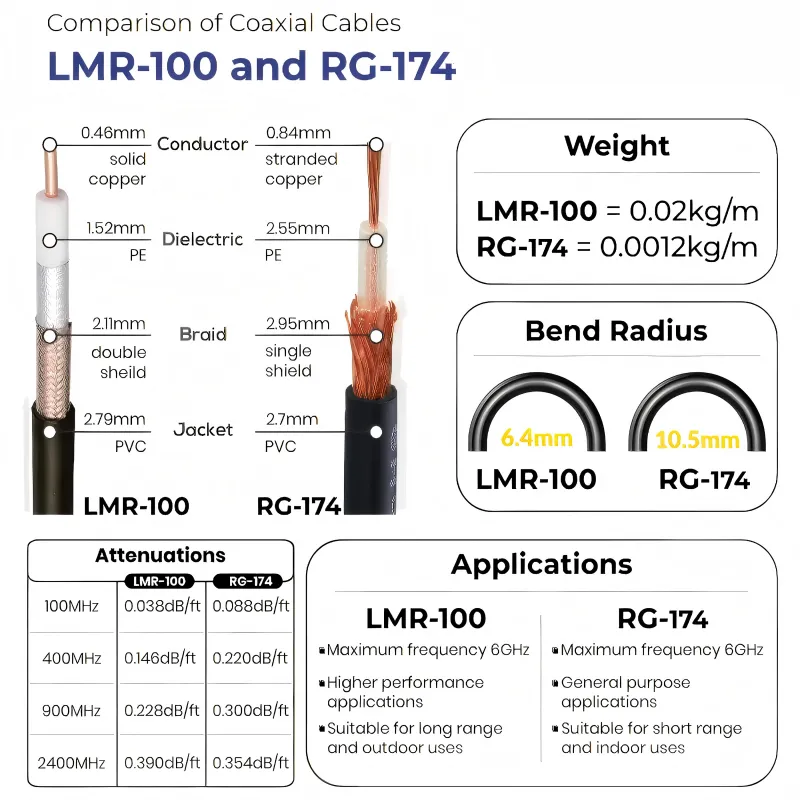
This figure displays several common RF coaxial cable types, such as RG58, RG316, LMR-240, and LMR-400, side by side. It highlights differences in diameter, shielding, and construction, which affect attenuation, power handling, and mechanical suitability. The image helps engineers select the right family based on system constraints.
In practice, engineers rarely start from abstract parameters like dielectric constant or shield coverage. They start from families they already know.
RG58, RG213, rg316 coaxial cable—these names are shorthand for size, loss, flexibility, and mechanical expectations. LMR cables fill a similar role for low-loss feeder applications, especially outdoors.
Despite their differences, these are all expressions of the same rf coaxial cable concept. Same basic structure. Same impedance targets. Different trade-offs.
Problems usually arise when those trade-offs are ignored. Expecting a miniature jumper to behave like a feeder cable, or forcing a stiff outdoor cable into a dense enclosure, tends to create issues that only show up after installation.
A scenario-driven comparison of RG and LMR families—based on how they are actually used rather than how they are marketed—is covered in the Best RG & LMR Coaxial Cables Guide.
Decide when an RF coaxial cable assembly is the right tool
Use RF coaxial cable assemblies instead of bare coax and loose adapters
Field-terminated coax works—until it doesn’t.
Every manual termination depends on tooling, technique, and inspection. Add a few loose adapters, and the RF path becomes difficult to characterize or reproduce. Loss and reflection accumulate quietly, especially when multiple hands touch the system over time.
Factory-terminated rf coaxial cable assemblies remove much of that uncertainty. Impedance is controlled. Connector geometry is consistent. Construction details are documented.
If a design starts accumulating adapters just to make endpoints meet, that is often a sign the wrong cable solution was chosen. This is exactly why adapter placement and count are treated as RF design parameters in the SMA Adapter Cable Selection and Routing Guide, rather than as mechanical conveniences.
Reserve RF coaxial cable for high-frequency, shielded signal paths
At RF frequencies, shielding is not optional.
In Wi-Fi, cellular, GNSS, and ISM-band systems, rf coaxial cable provides a controlled impedance environment and predictable isolation from external noise. Twisted pair may carry energy, but it rarely preserves signal integrity once frequency and EMI increase.
When receiver sensitivity or regulatory margins matter, RF coaxial cable is usually the only reasonable option for single-ended RF paths.
Recognize where twisted pair or waveguide should replace RF coaxial cable
Coax is versatile, not universal.
Differential twisted pair dominates high-speed digital links. Waveguide makes sense at very high frequencies and power levels. Fiber takes over when distance or isolation matters more than analog RF behavior.
Good RF design is not about forcing coax everywhere. It is about knowing when rf coaxial cable is the right tool—and when it is not.
How should you match RF coaxial cable families to your application?
Group RF coaxial cable into jumper, feeder, and instrumentation roles
Most RF cables fall into one of three roles.
Jumper or pigtail cables live inside enclosures. They are short, flexible, and handled often. Loss matters less than mechanical tolerance. This is where rg316 cable is commonly used.
Feeder cables connect radios to antennas over distance. Loss per meter dominates. Larger RG and LMR families become necessary.
Instrumentation cables prioritize stability and repeatability. Connector life and mechanical consistency matter more than cost.
This role-based framing mirrors how RF systems actually behave in the field and aligns with the broader application-driven structure used in the Coaxial Cable Ultimate Guide.
Treat RG316 coaxial cable as the baseline miniature RF jumper
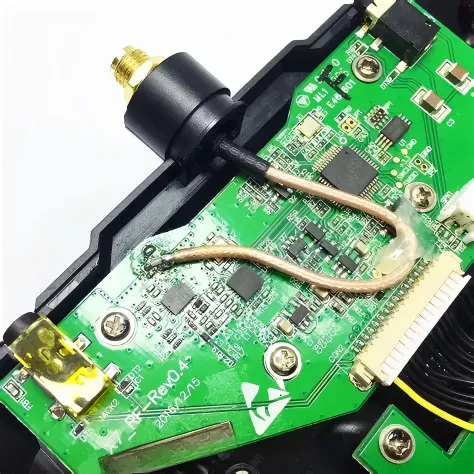
This photograph shows a short RG316 coaxial cable assembly connected between a compact RF module (with a miniature connector like MMCX) and a panel-mounted SMA bulkhead. It illustrates the common practice of using RG316 as a mechanical buffer, protecting board-level connectors from stress while maintaining 50-ohm integrity.
In compact RF systems, rg316 coaxial cable shows up everywhere for a reason.
It is thin enough to route easily, robust enough to survive repeated handling, and stable across temperature. At 50 Ω, it integrates cleanly with most RF hardware.
That combination explains its common use in sma adapter cable assemblies and mmcx to sma cable pigtails. When a module exposes a small RF port and the enclosure expects SMA, RG316 absorbs mechanical stress while keeping the RF path predictable.
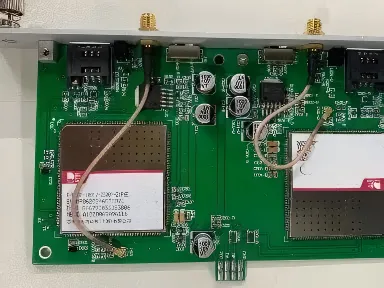
This image likely shows a close-up of an RG316 coaxial cable, either as a cross-section revealing the inner conductor, PTFE dielectric, braided shield, and jacket, or as a finished assembly with connectors. It reinforces the cable's construction quality, which contributes to its popularity in test setups, IoT devices, and aerospace applications where reliability is critical.
Step up to larger RF coax when power and distance increase
As cable length increases, loss stops being abstract.
RG58 and RG213 reduce attenuation compared to RG316, but demand more space and larger bend radius. LMR-240 and LMR-400 preserve link margin over long runs, at the cost of flexibility and routing complexity.
There is no universally “better” rf coaxial cable. Each family trades mechanical convenience for electrical performance. The right choice depends on how much margin the system can afford to lose—and how much mechanical compromise it can tolerate.
Plan loss, impedance, and shielding for RF coaxial cable runs
Estimate attenuation for common RF coaxial cable types across bands
Cable loss is rarely the reason an RF system fails outright. More often, it is why a system has no margin left.
Most datasheets list attenuation in dB per meter at a few reference frequencies. That is usually enough. You do not need perfect accuracy to make a good decision—you need order-of-magnitude clarity.
Engineers typically sanity-check loss at a few practical bands: sub-GHz, 900 MHz, 2.4 GHz, and 5.8 GHz. Once frequency climbs, differences between cable families stop being theoretical.
Below is a planning-level comparison that many teams use before pulling detailed datasheets:
| Cable family | 433 MHz (dB/m) | 900 MHz (dB/m) | 2.4 GHz (dB/m) | Typical role |
|---|---|---|---|---|
| RG316 | ~0.45 | ~0.65 | ~1.1 | Internal jumpers |
| RG58 | ~0.22 | ~0.35 | ~0.65 | Short feeders |
| LMR-240 | ~0.14 | ~0.22 | ~0.39 | Medium feeders |
| LMR-400 | ~0.07 | ~0.11 | ~0.22 | Long feeders |
These numbers do not need to be exact to be useful. They quickly answer practical questions:
“How much margin do I burn with one extra meter?”
“Is this jumper negligible, or is it already half a dB?”
Once a system is running close to its budget, rf coaxial cable loss stops being background noise and becomes a first-order design constraint.
Keep 50 ohm coaxial cable consistent from port to port
Most RF engineers do not consciously “choose” 50 Ω anymore. It is simply assumed.
That assumption works because nearly all RF components—modules, filters, amplifiers, antennas, test equipment—are built around 50 ohm coaxial cable. The entire ecosystem expects that impedance.
Problems arise when that consistency is broken quietly. A short 75 Ω segment. An unknown adapter. A salvaged cable with no datasheet. None of these usually cause immediate failure. Instead, they introduce reflections that worsen with frequency.
From a transmission-line standpoint, this is well understood and documented in basic coaxial theory, such as the overview on coaxial cable. What catches teams off guard is how forgiving systems appear at first—and how unforgiving they become after installation.
In practice, the safest rule is simple:
If the system is designed for 50 Ω, treat every jumper, adapter, and pigtail as part of a 50 ohm coaxial cable path unless proven otherwise.
Choose shielding and jacket options based on EMC and environment
Loss gets attention because it is easy to quantify. Shielding often gets ignored until EMC testing or field noise exposes it.
Single-braid shields are usually adequate for clean indoor environments. Once systems move into vehicles, industrial spaces, or shared racks, coupling and ingress become much more visible.
Double-shielded constructions—braid plus foil—reduce susceptibility and emissions at the cost of stiffness. Jacket materials matter as well. PVC is flexible but soft. PE and FEP improve durability and temperature tolerance, especially outdoors.
None of this changes the impedance, but it strongly affects how a cable behaves after six months of real use. That is where many RF systems quietly degrade.
Route RF coaxial cables safely in enclosures, vehicles, and racks
Respect bend radius and connector stress limits for RG316 and larger cables
Most cable failures are mechanical long before they are electrical.
Every coaxial cable has a minimum bend radius. For rg316 cable, that radius is forgiving—but not infinite. Tight bends right at the connector body are especially damaging. The cable may still measure fine initially, then drift over time.
Larger cables raise the stakes. RG58 and LMR families demand more space and mechanical planning. Ignoring bend radius is one of the fastest ways to turn a low-loss cable into a long-term reliability problem.
If a cable must flex during service, design for it explicitly. If it should never move, clamp and strain-relieve it accordingly.
Separate RF coaxial cables from power, digital, and moving harnesses
Physical proximity matters more than most layouts admit.
Routing rf coaxial cable alongside high-current power lines or noisy digital buses invites coupling and long-term abrasion. In vehicles and industrial enclosures, vibration adds another failure mechanism.
Good RF layouts often look “overly cautious” on paper: extra spacing, dedicated routing paths, intentional crossings instead of parallel runs. Those choices pay off after the system leaves the lab.
Use bulkhead transitions so RF coaxial cables don’t carry mechanical loads
RF cables are not structural components.
Any cable that exits an enclosure should do so through a bulkhead connector—SMA, N, or TNC—so that the enclosure carries mechanical load, not the coax itself. This is especially important for antennas, test ports, and field-serviceable connections.
Many long-term failures trace back to cables that were electrically correct but mechanically abused.
Integrate RF coaxial cables with adapters, pigtails, and jumpers
Bridge tiny RF ports with MMCX to SMA cable and similar pigtails
Modern RF modules increasingly expose miniature connectors: MMCX, MCX, U.FL, and similar.
A common and effective pattern is:
module RF port → mmcx to sma cable (short pigtail) → enclosure-mounted SMA → main rf coaxial cable to antenna.
The short pigtail absorbs mechanical stress and protects the module connector. Electrically, its loss is usually negligible compared to the benefits in robustness.
Mechanical tolerances and connector life in these transitions are discussed in more depth in the MMCX to SMA Cable Selection and Routing Guide, which focuses on exactly this interface boundary.
Use SMA adapter cable to transition between connector families
Mixed connector ecosystems are common. Test equipment still uses BNC. Some antennas expect N-type. Automotive systems introduce Fakra.
In these cases, a short sma adapter cable often performs better than stacking rigid adapters. The cable absorbs alignment errors, reduces connector stress, and keeps impedance transitions controlled.
Adapter cables are not “cheats.” They are deliberate RF components when used sparingly and placed intentionally.
Avoid daisy-chaining too many RF adapters in one path
Every adapter adds loss, reflection, and mechanical tolerance stack-up.
One or two transitions are usually acceptable. Beyond that, measurement repeatability starts to suffer. If a signal path requires several conversions, it is often better to specify a custom rf coaxial cable assembly with the correct connectors built in.
This is not about perfection. It is about knowing where uncertainty begins to dominate results.
For grounding and shielding behavior in real installations, many EMC engineers still reference guidance derived from standards bodies such as the IEEE and related RF practice notes, even when working outside formal compliance testing.
Build an RF coaxial cable selection matrix
Define the key fields and formulas for RF cable planning
Most RF teams already do this informally.
Someone sketches a link budget. Someone else estimates cable loss from memory. Connector count gets waved away as “probably small.” It works—until the system has to be replicated, audited, or handed off to procurement.
A selection matrix forces those assumptions onto paper.
A typical rf coaxial cable planning matrix includes fields such as:
- Application type (base station, IoT node, vehicle, lab setup)
- Frequency range (low band to high band)
- Cable family (RG316, RG58, RG213, LMR-240, LMR-400)
- Estimated loss per meter at the target band
- Planned cable length
- Connector count, including pigtails and adapter cables
- Connector loss estimate (often 0.1–0.3 dB each)
- Total RF path loss (cable + connectors)
- Allowed path loss or margin target
- Minimum bend radius from datasheet
- Planned bend radius after routing
- Environment (indoor, outdoor, automotive, industrial)
The math is simple by design. What matters is visibility. Once loss, margin, and mechanical limits are written down, weak assumptions become obvious.
Many teams reuse this same matrix later as an acceptance checklist, comparing delivered rf coaxial cable assemblies against the original design intent.
Walk through a small-cell or rooftop radio example
Consider a compact rooftop access point.
Inside the enclosure, a short rg316 coaxial cable jumper connects the radio module to an SMA bulkhead. From there, an LMR-400 feeder runs several meters to the antenna.
On paper, the system looks straightforward. In the matrix, it becomes concrete:
- RG316 jumper loss is small but not zero.
- LMR-400 loss dominates the budget.
- Two or three connectors already consume measurable margin.
- Bend radius constraints limit how tightly the feeder can exit the enclosure.
Running this example through the matrix often reveals where there is room to breathe—and where there is not. That clarity is what prevents late-stage surprises.
Reuse the matrix as an acceptance and sourcing tool
Once a matrix exists, it naturally becomes a reference during sourcing.
When samples arrive, engineers can verify cable family, length, connector types, and routing assumptions against the original plan. Procurement teams can see why a certain cable was specified instead of defaulting to the cheapest option.
Over time, the matrix stops being a one-off spreadsheet and becomes institutional memory.
Follow RF coaxial cable and assembly market trends
Track growth in RF coaxial cable assemblies
The market for rf coaxial cable assemblies continues to grow steadily, not explosively.
Industry analyses place global revenue in the mid–single-digit billion USD range in the mid-2020s, with projections approaching the high single-digit billions by the early 2030s. Annual growth rates hover in the mid–single digits.
That growth is not driven by novelty. It is driven by volume.
Link demand to 5G, automotive, and IoT deployments
Modern RF systems are connector-dense.
A single 5G radio, vehicle platform, or industrial IoT installation may contain dozens of RF interconnects: internal jumpers, test ports, feeder cables, antenna leads. Each one consumes a short length of rf coaxial cable.
As deployments scale, so does demand for consistent, well-documented assemblies that can survive real environments rather than ideal lab conditions.
Note emerging niches without overstating them
Certain segments grow faster than the overall market.
Leaky coaxial cables are increasingly used for coverage in tunnels and transit systems. Precision RF coaxial assemblies rated well above 18 GHz are now routine in mmWave radios and radar platforms.
These are not mass-market products, but they signal where RF cabling requirements are becoming tighter, not looser.
Resolve common RF coaxial cable design questions
Why do most RF systems still rely on RF coaxial cable instead of other media?
How far can an RF coaxial cable run at 2.4 GHz or 5.8 GHz before loss becomes critical?
There is no fixed distance. What matters is allowable loss.
At these bands, even a few meters of the wrong cable can consume several dB. That is why feeder selection becomes critical long before physical distance feels “long.”
When should RG316 coaxial cable be chosen over RG58 or LMR families?
Choose rg316 coaxial cable when flexibility, size, and handling matter more than loss—typically for short internal jumpers, pigtails, and adapter cables.
Once distance or power increases, larger families become more appropriate.
How many adapters and jumpers are reasonable in one RF path?
One or two transitions are usually acceptable. Beyond that, uncertainty dominates.
If a path requires many adapters, a purpose-built rf coaxial cable assembly is often the cleaner solution.
What field symptoms indicate an RF coaxial cable needs inspection or replacement?
Bonfon Office Building, Longgang District, Shenzhen City, Guangdong Province, China

A China-based OEM/ODM RF communications supplier
Table of Contents
Owning your OEM/ODM/Private Label for Electronic Devices andComponents is now easier than ever.