
SMA RF Cable Guide for Modules and Test
Feb 20,2026
Preface
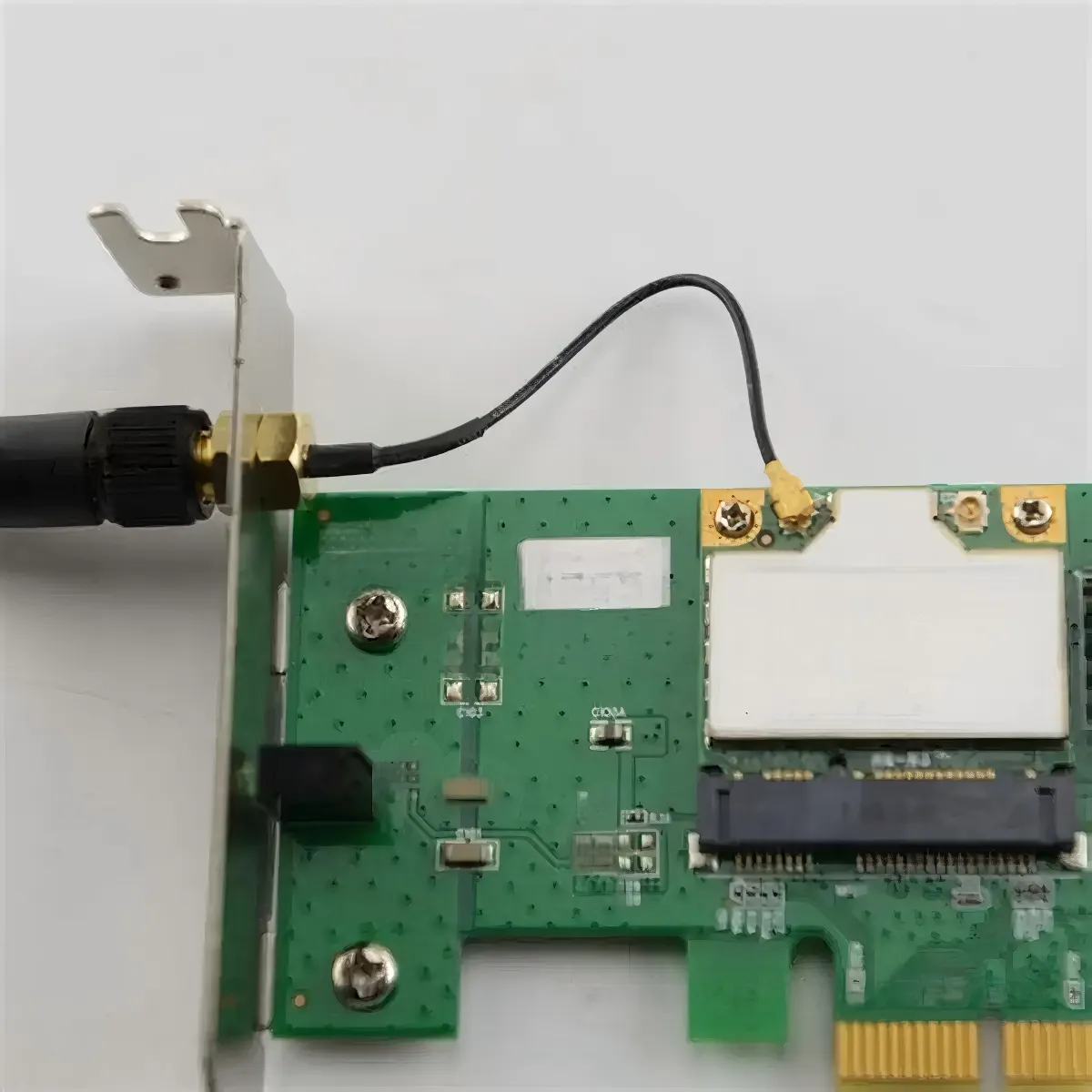
This figure illustrates a basic RF system where an SMA RF cable connects a radio module to an antenna. The cable is shown as an integral part of the signal path, emphasizing that its electrical behavior—insertion loss, impedance stability—shapes overall system performance.
In RF systems, cables are rarely questioned first. When a link underperforms, engineers tend to look at the radio, the antenna, or firmware settings. The sma rf cable sitting between them is often treated as background hardware — passive, assumed stable, and rarely documented with the same care as active components. That assumption usually holds during early bring-up. It starts to fail later, when enclosures are closed, antennas are moved, or test setups are reused by someone else.
This guide treats the SMA RF cable as part of the RF signal chain, not an afterthought. The focus is practical: how to map the cable into the system, define its operating envelope, and choose assemblies that remain predictable across design, test, and deployment. The intent is commercial and technical at the same time — helping engineers and sourcing teams select, route, verify, and procure SMA RF cables with fewer surprises downstream.
How should you map an SMA RF cable into your RF chain?
In many RF projects, the SMA RF cable appears later than it should. The radio already links. The antenna choice feels locked. Early measurements pass using whatever jumper happens to be nearby. Only after the system looks “good enough” does the actual cable get specified. By that point, the cable is no longer just a connection — it becomes a constraint.
An sma rf cable is not electrically neutral. Once installed, it shapes insertion loss, impedance stability, and how sensitive the system is to handling and routing. Treating it as interchangeable hardware is one of the most common ways RF margin quietly disappears.
Clarify which nodes your SMA RF cable actually connects
An SMA RF cable never connects “RF” to “RF” in the abstract. It links specific functional nodes, and those roles determine how strict your requirements need to be. A short internal link from a radio module to a filter behaves very differently from an external module-to-antenna run that exits the enclosure and gets handled during service.
Typical connection roles include radio module to antenna, PA or LNA stage to a filter or duplexer, module to a panel-mounted test port, or instrument output to a device under test. Each path has a different tolerance for loss, mechanical stress, and repeatability. Engineers who label these roles explicitly early in the design tend to avoid late-stage rework.
If you already maintain a higher-level view of RF interconnects, this article fits naturally alongside broader references such as Understanding RF Cables: The Ultimate Guide, where SMA assemblies are one specific branch of the overall coaxial ecosystem.
Identify all transitions in the SMA RF cable path
Cable length is obvious. Transitions are easier to miss. A real SMA RF cable path often includes SMA connector pairs, an mmcx connector on the module, a bulkhead SMA through the enclosure, short pigtails for routing, and a PCB launch or coax-to-microstrip transition. Each one introduces a small impedance discontinuity and a small amount of loss.
Individually, these effects look insignificant. In combination, they explain why measurements drift when a cable is touched or why a system that passed early tests becomes sensitive after integration. Listing every transition — including temporary adapters used during test — makes those losses visible before they accumulate.
Separate internal and external SMA RF cable paths
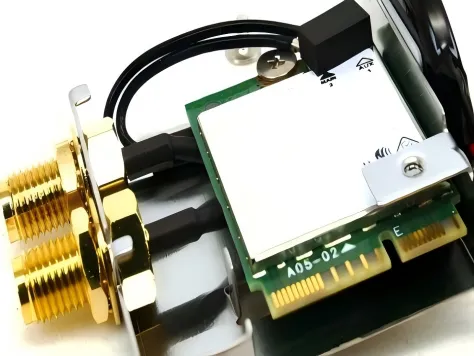
This diagram shows two distinct cable routing scenarios: one inside an enclosure (short, fixed routing, minimal handling) and one external (exposed, repeatedly mated, subject to environmental stress). The visual contrast highlights how different mechanical demands affect cable selection and durability expectations.
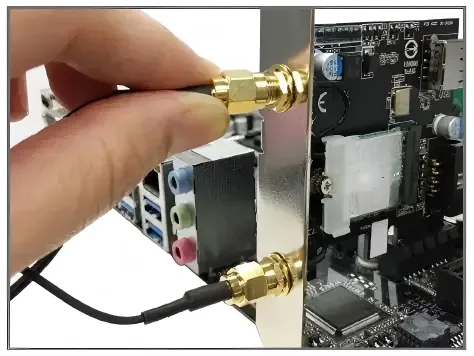
This photograph or CAD rendering depicts a compact RF enclosure with an internal SMA jumper connecting a module to a bulkhead SMA port, and an external SMA cable attached to the bulkhead for antenna connection. The image reinforces the need to treat internal and external paths separately in terms of strain relief, bend radius, and connector robustness.
Define the operating envelope for your SMA RF cable
Frequency range versus cable family
At low frequencies, most SMA RF cables look similar. As frequency increases, the differences become unavoidable. Thin SMA RF cable assemblies based on rg316 coaxial cable are widely used because they are flexible, thermally stable, and easy to route in compact hardware. The tradeoff is attenuation. At multi-GHz bands, loss increases rapidly with length.
For systems operating around 6 GHz or across wide bandwidths, engineers often shorten cable runs or step up to lower-loss cable families rather than compensating elsewhere in the RF chain. The cable does not fail; it simply consumes margin continuously.
How power handling and VSWR limits change with length
Power ratings are frequently misinterpreted. A cable that tolerates a given power level over a short length may not tolerate the same power once the run gets longer, especially when VSWR is no longer ideal. Longer SMA RF cables increase insertion loss and amplify the impact of mismatches introduced by connectors or adapters.
In PA-driven systems, this can quietly push the amplifier closer to compression or thermal limits without any obvious fault. The RF chain still functions, but the cable becomes the limiting element.
Temperature, flexing, and outdoor exposure considerations
Real systems move. Enclosures are opened. Cables flex during service. Vehicles vibrate. Outdoor installations see sun, moisture, and temperature cycling. If an SMA RF cable experiences elevated temperatures, repeated bending, or environmental exposure, jacket material, braid quality, and strain relief matter as much as datasheet attenuation values.
This is why cables that appear equivalent on paper often age very differently in the field.
Can you match SMA RF cable types to common RG families?
Search results often collapse everything into “SMA cable,” but the RG family underneath defines most electrical and mechanical behavior. RG316, RG174, RG58, and low-loss cable families each represent a different compromise between size, loss, flexibility, and durability.
RG316 remains a common choice for compact modules and test setups because it tolerates heat and movement well. Its limitation is length. For longer runs, attenuation dominates quickly, and stepping up to a larger or lower-loss cable often provides a cleaner solution than trying to recover margin elsewhere.
For a deeper, cable-specific comparison focused on module and test use, see RG316 Coax Cable Guide for RF Modules & Test, which explores where RG316 excels and where it becomes a constraint.
How do you translate “SMA RF cable” search terms into real assemblies?
Interpreting terms like sma coaxial cable, sma antenna cable, and panel SMA pigtail
“SMA coaxial cable” usually means a 50-ohm coaxial assembly terminated with SMA connectors, but it says nothing about the underlying cable family, shielding quality, or mechanical rating. Two assemblies with the same label can differ by several dB of loss at higher frequencies.
“SMA antenna cable” often implies that one end connects to an antenna or bulkhead feed-through. In practice, this usually means the cable will experience more handling, torque cycles, and environmental exposure than an internal jumper. That single phrase should immediately raise questions about strain relief, jacket material, and connector robustness.
A “panel SMA pigtail” typically describes a short cable with a bulkhead SMA on one end and a free or smaller connector on the other. These assemblies are electrically simple but mechanically critical. They sit at the boundary between enclosure and RF chain, which makes them disproportionately important for long-term stability.
Understanding how these terms are used — and misused — helps prevent mismatches between what is ordered and what the system actually needs.
Decoding gender and polarity: SMA male, SMA female, and mixed assemblies
Connector gender sounds straightforward until it isn’t. SMA connectors follow a defined mechanical and electrical interface, but confusion often arises when polarity and mating assumptions are mixed. A cable labeled “SMA male to SMA female” may be mechanically correct while still being electrically incompatible with a mating port if reverse-polarity SMA is involved.
This confusion is compounded by the fact that SMA threads will often mate even when the RF interface is wrong. The result is a connection that “fits” but performs poorly. Engineers who rely on drawings and pin descriptions rather than connector names alone tend to catch these issues earlier.
For background on the interface itself, a concise reference on the SMA connector explains why impedance continuity depends on more than thread compatibility.
Avoiding mismatches between marketing names, drawings, and RF specifications
A common failure mode appears late in projects: the drawing specifies one connector type, the BOM lists a “functionally equivalent” cable, and the delivered assembly matches neither perfectly. Electrically, small differences in connector geometry or dielectric support can introduce reflections that only show up at higher frequencies or wider bandwidths.
Treat marketing names as starting points, not specifications. The authoritative sources are mechanical drawings, cable datasheets, and measured RF performance. When those three align, surprises tend to disappear.
Estimate RF loss and margin for an SMA RF cable path
How much attenuation can an SMA RF cable add at your band of interest?
Attenuation increases with both frequency and length. Thin cables such as RG316 are convenient and durable, but at multi-GHz frequencies they can introduce several dB of loss per meter. That loss is always present. It does not average out, and it cannot be tuned away.
At higher bands, even modest increases in cable length can consume antenna gain or erase link margin. Engineers who quantify this early tend to avoid later compromises.
Include connector pairs, adapters, and test leads in the link budget
Connectors are rarely lossless. Each SMA pair, MMCX interface, or temporary adapter adds a small insertion loss and reflection component. In isolation, these values look negligible. In aggregate, they matter — especially in wideband or high-frequency systems.
Temporary test leads and adapters are particularly dangerous because they often disappear from the “official” documentation while remaining in the physical signal path.
For a deeper theoretical explanation of why these discontinuities matter, a general overview of coaxial cable theory and characteristic impedance provides useful context without diving into unnecessary math.
SMA RF Cable Loss & Margin Planner
| Field | Description |
|---|---|
| System role | Module-to-antenna / Module-to-module / Lab test |
| Frequency_GHz | Operating frequency |
| Cable_family | RG316 / RG174 / RG58 / low-loss type |
| Length_m | Total cable length |
| Atten_dB_per_m | Datasheet attenuation |
| Cable_loss_dB | Length_m × Atten_dB_per_m |
| N_connectors | All SMA, MMCX, and transitions |
| Conn_loss_per_pair_dB | Typical 0.05–0.2 dB |
| Conn_loss_total_dB | N_connectors × Conn_loss_per_pair_dB |
| Extra_adapter_loss_dB | MMCX-to-SMA, BNC-to-SMA, etc. |
| Total_path_loss_dB | Sum of all losses |
| Tx_power_dBm | Transmit power |
| Ant_gain_dBi | Antenna gain |
| Rx_sensitivity_dBm | Receiver sensitivity |
| Link_margin_dB | Tx + Gain − Loss − (−Sensitivity) |
| Margin_ok? | Yes / No |
Route SMA RF cables so they survive enclosures and motion
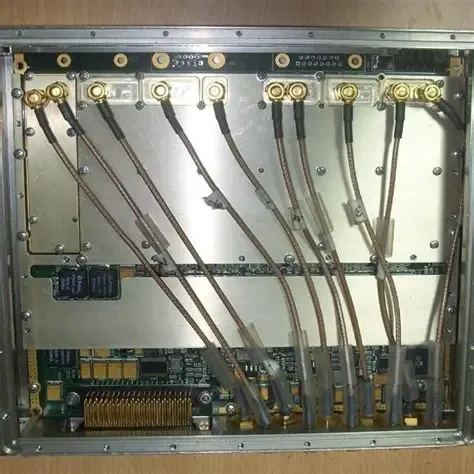
This figure shows an example of a planning worksheet or chart used to estimate total feeder loss from cable attenuation, connector losses, and mismatch effects. It likely includes fields for frequency, cable type, length, connector count, and resulting link margin, enabling engineers to compare options and avoid margin erosion.
Plan strain relief, clamp points, and minimum bend radius
Separate RF cables from noisy digital harnesses and power lines
Design test-friendly layouts
Integrating MMCX interfaces around an SMA RF cable
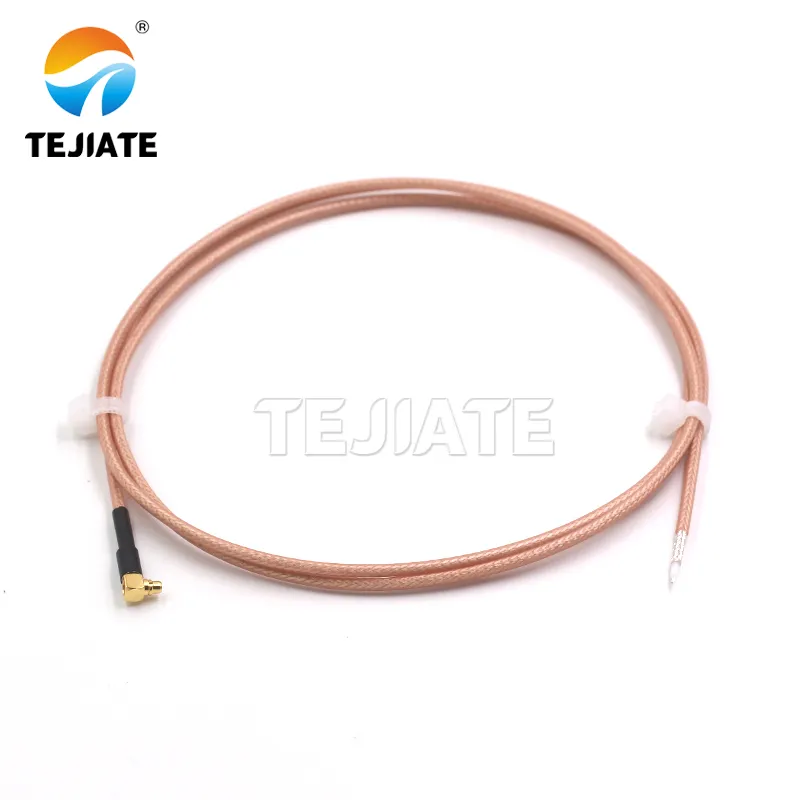
This image shows a typical assembly where a radio module uses an MMCX connector, which is then connected via a short MMCX jumper or an MMCX-to-SMA adapter to a panel-mounted SMA bulkhead. The arrangement protects the delicate MMCX interface from external handling while providing a robust SMA port for external connections.
When it makes sense to break out from MMCX to an SMA panel
MMCX works best when it stays internal. Short runs, minimal handling, no repeated torque. The moment an RF path needs to reach a panel, a test port, or anything that a technician might touch, MMCX stops being forgiving. Side loads, twisting during mating, or repeated cable swaps will eventually show up as intermittent loss or unstable return loss.
That’s why many teams choose to convert from MMCX to SMA early, while the cable is still inside the enclosure. The MMCX interface stays protected, and the outside world only sees a panel-mounted SMA that can tolerate repeated use. This approach rarely improves raw RF performance, but it dramatically improves predictability over time.
If you’ve dealt with modules that already expose MMCX, the practical layout and footprint tradeoffs are covered well in MMCX Connector Guide for RF Modules and Cables. The key takeaway is simple: treat MMCX as an internal interface, not a user-facing one.
Footprint choice and orientation matter more than expected
MMCX failures are often blamed on “connector quality,” but orientation is just as important. Vertical footprints transmit mating force straight into the board. Side-entry footprints consume more space but reduce axial stress when the cable moves. Neither option is universally correct, but pretending they are equivalent leads to fragile designs.
Engineers who consider how the cable will actually be installed — not just how it looks in CAD — tend to avoid this class of failure entirely.
The real cost of MMCX-to-SMA adapters
Adapters are convenient. They also accumulate quietly. Each MMCX-to-SMA adapter adds a small amount of loss and another impedance transition. In short internal paths, that may be acceptable. In longer or higher-frequency paths, it adds up faster than expected.
The bigger issue is not average loss but variability. Adapters increase sensitivity to handling and mating quality. If adapters remain in the final system, they should be treated as permanent RF elements and included explicitly in the loss budget, not left as “temporary” hardware that never quite goes away.
Specifying SMA RF cables for lab use versus production hardware
Why lab SMA RF cables are a different class of tool
Lab cables exist to protect measurement integrity. They’re designed for stable insertion loss, consistent phase behavior, and thousands of mating cycles. Cost and flexibility are secondary. When a cable drifts, your data drifts with it.
Using production-grade cables in the lab often leads to confusing results: measurements that change when the cable is touched, rotated, or reconnected. Nothing is “wrong,” but nothing is reliable either.
Why production SMA RF cables optimize for different priorities
Production cables don’t need to be perfect. They need to be repeatable, robust, and tolerant of real-world handling. Assembly variation, enclosure constraints, and environmental exposure matter more than absolute precision. A cable that survives installation and service without becoming a failure point is usually the right choice, even if it wouldn’t pass as a calibrated test lead.
Mixing these roles — lab cables in products or product cables in labs — almost always causes friction later.
Field replacement changes the specification
Trends that are quietly reshaping SMA RF cable decisions
Higher frequencies leave less room for casual cabling
Automotive, aerospace, and large-scale IoT deployments
SMA at the edge of its comfort zone
Practical FAQs engineers actually ask about SMA RF cables
How long can an SMA RF cable realistically be at 6 GHz?
Can different connector types be mixed in one RF path?
How often should lab SMA RF cables be replaced?
Can a 50-ohm SMA RF cable be used in a 75-ohm system?
How do you tell whether the cable or the antenna limits performance?
Final note
Bonfon Office Building, Longgang District, Shenzhen City, Guangdong Province, China

A China-based OEM/ODM RF communications supplier
Table of Contents
Owning your OEM/ODM/Private Label for Electronic Devices andComponents is now easier than ever.