
SMA Adapter Cable for RF Systems

Mar 20,2026

Diagram showing an SMA adapter cable appearing late in the design process to solve a connector mismatch

This figure illustrates a common scenario where an RF module with an SMA port needs to connect to a test instrument with a BNC port, or where a recessed panel connector requires a flexible transition. The SMA adapter cable is shown as a short flexible assembly bridging the two interfaces. The image emphasizes that once installed, this cable is no longer a simple adapter but a section of transmission line that affects loss, impedance continuity, and mechanical stress on the board-level connector.
SMA Adapter Cable in RF Workflows

A small connector mismatch usually shows up late.

The radio module is already selected. The enclosure drawing is almost finished. Someone on the bench connects the RF output to a test instrument and notices the ports don’t match. SMA on the device. BNC on the instrument. Or sometimes the port sits recessed behind a panel wall and the rigid adapter that “should work” simply doesn’t reach.

At that moment a sma adapter cable stops being a convenience accessory and becomes part of the RF signal path.

Once installed, it is no longer just a connector transition. It becomes a short section of transmission line. It introduces loss, absorbs mechanical stress, and quietly determines how much strain reaches the RF port on the device. In compact equipment—gateways, GNSS receivers, small radios—that flexible transition often ends up protecting the most fragile part of the system: the board-level connector.

Engineers sometimes treat that cable like a quick patch. Procurement teams often see it differently. For them it’s an assembly: connectors, coax, termination quality, and routing constraints all bundled into one small component that either behaves predictably for years—or causes intermittent problems nobody expects.

Map SMA adapter cable to real RF workflows

Connect radios, modules, panels, and test gear with one flexible transition

Diagram showing an SMA adapter cable as a flexible transition between a module and a panel connector

This figure depicts a typical RF path where a short SMA adapter cable connects a module on a PCB to a panel-mounted SMA bulkhead. The cable acts as a mechanical buffer, isolating the board-level connector from external forces such as vibration, cable pull, or repeated handling. Without this flexible section, the rigid connection would transfer all mechanical loads directly to the module’s connector. The image reinforces the role of the adapter cable as a protective element in the RF chain.
SMA Adapter Cable as a Flexible Transition

The phrase sma adapter cable can be misleading. It sounds like a specific cable type, but in practice it describes an assembly.

Inside that assembly sits a normal 50-ohm RF coaxial cable. What changes is the connector combination at each end.

One end might connect to a small module on a PCB.

The other end might terminate at a panel connector, a lab instrument, or a different connector ecosystem entirely.

In a typical RF path the sequence might look like this:

module → short coax assembly → panel connector → antenna feedline

That middle piece—the flexible transition—is where adapter cables usually live.

Without that flexibility, the connector on the module would have to absorb every mechanical load coming from the outside world. Routing stress, vibration, repeated reconnections, even enclosure movement would all transfer directly into the PCB mount. A short cable shifts that stress into the coax instead.

The concept itself is not new. It comes directly from the broader RF coaxial cable architecture, where signal transmission is handled by a controlled-impedance structure rather than a rigid metal interface. A short assembly simply applies that same principle inside smaller systems.

For readers unfamiliar with how coax behaves electrically, the basic structure is summarized well in the coaxial cable reference: center conductor, dielectric, shield, and jacket working together to maintain constant impedance along the signal path.

Adapter cables take that structure and combine it with connector transitions.

Treat SMA adapter cable as a cable assembly, not a rigid adapter

Side-by-side comparison of a rigid adapter and a flexible SMA adapter cable, showing mechanical differences

This image presents a visual comparison between a rigid SMA-to-BNC adapter (or similar) and a flexible SMA adapter cable. The rigid adapter is shown as a short metal body that creates a direct connection between two ports. The flexible cable is shown with a short section of coax between its connectors. The figure highlights how the rigid adapter transmits torque and bending forces to the port, while the cable assembly isolates the port from those forces, making it the preferred choice in applications with vibration, misalignment, or frequent handling.
Rigid Adapter vs. Flexible Cable

Rigid adapters and adapter cables often solve the same problem: converting one connector interface to another. Yet their roles inside a system are very different.

A rigid adapter behaves like a small mechanical bridge. Two connectors join directly with almost no length between them. This works well when both ports sit on the same axis and mechanical stress is minimal.

But the moment those conditions disappear, rigid parts start creating problems.

Imagine a board-mounted SMA connector sitting a few millimeters behind an enclosure wall. If a rigid adapter connects directly to that port, the entire cable harness outside the enclosure will pull on the PCB connector. Any vibration or cable movement transfers directly into the board.

A short adapter cable changes that dynamic.

The cable absorbs movement.

The connectors only see small rotational loads instead of constant bending force.

That distinction matters even more in field equipment. Portable radios, telemetry boxes, and industrial sensors often live in environments where connectors are handled repeatedly. The flexible section becomes a mechanical buffer.

From a procurement perspective this also changes how the part should be specified. A rigid adapter is mostly defined by connector geometry and plating. A cable assembly requires additional decisions: coax family, length tolerance, bend radius limits, and termination method.

Place SMA adapter cable inside the wider RF coaxial cable family

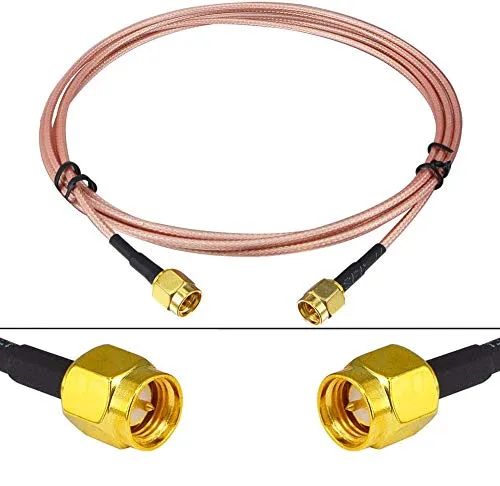
Product photo of a finished SMA adapter cable assembly with SMA connectors on both ends and flexible RG316 coaxial cable

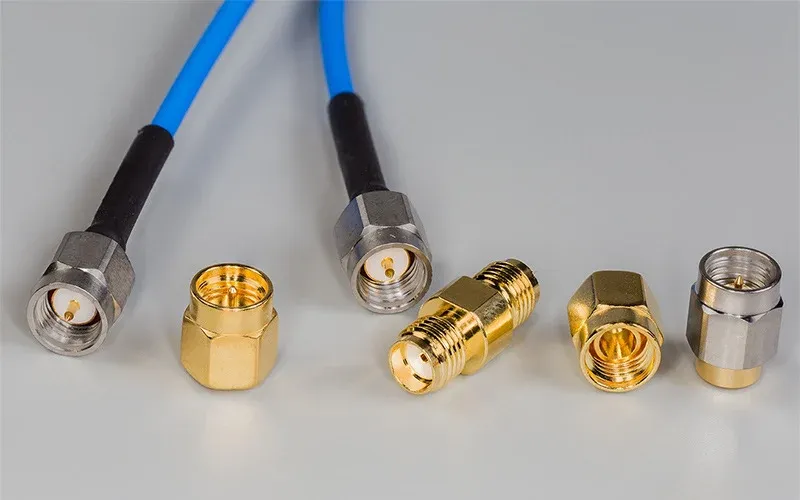
This product photograph shows a completed SMA adapter cable assembly. The cable features an SMA plug on each end (standard male/female configuration as required) and a flexible RG316 coaxial cable between them. The connectors are precision-machined with gold-plated center contacts and nickel-plated bodies for durability and consistent RF performance. The RG316 cable is visible with its characteristic small diameter (~2.5 mm) and flexible jacket, allowing easy routing in tight enclosures. This assembly is a typical example of a short internal jumper used to connect RF modules to panel connectors, test equipment, or antennas while maintaining 50-ohm impedance and providing strain relief. The image emphasizes the product as a complete, ready-to-install component rather than raw materials.
SMA Adapter Cable Assembly

Seen from a system perspective, an SMA adapter cable is simply a short RF coaxial cable assembly with different connectors on each end.

The coax inside the assembly still obeys the same rules as any RF feedline:

  • controlled impedance
  • frequency-dependent attenuation
  • minimum bend radius
  • shielding effectiveness

What changes is the scale.

Most adapter cables are relatively short—often under half a meter—and they are usually built with small-diameter coax families designed for tight spaces. One of the most common examples is RG316 coaxial cable, a PTFE-insulated 50-ohm cable roughly 2.5 mm in diameter used widely in compact RF equipment.

Because these assemblies are short, engineers sometimes ignore the coax choice entirely and focus only on the connectors. That shortcut works during early prototyping but can create problems later when frequency increases or cable routing becomes more complex.

The better approach is to treat the assembly exactly as you would treat a longer RF cable: start with the coax characteristics first, then choose the connectors that terminate it.

Choose cable instead of a rigid adapter when mechanical risk is real

Use cable when the ports are offset, recessed, or panel-separated

Mechanical alignment is the first place rigid adapters fail.

On paper, two connectors appear compatible. Both are SMA. Both are positioned on the same axis. The CAD model suggests the adapter should fit perfectly.

In the physical enclosure the situation looks different. The RF port sits slightly recessed. The panel cutout shifts the antenna connector a few millimeters sideways. Suddenly the rigid adapter cannot connect without forcing the ports together.

Installers sometimes solve this by tightening the adapter while slightly bending the cable path. The system powers on and everything appears fine.

Weeks later the module connector loosens or the solder joints on the board start showing stress.

A short adapter cable removes that alignment constraint entirely. The coax allows small offsets in position and angle, letting the connectors mate without forcing the mechanical structure.

Use cable when vibration, repeated handling, or field service is expected

Vibration exposes another weakness of rigid transitions.

Inside vehicles, industrial equipment, or portable radios, connectors rarely stay perfectly still. Small repetitive forces accumulate over time. A rigid adapter transmits those forces directly into both connectors.

The result is gradual mechanical fatigue.

The issue often appears as intermittent RF performance. The link still works, but return loss drifts slightly. Measurements become inconsistent between test sessions. Technicians blame the instrument, the cable harness, or even firmware timing before eventually discovering the connector pair moving slightly under vibration.

A flexible cable isolates those loads. Movement in the harness is absorbed along the coax rather than transferred into the connector threads.

This is one reason adapter cables show up frequently in small wireless hardware where board connectors—MMCX, u.FL, or compact SMA variants—cannot tolerate heavy mechanical stress.

Avoid adapter stacking when one short cable solves the whole transition

Another common field scenario involves stacking adapters.

A device exposes an SMA port.

The instrument uses BNC.

Someone grabs an SMA-to-BNC adapter.

Then another adapter is added to change orientation or gender.

Soon the signal path includes three or four rigid pieces in a row.

Electrically, each interface adds a small discontinuity. Mechanically, the stack behaves like a lever arm attached to the RF port. A single bump or cable pull can amplify stress on the device connector.

Replacing the entire stack with a short adapter cable removes several interfaces at once. The coax absorbs movement and the number of connector transitions drops.

The electrical difference may only be a few tenths of a decibel. But the mechanical reliability improves significantly.

Match the cable construction before you match the connector names

Start with RG316 coaxial cable for compact and heat-resistant assemblies

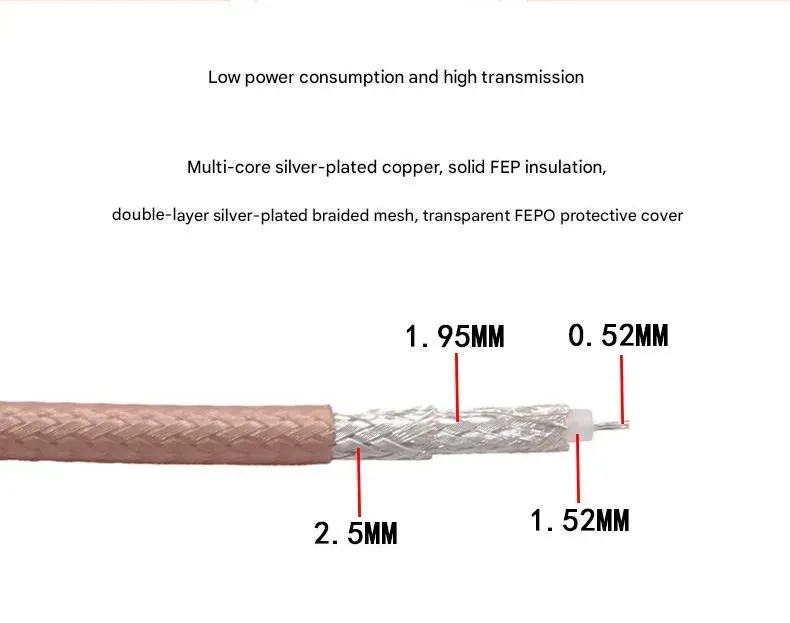
Cross-section diagram of RG316 coaxial cable showing center conductor, PTFE dielectric, braided shield, and FEP jacket

This figure provides a detailed cross-sectional view of an RG316 coaxial cable, illustrating its key layers: a silver-plated copper center conductor, a PTFE dielectric (providing thermal stability and controlled impedance), a braided shield (often silver-plated copper), and an FEP outer jacket. With an outer diameter of approximately 2.5 mm, RG316 balances flexibility with durability, making it the most common choice for short SMA adapter cables in compact RF devices where routing space is limited and temperature tolerance is required.
RG316 Coaxial Cable Construction

When engineers order a sma adapter cable, the connector combination usually gets attention first. SMA-to-SMA, SMA-to-BNC, or perhaps a miniature port on one side.

The coax inside the assembly is often assumed rather than specified.

In compact RF hardware that assumption frequently leads to RG316 coaxial cable. The cable’s PTFE dielectric and braided shield tolerate relatively high temperatures and tight routing spaces. With an outer diameter around 2.5 mm, it threads easily through dense enclosures and small cable harnesses.

Photograph or diagram of a completed SMA adapter cable using RG316 coaxial cable

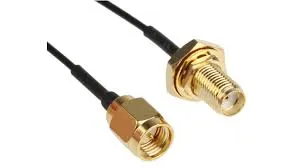
This figure likely shows a finished SMA adapter cable assembly, with an SMA connector on one end and another connector (SMA, BNC, or MMCX) on the other, and RG316 coaxial cable visible between them. It illustrates how the cable construction translates into a real component used in RF systems. The image reinforces that the coax choice (RG316) is as important as the connector selection, especially for short internal jumpers where routing flexibility and temperature tolerance are critical.
SMA Adapter Cable Built with RG316

Because of that combination—thin, flexible, heat-resistant—RG316 has become a common foundation for many short RF jumper assemblies.

TEJTE’s own RG316 coaxial cable guide covers typical construction and use cases in more detail, especially in compact systems such as GPS receivers, IoT gateways, and small wireless modules.

Yet the cable’s popularity sometimes hides its limitations.

Attenuation rises quickly as frequency increases. Over very short lengths that loss may not matter. Once cable runs approach tens of centimeters at higher frequencies, the difference between RG316 and thicker coax families becomes noticeable.

That is where the next design decision begins: staying with compact cable or moving toward lower-loss alternatives.

Move to thicker 50-ohm cable when loss or distance matters more

Short assemblies hide many electrical compromises.

A 10 cm jumper made from thin coax may introduce negligible loss even at several gigahertz. Extend that length toward half a meter or a meter and the numbers change quickly.

At that point the 50 ohm coaxial cable family offers many alternatives with lower attenuation and stronger shielding. The trade-off is physical size. Larger cables require wider bend radii and more installation space inside the enclosure.

Designers therefore face a practical compromise:

thin coax for routing flexibility

thicker coax for electrical margin

Neither option is universally better. The correct choice depends on frequency, allowable loss, and the available routing space inside the product.

This decision often appears late in development when prototypes begin to move from bench testing into real enclosures. A cable that seemed perfect during lab testing suddenly struggles to fit cleanly around mechanical structures.

Adapter cable selection is where those mechanical and electrical decisions finally meet.

Treat 50 ohm coaxial cable as the default baseline for RF assemblies

Nearly every RF connector ecosystem that involves SMA operates around a 50-ohm impedance environment. Radios, antennas, spectrum analyzers, and most microwave components assume that same baseline.

Because of that, the coax inside a sma adapter cable almost always belongs to the broader 50 ohm coaxial cable family.

This sounds straightforward, but sourcing sometimes introduces surprises. Cable assemblies may be ordered from general cable suppliers who also produce video harnesses, and those systems often use 75-ohm coax. The connectors look identical, the diameter may even appear similar, yet the impedance difference becomes visible once the cable enters an RF chain.

During low-frequency tests the system may appear normal. As frequency rises, the mismatch begins to affect return loss and measurement stability.

That is why many RF teams treat the coax specification as the first line in the assembly description, not the connectors. The connectors terminate the cable, but the cable determines how the signal behaves along the path.

Anyone reviewing coax fundamentals can see the structural reason for this in the basic coaxial cable architecture: the center conductor, dielectric, and shield geometry collectively establish the impedance. Once that geometry changes, the electrical behavior follows.

Verify the connector combination before you release the design

Confirm gender, polarity, and mounting role on both ends

Connector problems rarely come from misunderstanding SMA itself. They appear when two teams assume slightly different details.

An engineer writes “SMA connector” in the schematic.

Procurement orders a cable with SMA male connectors.

The module on the board actually exposes a female bulkhead port.

At that point the assembly no longer fits the hardware.

The safest practice is to document both ends of the cable assembly explicitly. A proper description normally includes:

connector gender

connector polarity

mounting style (panel, board, or cable termination)

orientation if a right-angle connector is required

These details seem small until the first shipment arrives and half the assemblies cannot be installed.

In large manufacturing programs this type of mismatch can delay production because cable harnesses often interact with multiple mechanical and electrical components simultaneously.

Separate straight and right-angle choices by stress, not appearance

Right-angle connectors are sometimes chosen because they make the cable routing look tidy. Inside a compact enclosure the cable exits sideways and follows the harness path neatly.

But visual symmetry is not the real reason these connectors exist.

The important factor is mechanical stress.

When a cable exits a connector and immediately bends downward or sideways, the coax experiences concentrated strain near the connector body. Over time that stress weakens the termination or damages the cable structure.

A right-angle connector moves the bend inside the connector housing where the geometry is controlled and reinforced.

The opposite scenario also exists. If the cable path continues straight away from the port, adding a right-angle connector may introduce unnecessary complexity. Straight connectors often produce cleaner mechanical routing when the cable path already aligns with the port.

In other words, orientation decisions should follow the cable path, not the visual layout of the enclosure.

Lock the connector pair before the cable length gets discussed

Length is often the first question asked during sourcing conversations.

“How long should the adapter cable be?”

That question matters, but it is rarely the first problem that needs solving.

More design issues originate from incorrect connector combinations than from incorrect cable length. A mismatched connector pair forces redesign of the cable assembly regardless of how carefully the length was specified.

Experienced RF teams therefore settle the connector pair first. Only after the two interfaces are confirmed does the conversation move to cable routing and physical length.

Once those details are fixed, the length becomes easier to determine.

Calculate loss before the assembly becomes the weakest link

Use attenuation-per-meter data for the chosen coax

Short coax assemblies often feel electrically invisible.

A small jumper connects a module to an antenna during early testing and the measurement looks clean. Engineers assume the cable contributes almost nothing to the signal path.

The assumption begins to break down as frequency rises.

Each coax type publishes attenuation data expressed as dB per meter. Even thin cables such as RG316 have measurable loss once frequencies move into several gigahertz. Over ten centimeters the effect may still be small, but once cable lengths increase the contribution becomes easier to detect.

Many adapter cables remain short enough that attenuation is not a major concern. The point is simply to verify the numbers rather than assuming the cable behaves like an ideal conductor.

Add transition loss for each connector interface

Cable attenuation describes only part of the signal path.

Every connector introduces a small transition between transmission line segments. That transition produces a minor insertion loss and sometimes a slight impedance discontinuity.

In a simple sma adapter cable with two connectors the effect remains modest. The more complicated the signal chain becomes, the more those transitions accumulate.

A signal path that includes several rigid adapters and cable assemblies can quietly lose a noticeable amount of margin even when each individual component looks harmless.

Reducing the number of interfaces often improves both electrical performance and mechanical reliability.

Set different length expectations for jumpers, patches, and external leads

RF cable assemblies perform different roles depending on where they appear in the system.

Some assemblies are extremely short internal jumpers connecting a module to a nearby panel connector. Others are longer patch cables used on laboratory benches. A third category consists of external leads running from equipment to antennas.

Treating all three categories the same leads to awkward design decisions.

Internal jumper assemblies prioritize flexibility and compact diameter so they can route through crowded enclosures. Patch cables often balance flexibility with durability because technicians handle them frequently. External leads usually focus on lower attenuation and environmental resistance.

Most sma adapter cable assemblies fall into the internal jumper category. Their job is not to carry RF signals across long distances. Their job is to connect two nearby ports while protecting those ports from mechanical stress.

Route SMA adapter cable like part of the enclosure, not part of the air

Protect the first bend near the connector body

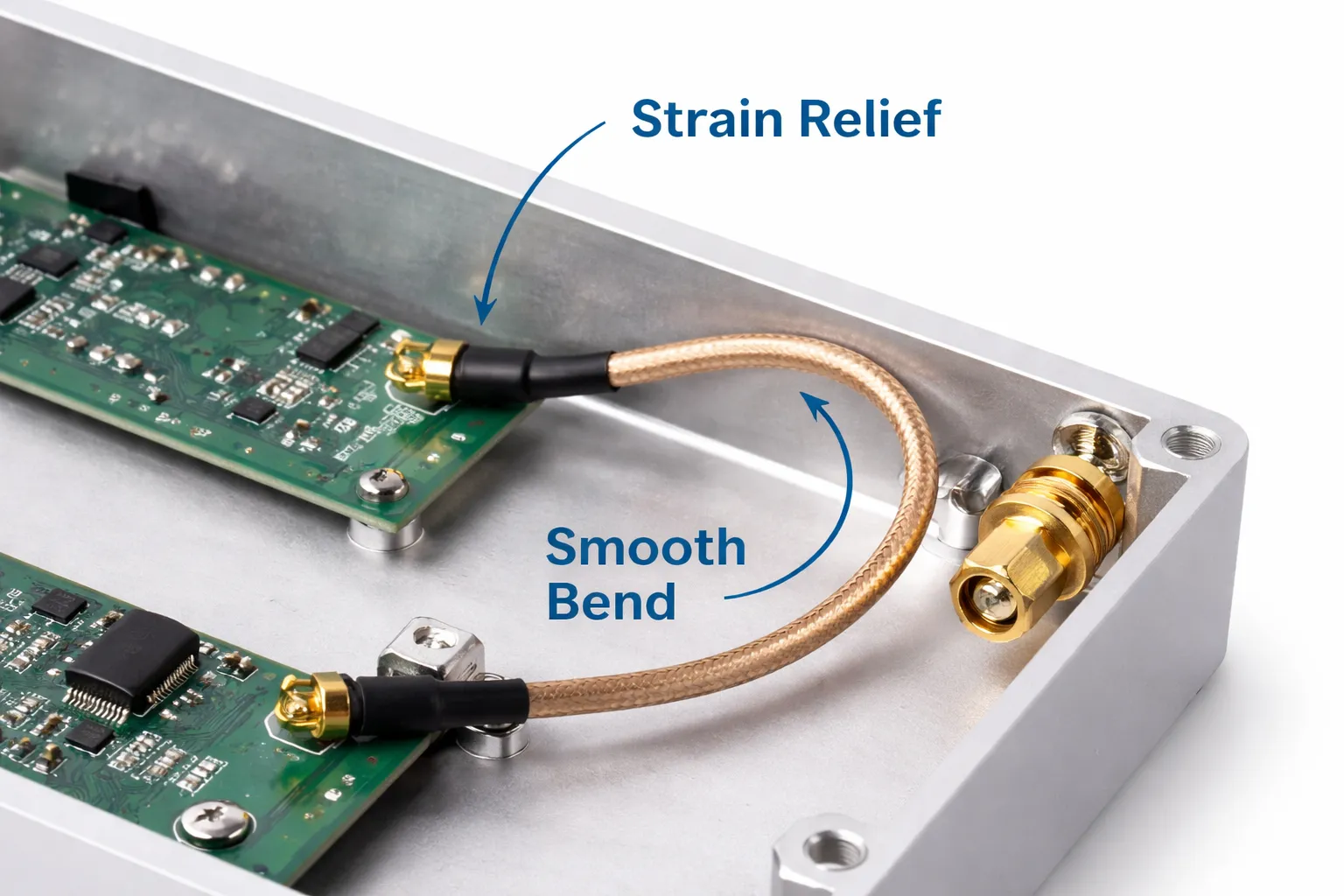
Diagram showing correct cable routing: a short straight section before the first bend to reduce stress near the connector

This figure illustrates a critical mechanical design detail for RF cable assemblies. It likely shows two scenarios: one where the cable bends sharply immediately at the connector body (incorrect), and another where a short straight section is maintained before the first bend (correct). The image highlights that the connector-to-cable transition is the most vulnerable point for fatigue and failure. By allowing a small straight run, the stress is distributed along the cable rather than concentrated at the termination, extending the assembly’s service life. This principle applies to all SMA adapter cables, especially those used in tight enclosures.

Protecting the First Bend Near the Connector

The weakest point in many cable assemblies sits right where the flexible coax meets the rigid connector.

If the cable bends sharply at that location, the internal conductors experience repeated mechanical strain. Over time the braid loosens or the center conductor fatigues.

Moving the first bend slightly away from the connector reduces that stress dramatically. Even a few millimeters of straight cable before the bend allows the load to distribute along the coax rather than concentrating at the termination.

This detail rarely appears in drawings, yet it strongly influences long-term reliability.

Keep the cable away from sharp edges, hot zones, and moving harnesses

Environmental conditions inside the enclosure can also damage RF cable assemblies.

Sharp metal edges gradually wear through cable jackets.

Heat from nearby components accelerates dielectric aging.

Moving wire bundles rub against the coax shielding.

None of these problems appear during initial testing. They develop slowly once the device begins operating in real conditions.

Routing decisions made during enclosure design therefore affect how long the adapter cable survives in service.

Move strain to clips, bulkheads, and the enclosure wall

Board-mounted RF connectors rarely tolerate significant mechanical load. Their primary job is electrical contact, not structural support.

Allowing a cable harness to pull on that connector transfers force directly into the PCB solder joints. Even small loads repeated over time can loosen the connector or crack the solder interface.

Strain relief features solve the problem by moving that load somewhere else. Clips, tie-points, or bulkhead mounts allow the enclosure structure to carry the cable tension instead of the connector itself.

When the cable is anchored properly, the connector effectively becomes an electrical interface rather than a structural anchor.

Use application cases to choose the right SMA adapter cable

Use MMCX to SMA cable for miniature board transitions

Small RF modules frequently use compact connectors such as MMCX. These connectors conserve board space but do not handle repeated external connections particularly well.

A short mmcx to sma cable bridges that gap.

The MMCX end attaches directly to the module. The SMA end connects to a panel port or an antenna feedline that users can handle more comfortably. The coax between them absorbs mechanical stress that would otherwise reach the board connector.

This configuration appears often in compact wireless hardware where antennas must connect outside the enclosure while the RF module remains protected inside.

Use SMA to BNC cable when test gear and RF devices use different connector families

Photograph of an SMA to BNC cable assembly, commonly used to connect modern SMA devices to legacy BNC test equipment

This image shows a short SMA to BNC cable assembly, typically built with RG316 coaxial cable. One end has an SMA plug (for connection to compact radios or modules), and the other has a BNC plug (for connection to oscilloscopes, signal generators, or spectrum analyzers). Such assemblies are common in RF labs where equipment from different eras must coexist. The flexible cable section absorbs mechanical stress that would otherwise transfer to the instrument ports, making it preferable to stacking rigid adapters. This figure is a practical example of how SMA adapter cables solve connector mismatches in mixed-interface environments.

SMA to BNC Cable for Mixed-Connector Test Setups

Another common transition appears in laboratories.

Modern RF modules frequently expose SMA ports, while older test instruments still rely on BNC connectors. Connecting the two ecosystems usually requires either a rigid adapter or a short cable assembly.

A sma to bnc cable solves the problem without stacking multiple rigid adapters.

In bench environments the difference may appear small. Yet once multiple cables and instruments connect to the same device, the flexibility of a cable assembly often reduces mechanical stress on the instrument ports.

Practical examples of these transitions appear in TEJTE’s SMA to BNC cable guide, which shows how such assemblies appear in mixed-connector test setups.

Use rigid adapters only when alignment is clean and stress is minimal

Rigid adapters remain useful when the mechanical conditions allow them.

If two ports align cleanly and the cable harness does not pull on the connection, a rigid adapter can provide a compact transition with minimal additional cable length.

Calibration fixtures and stationary laboratory equipment often use this approach successfully.

The key is recognizing when the surrounding mechanical environment supports it. In portable or vibration-prone systems, the flexibility of a cable assembly usually protects the connectors far better.

Build an assembly selection sheet before procurement starts

Small RF cable assemblies look simple, but they hide several decisions inside one part number: coax type, connector combination, length tolerance, and routing constraints. If those details stay informal, procurement usually ends up guessing.

A structured selection sheet forces those parameters to appear in one place before orders are released.

Define the fields and formulas

A practical SMA adapter cable selection sheet does not need to be complicated. Most teams only track a small group of technical and mechanical variables.

Typical fields might include:

Use_case

Module jumper / Panel transition / Test lead / Rack patch

Connector_A

SMA / RP-SMA / Bulkhead SMA

Connector_B

SMA / BNC / MMCX / other interface

System_impedance

50 Ω

Coax_family

RG316 / other 50-ohm coax

Length_m

Attenuation_dB_per_m

Cable_loss_dB

Length_m × Attenuation_dB_per_m

Connector_count

Connector_loss_dB

Connector_count × 0.15

Total_loss_dB

Cable_loss_dB + Connector_loss_dB

Allowed_loss_dB

Margin_dB

Allowed_loss_dB − Total_loss_dB

Min_bend_radius_mm

Planned_bend_radius_mm

Bend_margin_mm

Planned_bend_radius_mm − Min_bend_radius_mm

Serviceability_score (1–5)

Strain_risk (Low / Medium / High)

Cost_score (1–5)

Overall_score

A simple weighted score can help compare multiple options:

Overall_score =

0.4 × Margin_score

  • 0.3 × Strain_score
  • 0.2 × Serviceability_score
  • 0.1 × Cost_score

This type of sheet does not replace engineering judgement. It simply makes the assumptions visible so different teams evaluate the same assembly using the same criteria.

Walk through one module-to-panel example

Consider a small wireless module installed inside an enclosure.

The module exposes an MMCX port on the PCB.

The antenna mounts on an SMA bulkhead connector on the panel.

The mechanical distance between those two points is roughly 120 mm.

A typical assembly decision might look like this:

Use_case: Module jumper

Connector_A: MMCX plug

Connector_B: SMA bulkhead female

System_impedance: 50 Ω

Coax_family: RG316

Length: 0.15 m

If RG316 attenuation at the operating frequency is estimated around 1.5 dB/m, the cable portion contributes roughly:

0.15 × 1.5 = 0.225 dB

Two connector transitions add roughly another 0.3 dB combined.

Total estimated loss: about 0.5 dB.

In most RF systems that margin remains acceptable. The coax remains thin enough to route easily inside the enclosure, and the short length keeps attenuation low.

If the design later requires a longer cable path—perhaps 0.6 m instead of 0.15 m—the calculation quickly changes. Loss approaches 1.2 dB, and the design team might begin evaluating thicker coax alternatives.

The sheet therefore becomes a quick comparison tool rather than a rigid rulebook.

Convert the sheet into an incoming inspection checklist

Once the assembly specification exists, it can also guide incoming inspection.

Quality teams typically verify a few straightforward points:

connector type and orientation

cable length tolerance

visual termination quality

jacket condition

basic continuity

For higher-frequency systems some teams also measure insertion loss using a network analyzer, especially if the cable assembly forms a critical part of the RF chain.

Using the same parameters defined during selection makes inspection more predictable. Instead of vague acceptance criteria, the quality team knows exactly what the assembly was designed to achieve.

Track the shifts affecting SMA cable assemblies now

Follow RF interconnect market growth through 2030

The role of small RF cable assemblies continues to expand as wireless hardware spreads into more devices.

Industry analysis from Grand View Research estimates that the global RF interconnect market could grow from roughly $33 billion in 2024 to more than $50 billion by 2030. The category includes connectors, cable assemblies, and related RF components used in communications, automotive electronics, aerospace systems, and industrial equipment.

The implication is fairly simple: small RF assemblies—like the sma adapter cable discussed here—are becoming more common as wireless connectivity spreads into smaller and more diverse devices.

Growth does not necessarily mean every cable becomes more complex. It does mean that connector transitions and cable assemblies appear in more environments than traditional telecom infrastructure.

Watch PFAS-free SMA launches as an early materials signal

Material compliance has started to influence RF connector design as well.

Several manufacturers have introduced PFAS-free SMA connectors and adapters, signaling a shift toward alternative materials in RF interconnect products. The technical behavior of the connectors remains similar, but the change reflects regulatory pressure affecting many electronic materials.

For cable assemblies this shift may eventually influence dielectric materials, plating choices, or connector manufacturing processes.

Most current RF systems will not see immediate performance differences. However, procurement teams tracking long-term supply chains may notice new connector variants appearing in product catalogs.

Assembly strategy matters more as frequencies climb

Connector dimensions continue shrinking while operating frequencies climb higher. The combination creates a subtle design pressure.

Higher frequencies reduce tolerance for impedance discontinuities. Smaller connectors reduce tolerance for mechanical stress. The cable assembly sitting between them therefore becomes more important.

A poorly routed cable might still pass basic continuity tests, yet its mechanical stress can degrade the connector interface over time. Likewise, a poorly chosen coax type may introduce more attenuation than expected once the system moves beyond low-GHz frequencies.

The cable assembly itself becomes a design component rather than just a passive accessory.

Answer common SMA adapter cable questions

When should I use an SMA adapter cable instead of a rigid adapter?

Use a cable assembly when the connectors are not perfectly aligned or when the cable harness may apply mechanical force to the connection. The flexible coax absorbs stress that would otherwise reach the RF port.

Rigid adapters work best when both connectors remain stationary and aligned.

What coax is most common inside SMA adapter cable assemblies?

Thin RG316 coaxial cable appears frequently in compact RF jumper assemblies. Its small diameter and PTFE dielectric allow routing through tight enclosures while tolerating moderate temperature environments.

Other coax families appear when lower attenuation or higher power handling becomes necessary.

How long can an SMA adapter cable be before loss becomes noticeable?

The answer depends on frequency and coax type.

For thin coax such as RG316, very short lengths—tens of centimeters—usually introduce only modest attenuation. As cable length approaches a meter or operating frequencies rise into several gigahertz, attenuation becomes more noticeable.

Engineers normally estimate loss using the coax attenuation data from the manufacturer and combine it with connector transition losses.

When is RG316 a better choice than thicker coax in adapter cables?

RG316 becomes attractive when the assembly must route through confined mechanical spaces or tolerate higher temperatures.

Its small diameter allows tight routing paths inside equipment where thicker cables would be difficult to install. For short jumper lengths the attenuation penalty usually remains acceptable.

How do I reduce strain on board-level RF connectors?

The simplest method is to move mechanical loads away from the connector.

Short cable assemblies, strain-relief clips, and bulkhead connectors allow the enclosure structure to absorb cable tension instead of the PCB connector. Avoid routing cables so tightly that the first bend occurs directly at the connector body.

Should I solve the transition with one cable or several adapters?

In most situations one properly specified cable assembly performs better than several stacked rigid adapters.

Each adapter adds another mechanical interface and another small electrical transition. A single sma adapter cable often simplifies the signal path while reducing mechanical stress on the device connector.

Bonfon Office Building, Longgang District, Shenzhen City, Guangdong Province, China

customer service