
RG316 Cable Selection & Buying Guide
Mar 06,2026
This image shows a typical RG316 coaxial cable, likely with a portion of the jacket removed to reveal the inner conductor, dielectric, and braid. It represents the cable that engineers often treat as a passive component but which plays a critical role in short, controlled RF transitions. Its flexibility and heat resistance make it ideal for routing inside compact enclosures.
Where does RG316 cable belong in RF systems?
Before discussing specs, it helps to anchor expectations. RG316 is not a backbone feedline. It is not a rooftop cable. It is not meant to carry RF several meters without consequence. It excels in short, controlled runs where routing flexibility matters more than ultra-low loss. You’ll typically see rg316 cable between RF modules and panel connectors, inside enclosures, in lab test harnesses, or as part of compact adapter assemblies. In other words, it’s a bridge—often a short one.
If you zoom out and compare coax families across different diameters and loss classes, the positioning becomes clearer. In our broader breakdown of RF interconnect families in the RF Coaxial Cable Selection and Application Guide, miniature cables like RG316 sit firmly in the “internal jumper” category rather than long-haul transmission. That context matters because many procurement errors start with unrealistic expectations about distance and attenuation.
Another point that cannot be glossed over: RG316 is a 50 ohm coaxial cable. That sounds obvious, but impedance mistakes still happen. Most RF modules, SMA ports, MMCX interfaces, and N-type connectors operate in 50Ω systems. Mixing a 75Ω television-style coax into a 50Ω RF chain may still produce a working signal, but return loss degrades and reflections increase. The system may pass a basic power-on test yet quietly lose margin. In RF design, impedance consistency is not optional.
There’s also a practical purchasing distinction that engineers sometimes underestimate: buying bulk rg316 cable is not the same as buying finished rf coaxial cable assemblies. Bulk cable procurement focuses on material construction—center conductor type, dielectric composition, shield braid coverage, jacket rating. Finished assemblies introduce another layer of risk: connector quality, crimp height accuracy, solder discipline, pull strength, and return loss stability. In fact, many field failures attributed to “bad cable” are actually termination inconsistencies. If you are sourcing SMA jumpers or transition leads, the assembly process matters as much as the cable spool itself. Our discussion on standardized jumper practices in the SMA Adapter Cable Selection & Routing Guide expands on this idea, particularly for short RG316-based interconnects.
How do you avoid buying the wrong RG316 cable variant?
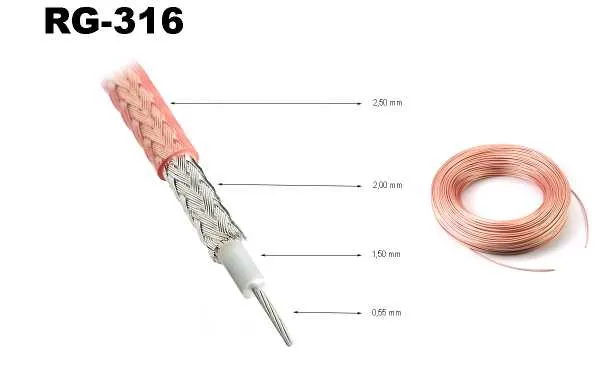
This figure illustrates the internal structure of an RG316 coaxial cable. From center to outer layer: a silver-plated copper-clad steel center conductor, a PTFE dielectric (providing thermal stability and low loss), a braided shield (often silver-plated copper for conductivity), and an FEP outer jacket (offering chemical and thermal resistance). Understanding this construction helps buyers verify specifications and avoid substitutes with lower braid density or different materials.
The phrase “RG316” suggests uniformity. In reality, construction can vary subtly between suppliers. Electrically, many variants will look similar at first glance. Mechanically, they may not behave the same under stress or heat. A typical RG316 structure includes a silver-plated copper-clad steel center conductor, a PTFE dielectric, a silver-plated copper braid shield, and an FEP outer jacket. PTFE provides temperature tolerance. Silver plating improves conductivity and corrosion resistance. FEP supports thermal and chemical stability. When any of those layers change, long-term performance can shift.
From experience, lower-cost substitutes sometimes reduce braid density or plating thickness. The cable may pass a quick continuity check and even a short bench measurement. Months later, vibration or thermal cycling exposes weaknesses. That is why datasheet validation is not a formality. Ask for conductor material, dielectric type, shield coverage percentage, outer diameter tolerance, and rated temperature range. If documentation is vague, pause before issuing a purchase order.
Temperature rating deserves particular attention. Many higher-grade variants align with the military designation M17/113-RG316 and support temperature ranges near -55°C to +200°C. Not every project requires formal military equivalence, but if your equipment operates in an automotive engine bay, an outdoor enclosure, or near power electronics, thermal headroom matters. It’s one thing to run a lab jumper at room temperature. It’s another to install the same construction next to a heat source and expect identical behavior. If temperature exposure is part of your real operating environment, make that requirement explicit in the specification.
At this stage, some buyers ask whether formal labeling such as “RG316/U” or documented equivalence is mandatory. The answer depends on risk tolerance. Aerospace, defense, and regulated sectors typically require traceability and documented compliance. Industrial IoT or internal test systems may rely more heavily on measured electrical performance and lot sampling. The key is alignment between documentation rigor and application risk. Overspecifying wastes budget; underspecifying increases downstream liability.
Which RG316 cable should you pick for your frequency and length?
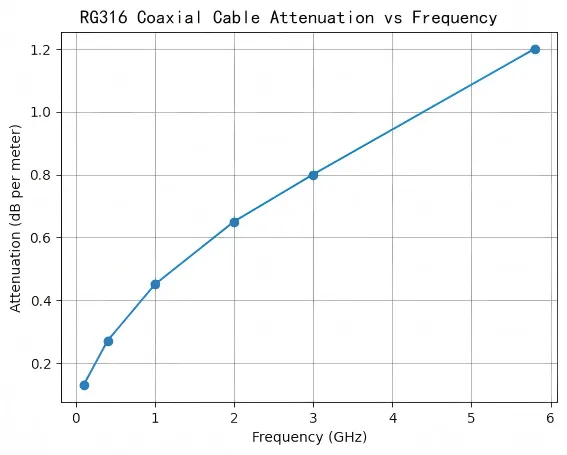
This chart or graph illustrates the typical attenuation per meter of RG316 coaxial cable across common RF bands (e.g., 1 GHz, 2.4 GHz, 5.8 GHz). It highlights that while RG316 is usable up to several GHz, loss rises steeply at higher frequencies. The data reinforces the need to calculate exact loss at the operating frequency rather than assuming a short jumper is negligible.
Frequency and length are inseparable in RF purchasing decisions. A half-meter jumper behaves very differently from a two-meter run at the same band. Every reputable supplier publishes attenuation data in dB per meter or dB per foot at defined frequencies. Use those numbers rather than assuming “short enough” is always safe. Suppose a datasheet lists 0.6 dB per meter at 2.4 GHz. A 0.5 meter assembly introduces roughly 0.3 dB of cable loss. Add two connector transitions—often around 0.1 to 0.2 dB each under typical conditions—and the total path impact can approach 0.6 dB. In a WiFi link with comfortable margin, that may be acceptable. In a system already operating close to sensitivity limits, that difference is noticeable.
Suppliers frequently advertise RG316 as usable “up to 3 GHz.” That phrase needs interpretation. Usable does not mean optimal, and maximum frequency does not guarantee low loss at the upper edge. If your system operates at 2.4 GHz, 3 GHz radar bands, or 5.8 GHz ISM frequencies, request attenuation data at your exact operating band. The closer you operate to the cable’s upper comfort zone, the more important real measurement becomes. Marketing ranges are broad; engineering tolerances are not.
There is also a point where RG316 should simply not be the chosen solution. If the planned run exceeds roughly one to two meters, or if your link budget is already constrained, consider stepping up to a thicker 50Ω coaxial family. RG316 was designed for compact routing, not long-distance efficiency. In our overview of different 50Ω options in the 50 Ohm Coaxial Cable Selection and Application Guide, you can see how miniature coax compares against larger-diameter alternatives in terms of attenuation and mechanical robustness. Flexibility is RG316’s advantage. Low-loss transmission over extended length is not.
In short, choose rg316 cable deliberately. Confirm its construction, verify its temperature rating, calculate its attenuation at your actual band, and ensure the application fits its design strengths. When it’s used where it belongs—short, controlled transitions inside 50Ω systems—it performs predictably. When it’s stretched beyond that role, it quietly erodes performance without obvious warning signs.
How do you build reliable assemblies from RG316 cable?
A spool of rg316 cable rarely fails by itself. Problems appear at the ends. Terminations, transitions, and strain relief determine whether a short jumper survives vibration and thermal cycling or becomes a service ticket waiting to happen.
In compact RF systems, especially those using SMA or MMCX interfaces, assembly discipline matters more than many teams expect.
Choose crimp vs solder based on repeatability
Both crimp and solder terminations are used with RG316. Neither is automatically superior. The real question is repeatability.
Crimp processes, when properly tooled and calibrated, produce consistent mechanical compression and electrical contact. Strip dimensions are controlled, crimp height is measurable, and production variance can be audited. In medium-to-high volume builds, crimping usually wins for consistency.
Solder termination allows flexibility in prototyping and repair. It also introduces risk. PTFE dielectric tolerates heat better than many plastics, but excessive dwell time can deform layers, change impedance geometry, or wick solder into the braid unintentionally. A cable that passes continuity after soldering may still exhibit degraded return loss because geometry shifted during heating.
From experience, most intermittent failures in short rf coaxial cable assemblies trace back to one of three issues: improper strip length, damaged braid during preparation, or incorrect crimp height. These are not exotic problems. They are process-control problems.
If your team is building RG316-based jumpers in-house, document strip dimensions and inspect crimp profiles. Treat the assembly as a controlled component, not a commodity.
Use RG316 to standardize sma adapter cable templates
In many systems, RG316 ends up forming the backbone of short sma adapter cable assemblies. You’ll see SMA-to-SMA jumpers, SMA-to-BNC transitions, and SMA-to-N leads built on RG316 because of its flexibility and compact size.
Without standardization, SKU chaos follows quickly. Different lengths get ordered ad hoc. Connector genders vary. Orientation (straight vs right-angle) becomes inconsistent. Service technicians then carry unnecessary inventory because nothing matches.
A simple discipline helps: define a small set of standard lengths and connector pairings. For example, 100 mm, 200 mm, and 500 mm internal jumpers. Clearly specify connector plating, torque values, and acceptable return loss. Once standardized, purchasing becomes cleaner and incoming inspection more predictable.
If your system includes SMA-to-N transitions, it is also worth reviewing structural decision rules discussed in the SMA to N Cable Selection Guide. The cable choice often interacts with connector architecture in subtle ways.
Connect miniature ports via mmcx to sma cable before handing off to RG316
This photograph shows a short MMCX to SMA cable assembly made with RG316 coaxial cable. One end features a compact MMCX plug for board-level connection, the other a standard SMA plug for panel mounting. Such pigtails are used to isolate the module's MMCX port from enclosure stresses, transferring load to the panel connector. The RG316 section provides flexibility and maintains 50-ohm integrity.
Many RF modules expose MMCX connectors on the PCB. MMCX is compact and convenient, but mechanically delicate. Directly attaching a long RG316 jumper to a board-mounted MMCX jack invites strain-related failure.
A more robust approach looks like this: PCB MMCX → short mmcx to sma cable pigtail → panel-mounted SMA → internal RG316 jumper. The short MMCX pigtail absorbs board-level tolerances. The panel connector handles mechanical load. The RG316 jumper then performs flexible routing inside the enclosure.
This layered approach may seem excessive in early prototypes. In production hardware—especially anything exposed to vibration—it significantly reduces connector fatigue.
For background on why mechanical interface stability affects RF performance, the overview of connector behavior on the SMA connector page provides useful structural context. Electrical continuity alone does not guarantee long-term reliability.
How should you route RG316 cable inside enclosures and racks?
Respect bend radius and protect the first 20 mm
RG316 is flexible, but flexibility does not mean immunity to stress. Sharp bends near connectors distort geometry and concentrate mechanical load. The first 15–20 mm from the connector body is the most vulnerable region. That is where braid transition and crimp termination meet.
Avoid tight angles immediately at the connector. Use gradual curves. If possible, secure the cable with a strain-relief clamp a short distance away from the termination. Let the clamp carry mechanical load rather than the connector joint itself.
Repeated flexing near the termination gradually alters impedance consistency. At microwave frequencies, even subtle geometry shifts affect return loss.
Keep RF cable away from heat and switching noise
PTFE dielectric supports high temperature ratings, but the outer jacket and braid still age under sustained thermal exposure. Continuous proximity to DC/DC converters, motor wiring, or hot heat sinks accelerates degradation.
Electrical noise is another factor. While coaxial construction inherently shields signals, running an rf coaxial cable parallel to high-current switching lines is unnecessary risk. Cross at right angles when possible. Maintain physical separation. Good routing discipline costs nothing during design and saves debugging hours later.
For a refresher on how shielding and geometry protect signal integrity, the general explanation under Coaxial cable provides a clear conceptual overview without getting lost in excessive theory.
Use bulkhead transitions to shift mechanical load
If an SMA or N-type connector sits on a PCB, that PCB should not be absorbing cable weight or vibration. Whenever possible, use bulkhead connectors mounted to the enclosure wall. Let the chassis handle torque and pull forces.
In vehicle or outdoor systems, this principle becomes even more important. Vibrational stress accumulates. A board-mounted connector might survive initial testing but loosen over time. By shifting the transition to a bulkhead, you separate mechanical stress from delicate PCB solder joints.
This design rule pairs naturally with the “SMA inside, N outside” architecture many teams adopt in mixed environments.
When should you use RG316 in SMA-to-N systems?
Use RG316 for short sma to n cable transitions, not long outdoor feeders
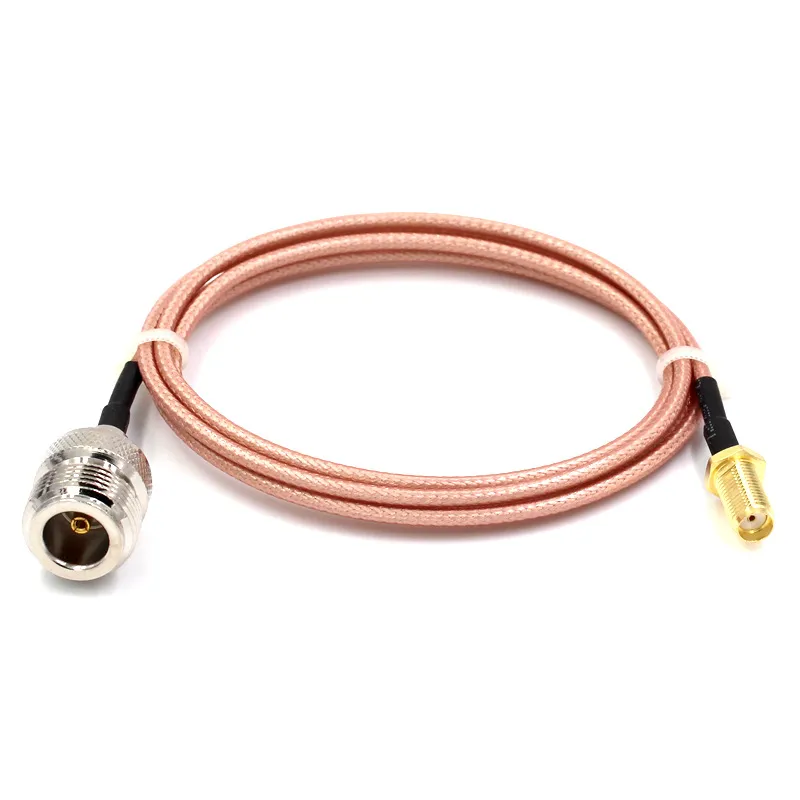
This image depicts a finished SMA to N cable assembly based on RG316 coaxial cable. The SMA connector (male or female) is on one end, and the N-type connector (male or female) on the other. The flexible RG316 section allows it to absorb misalignment, vibration, and routing constraints, making it suitable for internal transitions in mixed SMA/N environments. It is not intended for long outdoor runs, but rather as a short jumper inside enclosures or between equipment and bulkheads.
A common architecture looks like this: device-side SMA → short RG316-based sma to n cable → panel-mounted N bulkhead → outdoor low-loss feedline. In this arrangement, RG316 provides flexible internal routing while the N connector handles outdoor exposure.
What you should not do is run several meters of RG316 directly outdoors simply because it already terminates in the correct connectors. Loss increases, environmental durability decreases, and service life shortens.
Short internal transitions are where RG316 shines. Long feeder runs belong to thicker 50Ω coax families.
Choose between sma to n adapter and cable based on mechanical risk
If two ports align perfectly and remain static, a rigid sma to n adapter may suffice. It keeps the transition compact and reduces part count.
But if there is any misalignment, vibration, or tension, a short cable is safer. A flexible assembly absorbs stress and prevents torque transfer into connector threads. In vibration-prone systems, rigid adapters can gradually loosen or stress solder joints.
There is also a third case: structural design. When building enclosure ports, sometimes you need a dedicated sma to n connector solution integrated into the panel itself. That decision belongs at the mechanical design stage, not during late procurement.
If your project involves multiple transition points, reviewing transition best practices in the SMA to N Adapter Selection Guide helps clarify when rigidity helps and when flexibility prevents failure.
Standardize “SMA inside, N outside” architecture
Over time, many teams converge on a simple rule: use SMA connectors inside compact equipment and N-type connectors at the enclosure boundary or outdoors. SMA remains compact and easy to service. N-type provides better environmental robustness and higher power handling.
RG316 often becomes the short, flexible bridge between those domains.
Standardization reduces design drift. Once your organization adopts consistent transition logic, purchasing decisions become straightforward instead of reactive.
Can an acceptance matrix stop bad RG316 cable from entering production?
It can, if it forces numbers onto the table. Most procurement mistakes are not dramatic. They are incremental. A slightly higher loss here. A slightly lower braid density there. Over time, small inconsistencies accumulate and show up as unstable performance.
An incoming inspection matrix creates discipline. Instead of relying on supplier claims, you convert specifications into measurable thresholds.
RG316 Cable Selection & Incoming Inspection Matrix
| Field | Purpose |
|---|---|
| Supplier | Traceability |
| Part Number | Variant control |
| Spec Claim | M17/113 equivalent or not |
| Impedance (Ω) | Must equal 50 |
| Conductor Material | SCCS / SPC verification |
| Dielectric | PTFE confirmation |
| Shield Coverage (%) | Compare to datasheet |
| Jacket Material | FEP or equivalent |
| Temp Range (°C) | Verify rating |
| Band (GHz) | Actual operating band |
| Length (m) | Planned assembly length |
| Loss (dB/m) | Vendor data at frequency |
| Cable Loss (dB) | Loss × Length |
| Connector Count | Including transitions |
| Transition Loss (dB) | Connector Count × 0.15 |
| Total Loss (dB) | Cable Loss + Transition Loss |
| Allowed Loss (dB) | System budget |
| Margin (dB) | Allowed − Total |
| Visual Inspection | Jacket, braid integrity |
| Continuity Test | Open/short check |
| Sample Return Loss | Random verification |
| Pass/Fail | Margin ≥ 0 and inspections pass |
Core formula:
Total_loss_dB = (Loss_dB_per_m × Length_m) + (Connector_count × 0.15)
The 0.15 dB transition estimate reflects typical connector contribution under normal RF conditions. Adjust if your lab data shows otherwise.
The matrix forces a simple question: does the cable fit the system budget, or are you quietly losing margin?
Walkthrough example: purchasing RG316 for SMA jumper production
Suppose you are buying bulk rg316 cable to produce 0.5 meter sma adapter cable assemblies operating at 2.4 GHz.
Vendor loss spec: 0.6 dB/m
Length: 0.5 m
Cable loss = 0.3 dB
Connector count: 2
Transition loss = 0.3 dB
Total loss = 0.6 dB
If your system budget allows 1.0 dB for that segment, margin equals 0.4 dB. Acceptable.
If instead you were running 1.5 meters, cable loss becomes 0.9 dB. Add connector transitions and you exceed 1.2 dB total. The same cable suddenly becomes unsuitable.
This is why length cannot be separated from specification. It is common to approve a cable type without rechecking loss once assembly length changes. That oversight alone has caused measurable RF instability in real deployments.
Turn the matrix into a supplier scorecard
The matrix should not be a one-time checklist. Over multiple purchase cycles, track:
- Variation in measured return loss
- Visual defect frequency
- Crimp failure rates
- Lot-to-lot attenuation variance
After several batches, patterns emerge. Some suppliers remain stable. Others drift.
Procurement decisions should eventually reflect measured consistency, not just price per meter.
What regulatory and industry trends should buyers watch?
PFAS and PTFE material pressure
PTFE dielectric, commonly used in RG316 construction, falls under the broader chemical category of PFAS (per- and polyfluoroalkyl substances). Regulatory attention on PFAS has increased in the United States and Europe. While PTFE remains widely used in RF applications due to its excellent dielectric stability, compliance documentation is becoming more relevant in certain sectors.
Procurement teams should begin asking suppliers about material declarations and long-term compliance roadmaps. Changes in dielectric material can affect electrical stability, especially at higher frequencies.
Continued demand for compact RF assemblies
Market growth in wireless systems continues to support demand for compact interconnect solutions. Miniature coax such as RG316 remains common in internal routing, adapter assemblies, and modular equipment. As devices shrink and RF density increases, flexible short-run coax maintains relevance.
The lesson for procurement is simple: RG316 is not disappearing, but specification discipline will matter more as frequency bands expand and regulatory scrutiny increases.
Answer common RG316 cable buying questions
How do I verify an RG316 cable specification before buying?
How long can RG316 run at 2.4 GHz or 5.8 GHz before loss becomes a problem?
When should I choose rg316 coaxial cable instead of thicker 50Ω coax?
What are the most common assembly defects in RG316-based cables?
Should I use a rigid adapter or a flexible cable for SMA-to-N transitions?
Can MMCX to SMA pigtails be built reliably on RG316?
Final Perspective
The rg316 cable is small in diameter and modest in cost. That combination often leads teams to treat it casually. Yet in a tightly balanced RF system, even half a decibel matters. Impedance consistency matters. Mechanical stability matters.
Procurement discipline is not about overengineering. It is about clarity. Confirm construction. Calculate loss. Control assembly processes. Standardize transition architecture. Track supplier consistency over time.
When RG316 is used within its intended role—short, flexible transitions inside a 50Ω system—it performs predictably. When it is stretched beyond that role, it does not usually fail loudly. It simply reduces margin until the system becomes fragile.
Bonfon Office Building, Longgang District, Shenzhen City, Guangdong Province, China

A China-based OEM/ODM RF communications supplier
Table of Contents
Owning your OEM/ODM/Private Label for Electronic Devices andComponents is now easier than ever.