
MMCX to SMA Cable Selection and Routing Guide

Feb 24,2026
Diagram showing an MMCX to SMA cable connecting an RF module to an enclosure-mounted SMA bulkhead

This figure illustrates a common RF system configuration: an RF module with an MMCX connector, a short MMCX to SMA cable, and an SMA bulkhead mounted on the enclosure. The cable allows the module to remain compact while providing a durable SMA port for external antenna connection.

MMCX to SMA Cable in a Typical System
In many RF designs, cable selection happens after the radio and antenna are already chosen. At that stage, the link normally works and early measurements are acceptable. A common case is a module with an MMCX connector that needs to connect to an SMA antenna port on the enclosure. The typical solution is to use an mmcx to sma cable. From that point on, the cable is part of the RF path. It adds loss, adds connector interfaces, and introduces mechanical load that was not present during early testing. In compact products such as GNSS trackers, LTE modules, Wi-Fi devices, drones, and wearables, these factors often affect long-term stability more than initial link margin. This document focuses on practical selection and routing of an mmcx to sma cable in production hardware.

Map MMCX to SMA cables into your RF architecture

Place MMCX to SMA cables between modules, enclosures and antennas
Block diagram of the signal path: RF module → MMCX jack → MMCX to SMA cable → SMA bulkhead → external antenna

This block diagram details the typical placement of an MMCX to SMA cable in the RF chain. It highlights the transition from the module's MMCX connector, through the cable assembly, to the SMA bulkhead, and finally to the antenna. Each interface contributes to loss and mechanical stress, which must be accounted for in system design.

MMCX to SMA Cable Signal Path
MMCX connectors are commonly placed directly on RF modules or small carrier boards. The main reason is space. SMA connectors are usually mounted at the enclosure boundary and fixed mechanically with a nut or bulkhead. The mmcx to sma cable connects these two locations. A typical path is MMCX on the module, a short mmcx to sma cable, then an SMA bulkhead connected to an external antenna or test port. When this is viewed at the system level, the cable is not an adapter but a defined transition between an internal RF section and an external interface. Cable length, connector count, and routing path affect both RF performance and mechanical reliability. These points are easier to address during architecture planning than during validation. Background information on MMCX connector characteristics and typical applications is covered in the MMCX connector overview.

Separate MMCX to SMA cable assemblies from bare RF coaxial cable
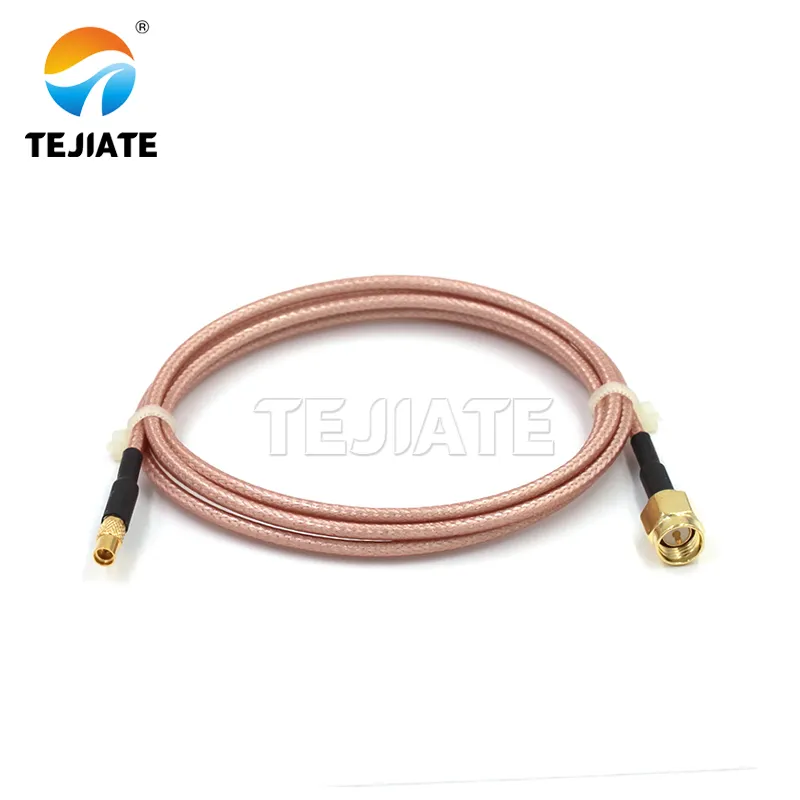
MMCX to SMA cable assembly with coaxial cable and connectors

This photograph shows a complete MMCX to SMA cable assembly. One end has an MMCX plug, the other an SMA plug or jack, connected by a length of flexible coaxial cable (typically RG316). Pre-terminated assemblies reduce variability compared to hand-made cables and are preferred for production and field use.
MMCX to SMA Cable Assembly
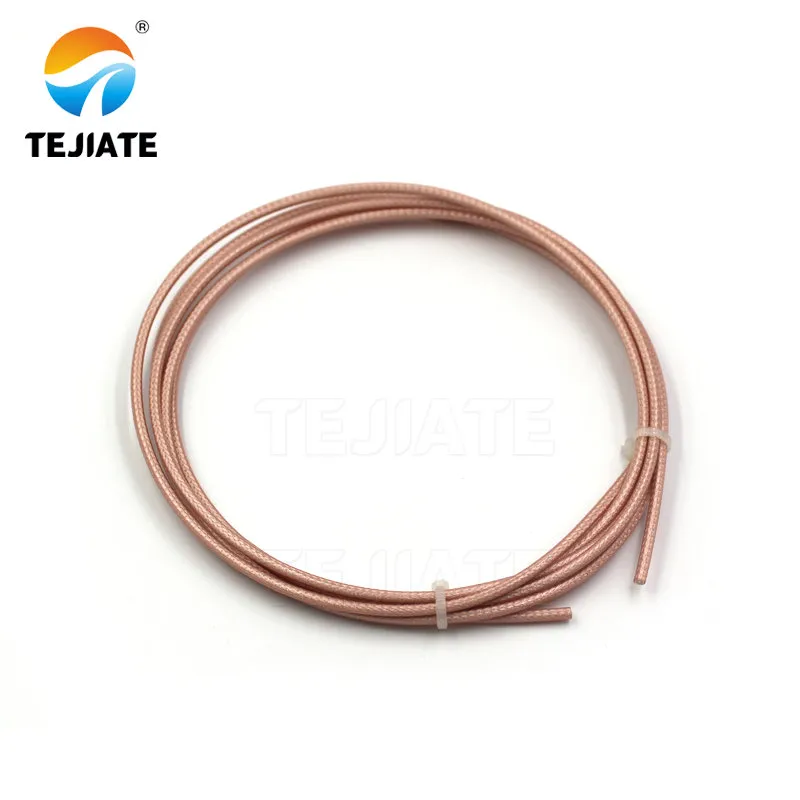
Section of bare RF coaxial cable showing layers: inner conductor, dielectric, shield, jacket

This image depicts a length of RF coaxial cable, likely RG316, with its layers exposed: inner conductor, PTFE dielectric, braided shield, and outer jacket. When terminated with connectors, it becomes a cable assembly. The quality of these layers directly affects RF performance and mechanical durability.

RF Coaxial Cable
A finished mmcx to sma cable is an assembly with known connectors and controlled electrical behavior. Bare rf coaxial cable is raw material. When raw coax is hand-terminated, results depend on stripping, soldering or crimp quality, and strain relief. This variation is usually acceptable for prototypes but creates risk in production. Cables are often moved, disconnected, or bent during assembly and service. In these situations, pre-terminated mmcx to sma cable assemblies provide more consistent results. A practical guideline is exposure: if the cable may be handled outside the lab, an assembly is normally preferred over raw coax. Differences between jumper assemblies and raw cable usage are discussed further in the RF coaxial cable guide.

Recognize devices that naturally favor MMCX connectors

MMCX connectors are common in designs where module size is limited. Typical examples include GNSS receivers, LTE and NB-IoT modules, embedded Wi-Fi cards, drones, and wearable devices. In these products, MMCX provides a compact RF interface with acceptable matching over several gigahertz when properly mated. Limited rotational freedom helps reduce torsional stress on small coax during installation. When combined with a short mmcx to sma cable, the design allows the RF module to remain compact while the enclosure uses a mechanically robust SMA interface.

Decide when an MMCX to SMA cable is the right solution

Replace soldered pigtails with detachable MMCX to SMA jumpers

Some designs still use soldered RF pigtails. In this approach, a thin coax is soldered directly to the PCB. Electrically this can work, but mechanically it concentrates stress at the solder joint. Over time, cable movement can damage the pad or joint. Using an MMCX connector on the board with a detachable mmcx to sma cable shifts mechanical load away from the PCB. The cable becomes a replaceable part. Antennas can be changed without rework. This approach generally improves serviceability and reduces field failures caused by mechanical fatigue.

Use MMCX to SMA cable instead of redesigning boards or enclosures

After PCB layout or enclosure tooling is fixed, relocating an RF connector becomes expensive. A short mmcx to sma cable allows the SMA exit point to be moved without changing the PCB or enclosure geometry. This is commonly used when antenna placement constraints are identified late in the design process.

Avoid rigid MMCX–SMA adapter stacks in production hardware
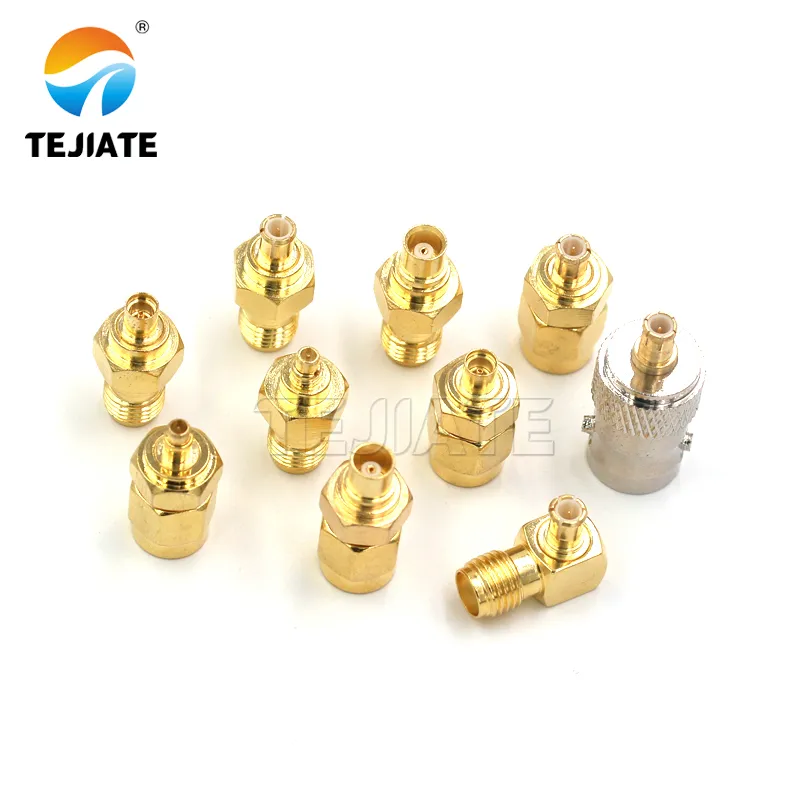
Rigid MMCX to SMA adapters (male/female)

This figure shows rigid MMCX to SMA adapters. They are often used in prototyping or lab setups to connect devices with mismatched connectors. However, because they are rigid, any cable movement or torque applied to the SMA side is transferred directly to the board-mounted MMCX jack, which can lead to long-term reliability issues in production hardware.
MMCX to SMA Rigid Adapters
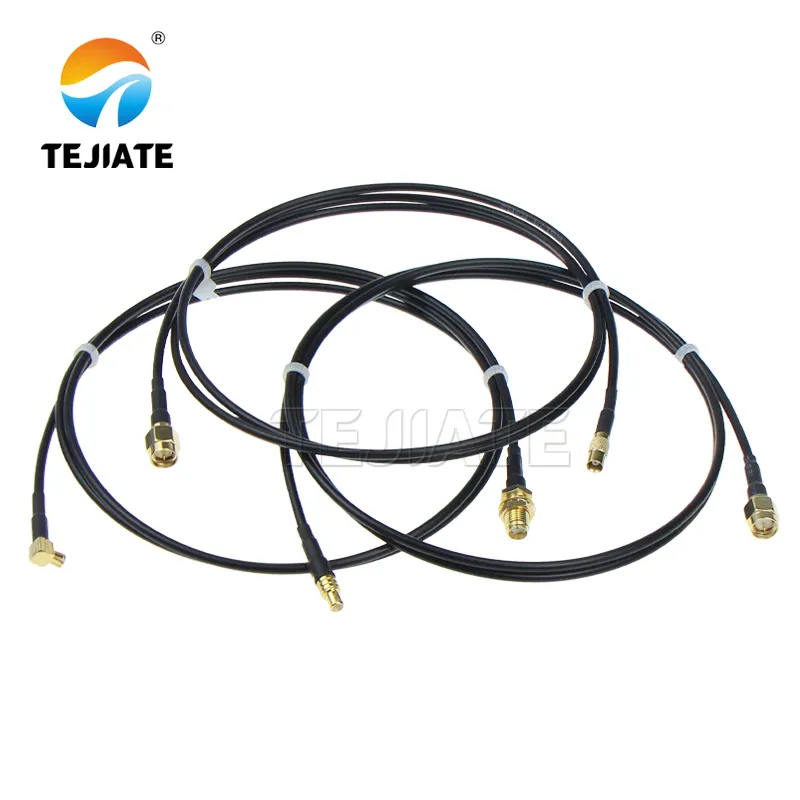
MMX to SMA cable assembly (note: MMX is likely MMCX)

This image shows a flexible MMX (presumably MMCX) to SMA cable assembly. It is similar to Figure but may represent a variant with a different orientation or strain relief. The flexible cable absorbs handling forces, protecting the module's MMCX solder joints. Such assemblies are critical for applications where the cable is moved or subjected to vibration.

MMX to SMA Cable
Rigid MMCX-to-SMA adapters mounted directly on a module transfer torque and vibration into the MMCX solder joints. In field use, this can lead to intermittent contact or degraded matching. A flexible mmcx to sma cable reduces this mechanical coupling. Adapter stacking issues and their mechanical impact are also mentioned in the SMA adapter cable guide.

Select coax types for MMCX–SMA jumper assemblies

Match RG316 coaxial cable to compact, high-frequency links

For many designs, rg316 coaxial cable is used for MMCX–SMA jumper assemblies. It provides stable electrical performance across common RF bands and tolerates heat better than PVC-based mini-coax. Silver-plated conductors handle repeated bending more reliably. Typical applications include 2.4 GHz and 5 GHz Wi-Fi, LTE bands, and GNSS receivers. When cable length is short and enclosure space allows, rg316 cable offers predictable loss and mechanical durability. Detailed loss data and comparisons with other 50 Ω options are available in the RG316 coaxial cable guide.

Keep 50 ohm coaxial cable consistent across MMCX and SMA ports

MMCX connectors used on RF modules are designed for 50 ohm coaxial cable. SMA connectors used for antennas and test ports are also 50 ohm in most RF systems. Mixing impedances inside a jumper path causes reflections. This often happens when a 75 ohm cable is reused because it is available or already qualified for another product. The link may still function, especially at low frequencies or short lengths, but return loss degrades. In production hardware, this reduces margin and increases unit-to-unit variation. When using an mmcx to sma cable, the impedance should remain 50 ohms from the module port to the antenna. This includes the cable, both connectors, and any intermediate transitions. There is no practical benefit to mixing impedances in this path. A broader overview of common 50 ohm cable families and where they are typically used is documented in the 50 ohm coaxial cable guide.

Decide when to use mini-coax instead of RG316 in extreme layouts

RG316 is commonly used for mmcx to sma cable assemblies, but it is not always easy to route in very tight spaces. In compact IoT or wearable designs, thinner mini-coax such as 1.13 mm or 0.81 mm cable is sometimes used. These cables allow smaller bend radii and occupy less volume. The trade-offs are higher attenuation and lower mechanical durability. Mini-coax generally shows higher loss per meter at 2.4 GHz and above. It also tolerates less heat and repeated bending. For short internal runs where space is the dominant constraint, mini-coax can be acceptable. For cables exposed to vibration, handling, or repeated service, RG316 usually provides more stable results. Practical comparisons between RG316 and thinner alternatives are included in the RG316 coaxial cable guide.

Control loss and matching in MMCX to SMA RF paths

Estimate path loss for common MMCX to SMA cable lengths

Loss estimation during design does not need laboratory accuracy. Order-of-magnitude accuracy is usually sufficient. For rg316 coaxial cable, typical attenuation values are well known and stable across vendors. Table 1 lists values commonly used during planning.
Frequency Typical RG316 Loss (dB/m)
1.0 GHz ~0.9
2.4 GHz ~1.8
5.0 GHz ~3.2
For a 0.5 m mmcx to sma cable at 2.4 GHz, cable loss is approximately 0.9 dB. This does not include connector loss. In short jumper assemblies, connector loss can be comparable to cable loss and should be included early in the link budget.

Include connector transitions and SMA adapter cables in the budget

Every connector interface adds insertion loss and mismatch. For planning purposes, MMCX and SMA transitions are often budgeted at 0.1–0.3 dB per interface, depending on frequency and connector quality. When sma adapter cable assemblies or between-series adapters are added, these losses accumulate. A typical mmcx to sma cable path includes at least two interfaces: the MMCX jack and the SMA bulkhead. Additional adapters increase loss and variation. These effects are small individually but significant in aggregate. Adapter stacking and its impact on RF paths are also discussed in the SMA adapter cable guide.

Protect high-frequency links from long, lossy or mismatched coax

As operating frequency increases, the effect of loss increases. At frequencies above several gigahertz, small increases in cable length or connector count can reduce margin noticeably. Market data on rf coaxial cable assemblies reflects this trend, with increasing use of short, purpose-built jumpers in 5G and high-data-rate IoT systems. In practice, improving margin often comes from mechanical changes rather than RF tuning. Shortening the mmcx to sma cable, removing adapters, or relocating the SMA exit point closer to the module usually provides measurable improvement. General trends in RF interconnect usage are summarized in the RF coaxial cable guide.

Route MMCX to SMA cables inside dense enclosures

Respect bend radius and strain limits for RG316 and mini-coax

All coaxial cables have a minimum bend radius. Exceeding this radius changes impedance and accelerates mechanical fatigue. For RG316, a common guideline is a minimum bend radius of roughly ten times the cable diameter. Mini-coax allows tighter bends but has a shorter service life. Sharp bends near MMCX or SMA connectors are especially problematic. In mmcx to sma cable assemblies, bends should be gradual and distributed along the cable rather than concentrated at the connector.

Steer MMCX jumpers away from digital noise and heat sources

Cable routing inside the enclosure affects RF stability. mmcx to sma cable assemblies should be routed away from high-speed digital buses, switching regulators, motor drivers, and other broadband noise sources. Heat exposure also matters. Even PTFE-based cables stiffen over time when subjected to repeated thermal cycling. Increased stiffness increases stress at connector terminations. Simple routing changes often mitigate these issues without redesign.

Anchor the SMA side so that MMCX solder joints survive handling

User interaction with antennas introduces mechanical load. If the cable is free to move, that load is transferred to the MMCX connector and its solder joints. Best practice is to anchor the SMA bulkhead firmly to the enclosure and secure the cable so that pulling forces are absorbed by the chassis. This isolates the MMCX interface from handling and improves long-term reliability in production systems.

Compare MMCX to SMA cables with MCX and SMA adapter options

Contrast MMCX to SMA cable with MCX to SMA cable

MMCX and MCX are not interchangeable in practice. MMCX is smaller. It is usually placed on RF modules. MCX is larger and holds better mechanically. MCX is more common in industrial or serviceable equipment. MMCX appears more often in compact radios such as GNSS, LTE, or Wi-Fi modules. If a module already uses MMCX, an mmcx to sma cable is the shortest path to an SMA antenna. Switching to MCX normally adds adapters. Adapters add interfaces. Interfaces add loss and mechanical risk. This is why MCX-to-SMA solutions are usually applied only when the module natively exposes MCX. Practical differences between the two connector paths are outlined in the MCX to SMA cable guide.

Decide when an SMA adapter cable beats MMCX to SMA for your design

If the RF module already has an SMA connector, an sma adapter cable is enough. Adding MMCX in this case provides no RF benefit. It increases connector count and assembly steps. The mmcx to sma cable is intended for modules that expose MMCX by design. Mixing SMA adapter cables and MMCX jumpers in the same RF path usually indicates an avoidable architecture issue. Adapter usage patterns and limits are discussed further in the SMA adapter cable guide.

Avoid over-engineering MMCX–SMA paths in low-frequency systems

Below roughly 1 GHz, short RF jumpers are tolerant of loss and mismatch. In these systems, very low-loss cable is rarely the limiting factor. What still fails is mechanics. Too many adapters. Poor strain relief. Excess cable length folded into the enclosure. An mmcx to sma cable in a low-frequency system should be short, directly routed, and mechanically supported. Over-design does not compensate for poor handling or mounting.

Build an MMCX–SMA cable planning worksheet

Define fields in your MMCX–SMA selection worksheet

The worksheet is not a simulation tool. It is a consistency tool. Typical fields used internally are listed below.
Field Notes
Project_name Internal reference
Wireless_standard Wi-Fi, LTE, GNSS, LoRa, NB-IoT
Band_GHz Center frequency
Run_length_m Cable length
Cable_type RG316, 1.13, RG174
Cable_loss_dB_per_m From datasheet
Cable_loss_dB Length × loss
Connector_count MMCX + SMA + adapters
Connector_loss_dB Connector_count × 0.15
Total_path_loss_dB Cable + connectors
Allowed_path_loss_dB System budget
Margin_dB Allowed − total
Min_bend_radius_mm Datasheet value
Planned_bend_radius_mm Layout value
Bend_margin_mm Planned − minimum
Serviceability_score 1–5
Cost_score 1–5
Overall_score Internal weighting
The worksheet forces decisions to be written down. That is its only purpose.

Run a design example for an IoT tracker using MMCX to SMA cable

Example. NB-IoT tracker with GNSS. Module uses MMCX. Enclosure uses SMA. Cable length around 0.4 m. Cable type RG316. Frequency 1.575 GHz and LTE band. Loss estimated using standard RG316 values. Connector count equals one MMCX and one SMA bulkhead. Margin checked against link budget. Bend radius checked against enclosure geometry. If margin is negative, cable length or routing changes. No simulation involved.

Standardize MMCX–SMA cable decisions across product families

When the same worksheet is reused, common cable configurations repeat. These can be standardized. New products then reference existing entries instead of starting from zero. This reduces variation and review time.

Track MMCX to SMA cable demand in RF and IoT markets

Follow RF coaxial cable assemblies growth driven by 5G and IoT

Use of rf coaxial cable assemblies continues to increase as radios move into smaller devices. 5G, private wireless, vehicle electronics, and industrial IoT all use short jumper assemblies instead of long runs. This favors compact module connectors internally and robust connectors at the enclosure.

Note RF connector trends favoring compact, high-frequency interfaces

MMCX remains common on modules. SMA remains common on enclosures. Neither trend is new. The combination persists because it works mechanically and electrically in the 1–6 GHz range.

Link MMCX to SMA cable usage to GNSS and smart transportation

GNSS devices used in tracking and transportation typically place the receiver module inside the enclosure and the antenna outside. MMCX on the module plus an mmcx to sma cable to a panel-mounted SMA remains a common pattern.

Answer MMCX to SMA cable design questions

Can one MMCX to SMA cable support both GPS and LTE bands?

Yes. Cable and connectors must be rated for the highest frequency used.

How long can an MMCX to SMA cable be before loss becomes critical?

No fixed length. Higher frequency and smaller margin reduce allowable length.

Is an MMCX to SMA cable robust enough for drones and wearables?

Yes, if strain is not transferred to the MMCX connector.

Should I use RG316 or a mini-coax for MMCX to SMA links?

RG316 when space allows. Mini-coax only when routing space dominates.

How many connector transitions are acceptable in one MMCX–SMA run?

Two is typical. More increases loss and mechanical risk.

When should I choose MCX to SMA instead of MMCX to SMA?

When the module already uses MCX or higher retention is required.

Bonfon Office Building, Longgang District, Shenzhen City, Guangdong Province, China

customer service