
MMCX Cable Use in RF Modules, SMA Interfaces, and RG316 Links
Feb 17,2026
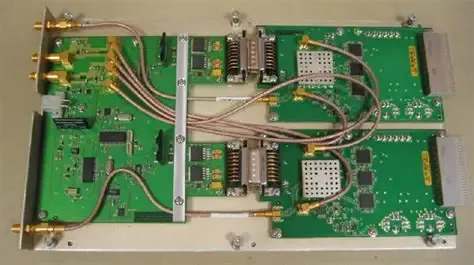
This image shows a typical setup where an MMCX cable connects an RF module to a panel-mounted SMA connector, illustrating the internal usage and the boundary between internal and external interfaces.
MMCX cables usually enter a design quietly. The radio already links. The antenna choice feels settled. The enclosure outline is mostly done. Someone notices a small RF connector footprint on the module and picks an MMCX cable because it fits and looks familiar. At first, nothing seems wrong. Sensitivity meets the target. Return loss is acceptable. The system passes early checks.
The trouble starts later. Measurements begin to shift when the cable is touched. A unit that tested fine on one bench behaves differently on another. Margins that once looked comfortable slowly disappear. In many postmortems, the MMCX cable never gets blamed directly, even though it sits in the signal path the entire time.
In compact RF hardware, MMCX cables do more than bridge two points. They absorb mechanical stress, define part of the impedance environment, and often become the weakest link between an RF module and an external SMA cable interface. Because many MMCX assemblies are built on RG316 coaxial cable structures, their behavior is predictable—if you treat them as RF components instead of generic jumpers. This guide focuses on how MMCX cables actually behave in real systems, how they interact with SMA links, and how to manage loss and durability before problems show up during validation or deployment. If you’re looking for connector footprint or PCB layout details, those are covered separately in MMCX Connector Guide for RF Modules and Cables. Here, the emphasis is on the cable itself and the decisions that surround it.
Align MMCX cable with RF modules and SMA ports
Map MMCX cable roles in RF modules vs. test setups
Inside a finished product, an MMCX cable is almost always an internal jumper. It connects an RF module to an antenna feed, a matching network, or a panel transition. Once installed, it is rarely moved. The enclosure limits its bend radius. Mechanical stress is low and predictable. In that environment, MMCX cables are generally stable and repeatable.
In the lab, the same cable lives a very different life. It becomes part of the measurement chain. It is plugged and unplugged daily, routed across benches, bent around fixtures, and adapted repeatedly to instruments. Even when electrical specs look identical on paper, cables used this way age faster and behave less consistently. Using a production-style MMCX jumper as a semi-permanent lab lead often explains why measurements drift without an obvious cause.
A simple distinction helps avoid confusion: production MMCX cables are optimized for stability, while lab MMCX cables must survive handling. Mixing those assumptions usually ends badly.
Separate “internal jumpers” from “external RF connectors”
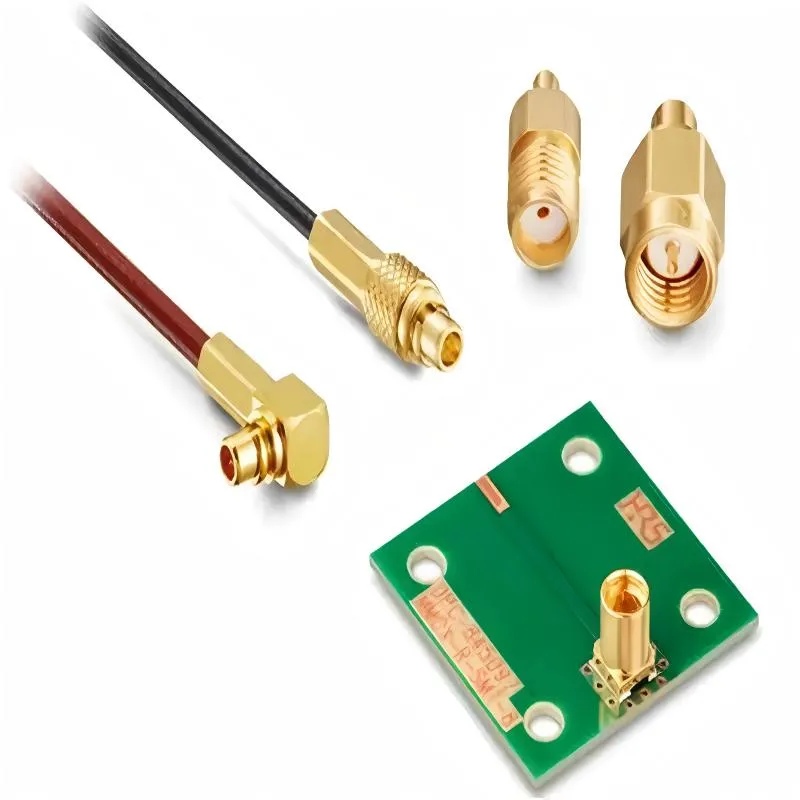
This figure illustrates the boundary between internal MMCX jumpers and external SMA connectors, emphasizing that MMCX should remain inside the enclosure to avoid wear and inconsistency.
MMCX was never intended to be a user-facing interface. Threaded connectors such as SMA connector exist precisely because they tolerate repeated mating, cable weight, and accidental movement better than snap-on formats. When MMCX cables are exposed as external connections, systems often become sensitive to cable motion or connector wear long before outright failure occurs.
Robust RF architectures draw a clear boundary. MMCX stays inside the enclosure. SMA defines the outside world. When the two must meet, the transition should be deliberate and short, typically using an MMCX jumper feeding a panel-mounted SMA bulkhead. The practical implications of that transition—especially adapter count and loss stacking—are covered in MMCX to SMA Adapter Choices for RF Modules.
Match MMCX cable usage with power level and frequency bands
From a power standpoint, MMCX cables are rarely the limiting factor in low-power RF systems. Most applications operate well below a watt, where thermal concerns are modest. Frequency is where constraints appear. At sub-GHz and 2.4 GHz, MMCX cables are forgiving and easy to work with. As systems move into 5 GHz and beyond, losses accumulate quickly, and connector quality starts to matter more than cable length alone.
At higher frequencies, small mechanical differences—slight misalignment, uneven strain relief, marginal shielding—can show up as measurable changes in return loss or insertion loss. MMCX cables can still work in these bands, but they stop being tolerant of casual routing and excessive transitions. Treating them as “small SMA cables” is where most designs lose margin.
How do MMCX cable structure and specs affect RF?
Break down MMCX cable construction and geometry
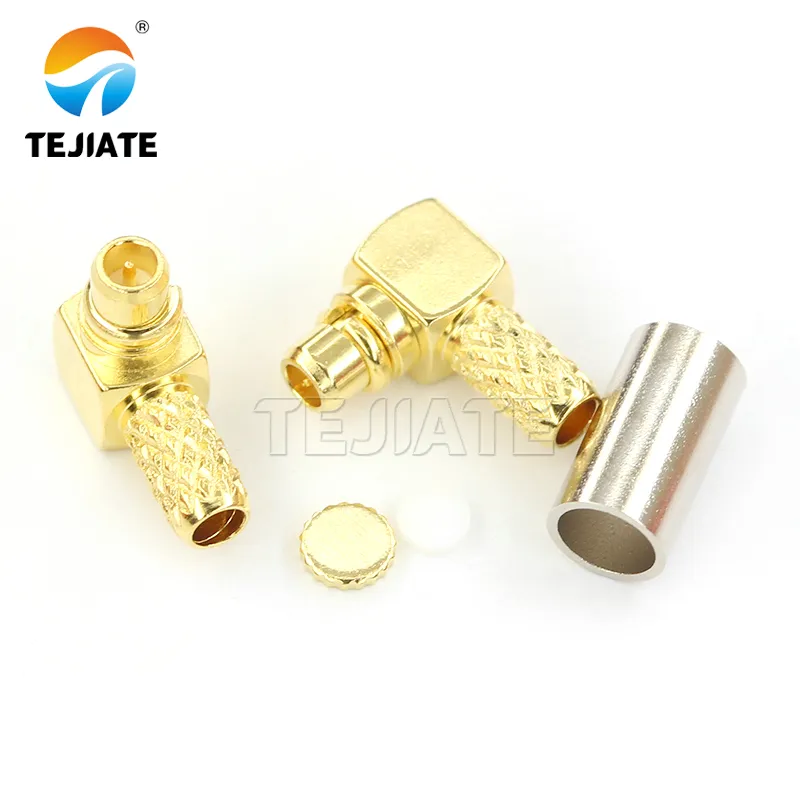
This image shows the structure of an MMCX male connector, including the center contact, dielectric, and outer shell, which is typical for RG316-based assemblies.
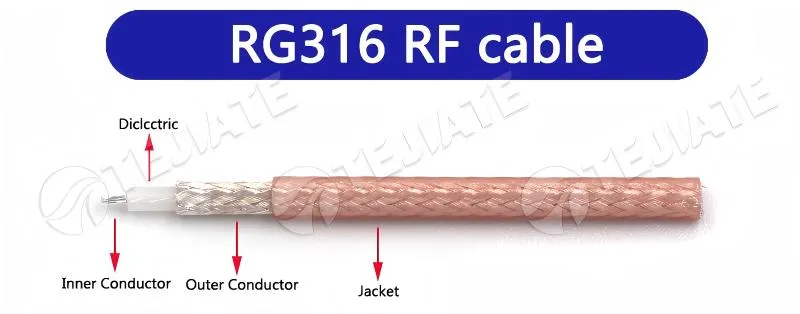
This diagram reveals the layers of RG316 cable: inner conductor, PTFE dielectric, outer conductor (braid), and jacket, which is commonly used in MMCX assemblies.
Use key RF specs instead of generic “50 ohm” labels
Connect RG316 coaxial cable specs to MMCX jumpers
When is MMCX cable better than RG316 or SMA jumpers?
MMCX cables usually appear when something else stops working. The enclosure gets tighter. The RF module moves closer to the antenna. Suddenly, a straight SMA cable no longer fits, or the bend radius starts fighting the mechanical design. That’s when MMCX enters the conversation—not because it’s ideal, but because it solves a specific constraint.
The mistake is assuming that solution comes without cost.
Compare MMCX cable vs. direct SMA cable runs
If you can route a clean SMA-to-SMA cable, most engineers eventually do. Threaded connectors tolerate cable weight, side loads, and repeated reconnection in a way snap-on interfaces simply don’t. Measurement setups feel calmer. Numbers move less when someone reaches across the bench.
MMCX cables win when geometry becomes the bottleneck. Low profile, tighter spacing, and easier routing inside dense assemblies are real advantages. But those advantages only hold if the cable is treated as fixed. Once the cable starts moving—even slightly—the system becomes more sensitive than expected. Designs that rely on MMCX should assume the cable will stay exactly where it was routed. If it won’t, SMA is usually the safer compromise, even when it complicates mechanics.
Decide between MMCX connector and MMCX cable on the PCB
There are two common design paths here, and neither is universally right. One places an MMCX connector on the PCB and treats the cable as replaceable. The other permanently attaches the cable during assembly.
The connector-based approach buys flexibility. Modules can be swapped. Antennas can change late. Failures are easier to isolate. The downside is one more mechanical interface that can be abused if handled carelessly.
Fixed cables reduce part count and remove one interface, but they push risk elsewhere. If the cable fails, repair options narrow quickly. Teams that expect iteration or field service tend to accept the connector. High-volume, stable designs sometimes accept the fixed cable once the risk is well understood. The problem isn’t choosing either option—it’s choosing by accident.
Short note on miniaturized RF modules using MMCX
Some compact RF modules have quietly moved away from ultra-small snap connectors toward MMCX. The reason is not bandwidth or impedance; it’s durability. MMCX sits in an uncomfortable middle ground—larger than U.FL, smaller than SMA—but that middle ground buys more mating cycles and better mechanical resilience. It’s not a cure-all, but it reflects a growing acknowledgment that connector mechanics matter just as much as electrical specs.
If you want background context on how these miniature coaxial interfaces fit into the broader connector ecosystem, the overview of micro-miniature coaxial connectors on Wikipedia is a reasonable neutral reference.
Choose MMCX connector, cable, and adapter combos wisely
Pair MMCX connector and cable types for each RF module family
Different RF modules stress cables in different ways, and treating them as interchangeable often backfires. Wi-Fi modules push bandwidth. Cellular modules push margin and validation time. GNSS modules punish mismatch more than loss. Industrial ISM modules care less about frequency and more about vibration and temperature.
Using the same MMCX cable everywhere is convenient, but convenience is rarely the same as robustness. Small differences in shielding, jacket stiffness, or strain relief that seem irrelevant on paper can show up clearly once the product leaves the bench.
Use MMCX to SMA adapter only where transitions are needed
MMCX-to-SMA adapters are incredibly useful in the lab. They make instruments accessible and measurements repeatable. Problems start when those adapters quietly migrate into production signal paths.
An adapter left in place adds loss, leverage, and one more failure point—without providing any long-term benefit. As discussed in MMCX to SMA Adapter Choices for RF Modules, adapters solve transitions, not architecture. Treating them that way avoids a lot of downstream troubleshooting.
Avoid long adapter chains with MMCX to SMA connector stacks
A single transition is rarely an issue. Multiple stacked transitions are. Every added interface introduces small mismatches and mechanical play. At higher frequencies, those small effects stop averaging out.
Many teams eventually impose an informal rule: no more than two transitions beyond the cable itself. It’s not a law of physics, just a hard-earned guideline. Past that point, measurement repeatability degrades faster than expected, and debugging becomes guesswork.
Standardize MMCX cable and adapter SKUs per project
Standardization doesn’t feel like an RF decision, but it often has RF consequences. Limiting a project to a small set of MMCX cable lengths and adapter types makes behavior easier to recognize and anomalies easier to spot. It also reduces the chance that two engineers are unknowingly testing with slightly different signal paths.
For readers who want a neutral refresher on how coaxial cables behave in general—impedance, shielding, and loss mechanisms—the general overview on coaxial cable provides helpful background without tying the discussion to any specific product or vendor.
Control MMCX cable length, loss, and flex life
Most MMCX cable problems don’t start with a bad cable. They start with a reasonable compromise that never gets revisited. Someone adds a little length to make assembly easier. Another connector stays because “it doesn’t hurt.” The cable bends tighter than recommended because the enclosure is already frozen. None of this looks wrong in isolation. Over time, it adds up.
Teams that stop seeing random RF drift usually do one thing differently: they stop treating MMCX cables as qualitative parts and start putting numbers around them.
MMCX Cable Loss & Flex Risk Scorecard
| Field | Meaning in practice |
|---|---|
| f_GHz | Where the link actually operates, not the marketing band |
| L_m | Total MMCX cable length, including slack |
| alpha_dB_per_m | Loss per meter, typically borrowed from RG316 data |
| N_connectors | Every RF interface in series, adapters included |
| Loss_per_connector_dB | Realistic loss per interface, not best-case |
| Min_bend_radius_mm | What the cable datasheet recommends |
| Actual_bend_radius_mm | The tightest bend you actually routed |
| Flex_cycles_expected | How often the cable will move or be reconnected |
| Flex_cycles_rating | What the vendor claims it can survive |
| Target_link_margin_dB | Margin you want to keep, not what's left |
Loss estimate
Cable_loss_dB = alpha_dB_per_m × L_m
Connector_loss_dB = N_connectors × Loss_per_connector_dB
Total_loss_dB = Cable_loss_dB + Connector_loss_dB
Mechanical stress indicators
Bend_stress_ratio = Min_bend_radius_mm / Actual_bend_radius_mm
Flex_usage_ratio = Flex_cycles_expected / Flex_cycles_rating
Risk score
Risk_score =
0.4 × (Total_loss_dB / Target_link_margin_dB)
- 0.3 × max(0, Bend_stress_ratio − 1)
- 0.3 × Flex_usage_ratio
If this number feels uncomfortably high, it usually is. Engineers who ignore it often end up chasing intermittent behavior that never reproduces cleanly.
Choose practical MMCX cable lengths for lab vs. field
Estimate loss budget using RG316 cable attenuation
Derate MMCX cable for flex cycles in moving assemblies
How should you test MMCX cable assemblies?
Separate incoming MMCX cable checks from system-level tests
Use SMA adapters and fixtures to probe MMCX cable behavior
Define pass/fail limits for loss, VSWR, and intermittents
Capture MMCX cable issues in a reusable RF test checklist
Plan sourcing and lifecycle for MMCX cable links
Consolidate MMCX cable SKUs across projects
Qualify alternative MMCX cable and connector suppliers
Plan EOL and engineering change for MMCX cable parts
Track standards and compliance trends for RF cable assemblies
FAQs
Can I use MMCX cable for sub-6 GHz 5G or Wi-Fi 6E links?
Yes, but margins shrink quickly. Short lengths and controlled routing matter more than connector type.
Is MMCX cable reliable enough for outdoor or vehicle installations?
It can be, but only with protection against moisture, vibration, and repeated flexing.
How many mating cycles can an MMCX connector realistically survive?
Hundreds to low thousands is typical. Lab use often consumes this faster than expected.
What really separates MMCX from MCX or U.FL in practice?
MMCX trades size for durability. It survives more abuse than ultra-small connectors, but less than threaded ones.
Can MMCX cables from different vendors be mixed in one product?
Only after checking fit and RF behavior. Small differences show up sooner than expected.
How short can an MMCX cable be before it becomes fragile?
Very short helps loss but increases bend stress. There is always a tradeoff.
When is a custom MMCX cable worth the effort?
When environment, frequency, or lifecycle constraints make off-the-shelf parts unpredictable.
Bonfon Office Building, Longgang District, Shenzhen City, Guangdong Province, China

A China-based OEM/ODM RF communications supplier
Table of Contents
Owning your OEM/ODM/Private Label for Electronic Devices andComponents is now easier than ever.