
E-Band (71–86 GHz) Guide: mmWave for 5G Backhaul
Aug 13,2025
Introduction
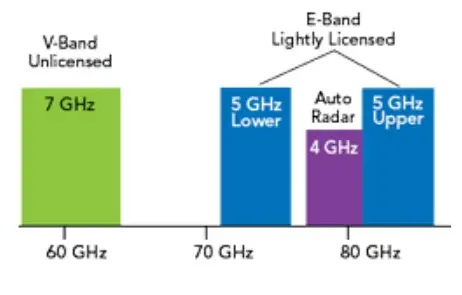
This diagram presents the two E-Band frequency slices used in telecom—71–76 GHz and 81–86 GHz—highlighting their position in the mmWave spectrum and their separation by the automotive radar band.
In the world of high-speed wireless communication, E-band has carved out a unique niche. Spanning 71–76 GHz and 81–86 GHz, it sits in the millimeter-wave (mmWave) range — where wavelengths are just a few millimeters long and signals behave almost like beams of light.
What makes E-band so compelling is its ability to deliver fiber-grade speeds without laying a single strand of fiber. With 10 GHz of spectrum available in two wide blocks, it’s capable of moving massive amounts of data — ideal for 5G backhaul, dense urban broadband, or quickly linking buildings that fiber can’t easily reach.
Unlike lower-frequency bands that blanket large areas, E-band excels in short-range, line-of-sight links. Its highly directional signals reduce interference and enable dense deployments in busy cityscapes. As we explore further, you’ll see how E-band compares with V-band, where it fits in the broader mmWave ecosystem, and why it’s becoming an essential part of next-generation networks.
What Is E-Band?
When engineers talk about E-band in telecom, they usually mean two specific frequency slices:
- Lower E-band → 71–76 GHz
- Upper E-band → 81–86 GHz
Between them lies the 76–81 GHz gap, home to applications like 77 GHz automotive radar. Together, the two E-band segments offer a massive 10 GHz of usable spectrum — far more than most traditional microwave bands.
E-band belongs to the Extremely High Frequency (EHF) zone within the mmWave spectrum (30–300 GHz). At these short wavelengths — roughly 4 mm — signals travel in tight, laser-like beams and require an unobstructed path from transmitter to receiver.
Back in 2003, the U.S. FCC unlocked these frequencies for fixed wireless services, marking the largest commercial spectrum release in its history: 13 GHz in total, counting the adjacent 92–95 GHz range. That decision instantly expanded available licensed bandwidth by 20% and offered 50× more capacity than all legacy cellular bands combined. Since then, many countries have followed suit with light licensing frameworks, making E-band a globally accessible tool for high-capacity point-to-point links.
E-Band Frequency Snapshot
| Segment Name | Frequency Range | Typical Use Case | Notes |
|---|---|---|---|
| Lower E-band | 71–76 GHz | Long-range point-to-point backhaul | Paired with Upper E-band for dual-link setups |
| Gap Zone | 76–81 GHz | Automotive radar (77 GHz) | Not generally available for telecom use |
| Upper E-band | 81–86 GHz | High-capacity metro backhaul | Often combined with Lower E-band for load balancing |
In short, E-band is the “wireless fiber” of the mmWave world — perfect for multi-gigabit point-to-point connectivity when you’ve got clear sightlines, high traffic demands, and the need for rapid deployment without trenching fiber.
Key Characteristics of E-Band Frequencies
Working in the 71–86 GHz range offers serious performance advantages — but also demands a bit of engineering finesse. Here’s what stands out when you operate in E-band:
1. Unmatched Data-Carrying Power
Because each channel can be hundreds of MHz — even up to a few GHz — wide, E-band links easily push 1–10 Gbps without resorting to overly complex modulation schemes. That’s why carriers love it for 5G backhaul, where a single hop can move the kind of data volume normally reserved for fiber.
2. Tight, Highly Directional Beams
At ~80 GHz, wavelengths are just a few millimeters. This makes it possible to use compact dish antennas — sometimes as small as 30 cm — to create “pencil beams” that barely spill signal beyond their intended path. Result: minimal interference, even in dense city deployments.
3. Line-of-Sight Is Non-Negotiable
Like most mmWave links, E-band can’t bend around corners or punch through walls. Trees, rooftops, or even a passing truck can cause a signal drop if they block the path. That’s why you’ll often find E-band antennas mounted high — on rooftops, towers, or pole tops — with precise alignment.
4. Range That’s Short, but Not Tiny
While V-band (around 60 GHz) struggles past a few hundred meters due to oxygen absorption, E-band can reach a few kilometers under good conditions. A well-designed link — with high-gain antennas and proper fade margins — can maintain stability over 1–3 miles.
5. Friendly Licensing in Many Regions
One reason E-band adoption has surged: in many countries, getting permission is quick and inexpensive. In the U.S., you can register a link online for a few hundred dollars. Other markets even allow unlicensed operation in certain E-band portions.
6. Weather Matters, but Oxygen Isn’t the Culprit
E-band avoids the severe oxygen absorption peak that limits V-band, but heavy rain is still a factor. Raindrops can scatter and absorb enough 80 GHz energy to cause temporary fades. That’s why network designers add fade margins or shorten link spans in high-rainfall zones.
In short, E-band offers the raw bandwidth and beam precision that high-capacity wireless demands — as long as you plan for line-of-sight and weather impacts.
Applications of E-Band in Wireless Communication
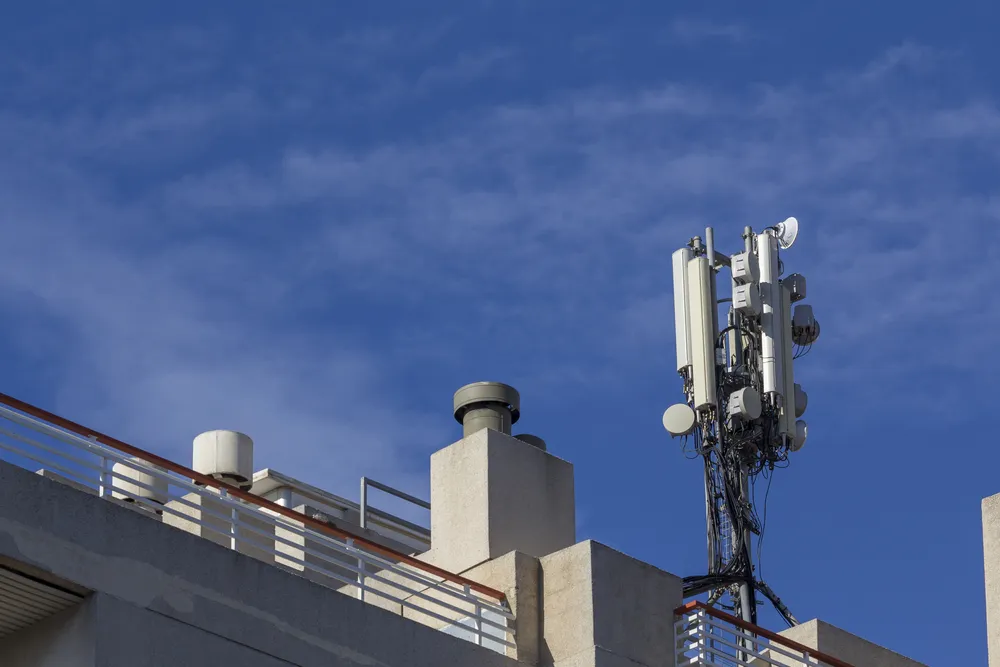
This image shows a real-world E-Band point-to-point link mounted on urban rooftops, enabling multi-gigabit 5G backhaul without fiber trenching. Such installations are common in dense cities for rapid network deployment.
Walk around any modern city, and chances are you’re already walking under — or past — an E-band link without knowing it. These compact, high-frequency point-to-point systems show up wherever someone needs fiber-like speed, but can’t (or won’t) dig up streets to lay actual fiber.
Backbone for 5G Backhaul and Fronthaul
Instead of pulling kilometers of cable, operators often mount E-band radios on rooftops, linking 5G base stations in a neat line-of-sight chain. One network in Singapore, for example, connected a cluster of small cells this way in just three days — the same job with fiber would have taken weeks.
Business-to-Business Links
Two office towers in a busy downtown may share far more than skyline views. With E-band, they can trade massive datasets daily without touching the public internet. The setup? A pair of narrow-beam antennas, mounted high, whispering gigabits back and forth.
Fixed Wireless Access (FWA)
Some wireless ISPs skip the phone lines entirely. They’ll stick an E-band receiver on a customer’s roof, point it toward a tower two or three kilometers away, and deliver internet that clocks faster than most cable plans. This is especially common in suburbs where fiber buildouts crawl along year after year.
City Services and Surveillance
E-band has also crept into public service networks. In parts of the UAE, municipal “safe city” projects use it to ship HD video from street cameras to control centers, without having to route everything through buried fiber conduits.
Lab and Test Bench Work
Step into a mmWave research lab and you’ll often see E-band on the test bench. Engineers plug it into measurement gear to probe new 77 GHz radar modules or next-gen wireless gear. The same antennas feeding telecom links can just as easily feed data to a spectrum analyzer.
The New Frontier: Satellites
Even in orbit, E-band is getting attention. SpaceX has greenlit trials for Starlink Gen2 satellites using E-band for high-capacity downlinks. Up there, rain fade isn’t a problem — the challenge is keeping a beam steady between moving objects hundreds of kilometers apart.
E-Band vs V-Band: Same mmWave Family, Different Jobs
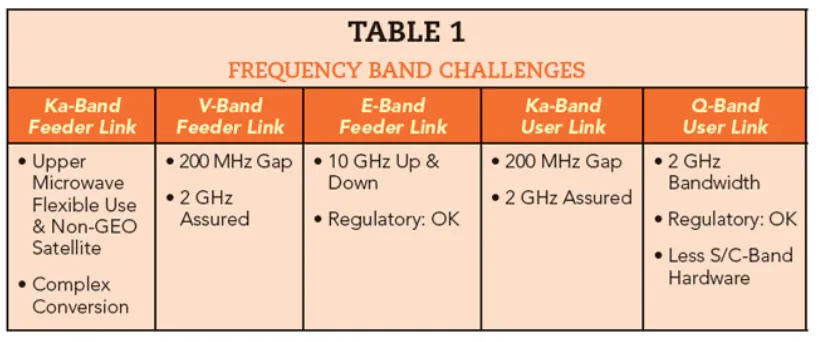
This chart contrasts E-Band’s longer range and higher capacity with V-Band’s short-range, license-free advantages, helping network designers choose the right mmWave band for each deployment.
Although E-band and V-band both belong to the mmWave spectrum, they have very different personalities. They complement each other in network design, but their strengths are not interchangeable.
Think of it like this: if E-band is the long-distance sprinter carrying a heavy load over several kilometers, V-band is the nimble short-distance runner, darting between nearby points with ease.
Frequency & Spectrum
- E-band → Two slices: 71–76 GHz and 81–86 GHz, totaling around 10 GHz of spectrum.
- V-band → Typically 57–71 GHz in telecom use, with about 7 GHz available. Often unlicensed.
Capacity & Range
- E-band supports 10+ Gbps and can reach several kilometers in good conditions.
- V-band can also deliver multi-gig speeds, but oxygen absorption near 60 GHz limits it to about 1 km — often just a few hundred meters.
Interference & Licensing
- E-band is lightly licensed in most regions, meaning registered links and predictable interference protection.
- V-band is unlicensed in many countries — easier to deploy but with some risk of interference in crowded zones.
Weather Effects
- Both are affected by rain fade.
- V-band also suffers from oxygen absorption, making it more range-limited regardless of weather.
- E-band avoids the oxygen absorption peak, so range reduction mainly comes from heavy rain.
Quick Comparison Snapshot
| Feature | E-Band | V-Band |
|---|---|---|
| Frequency | 71–76 GHz & 81–86 GHz | ~57–71 GHz |
| Spectrum Size | ~10 GHz, lightly licensed | ~7 GHz, often unlicensed |
| Typical Range | 1–3 km | < 1 km |
| Peak Data Rate | 10+ Gbps | 1–7 Gbps |
| Interference Risk | Very low | Medium |
| Weather Sensitivity | Rain fade only | Rain fade + oxygen absorption |
| Common Use Cases | Long backhaul, macro links | Short hops, dense urban links |
Further Reading
If you’d like to dive deeper into V-band — including its 60 GHz WiGig capabilities, short-range backhaul uses, and how it complements E-band in a real network — check out our detailed V-Band 60 GHz mmWave WiGig Backhaul Guide. It expands on many of the differences touched on here, and shows where V-band shines in modern mmWave deployments.
Advantages of E-Band

This image highlights the advantages of E-Band in wireless communication, including ultra-high data throughput, minimal spectrum congestion, precise beamforming for secure links, and the ability to deploy quickly without fiber infrastructure.
1. High Capacity Without Fiber
With up to 10 GHz of spectrum, an E-band link can deliver 10+ Gbps — enough to stream thousands of HD videos at once. In a 5G rollout, that means linking small cells or entire office campuses in days rather than months, without touching a single sidewalk slab.
2. Low Interference in Dense Deployments
At ~80 GHz, those “pencil beam” links are so narrow they feel like private highways in the sky. Even in a crowded downtown, multiple E-band dishes can sit within sight of each other without stepping on each other’s signals.
3. Enhanced Security
A beam just a few degrees wide is tricky to intercept — you’d have to physically be in its path. When combined with standard encryption, E-band becomes a secure bridge for sensitive corporate or government data.
4. Fast, Flexible Deployment
Disaster recovery teams love E-band for the same reason broadcasters do during live events: it can be set up in hours, restoring or creating high-capacity links without waiting for fiber permits.
5. Cost-Friendly Licensing
In many regions, “light licensing” means registering a link online for a modest fee. Compared to traditional licensed microwave, E-band spectrum is both cheaper and faster to secure.
Disadvantages and Challenges of E-Band
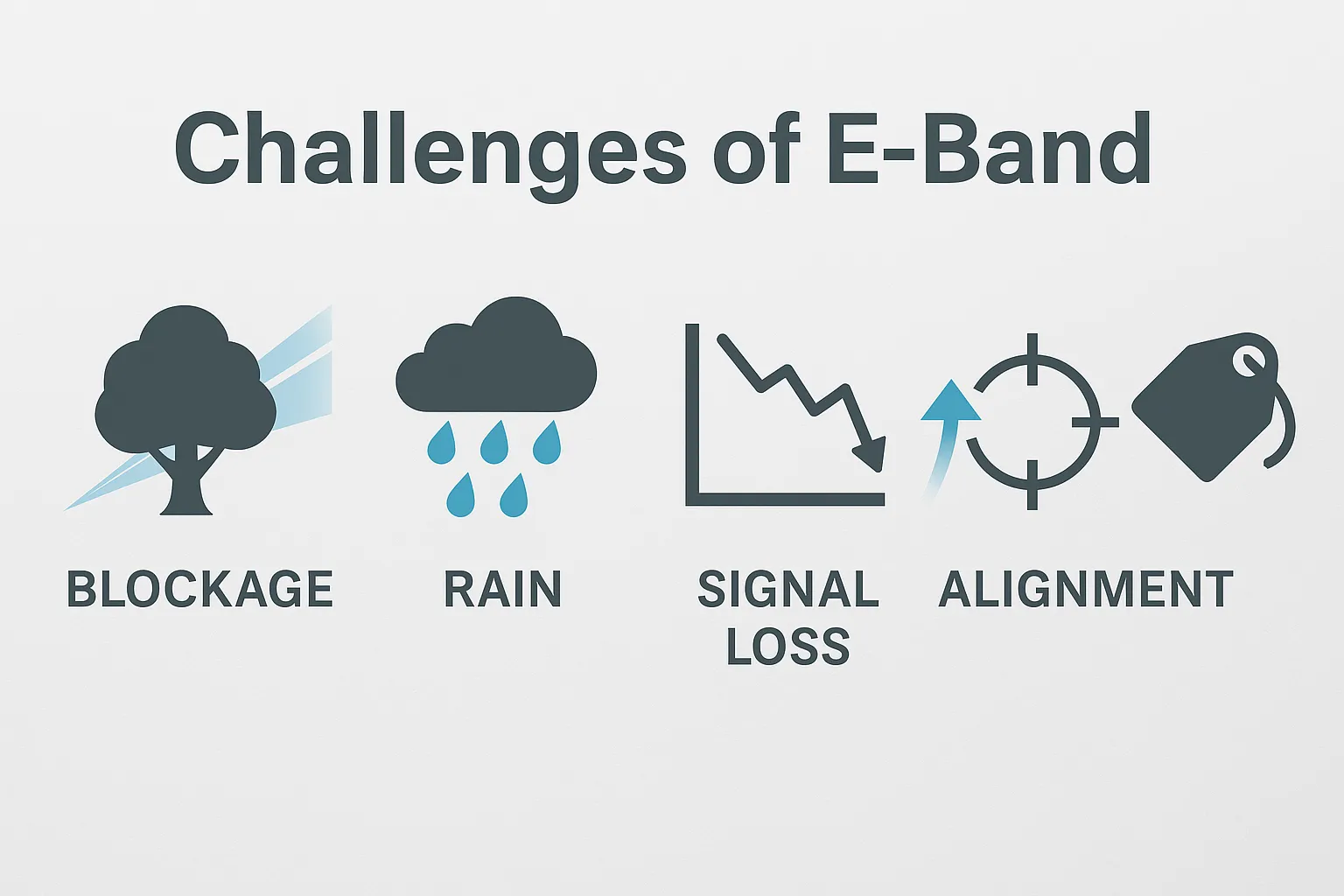
This image outlines the challenges of E-Band usage, including susceptibility to heavy rain attenuation, limited effective range compared to lower frequency bands, and the need for precise antenna alignment in point-to-point deployments.
1. Shorter Range Compared to Lower Bands
While it can reach a few kilometers, E-band is still a line-of-sight sprinter — a single tree, crane, or truck in the wrong place can bring it to a standstill.
2. Weather Sensitivity
Tropical downpour? Expect temporary signal fade. Engineers often shorten hop lengths or build in fade margins in high-rainfall zones to keep availability high.
3. Higher Free-Space Path Loss
At mmWave frequencies, the signal weakens faster over distance. High-gain antennas help, but physics sets a hard limit — you can’t cheat the air.
4. Precision Alignment Required
Those laser-like beams don’t forgive sloppy aim. Even a slight pole sway in the wind can cause a noticeable drop in throughput, so skilled installation is a must.
5. Cost and Hardware Complexity
Although prices are coming down, E-band gear still costs more than many sub-40 GHz options. The components are intricate, often pushing manufacturing tolerances to the millimeter.
E-Band and mmWave 5G Networks

This diagram highlights E-Band’s role as a high-capacity backbone in mmWave 5G networks, efficiently linking dense small cell deployments to core network nodes.
1. Not for Phones (Yet)
Today’s 5G NR handsets top out below E-band’s 71–86 GHz range. For now, you’ll find E-band in the network’s backbone, not in your smartphone’s radio.
2. The Backbone for mmWave 5G
Picture a city with hundreds of small cells — each one needs multi-gigabit backhaul. Running fiber to all of them would take years. E-band closes that gap in weeks, beaming data between rooftops and aggregation points.
3. Why mmWave Needs It
Ultra-fast mmWave 5G comes with short coverage footprints. The more cells you deploy, the more high-capacity links you need. E-band acts as the expressway, carrying aggregated traffic where it’s needed most.
4. Looking Ahead
Industry chatter hints at E-band’s possible role in future 5G NR for fixed wireless access or specialty high-throughput links. If that happens, E-band could blur the line between backhaul and direct-to-user access.
Further Reading:
If you want a complete picture of how mmWave fits into today’s and tomorrow’s 5G landscape — from its benefits to its technical challenges — read our full What is mmWave? Millimeter Wave Frequency Guide. It’s the perfect companion to understanding E-band’s place in the high-frequency spectrum.
Conclusion
When you look at the wireless landscape today, E-band no longer feels like an exotic high-frequency experiment — it’s a working tool, woven quietly into the backbone of modern networks. In the space of just a few years, it’s gone from FCC allocation notes to rooftop dishes linking 5G small cells, corporate campuses, and even municipal camera networks. It delivers fiber-grade capacity without the asphalt dust and permit delays of laying cable, and in a world where data demand doesn’t wait, that agility is priceless.
Of course, the physics haven’t changed. E-band still demands a clear line-of-sight, still frowns at tropical downpours, and still asks installers to hit their alignment marks with millimeter precision. But network engineers have learned to work with those traits — shortening hops where rain is heavy, adding fade margins, or pairing E-band with other mmWave bands to create a resilient mesh. This is where V-band often comes in, handling the ultra-short links while E-band carries the heavier loads a few kilometers further.
What makes E-band compelling is not that it replaces fiber or magically ignores weather, but that it fills a gap no other wireless band can quite match: ultra-high throughput, deployed fast, with enough spectrum headroom to grow. As cities densify and operators chase both capacity and coverage, that role will only grow. In time, we may see E-band step beyond backhaul into fixed wireless access, satellite downlinks, or even future 5G NR releases — scenarios that blur the line between infrastructure and access.
If you want the wider context — how these frequencies fit into the broader mmWave story — our What is mmWave? Millimeter Wave Frequency Guide walks through the physics, the possibilities, and the pitfalls. And for a closer look at its shorter-range cousin, see the V-Band 60 GHz mmWave WiGig Backhaul Guide, which explains how the two work side by side in real-world networks.
Bonfon Office Building, Longgang District, Shenzhen City, Guangdong Province, China

A China-based OEM/ODM RF communications supplier
Table of Contents
Owning your OEM/ODM/Private Label for Electronic Devices andComponents is now easier than ever.