
A connector can fit perfectly and still create problems later.
A common situation in RF testing is connecting a compact device with an SMA port to an antenna cable or test cable using an N Type interface. The first sample usually looks simple: install an adapter, tighten the thread, check the signal, and continue testing.
The trouble appears when the system moves from a short bench connection to a real application.
A longer coaxial cable is added. The adapter is installed near a vibration point. The operating frequency moves closer to the upper limit. Suddenly the return loss changes, the VSWR is higher than expected, or the SMA port starts carrying mechanical stress from a heavier cable.
This is why selecting an sma to n adapter is not only a matter of matching two connector names. The adapter becomes part of the RF path, and its interface type, gender, impedance, frequency capability, and installation position all affect the final result.
How Do You Connect SMA Equipment With N Type RF Systems?
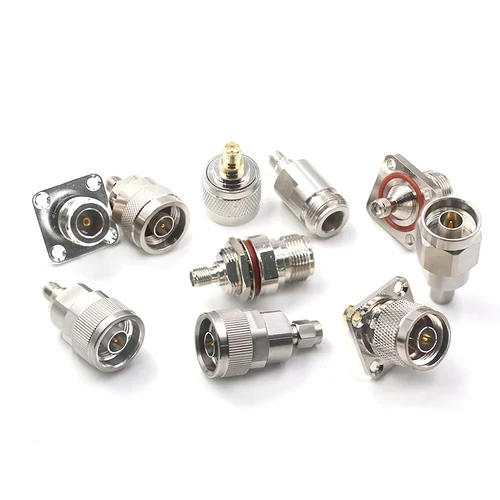
A variety of RF adapter connectors designed for signal conversion between different coaxial interfaces. Suitable for RF laboratories, communication equipment, antenna testing, and microwave applications.
SMA and N Type connectors often appear together because they are used on different sides of an RF system.
A compact RF module may use SMA because the equipment designer needs a smaller interface. A test cable, antenna feeder, or outdoor RF connection may use N Type because the larger connector is easier to handle and better suited for mechanical loads.
The adapter solves one problem: interface conversion.
It does not solve everything else.
For example, an adapter cannot compensate for:
- incorrect cable impedance;
- excessive cable attenuation;
- poor antenna matching;
- unsuitable frequency range;
- damaged connector interfaces.
This point is easy to miss during purchasing. A connector assembly can pass a simple continuity check and still perform poorly at RF frequencies.
A buyer looking for a replacement should provide more than “need SMA to N adapter”.
A practical specification normally includes:
| Required Information | Example |
| SMA side | Male or Female |
| N Type side | Male or Female |
| Impedance | 50Ω |
| Frequency | DC–6 GHz / higher if required |
| Application | Antenna, VNA testing, RF equipment |
| Installation | Indoor, outdoor, panel, cable connection |
Without this information, two suppliers may quote completely different products while both appear to meet the same request.
Why Do SMA and N Type Interfaces Require Different Adapter Structures?
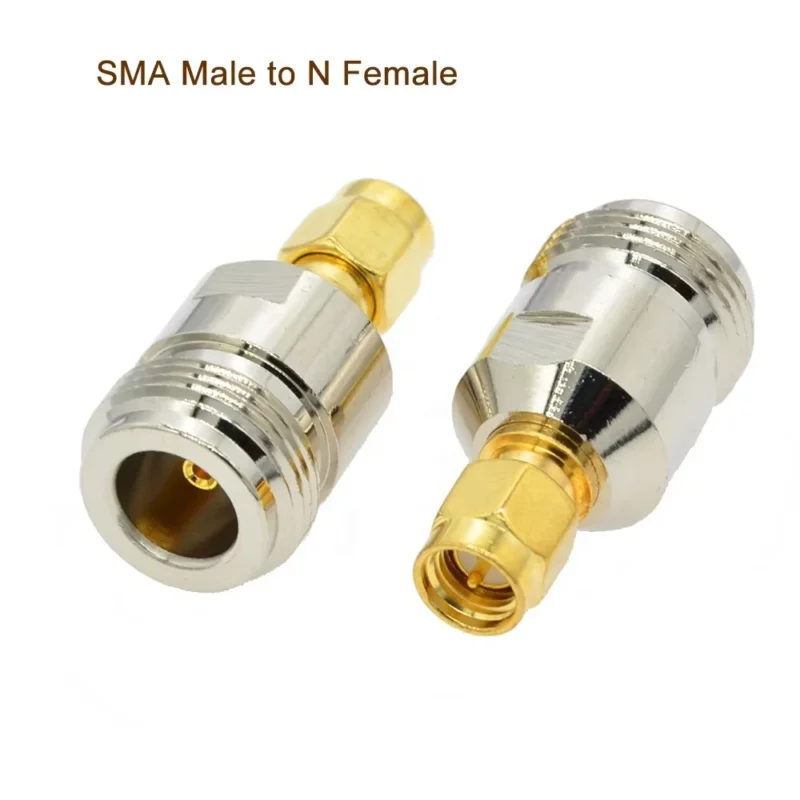
SMA and N Type are both threaded RF interfaces, but their mechanical roles are different.
SMA was developed for compact microwave connections. It is frequently found on:
- RF modules;
- wireless development boards;
- measurement equipment ports;
- compact communication devices.
N Type is physically larger and is commonly selected for:
- antenna feeders;
- communication systems;
- outdoor RF links;
- larger coaxial cables.
The difference becomes noticeable when cable weight and installation conditions are considered.
An N Type cable is usually much larger than an SMA cable. If a heavy cable is connected through a small adapter directly to an SMA equipment port, the connector may experience sideways force.
The RF signal may still work.
The mechanical reliability may not.
For temporary laboratory testing, this arrangement is often acceptable because the setup is controlled and the cable is supported.
For permanent installations, engineers usually need to consider:
- cable support method;
- connector mounting strength;
- vibration conditions;
- mating frequency;
- environmental exposure.
A simple adapter connection is sometimes the right choice. In other cases, an SMA to N cable assembly may reduce mechanical stress by moving the transition point away from the equipment port.
How Should You Check SMA Male, SMA Female, N Male, and N Female Before Ordering?
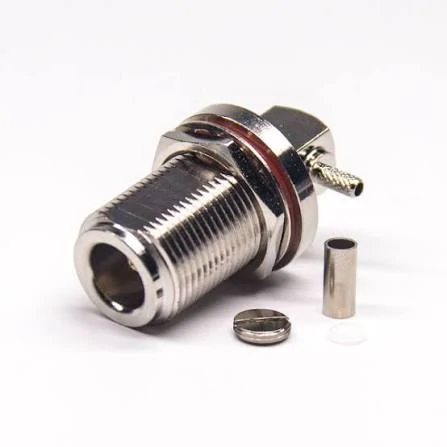
This SMA to N adapter features a panel mount structure with threaded coupling, suitable for RF equipment, antenna systems, and microwave testing applications. The adapter helps connect different connector standards while maintaining a stable 50Ω signal path.
Many incorrect RF adapter purchases come from ignoring connector gender.
The product name may look correct, but the physical interface may not mate with the existing equipment.
For SMA:
- SMA male normally has a center pin;
- SMA female normally has a socket contact.
For N Type:
- N male normally has a center pin;
- N female normally has a socket contact.
Before ordering an adapter, check both sides of the connection.
This is also why terms such as:
- sma to n adapter;
- n type to sma adapter;
- n to sma adapter;
can describe similar conversion requirements but may refer to different installation directions.
For procurement teams, the safest method is to describe the complete connection:
SMA male to N female adapter, 50Ω, for connecting RF module output to N Type coaxial cable.
What Should Engineers Check Before Replacing an SMA to N Adapter?
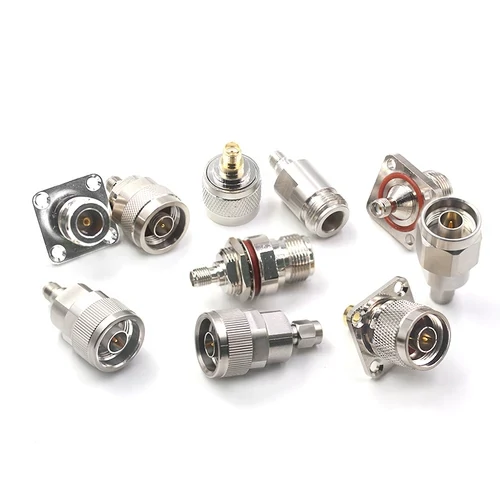
A variety of RF adapter connectors designed for signal conversion between different coaxial interfaces. Suitable for RF laboratories, communication equipment, antenna testing, and microwave applications.
Replacing an adapter with a visually similar part is a common RF sourcing mistake.
Two adapters may have the same external dimensions but different internal designs.
Differences may include:
- center contact structure;
- dielectric material;
- plating thickness;
- machining tolerance;
- frequency rating;
- assembly method.
At lower frequencies, these differences may not immediately appear.
Near microwave frequencies, small mechanical variations can affect RF behavior.
A basic replacement check should include:
| Check Item | Reason |
| Interface direction | Prevent wrong mating structure |
| Connector gender | Confirm mechanical fit |
| Impedance | Maintain 50Ω RF path |
| Frequency range | Avoid operation near limit |
| Cable type | Match mechanical and electrical requirements |
| Test requirement | Confirm VSWR / insertion loss if needed |
For engineering samples, a quick connection test may be enough.
For production use, the adapter specification should be recorded in the BOM or assembly drawing.
The connector that fits today is not always the connector that will perform consistently after thousands of production cycles.
How Does 50Ω Matching Affect SMA to N Adapter Selection?
The adapter may be mechanically correct and still create an RF problem.
This usually happens when the connector conversion is treated as an isolated part instead of part of the entire transmission path.
An SMA interface, an adapter, an N Type cable, and the final RF equipment should normally work as one 50Ω system.
Each transition adds another interface.
At low frequencies, a small mismatch may not be obvious. Near the upper operating range, the same mismatch can appear as higher reflection, unstable measurements, or reduced system margin.
This is why an RF adapter should be selected together with:
- operating frequency;
- cable specification;
- connector quality;
- required VSWR;
- measurement accuracy.
Why Is 50Ω Impedance Important in SMA and N Type Connections?
Most RF SMA and N Type systems used for communication and testing are based on 50Ω impedance.
When impedance changes unexpectedly, part of the RF energy can reflect back toward the source.
Engineers usually observe this through parameters such as:
- VSWR;
- return loss;
- insertion loss.
A simple adapter replacement may appear acceptable because the connector can be tightened normally.
However, RF performance depends on the internal structure.
Important factors include:
- center contact alignment;
- dielectric support;
- machining accuracy;
- connector interface condition;
- frequency rating.
A continuity test only confirms that the electrical path is connected.
It does not confirm that the RF transition is optimized.
This difference becomes important during production sourcing.
A supplier may provide an SMA to N adapter that physically fits the system, but the engineering requirement may actually need a specific frequency range or test result.
How Should Cable Compatibility Be Checked Before Using an SMA to N Adapter?
The adapter is only one part of the assembly.
The connected cable also determines whether the RF connection is suitable.
For example, an N Type adapter connected to a large low-loss cable may be used in an antenna installation.
The same adapter may be connected to a small flexible cable for laboratory testing.
The connector interface is identical, but the mechanical and electrical conditions are different.
Before selecting an adapter, check:
| Item | Question to Confirm |
| Cable impedance | Is the cable 50Ω? |
| Cable diameter | Does the connector match the cable structure? |
| Frequency range | Is the cable suitable for the target band? |
| Attenuation | Is signal loss acceptable at required length? |
| Installation | Will the cable create mechanical stress? |
A common mistake is choosing the adapter first and checking the cable later.
The better approach is to define the complete RF chain first.
For example:
Incorrect specification
Need SMA to N adapter.
How Does an SMA to N Adapter Affect RF Testing Results?
Adapters are frequently used in laboratories because they allow different equipment standards to be connected without changing the entire setup.
A typical example:
- RF analyzer with SMA port;
- calibration cable with N Type connector;
- SMA to N adapter used as the transition point.
This setup is practical.
The problem is that every additional connection becomes part of the measurement system.
Why Can Extra Adapters Change Measurement Results?
In RF testing, the adapter is not invisible.
It may introduce:
- insertion loss;
- additional reflection;
- calibration uncertainty;
- mechanical repeatability issues.
For general signal connection, these effects may be acceptable.
For precision measurement, they need to be considered.
A VNA test setup may evaluate:
- S11;
- S21;
- VSWR;
- return loss;
- insertion loss.
For example, if an engineer is measuring a cable assembly near its maximum frequency, adding multiple adapters between the VNA port and the device under test can affect the measurement result.
The issue is not that adapters should be avoided.
The issue is that their quantity and specification should be controlled.
When Should You Verify an SMA to N Adapter With a VNA?
A VNA check is usually considered when:
- the operating frequency is high;
- the RF margin is small;
- the product is used in test equipment;
- repeatability between assemblies matters.
For production purchasing, the inspection requirement should be defined before mass ordering.
A useful specification example:
SMA male to N female adapter, 50Ω, operating frequency DC–18GHz, VSWR verification required before shipment.
This avoids disagreement after delivery.
What Should Be Checked Before Accepting an SMA to N Adapter Shipment?
A connector supplier and a buyer may evaluate the same adapter differently.
A buyer may focus on whether the connector mates.
An RF engineer may focus on whether the part behaves correctly at the target frequency.
A practical incoming inspection can include:
SMA to N Adapter RF Validation Checklist
| Parameter | Record |
| Adapter Direction | SMA / N conversion direction |
| SMA Gender | Male / Female |
| N Gender | Male / Female |
| Impedance | 50Ω |
| Frequency Range | Required MHz/GHz range |
| VSWR | Measured value |
| Return Loss | dB result |
| Insertion Loss | dB result |
| Test Equipment | VNA / RF analyzer |
| Final Result | Pass / Fail |
This type of record is especially useful for repeat purchases.
The same part number may be ordered months later by another engineer or purchasing team. Without a clear specification, substitutions can happen accidentally.
When Should You Use an SMA to N Adapter Instead of a Cable Assembly?
The choice between an adapter and a cable assembly depends on how the RF connection will be used.
An adapter is flexible.
A cable assembly is usually more stable.
Neither option is automatically better.
The correct choice depends on the installation.
When Is an Adapter the Better Choice?
An SMA to N adapter is suitable when the connection needs to be changed temporarily.
Typical examples:
- laboratory testing;
- prototype development;
- equipment evaluation;
- troubleshooting.
Advantages:
- easy replacement;
- reusable;
- supports different equipment combinations.
For engineers working with multiple RF instruments, adapters reduce the number of dedicated cables required.
A test laboratory may keep several adapter combinations because equipment interfaces are not always identical.
When Is an SMA to N Cable Assembly a Better Solution?
A cable assembly is usually preferred when the connection becomes part of the final product or installation.
Examples:
- antenna systems;
- communication equipment;
- fixed RF links;
- production assemblies.
A cable assembly reduces the number of connection points.
Fewer interfaces generally mean fewer mechanical joints and fewer possible failure points.
Adapter vs Cable Assembly Decision Matrix
| Condition | Better Choice | Reason |
| Temporary laboratory setup | Adapter | Fast interface conversion |
| Prototype testing | Adapter | Easy configuration changes |
| Heavy N Type cable connection | Cable assembly | Reduce SMA port stress |
| Outdoor antenna installation | Cable assembly | Better mechanical stability |
| Production equipment | Cable assembly | Repeatable installation |
| Frequent equipment changes | Adapter | Flexible replacement |
A practical rule:
Use an adapter when flexibility matters.
Use a cable assembly when stability matters.
The decision should also consider cable weight, vibration, installation access, and expected mating cycles.
How Do SMA to N Adapters Compare With Other RF Conversion Options?
SMA to N is not the only RF conversion choice.
During equipment development, engineers often face several possible transitions:
- SMA to N;
- SMA to BNC;
- SMA to TNC;
- SMA to PL259;
- custom RF cable assemblies.
The correct option depends on the equipment interface and application environment.
A common mistake is selecting a conversion adapter because the connector looks similar.
RF connectors are not interchangeable only because the threads match or the cable can be physically attached.
The operating frequency, impedance, mechanical environment, and purpose of the connection should decide the final selection.
How Does SMA to N Compare With N Type to SMA Adapters?
The difference between SMA to N and N Type to SMA is mainly the installation direction.
The connector standards are the same on both sides.
The question is:
Which interface exists on the equipment side?
For example:
A measurement device has an SMA female port.
The existing cable has an N male connector.
The required adapter needs to provide the correct mating structure between these two interfaces.
The product description should therefore focus on the actual connection:
| Existing Equipment | Cable Interface | Suitable Description |
| SMA port | N cable | SMA to N adapter |
| N port | SMA cable | N Type to SMA adapter |
| SMA test equipment | N calibration cable | SMA to N adapter |
| N antenna system | SMA module | N to SMA adapter |
The wording may vary between suppliers.
The physical connection requirement does not.
How Does SMA to N Compare With SMA to BNC Adapters?
This makes them convenient for laboratory equipment, instruments, and lower-frequency applications where fast connection is useful.
SMA uses threaded coupling and is commonly selected when a smaller microwave connection is required.
A simplified comparison:
| Adapter Type | Common Application | Main Consideration |
| SMA to N | Antenna systems, RF links, microwave testing | Frequency and mechanical durability |
| SMA to BNC | Test instruments, laboratory equipment | Interface compatibility |
| SMA to TNC | RF communication equipment | Threaded RF transition |
| SMA to PL259 | Radio equipment applications | Frequency limitation and cable matching |
The adapter choice should follow the system requirement rather than the availability of a connector.
Why Should SMA to PL259 Conversion Be Evaluated Carefully?
PL259 connectors are frequently seen in amateur radio and traditional radio antenna systems.
A PL259 conversion may be suitable for some radio applications, but it should not automatically replace an N Type connection.
The main differences include:
- mechanical structure;
- frequency capability;
- cable compatibility;
- RF application.
For higher-frequency communication or measurement systems, N Type is often considered because it better matches many RF coaxial applications.
How Are SMA to N Adapters Used in Antenna and Communication Systems?
Many SMA to N applications appear where compact electronics need to connect with external RF infrastructure.
A typical example is a wireless device with an SMA interface connected to an antenna cable using N Type hardware.
Common applications include:
- wireless communication equipment;
- RF module evaluation;
- SDR development;
- antenna testing;
- communication system maintenance.
How Do Engineers Use SMA to N Adapters During RF Development?
During prototype development, hardware teams often use different RF components from different suppliers.
The module may already have an SMA connector.
The antenna system may already use N Type cabling.
Replacing either side can increase cost and delay.
An adapter provides a practical transition while the design is being evaluated.
A permanent product may benefit from a dedicated cable assembly instead.
What Information Should Be Recorded for Repeatable RF System Design?
RF teams often encounter problems when a prototype works but the next batch uses a slightly different component.
A simple part description such as:
“SMA-N adapter”
is difficult to reproduce.
A better record includes:
| Specification | Example |
| Interface A | SMA Male |
| Interface B | N Female |
| Impedance | 50Ω |
| Frequency Range | DC–18GHz |
| Application | RF testing |
| Quantity | Production requirement |
| Inspection | VSWR / appearance check |
This information helps purchasing teams avoid accidental substitutions.
It also allows suppliers to understand whether the part is intended for:
- laboratory testing;
- antenna installation;
- production equipment;
- field replacement.
How Should You Specify an SMA to N Adapter When Purchasing?
Many purchasing problems start from incomplete descriptions.
The supplier may receive:
Need SMA N adapter.
The problem is that several products could match this description.
A complete RF purchasing request should include:
- SMA gender;
- N gender;
- impedance;
- frequency range;
- body style;
- application;
- quantity;
- inspection requirement.
A practical BOM description could look like:
SMA male to N female adapter, 50Ω, DC–6GHz, threaded coupling, for RF antenna measurement equipment.
For a higher-frequency test application:
SMA female to N male adapter, 50Ω, DC–18GHz, low VSWR requirement, for VNA measurement setup.
These descriptions reduce communication errors between engineering and purchasing teams.
FAQ
Are SMA and N Type connectors always 50Ω?
Most RF SMA and N Type connectors used for communication and testing are 50Ω versions.
However, the specification should always be confirmed before assembly because connector families may have different impedance versions or application requirements.
Does an SMA to N adapter need to match the cable frequency range?
Yes. The adapter should be selected according to the highest operating frequency of the complete RF path.
A part that works correctly at lower frequencies may not provide the same results near its upper frequency limit. When selecting an adapter, engineers should consider frequency range together with cable type, VSWR requirement, and measurement accuracy.
Can an SMA to N adapter be used with any N Type coaxial cable?
Not always.
The N Type interface only describes the connector style. The cable itself still needs to match the application.
Engineers normally check whether the cable is 50Ω, whether its frequency range covers the working band, and whether the cable size creates mechanical stress on the adapter or equipment port.
For example, a large N Type cable used in an antenna installation and a small flexible cable used in a test bench may require different considerations even when the connector interface is the same.
Why does an SMA to N adapter affect VSWR measurements?
Because the adapter becomes part of the RF path.
During VNA testing, the adapter is located between the instrument port and the device under test. Any additional interface may introduce small changes in insertion loss, reflection, or calibration conditions.
For general connections, this effect may be acceptable.
Final Practical Note Before Ordering
An SMA to N adapter is a small component, but it sits directly inside the RF signal path.
The most common sourcing mistakes are not caused by the connector name itself. They usually come from missing details:
- wrong gender;
- wrong conversion direction;
- unsuitable frequency range;
- incorrect cable matching;
- unnecessary adapter stacking.
For simple laboratory conversion, a standard adapter may be enough.
For production systems or higher-frequency applications, the better approach is to define the complete RF requirement first:
- operating frequency;
- cable type;
- connector interfaces;
- impedance;
- mechanical environment;
- inspection target.
If the assembly will operate close to the upper frequency range, providing the supplier with the complete RF path information helps determine whether a standard SMA to N adapter is suitable or whether a dedicated cable assembly would be a better option.