
What Is an N-Type Connector? 50Ω vs 75Ω, Uses & Tips
Aug 27,2025
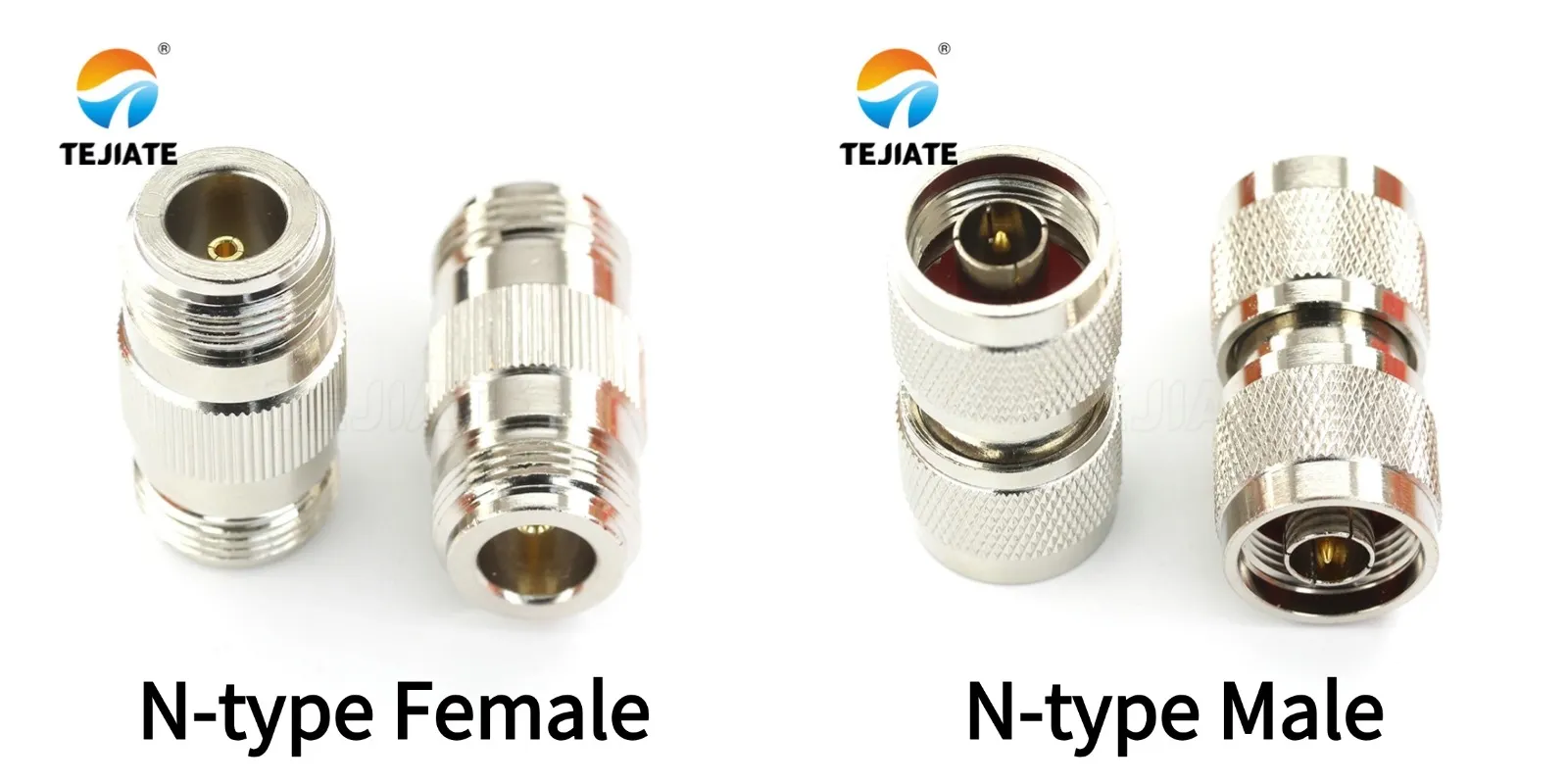
Clean side-by-side photo highlighting the center pin (male) and the receptacle (female) with threaded coupling.
Definition: An N-Type connector is a threaded RF interface for outdoor, higher-power links in 50 Ω or 75 Ω systems.
the N-Type connector is the workhorse for outdoor RF and higher-power links. It’s threaded (stable), relatively large (easy to handle), and—when specified correctly—stays consistent from VHF through microwave bands. If your job involves rooftop antennas, long coax runs, or telecom cabinets, this guide is for you.
Why engineers pick N-Type
- Threaded coupling = secure mating under vibration and weather.
- Available in 50 Ω (telecom/RF data) and 75 Ω (broadcast/video).
- Robust body size makes on-site installs and troubleshooting less finicky.
- Pairs well with low-loss cables (LMR-240/400/600) for longer outdoor runs.
- Easy to adapt to SMA/BNC via N↔SMA or N↔BNC.
- Minimize adapters: every extra joint adds tiny loss and another failure point.
What Is an N-Type Connector?
An N-Type connector is a threaded RF coaxial interface designed for stable, low-loss connections with solid power handling. In day-to-day terms: if your antenna lives outside—on a mast, tower, or rooftop—there’s a strong chance you’ll meet N-Type. Its size provides mechanical strength and helps maintain a consistent impedance, which protects link budget and VSWR.
You’ll see 50 Ω N-Type on RF data links (Wi-Fi backhaul, LTE/5G small cells, point-to-point radios, ham/land-mobile), and 75 Ω N-Type in certain video/broadcast chains. The threaded coupling resists accidental disconnects—handy when wind and temperature swings try to loosen everything you’ve carefully installed.
Why it exists: SMA is compact and reaches higher microwave bands, but it’s not always ideal for frequent field mating or high-power outdoor duty. BNC is quick, yet its bayonet lock isn’t as weather-tough. N-Type sits in the middle: robust, repeatable, and field-friendly. For a broader comparison, see SMA vs BNC vs N-Type later.
How N-Type Stays Stable
The N-Type’s threaded coupling nut pulls plug and jack together with steady axial pressure. Inside, precision contact geometry maintains the coax’s characteristic impedance through the interface. Quality parts also mind dielectric supports and plating (nickel, silver, gold on key areas), all targeting low contact resistance and long-term stability.
Traits practitioners care about:
- Full-thread engagement spreads load and reduces micro-motion under vibration.
- Repeatable mating helps keep return loss predictable across temperature swings.
- Size you can grip: in gloves, on ladders, or in light rain, the N-Type connector is simply easier to handle than tiny lab-grade interfaces.
Field note: Don’t chase torque myths. Follow the connector vendor’s datasheet for coupling-nut torque when moving from bench to tower installs.
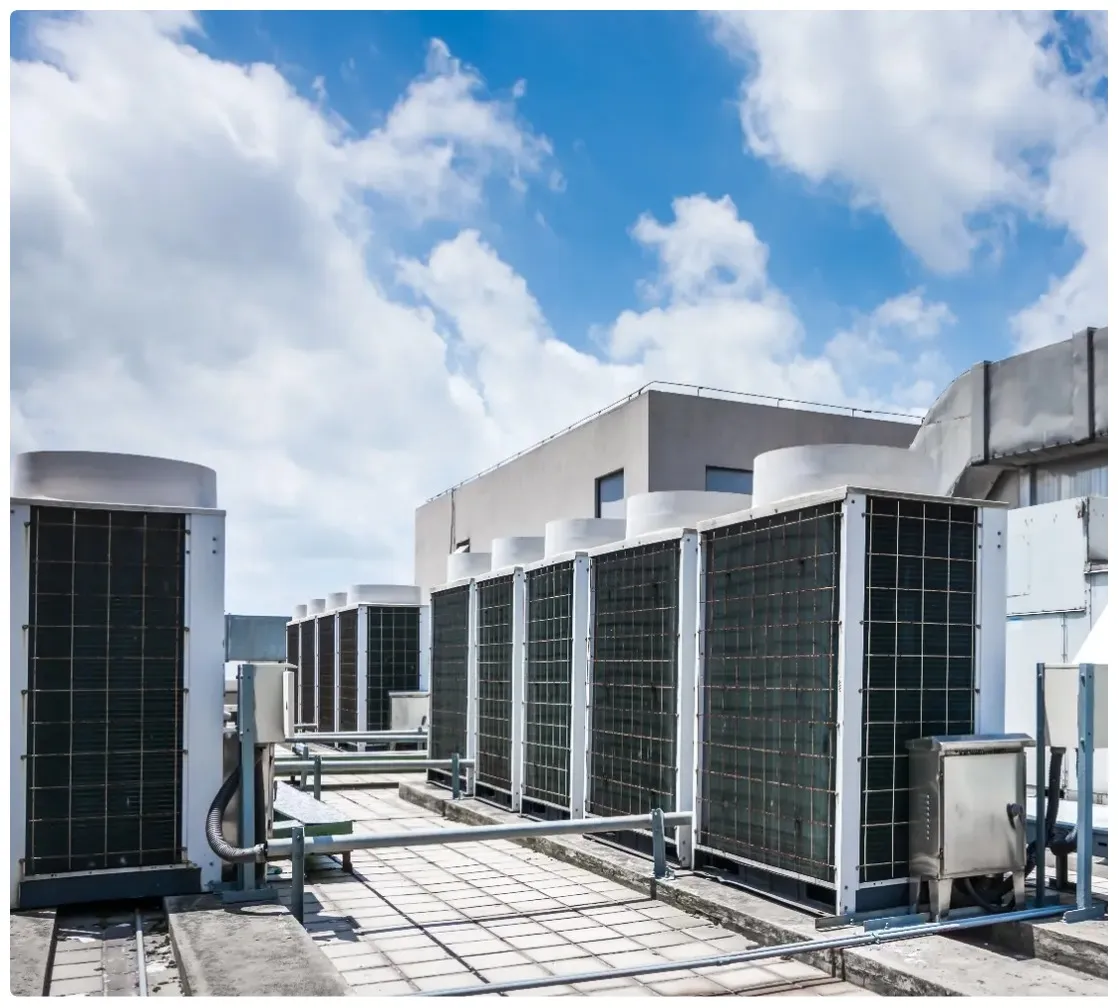
Wide rooftop shot showing industrial equipment and cable routing paths; used to illustrate outdoor conditions affecting RF cable loss and weatherproofing.
Weatherproofing
A correctly specified n type connector can last years outdoors—if you protect it. Moisture and galvanic corrosion raise losses and wreck matching.
Habits that pay off:
- O-ring & gasket integrity: Many outdoor N-Type jacks include seals; confirm presence and condition before install.
- Right-angle vs straight: On tight masts, a right-angle body can reduce strain and water pooling.
- Finish the joint: After mating, wrap self-amalgamating tape, then add a UV-resistant over-wrap or cold-shrink.
- Dissimilar metals: Mixed platings accelerate corrosion; prefer matched finishes and protective coatings.
Quick sanity check: if your “weatherproofing” is just vinyl electrical tape, expect a callback when the first storm hits.
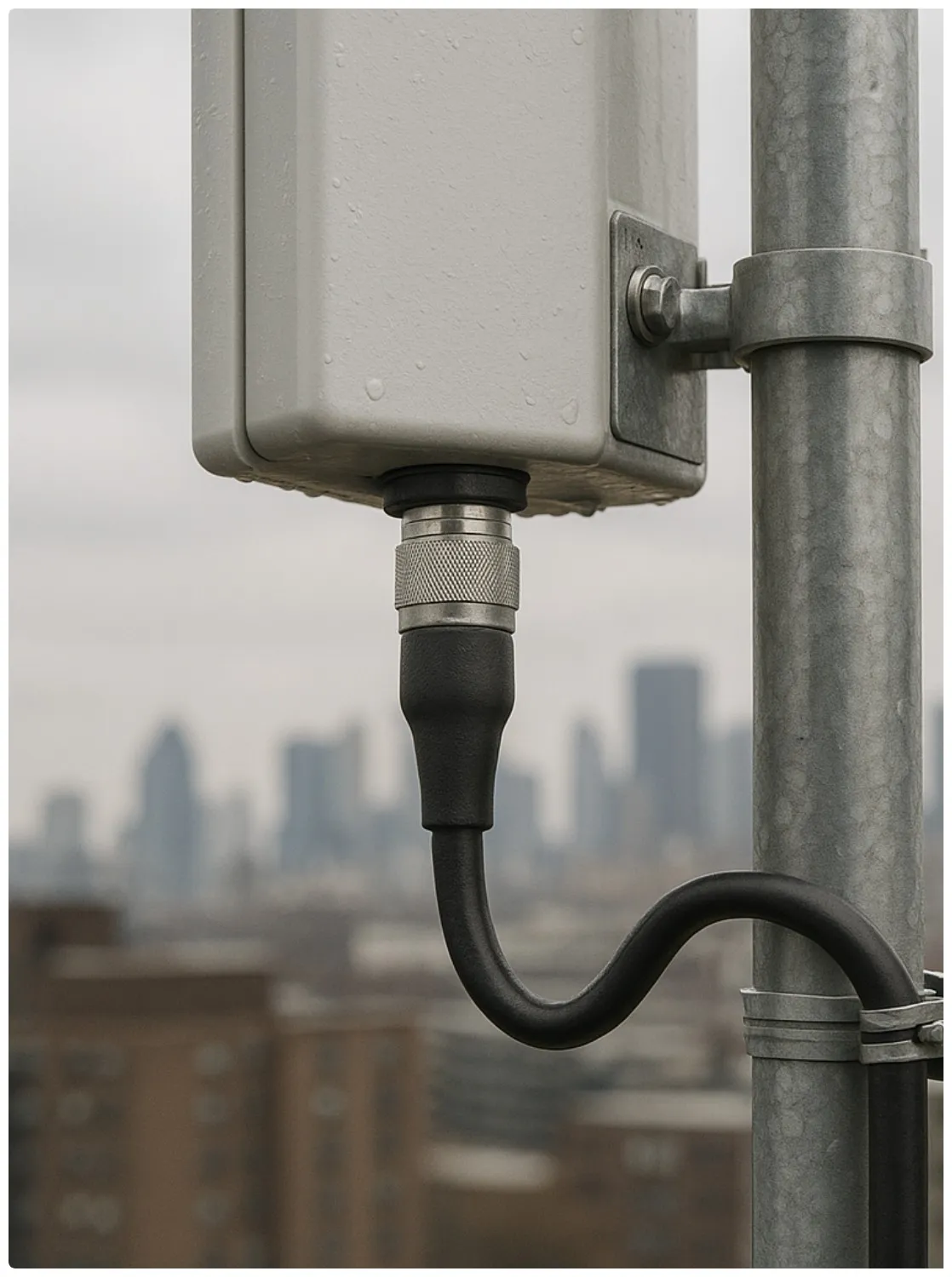
Step-by-step collage: clean joint → tape overlap → outer UV wrap/cold-shrink.
N type male connector vs n type female connector
In RF:
- Male (plug) has the center pin and the coupling nut you rotate.
- Female (jack) has the receptacle (socket) and panel/bulkhead features.
Avoid these confusions:
- “Female plug” isn’t a thing—don’t mix terms from other connector families.
- Vendors often use “jack” (female) / “plug” (male). Include a drawing or photo in your PO to prevent errors.
- Distinguish bulkhead female (panel-mount) vs inline female (cable). Both are “female,” but mechanics differ.
If your deployment mixes adapters (say N↔SMA), confirm sex at each end and polarity if SMA is RP-SMA on the Wi-Fi side. A refresher via a focused SMA primer helps.
Picking the Right Impedance
Rule of thumb:
- 50 Ω N-Type → two-way radios, WLAN backhaul, cellular, test links, general RF data.
- 75 Ω N-Type → certain broadcast/video paths and long coaxial video runs.
Can they physically mate? Often yes. Should they? No. Mismatching 50 Ω with 75 Ω degrades return loss and eats link margin. On paper it might “work,” but you’ll spend that margin you could’ve kept.
Sanity tip: On inherited systems, measure or trace the chain. One stray 75 Ω jumper inside a 50 Ω run turns performance into a shrug emoji.
Cable Pairing & Loss
Connectors don’t live alone—cable choice dominates total loss on long runs. That’s why you’ll see the N-Type connector paired with LMR-240/400/600 or other low-loss coax outdoors.
What experienced installers do:
- Short indoor patch (few feet): RG-58 or RG-142 can be fine.
- Medium outdoor hops (10–50 m): LMR-240 or LMR-400 to keep dB/km in check.
- Longer backhaul or lower-frequency, higher-power work: LMR-600 or larger, if bend radius/weight allow.
Practical aside: every extra adapter is an extra tiny loss—and a moisture risk. Plan lengths so the chain stays clean: one connector at each end, no ornaments. Consider inline lightning/surge arrestors near the entry point and bond to the site ground per code.
Table A — Frequency × Distance × Cable
Use this as a conversation starter, not a hard rule. Always check radio/antenna/cable datasheets.
| Typical Use Case | Band Frequency | Run Length | Suggested Cable Family | Connector Pairing |
|---|---|---|---|---|
| Rooftop AP to indoor rack | 2.4/5 GHz | 10–20 m | LMR-240 / LMR-400 | N-Type outdoors; adapt to SMA/BNC inside as needed |
| Point-to-point pole mount | 5–7 GHz | 20–50 m | LMR-400 | N-Type both ends if supported; minimize adapters |
| VHF/UHF base station | 150 / 450 MHz | 20–60 m | LMR-400 / LMR-600 | N-Type; add lightning arrestor with N pass-through |
| L-band GPS radiator | 1–2 GHz | 10–30 m | LMR-240 / LMR-400 | N-Type to masthead; SMA inside equipment if required |
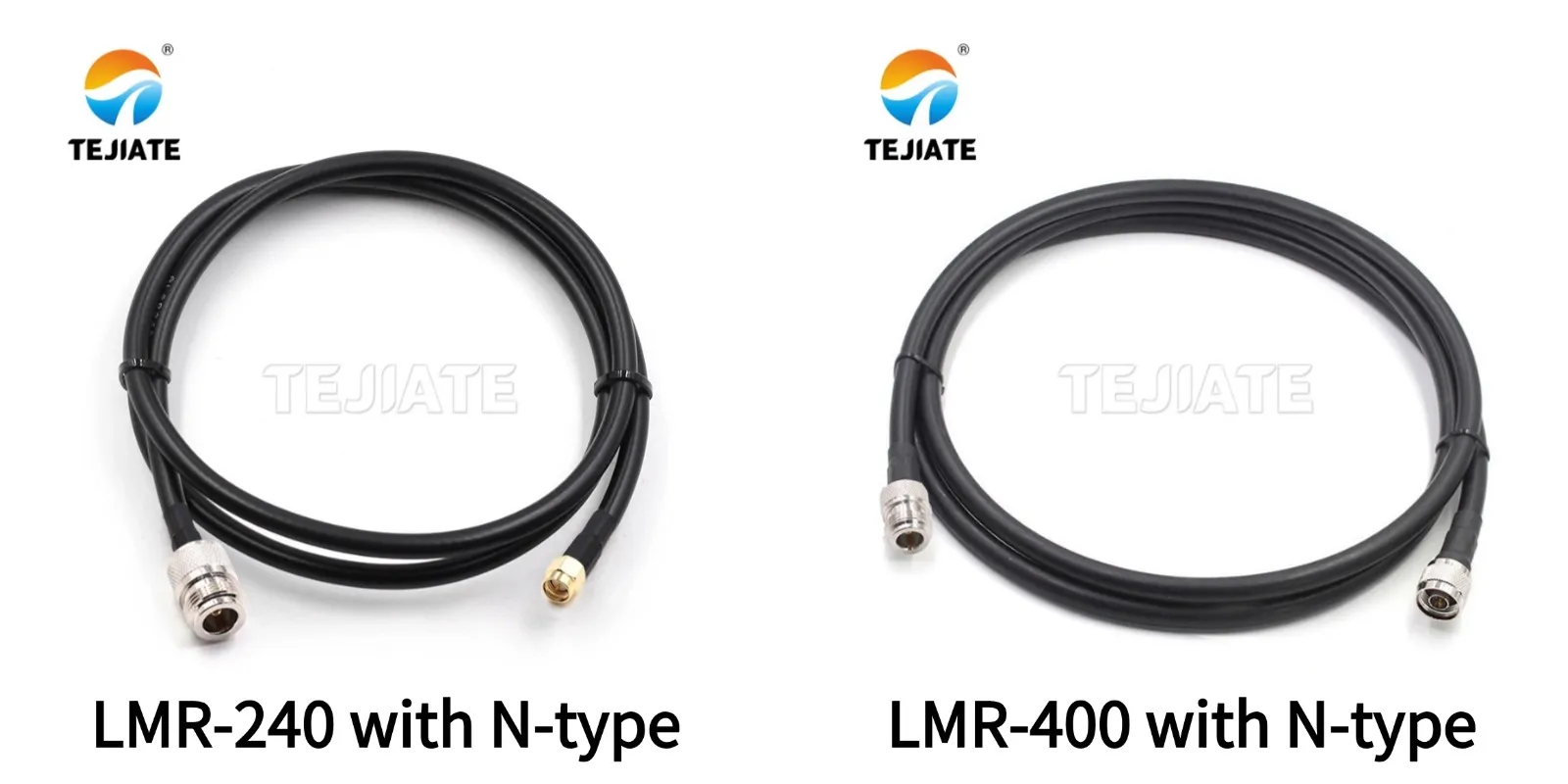
Side-by-side coils or cross-sections of LMR cables terminated with N-Type.
7) N-Type vs SMA vs 4.3-10 vs 7/16 DIN
You’ll encounter all four in telecom and pro-RF. Each solves a different problem.
- SMA: compact, precision threaded, great up to microwave; less friendly to frequent field mating or very high power.
- N-Type: sturdy outdoor all-rounder; glove-friendly; common on antennas and surge protection.
- 4.3-10: modern cellular, compact with low PIM; designed for dense base-station hardware.
- 7/16 DIN: large legacy powerhouse; excellent PIM and power, but bulky/heavy.
Table B — Connector Family Comparison
A quick way to align connector choice with environment and constraints.
| Feature | N-Type | SMA | 4.3-10 | 7/16 DIN |
|---|---|---|---|---|
| Coupling | Threaded | Threaded | Threaded / Hand-tight | Threaded |
| Handling outdoors | Excellent | Fair (small) | Excellent | Good (bulky) |
| Typical use | Antennas, outdoor RF | Lab, modules, jumpers | Cellular RRUs, base stations | Legacy macro sites |
| Size/weight | Medium | Small | Medium-small | Large |
| Power handling | High (outdoor) | Moderate | High, low PIM | Very high, low PIM |
| Adapter ecosystem | Rich (N-SMA/BNC) | Vast | Telecom-focused | Telecom-focused |
Not sure what to pick for a mixed environment—say, an outdoor antenna feeding an indoor bench? Start at the antenna with N-Type for weatherproofing, then step down to SMA at the rack. Keep adapters to a minimum, and keep them indoors where they’re dry.
Adapters & Conversions

Side-by-side photo of N-Type female–female and male–male barrel adapters with 5/8-24 UNEF thread drawings; dimensions are typical and may vary by vendor.
Adapters exist for nearly every pair. The two you’ll use most:
- N to SMA adapter / pigtail — common when the antenna port is N-Type but the radio/instrument is SMA.
- N to BNC adapter — handy for test gear and certain surveillance/video paths.
Keep your link clean:
- Use as few adapters as possible. Each adds a tiny loss and a reflection point.
- Mind gender & impedance. A 50 Ω n type female connector to a 75 Ω BNC will “fit” via an adapter, but it’s not RF-clean.
- Quality matters. Cheap adapters can “hide” 1–2 dB. Good plating and repeatable geometry pay for themselves.
Termination & Installation
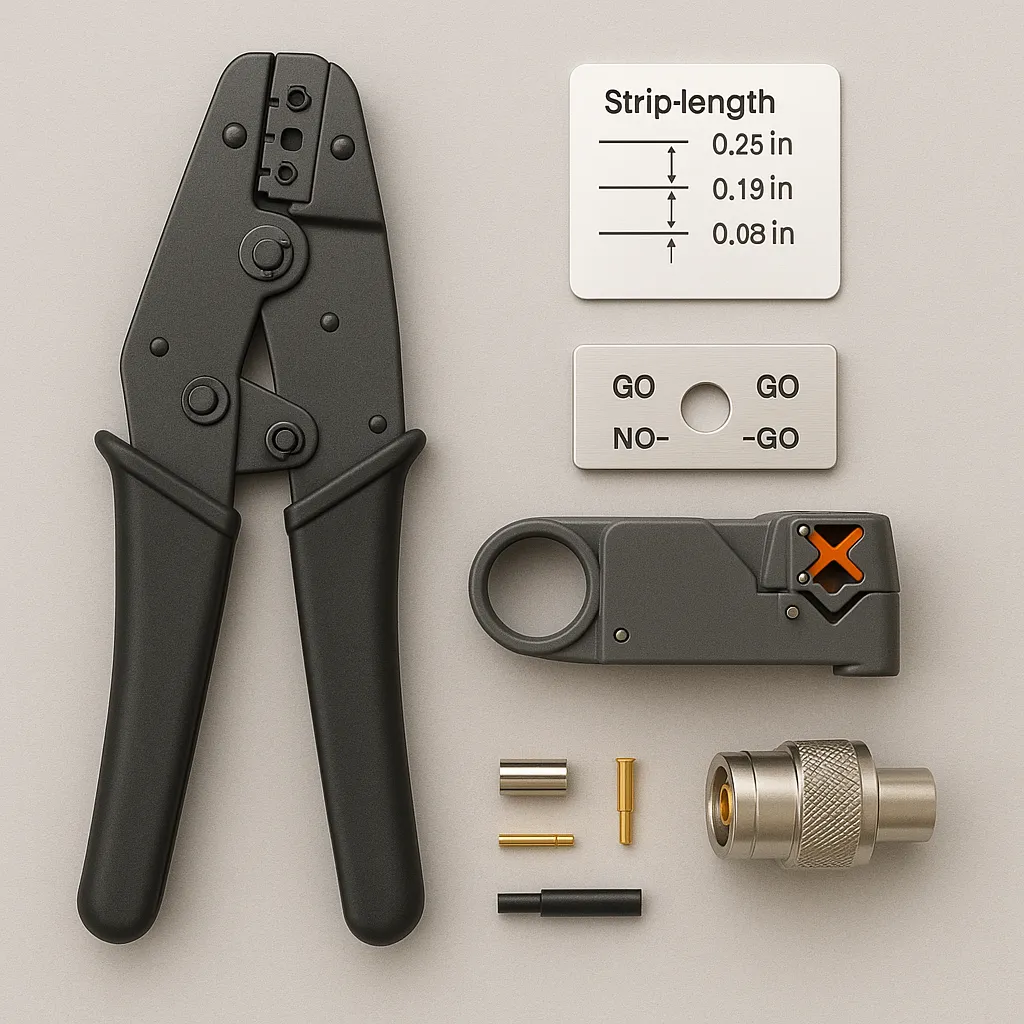
Flat-lay of crimp tool, stripper, strip chart card, and pin gauge near an N-Type connector.
Termination quality matters as much as connector choice. Poor strip lengths or uneven braid capture can spike VSWR and add intermittent faults that only show in rain.
- Crimp: repeatable with the right die set; fast in volume; verify hex size per BOM.
- Solder: excellent electricals if precise; slower; watch wicking to keep the joint flexible.
- Clamp/compression: common on certain cable families; mechanically robust; follow the vendor’s strip diagram religiously.
Pro move: use a calibrated stripper and a go/no-go gauge for the center-pin height. Consistent pin protrusion is the difference between “spec” and “almost.”
Grounding & Surge Protection
Where cables enter a building or cabinet, include inline lightning/surge arrestors with N-Type pass-through, bond them to the site ground, and respect bend radius on the down-lead. A clean ground path often fixes “mystery” failures after storms.
Buying Checklist
Before you hit “order,” walk through this list:
- Impedance — 50 Ω for RF data/comms, 75 Ω for video/broadcast. Don’t mix unless you’ve modeled the impact.
- Gender & form factor — n type male connector (plug) vs n type female connector (jack); straight vs right-angle; bulkhead vs inline.
- Environment — outdoor sealing features, plating suited to your climate, temperature range.
- Cable compatibility — match the connector variant to your exact cable SKU (dielectric OD, braid type, jacket). Connector kits are cable-specific.
- Compliance — PIM needs? Halogen-free jacket? Any site-specific standards?
- Accessories — weather boots, cold-shrink, arrestors, torque tools, spare n type to sma adapter. Skipping a $5 boot can cost a $500 truck roll.
Common Mistakes
- 50 Ω ↔ 75 Ω mismatches hidden in the chain, causing SNR and throughput swings.
- Forgetting strain relief on pole-mounted gear; wind fatigue breaks the center conductor over time.
- “It fits, ship it.” Using the wrong N-Type variant for your cable size—looks okay on day one, drifts later.
- Waterproofing with the wrong tape; tidy for a week, then capillary action invites water.
- Over-adapting between N↔SMA↔BNC; consolidate with a single high-quality pigtail.
- Winging strip lengths instead of following the connector’s strip chart.
FAQ
Q1: What’s the real advantage of an N-Type outdoors?
Mechanical stability. The threaded coupling and larger body keep the interface tight during temperature swings and vibration, and it’s easier to seal against rain and dust.
Q2: Can I mix 50 Ω and 75 Ω N-Type in a pinch?
It’ll likely mate, but it’s not best practice. Expect reflections and some performance loss—how much depends on frequency and the rest of the chain.
Q3: How do I connect an N-Type antenna to an SMA radio?
Use an n type to sma adapter or short pigtail. Keep adapter count low and choose reputable parts.
Q4: Do right-angle N-Type connectors perform worse?
Not inherently. Quality right-angles are fine within spec. They help when clearance is tight or to reduce strain on a vertical run.
Q5: How do I “weatherproof” properly?
Start with an O-ringed jack or weather-boot. After mating, apply self-amalgamating tape with proper overlap, then a UV-resistant over-wrap or cold-shrink. Avoid leaving the joint exposed.
Q6: Which cable for a 30 m 5 GHz link?
Common picks: LMR-240 or LMR-400, depending on your loss budget and bend-radius constraints. Plan the run before terminating.
Q7: Is N-Type obsolete compared to 4.3-10?
No. 4.3-10 shines in modern base stations with low-PIM requirements, but N-Type remains everywhere on antennas, outdoor radios, and lightning protection—thanks to its balance of cost, robustness, and availability.
Conclusion
When projects move out of the lab and into the weather, the N-Type connector earns its keep. It’s big enough to handle, strong enough to last, and—when paired with the right cable and sealing—quiet enough electrically that it disappears into the RF path. That’s the goal.
Choose 50 Ω vs 75 Ω with intent, match male/female and the cable SKU precisely, and keep adapters to a minimum. Do those boring things well, and you’ll spend your weekends off the tower.
Bonfon Office Building, Longgang District, Shenzhen City, Guangdong Province, China

A China-based OEM/ODM RF communications supplier
Table of Contents
Owning your OEM/ODM/Private Label for Electronic Devices andComponents is now easier than ever.