
A 0.250-inch tab can still be the wrong tab.
That sounds odd until a buyer receives a batch of female receptacles that slide on easily, pass a quick continuity check, and then loosen after a few service cycles. The width looked right. The product title said “spade connector.” The problem was hidden in the blade thickness, spring geometry, insertion depth, or a mismatch between the terminal and the actual equipment tab.
That is why a spade connector should not be selected by name alone. For real wiring work, you need to confirm the connector style, blade dimensions, terminal gender, wire gauge, insulation system, and the way the assembly will be maintained in the field.
Which “Spade Connector” Does the Job Actually Require?
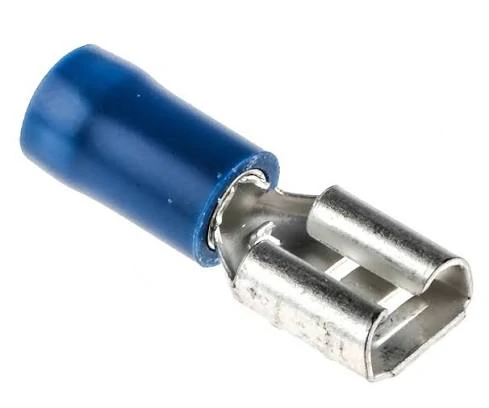
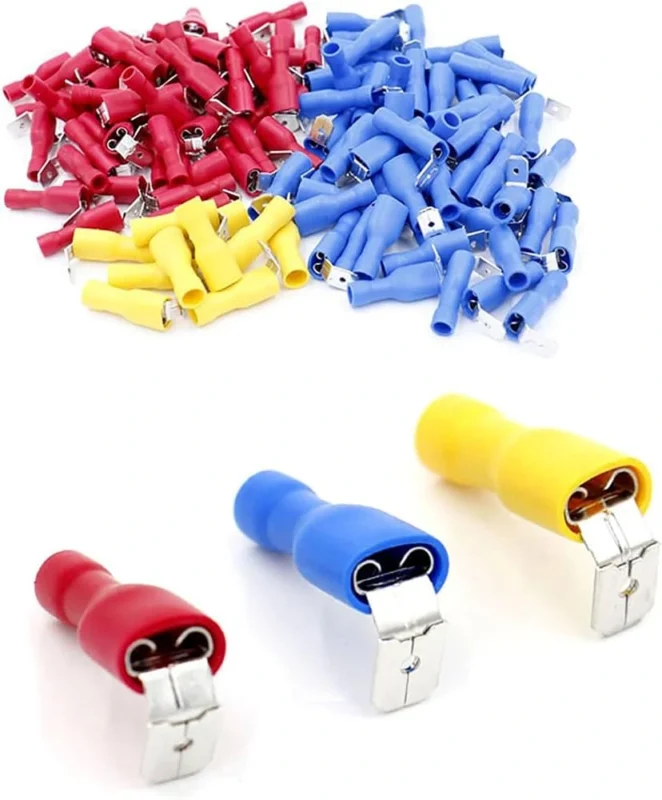
A blue insulated female spade connector terminal designed for quick electrical connections. The terminal features a metal receptacle and insulated sleeve, commonly used with stranded wires in automotive, appliance, and low-voltage electrical applications.
“Spade connector” is not always used the same way in the U.S. market. Some suppliers use it for blade-style quick disconnect terminals: a male flat tab and a female receptacle that pushes onto it. Others use it loosely for an open fork terminal that fits under a screw or stud.
Those two parts solve different problems.
A blade-style spade terminal is made for quick connection and disconnection. You see it on switches, relays, appliance tabs, control boards, automotive accessories, power supplies, and equipment panels where maintenance access matters. The female receptacle grips the male blade through spring pressure, so mating force and retention force are part of the electrical design, not just a handling detail.
An open fork terminal is different. It sits under a screw head or terminal block clamp. The fastener provides the holding force. If the screw loosens, the connection can move. If the screw is tightened correctly, the fork can be serviced faster than a closed ring terminal because the screw does not need to be removed completely.
This guide focuses mainly on blade-style spade connectors. If the wire must stay captured on a stud even when the fastener loosens, a closed ring terminal is usually the safer style. For a broader comparison of wire joining and terminal formats, see TEJTE’s guide to electrical wire connector formats. For stud-mounted wiring, compare the trade-off with a closed ring terminal.
Distinguish blade-style quick disconnects from open fork terminals
Before ordering, confirm which “spade” the drawing or customer means:
| Name used by buyer | Likely part | Main retention method | Typical use |
| Female spade connector | Blade receptacle | Spring contact force | Push-on equipment tabs |
| Male spade connector | Flat blade tab | Mates with female receptacle | Wire-to-wire or panel transitions |
| Spade terminal | Could mean blade or fork | Must be clarified | Depends on supplier wording |
| Fork spade | Open fork terminal | Screw or clamp | Terminal blocks and grounding points |
Identify male tabs, female receptacles, and flag terminals
A male spade connector has the flat blade. A female spade connector has the receptacle that receives the blade. In many assemblies, the equipment already provides the male tab, so the harness only needs the female terminal.
Orientation matters too. A straight female receptacle exits in line with the tab. A 90-degree flag terminal turns the wire exit sideways, which can help in a shallow enclosure or behind a switch. A piggyback spade terminal allows another terminal to be stacked onto the same connection point, but it should not be used casually. The added interface can change space, mechanical leverage, current path, and service risk.
Plan the terminal orientation before crimping. Once a flag terminal is crimped in the wrong direction, rotating the wire to “make it fit” usually loads the barrel and conductor exit.
How Do You Match Blade Width, Thickness, and Terminal Gender?
Blade width gets most of the attention because it is easy to see. It is not enough.
A common nominal size is 6.3 mm, often called 0.250 inch. Other common flat quick-connect widths include 2.8 mm, 4.8 mm, and 9.5 mm. But a receptacle that fits one 6.3 mm male tab may not fit another 6.3 mm tab correctly if the blade thickness, detent shape, tab length, or shoulder location is different.
The female terminal is a spring contact. It needs enough pressure to maintain low resistance, but not so much that installation damages the blade, plating, or plastic housing. A connection that feels “very tight” is not automatically better. Excessive insertion force can bend the tab, distort the receptacle, or make production workers install it at an angle.
Measure the male tab instead of relying on its visual size
When matching spade connector sizes, record the actual tab dimensions:
| Nominal size | Inch equivalent | Notes |
| 2.8 mm | 0.110 in | Small control and compact equipment tabs |
| 4.8 mm | 0.187 in | Medium equipment and appliance terminals |
| 6.3 mm | 0.250 in | Very common automotive and equipment size |
| 9.5 mm | 0.375 in | Higher-current or larger equipment connections |
Match male and female spade connectors as a tested pair
A safe specification does not say only “0.250 female spade.” It should say something closer to:
“Female quick-disconnect receptacle for 6.3 mm x specified-thickness male tab, matched to 16 AWG stranded copper wire, nylon insulated, straight orientation, with required insertion and withdrawal force.”
That wording may feel slow, but it gives purchasing, production, and inspection the same target. It also makes substitutions harder to hide. If a supplier changes the female box geometry or spring material, the assembly may still look the same in a product photo. The mating force may not be the same.
Spade Blade Fit Matrix
Use this matrix when approving a new terminal combination or replacing an existing part.
| Field | Record |
| Connector model | Supplier part number or internal code |
| Terminal gender | Male / female |
| Blade width | mm and inch |
| Blade thickness | Measured or drawing value |
| Tab length | Effective insertion length |
| Detent style | Hole / dimple / none |
| Mating connector | Approved paired terminal or equipment tab |
| Wire gauge | AWG range |
| Insulation type | Insulated / non-insulated / heat shrink |
| Orientation | Straight / flag / piggyback |
| Insertion force | Measured value or supplier range |
| Withdrawal force | Measured value or supplier range |
| Application | Switch, relay, ground, appliance tab, panel wiring |
| Fit decision | Accept / verify / reject |
How Should Wire Gauge and Barrel Size Be Paired?
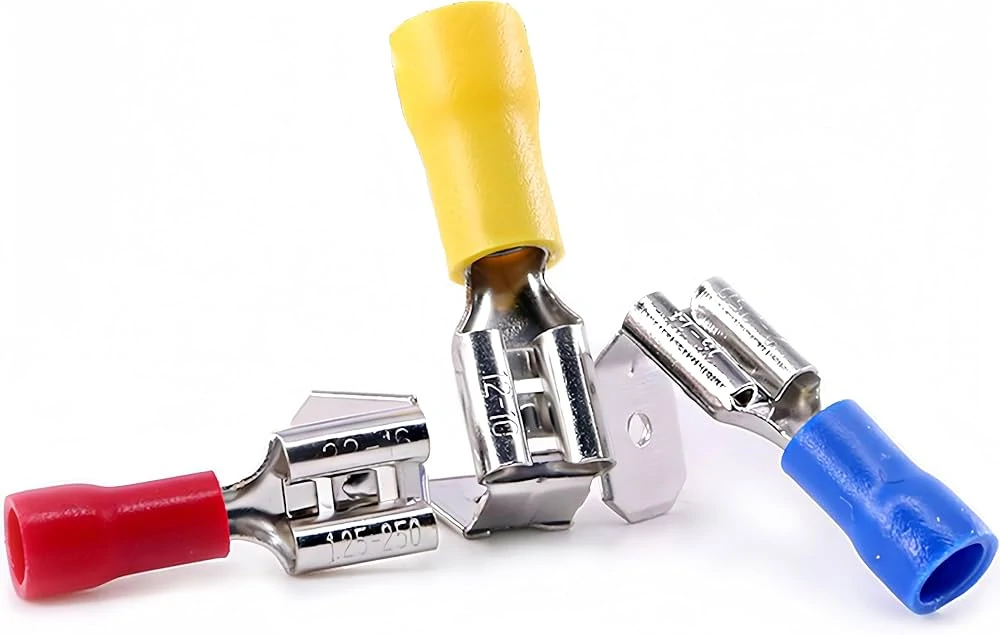
This image shows insulated female spade connector terminals with different blade sizes and wire connection styles. Female spade connectors provide quick disconnect connections by mating with flat male tabs and are commonly used in automotive wiring, appliance terminals, control panels, and electrical equipment.
The wire end is where many spade terminals fail quietly.
A terminal may mate correctly with the tab and still have a poor crimp. If the barrel is too large for the conductor, the strands do not fill the crimp zone and the connection can develop high resistance. If the barrel is too small, workers may cut strands to make the wire fit, or the wire may not insert fully. Both defects can pass a light tug by hand.
Read the conductor range before using terminal color as a guide
Insulated spade connectors often use color-coded insulation sleeves. Red, blue, and yellow are commonly associated with different wire ranges, but color is not a universal engineering standard across every manufacturer. It is a quick shop-floor cue, not a substitute for the terminal drawing.
Always confirm the approved AWG range, conductor type, and strip length. Fine-stranded wire, tinned copper, solid wire, and high-temperature insulation can change the way the barrel fills and compresses. Do not assume a terminal approved for standard stranded copper is also approved for every flexible lead wire or every appliance harness.
Match barrel inside diameter to conductor cross-section
A good crimp forms controlled metal deformation between the barrel and conductor. The strands should be inside the barrel, not flared outside it. The insulation should sit in the correct support area if the terminal has an insulation grip.
For wire spade connectors, check four things before production:
| Checkpoint | Why it matters |
| Conductor AWG | Determines barrel size and crimp die |
| Strand structure | Affects compression and pull strength |
| Strip length | Prevents exposed copper or incomplete insertion |
| Insulation diameter | Affects support sleeve, seal, and fit in housing |
If the terminal is heat shrink style, insulation diameter matters even more. The tubing must recover tightly around the wire jacket, and any adhesive liner must flow enough to seal the wire entry. A sealed wire barrel does not automatically seal the male/female mating interface, though. Moisture can still enter at the blade connection unless the design includes a boot, housing, or protected enclosure.
That distinction is easy to miss during purchasing. A heat shrink spade connector may protect the crimped wire end, but the exposed tab can still corrode if it sits in road spray, battery mist, outdoor equipment, or a damp appliance compartment.
Which Insulation System Fits Heat, Moisture, and Service Access?
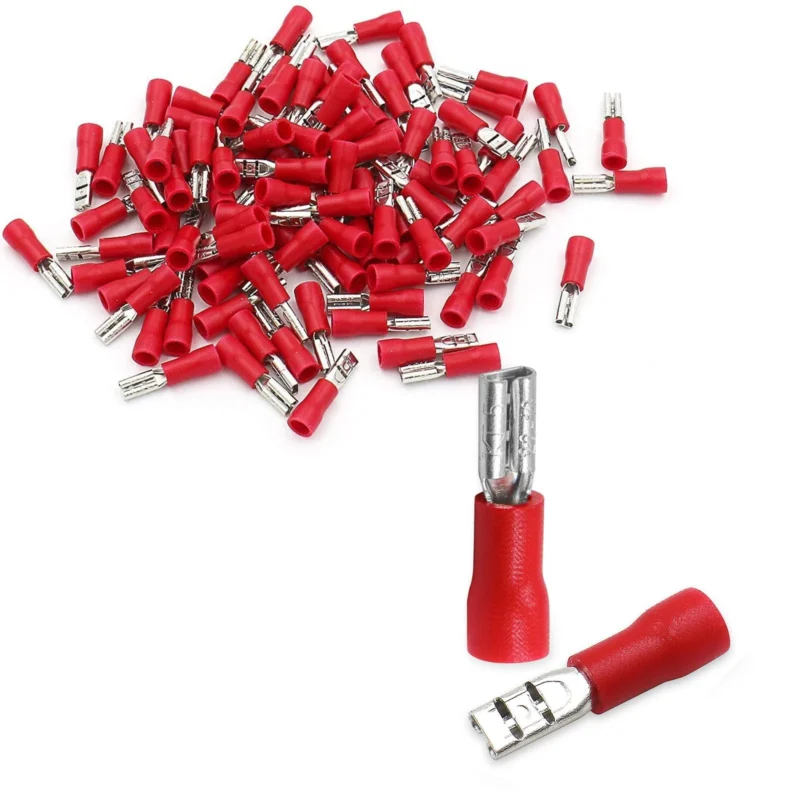
Insulation on a spade connector is not just a color sleeve. It affects handling, spacing, strain relief, moisture protection, inspection visibility, and sometimes the crimping process itself.
A buyer may ask for “insulated spade connectors” because the application needs basic touch protection. That does not mean the connection is waterproof. It also does not mean the part is suitable near a motor, heater, battery compartment, or vibrating panel. The insulation system has to match the installation environment, not just the wire gauge.
Use insulated spade connectors for protected equipment wiring
PVC and nylon insulated spade terminals are common in control panels, appliance wiring, low-voltage equipment, and serviceable harnesses. The sleeve helps prevent accidental contact with nearby metal parts and gives the operator a safer gripping area during installation.
Nylon insulation usually has better mechanical toughness than basic PVC, but the exact temperature and voltage rating still depends on the terminal manufacturer. Do not assume a blue insulated terminal from one supplier equals a blue insulated terminal from another supplier.
For production use, insulated terminals are convenient because workers can quickly identify the wire range. The trade-off is visibility. The insulation sleeve can hide whether the conductor is fully inserted into the barrel. If the crimp is weak, the defect may not be obvious until a pull test, voltage drop test, or field failure exposes it.
Select non insulated spade connectors for controlled insulation processes
Non insulated spade connectors are useful where the manufacturer wants more control over the final insulation method. They are often used with separate sleeves, boots, heat shrink tubing, terminal housings, or enclosed equipment compartments.
They also make crimp inspection easier. The barrel deformation, conductor position, and wire entry are visible before the assembly is covered. For production teams, that visibility can matter more than convenience, especially during first article approval or when a new crimp die is introduced.
The risk is obvious: a non insulated terminal left exposed can become a short-circuit point. If the design uses non insulated terminals, the drawing should also specify the insulation sleeve, housing, spacing, or protective cover. Leaving that decision to the assembly bench creates inconsistent results.
Reserve heat shrink spade connectors for moisture-prone wire entries
Heat shrink spade connectors can help where the wire entry needs better moisture resistance. The tubing shrinks around the insulation, and adhesive-lined versions can seal the rear of the terminal more effectively than a basic sleeve.
This is useful for trailer wiring, vehicle accessories, outdoor equipment, marine-adjacent installations, and repair work where the wire may see splash or condensation. Still, the word “sealed” needs discipline. The heat shrink protects the crimp barrel area. It does not automatically protect the flat blade mating area.
If the male tab and female receptacle remain exposed, water and conductive debris can still reach the contact surface. For harsh environments, consider a boot, terminal housing, sealed connector system, or a different connector type. A heat shrink sleeve is not a complete environmental connector by itself.
Do not confuse a sealed wire barrel with a sealed mating interface
This mistake causes many overheated or intermittent connections. The crimp looks clean. The tubing has recovered nicely. The wire entry is sealed. But the female receptacle is still open at the front, and the male tab may be exposed to moisture, vibration, or contamination.
If the application includes washdown, engine-bay exposure, outdoor control boxes, or battery acid vapor, ask a stricter question: what protects the actual contact interface? If the answer is “nothing,” the assembly may need a boot, housing, dielectric protection approved by the equipment manufacturer, or a connector style made for that environment.
How Do You Crimp a Female or Male Spade Connector Correctly?
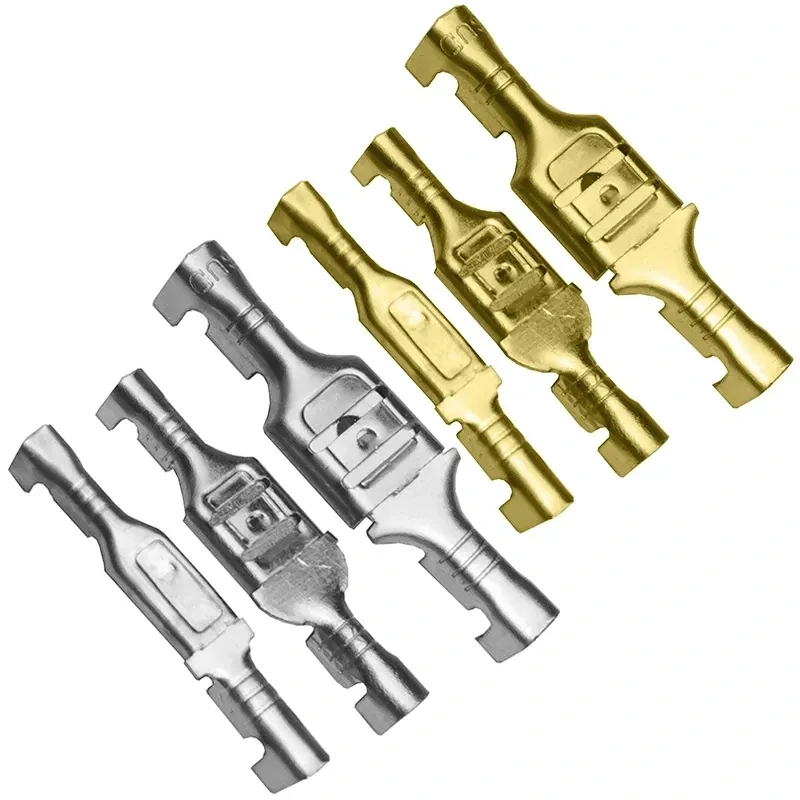
Non-insulated spade terminals shown with exposed metal contact areas. These terminals are often used in controlled assembly processes where additional insulation sleeves, housings, or heat shrink protection are added separately.
A spade crimp connector should be treated as a matched system: terminal, wire, strip length, crimp tool, die cavity, and operator method. Swapping one part of that system can change the result.
The fastest way to make a bad crimp is to use a general-purpose plier because the terminal “looks simple.” It may hold the wire during a hand pull and still fail under current, heat, or vibration. A proper crimp compresses the barrel in the intended area and shape. It should not crush the female receptacle, flatten the blade, or deform the locking feature.
Cut back oxidized, overheated, or strand-damaged wire
Do not crimp over damaged copper. Darkened strands, burned insulation, green corrosion, solder-wicked wire, or broken strands are warning signs. Cut back to clean conductor before stripping.
Repair work is especially risky because the wire end may already be stressed from heat or previous crimping. A new terminal on a damaged conductor only moves the failure point into a fresh-looking part.
Strip to the specified barrel depth without nicking strands
Strip length affects both electrical and mechanical quality. Too short, and the conductor may not reach the full crimp zone. Too long, and bare copper may remain exposed beyond the barrel, increasing short-circuit risk.
The stripped conductor should enter fully without forcing. If strands flare out at the barrel entrance, the strip or insertion method needs correction. Do not twist off loose strands or trim the conductor diameter to fit a smaller barrel. That changes the current-carrying cross-section and weakens the crimp.
Insert every strand and position the insulation correctly
For insulated terminals, the insulation support should grip the jacket where designed. The conductor crimp should hold copper, not insulation. The insulation grip should support the wire, not replace the conductor crimp.
On a good crimp, the wire cannot rotate freely inside the terminal, and the insulation is not crushed to the point that it splits. If the wire exits at an angle immediately after crimping, check whether the terminal was placed incorrectly in the die or whether the wire was pulled sideways during the ratchet cycle.
Place the barrel in the approved die cavity and orientation
A ratchet crimper helps because it completes a full compression cycle before release. But the correct tool still has to be used correctly. The terminal barrel must sit in the approved cavity, facing the proper direction, with the crimp area aligned to the die profile.
Do not let the die contact the male blade, female box, tab shoulder, or flag bend. These areas are not meant to be crushed. Damage here can change the mating force even if the wire crimp looks acceptable.
Complete the ratchet cycle without crushing the blade or receptacle
Once the terminal is positioned, complete the crimp in one controlled cycle. Re-crimping a finished terminal to “make it tighter” is poor practice unless the terminal manufacturer specifically allows a defined correction process.
A double-crimped barrel may look strong but have cracked plating, cut strands, or unstable compression. In production, reject and replace questionable crimps. It is cheaper than chasing intermittent heating failures later.
Perform a pull check before mating the connector
A basic pull check should be done before the terminal is installed onto the tab. Pull from the wire axis, not at an angle. For production approval, use the specified pull-force requirement rather than a casual hand tug.
After pull testing, inspect the terminal again. The wire should not move out of the barrel, the insulation should not separate, and the receptacle should not be distorted from handling.
How Can You Check Mating Force Without Damaging the Tab?
A spade connection should mate cleanly. If a worker has to rock the terminal side to side, pull on the wire, or use pliers to force it into place, something is wrong.
Mating force matters because the contact interface depends on spring pressure. Too loose, and resistance increases. Too tight, and installation may damage the tab or female receptacle. Either condition can lead to heating, arcing, or service complaints.
Inspect the male blade for burrs, twisting, and plating damage
Before blaming the female terminal, inspect the male tab. A bent blade, sharp burr, rough plating, or oversized thickness can make a correct receptacle feel wrong. Equipment tabs can also be damaged during previous service, especially if old terminals were removed with pliers.
A twisted male tab creates uneven contact pressure. The female receptacle may grip on one edge while the other side barely touches. That kind of defect may pass continuity at no load, then heat under current.
Align the receptacle before applying insertion force
Push the terminal straight onto the blade. Do not use the wire as a handle if the receptacle body can be gripped directly. Pulling or pushing through the wire transfers stress into the crimp barrel and conductor exit.
For tight locations, a flag terminal or a housing with a guided entry may be better than forcing a straight receptacle into a cramped space. If the assembler cannot see the tab clearly, incomplete engagement becomes much more likely.
Measure insertion and withdrawal force in production assemblies
For sample approval, record insertion force and withdrawal force using the actual mating tab or approved paired connector. This is especially useful for automotive spade connectors, appliance tabs, and equipment harnesses that may be serviced more than once.
A connection that is too easy to remove should be rejected or investigated. A connection that requires excessive force should also be investigated. Both create production risk.
Replace a widened female receptacle instead of squeezing it randomly
A loose female spade connector is sometimes “fixed” by squeezing the receptacle with pliers. That may create temporary tightness, but it can damage the spring geometry and plating. It can also make contact pressure uneven.
If a receptacle has lost retention after repeated disconnection, replace it. If many terminals in a batch are loose, check the mating tab thickness, terminal model, material temper, and supplier lot. Random bench adjustment is not a process.
Why Do Spade Connections Loosen, Arc, or Overheat?
A spade connection usually fails for a practical reason, not a mysterious one. The terminal was not fully seated. The female receptacle lost spring force. The wire crimp had too much resistance. The tab was dirty. The current rating was copied without checking the test conditions.
The difficult part is that several of these problems can look the same after failure. Heat marks, melted insulation, discoloration, and intermittent power do not automatically prove the connector size was wrong. You need to separate the mating interface from the crimp barrel and the rest of the circuit.
Diagnose incomplete engagement and mismatched blade thickness
If the male blade only enters the front of the female receptacle, the contact area is too small. The connection may work at low current, then heat under load. This can happen when the tab shoulder stops the receptacle early, when the terminal housing blocks full insertion, or when the worker stops pushing after feeling partial resistance.
Blade thickness matters just as much. A thin tab in a receptacle designed for a thicker blade may feel loose from the beginning. A thicker tab forced into the wrong female terminal can overstress the spring contact and reduce its holding force after removal.
Find weak female spring force after repeated disconnection
Spade terminals are serviceable, but they are not endlessly reusable. Every disconnect cycle can affect the female spring structure, especially if the terminal is pulled off by the wire or removed at an angle.
After maintenance, inspect the receptacle before reinstalling it. Look for widening, uneven contact leaves, plating wear, discoloration, or signs that someone has squeezed the terminal with pliers. If retention is weak, replacement is cleaner than trying to reshape the part by hand.
Separate mating-interface resistance from crimp-barrel resistance
A hot spade connector does not always mean the blade interface is the only problem. The crimp barrel can also generate heat if the conductor was underfilled, over-crimped, poorly stripped, contaminated, or crimped with the wrong die.
A useful inspection sequence is:
| Check area | What to look for |
| Male blade | Burrs, oxidation, twisting, heat marks |
| Female receptacle | Weak retention, widening, plating damage |
| Crimp barrel | Loose wire, cut strands, wrong compression |
| Wire exit | Broken strands, sharp bend, vibration stress |
| Circuit load | Actual current, duty cycle, ambient temperature |
Avoid using current ratings without the specified test conditions
Current rating depends on the terminal material, plating, wire gauge, temperature, enclosure, airflow, mating force, and test method. A bare terminal tested in open air may behave differently inside a warm appliance, sealed control box, or vehicle compartment.
For production or OEM use, do not specify only “rated current.” Specify the terminal model, wire size, mating tab, insulation system, ambient condition, and acceptable temperature rise.
Where Do Automotive and Equipment Spade Connectors Belong?
Automotive spade connectors are common because they are easy to install and service. They are used on relays, switches, fuse accessories, lighting circuits, control modules, and aftermarket equipment. That does not mean every vehicle circuit should use a loose individual spade terminal.
Vibration, splash, pulling force, heat, and service access must all be considered. A protected relay socket is different from an exposed terminal near the engine bay. A dashboard switch is different from a chassis ground point.
Use automotive spade connectors where service access is required
Blade-style terminals make sense where a component may be replaced, tested, or disconnected during maintenance. The connector gives technicians a fast way to remove the wire without unscrewing a fastener.
For higher-vibration areas, add housings, boots, locking features, strain relief, or a different connector system. If accidental pullout creates a safety or grounding risk, a closed ring terminal may be more appropriate.
Match electrical spade connectors to appliance and equipment tabs
Many appliances and industrial devices use fixed male tabs. In that case, the harness terminal must match the equipment tab, not the other way around.
Before approving an electrical spade connector, check the equipment drawing or measure the real tab from a qualified sample. Confirm blade width, thickness, insertion depth, operating temperature, voltage, current, and clearance from nearby metal parts.
If the terminal will be touched during service, add insulation, a boot, or a housing. If the mating interface may be exposed to moisture or conductive debris, do not rely on a basic insulated sleeve.
How Should Production Teams Validate Spade Connector Assemblies?
Production validation should approve the terminal, wire, tool, die, strip length, and mating tab as one combination. Treating each item separately leaves too much room for substitution.
A practical approval record should include:
| Item | Record in production |
| Terminal model | Male or female part number |
| Wire gauge | AWG and conductor structure |
| Crimp tool | Tool model and die cavity |
| Strip length | Target and tolerance |
| Crimp height | Measured value |
| Pull test | Pass/fail and measured force |
| Mating tab | Model or measured dimensions |
| Insertion force | Sample value |
| Withdrawal force | Sample value |
| Electrical test | Voltage drop or contact resistance |
| Heat check | Temperature rise under load |
| Lot traceability | Terminal, wire, and tooling records |
FAQ
Will every 0.250-inch female spade connector fit a 0.250-inch male tab?
No. The nominal width may match, but blade thickness, detent style, insertion length, spring geometry, and manufacturing tolerance still affect fit.
Can a loose female spade connector be tightened with pliers?
It is not recommended. Random squeezing can damage the plating and spring structure. Replace the terminal or follow the manufacturer’s approved repair method.
Why does a tight spade connection still overheat?
The crimp may be poor, the contact surface may be contaminated, the blade may not be fully inserted, or the actual current and temperature may exceed the terminal combination’s tested condition.
Can insulated and non-insulated spade terminals mate with each other?
Sometimes, but insulation style is not the deciding factor. The blade width, blade thickness, receptacle geometry, locking feature, and available space must match.
Can a spade connector be used for a grounding wire?
Only if the equipment design, retention force, vibration level, and environment allow it. For critical grounds or high pullout risk, a closed ring terminal is often safer.
How many times can a spade connector be disconnected and reused?
There is no universal number. After each service cycle, inspect retention force, plating wear, deformation, and heat marks before reuse.
How far should the male blade enter the female receptacle?
It should seat to the designed stop or locking position. Partial front-edge contact is not enough, even if continuity looks normal during a quick test.