
SMA to BNC Cable Use and Selection Guide

Feb 10,2026

Physical overview of a typical SMA to BNC coaxial cable assembly

This introductory figure visually anchors the guide’s central theme. It depicts a standard SMA to BNC cable, representing those ad-hoc connections that appear out of necessity rather than design. The surrounding text emphasizes that while such cables “feel too simple to matter,” they often occupy critical junctures in systems (e.g., between calibrated and uncalibrated gear), where their electrical properties directly influence measurement consistency and trust in data.
SMA to BNC Cable: The Unplanned Bridge

Most mixed-connector RF links don’t start as a design decision. They show up later, usually when something that already works needs to talk to something older. A new RF module exposes SMA ports. The instrument on the bench still uses BNC. Nobody planned the transition; it simply appeared. That’s how an SMA to BNC cable becomes part of the signal path—quietly, and often without much scrutiny.

At first glance, this kind of cable feels too simple to matter. One connector on each end, a short length of coax in between. Signals pass. Measurements look reasonable. The system moves on. The problem is that these cables almost never sit in forgiving parts of the chain. They tend to land between calibrated equipment and uncalibrated fixtures, between modern RF front ends and legacy measurement hardware, or between antennas and receivers that were never meant to share an interface. Small compromises here don’t cause obvious failures; they cause drift, inconsistency, and arguments about whether the data can be trusted.

What follows treats the SMA to BNC cable as an RF component, not an accessory. The focus stays on where these cables are actually used, how impedance and bandwidth limitations show up in practice, and why certain choices make life easier months later when the setup has been rebuilt for the fifth time. If you need a broader refresher on how coaxial cables behave electrically before diving into mixed interfaces, this overview of RF cable fundamentals is a useful baseline: Understanding RF Cables: The Ultimate Guide.

How should you map SMA to BNC cable use cases?

: Diagram mapping common application scenarios for SMA to BNC cables

This figure, likely a flowchart or block diagram, is central to the section on understanding use cases. It illustrates the specific scenarios where SMA-to-BNC cables become essential: connecting modern RF modules/antennas (SMA) to older test instruments like oscilloscopes (BNC), or bridging new DUTs with aging production test fixtures. The image helps users systematically identify the “why” behind the cable’s presence in their setup.
Where the Bridge is Needed: Mapping Use Cases

When engineers get into trouble with cable selection, it’s rarely because they picked the wrong RG type. It’s because they never asked why the cable exists at all. An SMA to BNC cable almost always exists because two parts of the system aged differently. RF hardware standardized on SMA years ago. Test equipment, fixtures, and legacy receivers often did not. The cable becomes a bridge, not because it’s ideal, but because it’s necessary.

In RF labs, this shows up daily. SMA connectors dominate on radios, front-end boards, amplifiers, and antennas. BNC, meanwhile, remains common on oscilloscopes, spectrum analyzers, and monitoring equipment—especially for IF paths, trigger inputs, or lower-frequency signal observation. When these two worlds meet, the SMA to BNC cable ends up in the middle of harmonic tests, output power checks, and bandwidth validation. At that point, it stops being “just a cable.” Its impedance consistency and loss characteristics influence how repeatable those measurements are.

There’s a similar pattern on the antenna side. Many older receivers, scanners, and monitoring systems still provide only BNC inputs. Modern antennas and RF modules almost never do. In temporary benches or field setups, it’s tempting to stack adapters at the antenna feed and move on. That usually works—until the antenna gets bumped, the adapters loosen slightly, or results start to vary between setups. A single SMA to BNC cable often produces a more stable transition simply because it reduces the number of mechanical interfaces involved.

Production and service environments make this even more obvious. Test fixtures tend to outlive the products they support. Many were built around BNC-based instrumentation years ago, while today’s devices under test expose only SMA RF ports. Over time, SMA to BNC cable assemblies become standardized items on the production floor. They get replaced, logged, and reused across multiple programs. In that context, predictability matters far more than chasing marginal performance improvements. A known cable that behaves the same way every time is worth more than a clever but fragile workaround.

How do you keep SMA to BNC cable impedance and bandwidth aligned?

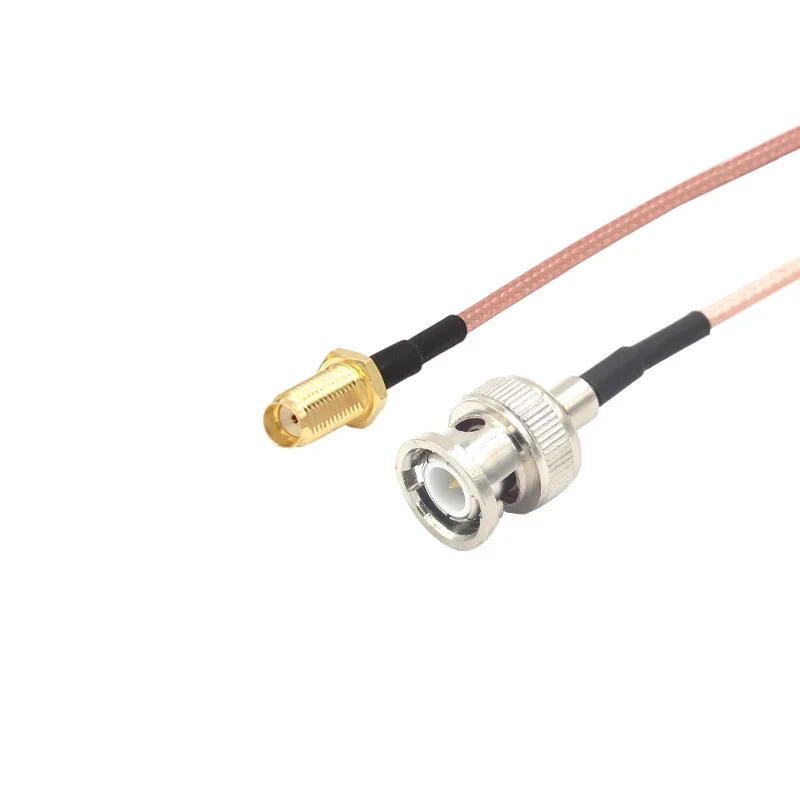
Close-up of an SMA to BNC cable using thicker, flexible RG316 coaxial cable

This detailed image shows an SMA-to-BNC cable constructed with RG316 coaxial cable. Positioned in the cable selection discussion, it represents the preferred choice for general lab and high-frequency flexible links. The guide states that RG316 is trusted not for perfect specs, but for “failing gracefully”—offering predictable performance, good mechanical durability against bending/heat, and stable behavior even when rerouted, making it reliable for dynamic bench environments.
The Bench Workhorse: SMA to BNC with RG316
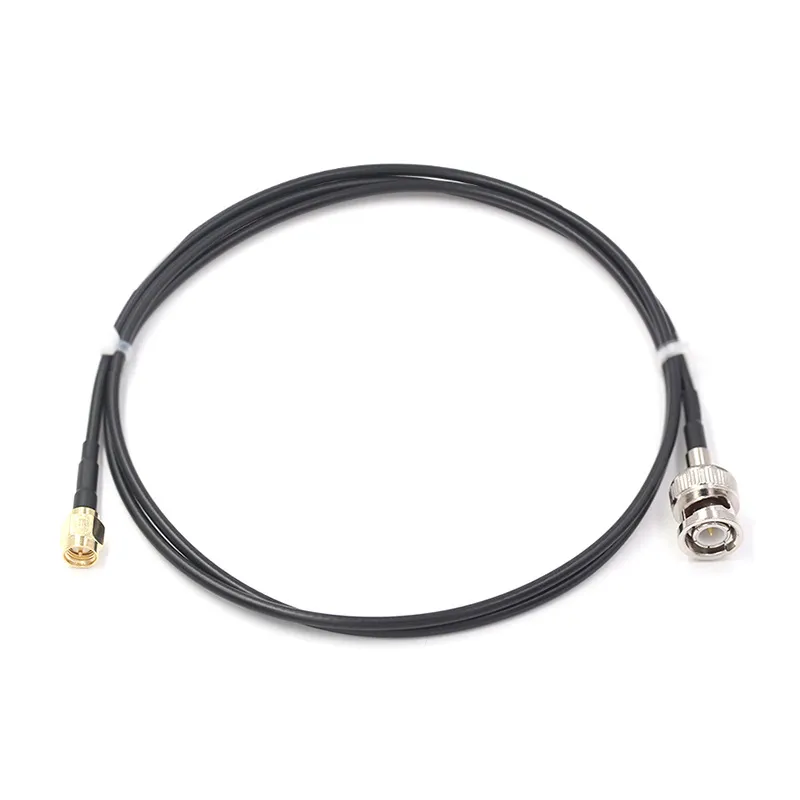
Close-up of an SMA to BNC cable using thinner, more flexible RG174 coaxial cable

This image serves as a direct counterpart to Figure 3, showcasing the slimmer RG174-based cable. The text describes RG174 as the choice when space and extreme flexibility are dominant concerns, such as in portable field kits or tightly packed enclosures. The visual comparison highlights the trade-off: RG174 is thinner and lighter but has higher signal loss at frequency and less robust shielding, making it suitable for applications where convenience and form factor outweigh the need for maximum performance margin.
The Space-Saver: SMA to BNC with RG174

From an RF perspective, everything comes back to one question: is the signal path actually 50 ohms from end to end? SMA connectors make this easy. They are defined at 50 Ω, and in practice they behave that way. BNC connectors complicate things. They exist in both 50 Ω and 75 Ω versions, and the difference is not always obvious by inspection.

A proper SMA to BNC cable for RF work needs to preserve a continuous 50-ohm environment. That means a 50-ohm SMA connector, a 50-ohm BNC connector, and a 50-ohm coaxial cable in between. Trouble starts when a 75 ohm BNC cable or connector slips into the chain. Signals still pass, which is why the mistake often survives initial testing. What changes is accuracy. Impedance mismatches introduce reflections that degrade return loss and quietly distort amplitude and phase, especially as frequency increases.

Bandwidth is where these issues stop being subtle. SMA connectors are comfortable well into the multi-gigahertz range. BNC connectors were never designed for that level of precision. At lower frequencies—tens or a few hundreds of megahertz—BNC usually behaves well enough. As frequency climbs toward a gigahertz and beyond, performance becomes highly dependent on connector quality, tolerances, and cable construction. In many mixed-interface setups, the BNC side ends up defining the usable bandwidth, not the SMA side.

Another source of confusion is the overlap between RF and video conventions. 75 ohm BNC cables are correct for video, CCTV, and SDI systems. They are not correct for RF measurement chains. Mixing them on the same bench doesn’t always cause obvious failures, but it does create inconsistency that wastes time during debugging. A simple rule helps keep things straight: if an SMA connector appears anywhere in the path, treat the entire chain as 50 ohms only. Engineers who want a deeper comparison between RF and video BNC usage will find this breakdown useful: When to Use 50 Ohm vs 75 Ohm BNC Cable.

Select SMA to BNC cable types for lab, field, and rack systems

Once you accept that an SMA to BNC cable is part of the signal path, cable choice stops being a catalog exercise and starts becoming a trade-off discussion. There is no single cable that works best everywhere. Frequency matters, but so does how the cable is handled, how often it is moved, and how forgiving the environment is when something gets bent the wrong way.

In real RF setups, most SMA-to-BNC links fall into one of three situations. Some live permanently on a bench and get touched every day. Others sit inside racks or fixtures and rarely move. A third group travels in field kits and gets abused far more than anyone wants to admit. Cable selection only makes sense when you know which group you are dealing with.

Choose RG316 coaxial cable for high-frequency and flexible links

For many lab environments, RG316 coaxial cable becomes the default choice, not because it is perfect, but because it fails gracefully. Electrically, it behaves predictably into the gigahertz range. Mechanically, its PTFE construction tolerates heat, repeated bending, and the occasional careless reroute better than softer PVC-based cables.

This is why RG316 shows up so often on benches where cables are plugged, unplugged, and repositioned throughout the day. It is flexible enough to route cleanly, stiff enough not to collapse under its own weight, and stable enough that small changes in routing do not immediately show up in measurements. Engineers tend to trust it because they have seen how it behaves over time, not because it looks good on a datasheet.

Compare RG174 and other slim SMA to BNC cable options

RG174 usually enters the conversation when space or flexibility becomes the dominant concern. It is thinner, lighter, and easier to route in tight places. That softness comes at a cost. Loss increases quickly with frequency, and shielding is less robust than heavier constructions.

In practice, RG174 works best when expectations are clear. Short runs, lower frequencies, temporary setups, or portable kits where convenience matters more than absolute performance. Problems arise when it is treated as a drop-in replacement for RG316 in higher-frequency or longer links. The cable does not suddenly fail, but margins shrink, and measurements become more sensitive to small changes.

On the opposite end are thicker, low-loss cables. These are rarely enjoyable to work with on a bench, but they earn their place when distance dominates the loss budget. Long runs through racks or enclosures are where these cables make sense. They trade flexibility for attenuation, which is often the correct decision when the cable is installed once and left alone.

Match cable jacket and shielding to your installation environment

Electrical specifications rarely capture what actually kills cables. Heat, chemicals, repeated stress, and poor strain relief do. PVC jackets are common and inexpensive, but they age poorly in hot or industrial environments. PTFE and FEP jackets survive conditions that would quickly stiffen or crack softer materials.

Shielding matters for reasons beyond interference. A well-shielded cable holds its geometry better when bundled with others or routed through tight spaces, which helps preserve impedance consistency. For readers who want a neutral, foundational explanation of how coaxial construction affects performance, the overview on Coaxial cable provides useful background without vendor bias.

Plan SMA to BNC cable length, loss, and connector count

Cable length is where mixed-interface paths quietly go wrong. Loss is easy to underestimate, especially when a setup grows incrementally. One longer jumper here, an extra adapter there, and suddenly the margin that looked comfortable on paper is gone.

Rather than guessing, it helps to work backward from how much loss the system can tolerate.

SMA to BNC Cable Length & Loss Quick Planner

Application Frequency_MHz Max_Extra_Loss_dB Cable_Type Loss_per_meter_dB Max_Length_meter Connector_Count Estimated_Conn_Loss_dB Safety_Margin_dB
RF Bench Measurement 1000 2.0 RG316 0.9 1.5 2 0.4 1.0
Antenna Feed Test 900 1.5 RG174 1.5 0.3 2 0.4 1.0
Production Test Fixture 500 3.0 Low-loss coax 0.4 4.0 3 0.6 1.0

These numbers are intentionally conservative. They assume real connectors, real handling, and real-world variation rather than ideal lab conditions.

The underlying relationships are simple:

Cable_Loss_dB = Loss_per_meter_dB × Length_meter

Total_Loss_dB = Cable_Loss_dB + Estimated_Conn_Loss_dB

To stay within limits:

Total_Loss_dB ≤ Max_Extra_Loss_dB − Safety_Margin_dB

Solving for length gives:

Max_Length_meter = (Max_Extra_Loss_dB − Safety_Margin_dB − Estimated_Conn_Loss_dB) ÷ Loss_per_meter_dB

Estimate insertion loss for your SMA to BNC cable path

Manufacturers typically specify attenuation per meter or per 100 feet at defined frequencies. Converting those values once and reusing them consistently avoids guesswork later. Engineers who rely on network analyzers learn quickly that small, unaccounted losses can shift baselines enough to invalidate comparisons made weeks apart.

Limit extra SMA to BNC connectors and adapters in series

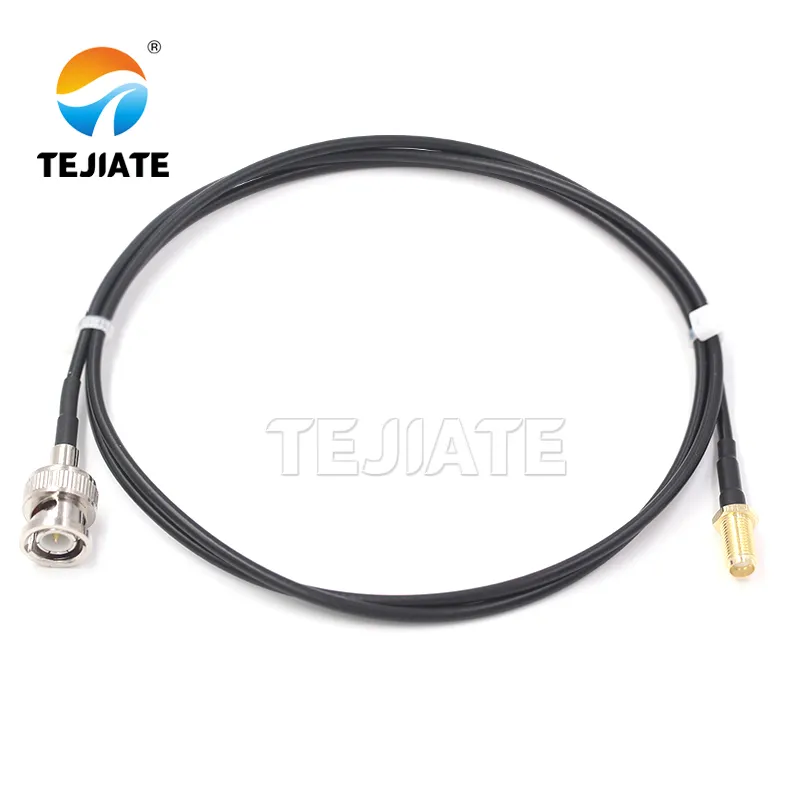
Every additional interface adds two risks: electrical discontinuity and mechanical uncertainty. A single bnc to sma adapter is rarely a problem. Multiple adapters stacked together almost always are. Reflections accumulate, connector wear accelerates, and the setup becomes sensitive to movement. This is one of the clearest cases where a dedicated SMA to BNC cable is preferable to a collection of short jumpers.

For readers who want a formal measurement perspective on why impedance continuity matters, introductory material from test and measurement vendors such as Keysight explains the underlying principles of 50-ohm systems and why small mismatches matter more than intuition suggests.

When should you choose an SMA to BNC cable instead of an adapter?

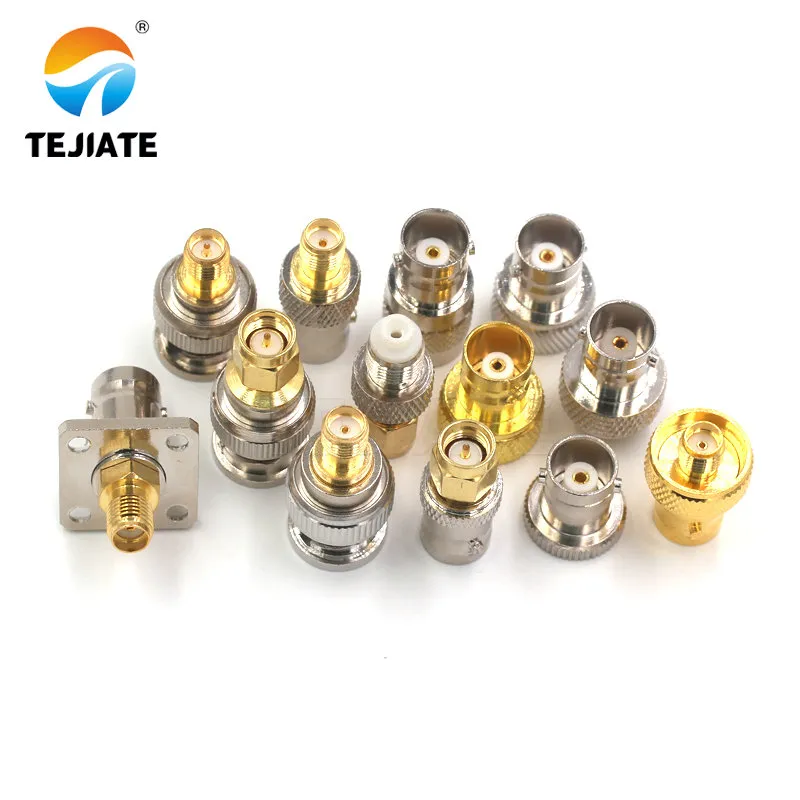
A selection of various BNC to SMA adapters, including different genders and styles

This figure displays a range of BNC-to-SMA adapters. It is used in the section debating “Cable vs. Adapter.” The guide positions adapters as convenient tools for short-term, low-frequency, or clearly temporary links. The image supports the argument that while adapters solve an immediate connection problem, they can inadvertently become permanent, adding points of potential electrical discontinuity and mechanical wear that may compromise long-term measurement stability.
The Quick Fix: An Assortment of Adapters
A dedicated, single-assembly SMA to BNC cable as a preferable alternative to adapter stacks

Presented in contrast to Figure 5, this image depicts a complete SMA to BNC cable assembly. It embodies the guide’s recommendation for scenarios demanding repeatability and stability. The cable is presented as a superior RF component compared to a chain of adapters because it reduces the total number of separable interfaces, minimizes cumulative reflections and connector wear, and is easier to characterize and manage as a single, known entity in the signal path. This choice prioritizes predictable performance over short-term convenience.

The Purpose-Built Path: Dedicated SMA to BNC Cable
Adapters exist because they are convenient. They also encourage temporary solutions to become permanent. Deciding between an adapter and a full SMA to BNC cable usually comes down to how repeatable the setup needs to be and how often it will be touched.

Use dedicated SMA to BNC cable for repeatable RF measurements

If measurements must agree across benches or over time, a single cable assembly is easier to characterize and control. Once its behavior is known, it stays known. Adapter chains rarely offer that stability.

Reserve BNC to SMA adapter for short, low-frequency, or temporary links

Adapters make sense when the frequency is low, distances are short, and the setup is clearly temporary. Outside those conditions, their limitations become visible sooner than expected.

Match SMA to BNC connector genders for field retrofits

In service and retrofit work, connector gender often dictates the solution. SMA female to BNC male adapters commonly appear on instrument-facing ports, while SMA male to BNC female adapters are more common on panel or cable-side transitions. Planning this ahead of time avoids improvised fixes that stress connectors unnecessarily.

Manage strain relief, flex life, and connector durability

If an SMA to BNC cable causes trouble, it almost never does so immediately. Most failures show up slowly. A connector that feels slightly different than it used to. A measurement that changes when the cable is touched. A setup that only misbehaves after it has been running for a while. By the time anyone suspects the cable, it has usually been in service long enough to escape blame.

The weakest area is usually right where the connector meets the coax. That transition from rigid metal to flexible cable does not tolerate sharp bends or constant motion. Tight routing close to the SMA or BNC body concentrates stress into a very short section of shield and dielectric. Nothing breaks outright. Instead, the cable becomes inconsistent. That inconsistency is what makes these problems frustrating to trace.

On lab benches, strain relief is often ignored. Cables hang from instrument ports, especially BNC inputs, and slowly turn the connector into a structural support. In racks and fixtures, vibration replaces gravity as the main enemy. In both cases, the fix is boring but effective. Support the cable close to the connector. Give it somewhere else to transfer load. That single change often doubles usable life.

Portable setups create a different kind of wear. Cables are bent, coiled, and shoved into cases repeatedly. In that context, stiffness becomes a disadvantage. This is why many engineers keep coming back to RG316 for field kits even when loss is not ideal. It does not perform miracles, but it fails in predictable ways, which is often what matters.

How can you verify SMA to BNC cable performance on the bench?

Most cables are trusted until proven guilty. That works fine until a measurement becomes hard to reproduce. Verification does not need to be formal, but it should exist.

Simple checks catch a surprising number of issues. A continuity check with a multimeter quickly reveals broken center conductors or shields that only connect intermittently. These faults are common in cables that look fine from the outside. Basic cable testers add another layer by confirming shield integrity without touching RF equipment.

For RF behavior, a network analyzer is still the clearest reference. Measuring return loss and insertion loss once gives you a baseline for that SMA to BNC cable. That baseline becomes valuable later, when numbers drift and nobody remembers whether the system ever behaved differently. Engineers already do this for fixtures and adapters; extending the habit to cables closes a gap that causes more confusion than it should.

Not every cable needs a test record. Some do. Cables that live in critical paths or production setups tend to justify periodic rechecks. That practice lines up with general RF measurement guidance from test equipment vendors, where known impedance and controlled loss are treated as prerequisites rather than nice-to-haves.

Track how SMA and BNC interfaces are evolving in test equipment

Connector choices in test equipment rarely change overnight. They drift. High-bandwidth paths increasingly move toward SMA or larger threaded connectors. BNC stays where bandwidth demands are lower or where fast connect and disconnect still matters.

On the device side, RF modules have mostly settled on SMA. Size, defined impedance behavior, and ecosystem compatibility make that choice hard to argue with. Test benches and fixtures, on the other hand, age slowly. BNC-heavy infrastructure tends to remain in place long after new products ship. That overlap is why SMA to BNC cable assemblies are not a temporary inconvenience but a long-term reality.

Understanding this helps in design reviews. Mixed interfaces are sometimes treated as legacy baggage. In practice, they are often the cheapest and most stable way to bridge equipment generations without constantly rebuilding fixtures.

Document SMA to BNC cable choices in your BOM and procedures

Cable confusion usually starts with vague descriptions. “SMA to BNC cable” leaves too many variables open. Length, cable type, and connector gender should be explicit. Encoding that information into part numbers or internal naming conventions prevents accidental substitutions that look acceptable but behave differently.

Handling rules matter just as much. Written lab procedures that mention bend radius, connector support, and proper disconnection habits prevent damage that would otherwise be blamed on chance. These rules sound obvious. They work better when they are written down.

From a purchasing standpoint, key parameters should not be implied. Impedance, usable frequency range, shielding construction, and temperature rating belong in procurement and inspection documents. This reduces the chance that a visually similar cable slips in and quietly changes system behavior. For neutral background on why construction details matter, the fundamentals are laid out clearly in the Wikipedia overview of Coaxial cable.

Common questions that keep coming up

Can I use a 75 ohm BNC cable in an SMA to BNC RF chain?

It will usually pass a signal. It will also undermine impedance matching. For RF measurements, a consistent 50-ohm path avoids unnecessary uncertainty.

How long can an SMA to BNC cable be before loss matters?

There is no single number. Frequency, cable type, and how much loss the system can tolerate define the limit. Working backward from that tolerance is safer than guessing.

When is a BNC to SMA adapter good enough instead of a full cable?

Short runs, low frequencies, and setups that are clearly temporary. Beyond that, dedicated cables tend to be more predictable.

RG316 or RG174 for lab work?

RG316 usually survives handling and higher frequencies better. RG174 makes sense when flexibility and space matter more than margin.

How do I avoid damaging connectors when cables move a lot?

Support the cable near the connector, avoid tight bends, and do not use the connector body as a handle.

What’s the minimum test before trusting a new SMA to BNC cable?

Check continuity and shielding, then capture a simple RF baseline so you have something to compare against later.

Is it okay to mix cables from different vendors?

Yes, but variability increases. For critical paths, consistency simplifies troubleshooting.

One last observation

An SMA to BNC cable almost never gets credit when a setup works. It only gets noticed when results stop lining up. Treating it as a defined RF component rather than an afterthought does not make systems perfect, but it removes one quiet source of uncertainty.

Bonfon Office Building, Longgang District, Shenzhen City, Guangdong Province, China

customer service