
SMA to BNC Adapter Selection & Install Guide
Mar 08,2026
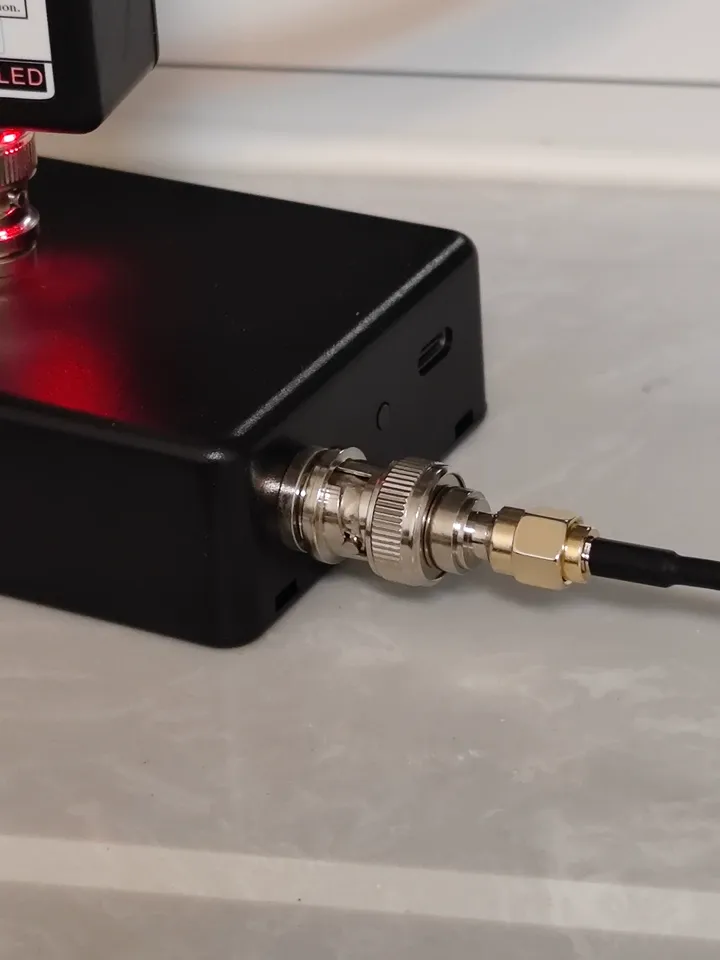
This figure illustrates a common lab scenario where a device with an SMA connector (such as a compact radio or development board) needs to connect to test equipment with a BNC input (like an oscilloscope or older spectrum analyzer). The SMA to BNC adapter serves as the bridge between these two connector ecosystems. Once installed, it contributes insertion loss and mechanical interface transitions that must be accounted for, especially at higher frequencies.
A SMA to BNC adapter usually enters the conversation late.
The radio is already mounted. The antenna choice is settled. The instrument powers up without complaint. Then someone notices the connector mismatch. SMA on the device. BNC on the bench equipment.
You grab an adapter.
At first glance, it feels trivial—a small mechanical bridge. But in RF work, nothing in the signal path is neutral. Once installed, that adapter becomes part of the transmission line. It contributes insertion loss. It influences return loss. It transfers torque. In some cases, it quietly shortens the life of a PCB-mounted SMA jack.
This guide is written for engineers and buyers who want to get it right the first time—correct gender, correct impedance, correct mechanical form—and avoid the usual pitfalls like RP-SMA confusion or stacking too many transitions.
Let’s start with where this adapter actually belongs in a real workflow.
Where does an SMA to BNC adapter belong in your RF workflow?
Map SMA devices to BNC instruments and legacy RF gear
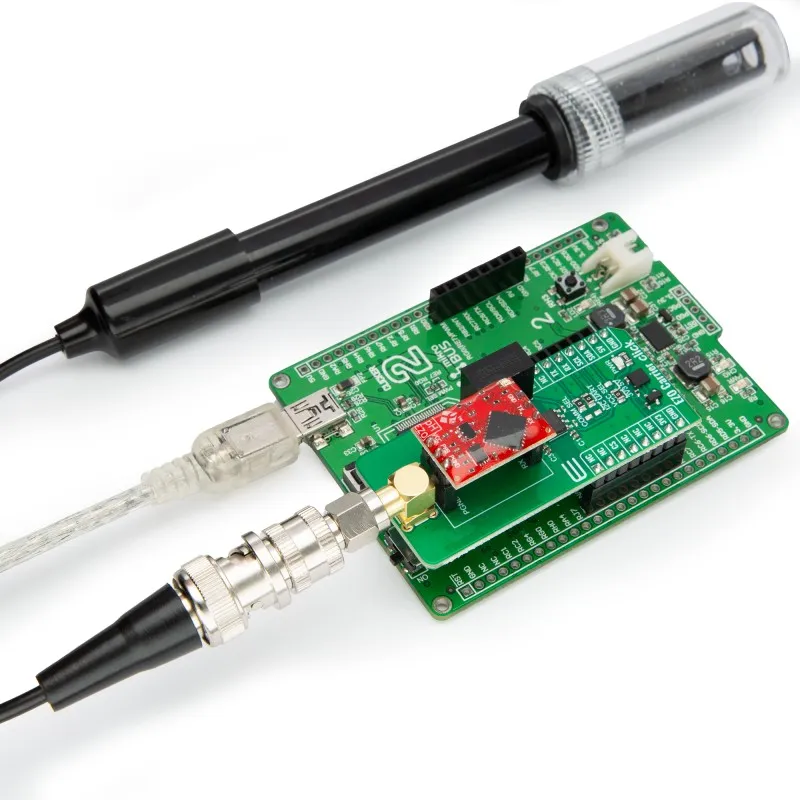
This figure maps the typical workflow where an SMA-equipped device (e.g., a radio module) connects to a BNC-based instrument (e.g., a signal generator or spectrum analyzer) via an SMA to BNC adapter. It highlights that the adapter is not just a mechanical convenience but an electrical element that affects impedance continuity and loss. The diagram reinforces the need to maintain 50-ohm consistency throughout the chain.
Connector ecosystems evolve slowly. That’s why this transition exists in the first place.
Compact radios, embedded transceivers, and small RF modules commonly expose SMA ports. They’re compact, threaded, and stable at microwave frequencies. Lab equipment, on the other hand—signal generators, oscilloscopes, spectrum analyzers—often retains BNC interfaces. Many legacy distribution systems still depend on BNC as well.
So the real-world chain looks like this:
SMA device → SMA to BNC adapter → BNC instrument
Or in reverse:
BNC source → BNC to SMA adapter → SMA device under test
Neither side is “wrong.” They simply evolved in different design eras.
If you zoom out, what matters isn’t the connector label—it’s impedance continuity. RF systems typically operate in a 50-ohm environment. Every transition must respect that.
For a deeper breakdown of how impedance consistency affects link stability, you can review our detailed explanation of 50-ohm impedance planning. It outlines how mismatches accumulate—not dramatically at first, but measurably over time.
Keep the chain aligned with 50-ohm practice
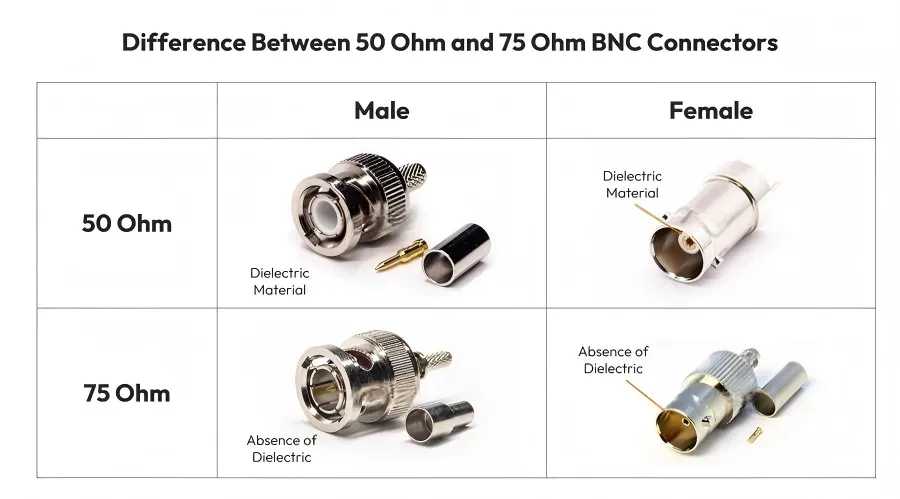
This image provides a side-by-side comparison of 50-ohm and 75-ohm BNC connectors, likely showing internal dielectric differences. The 50-ohm version typically uses a solid dielectric (e.g., PTFE), while the 75-ohm version may have an air-filled or different dielectric to achieve the higher impedance. The visual reference helps engineers and buyers distinguish between the two, preventing accidental mixing that would degrade return loss and increase reflections in 50-ohm RF systems.
Here’s the practical rule most labs follow:
If it’s RF measurement, stay 50 ohms from end to end.
BNC connectors exist in two common impedance variants:
- 50 Ω (RF systems)
- 75 Ω (video systems)
They are mechanically similar. Electrically, they are not.
If your chain uses 50 ohm coaxial cable, introducing a 75 Ω component—even something as small as an adapter—creates a discontinuity. The result isn’t catastrophic failure. It’s reflection. Slight degradation. Margins quietly shrinking.
At low frequencies and strong signal levels, you may not notice. In weak-signal testing or calibration work, you will.
That’s why impedance confirmation should never be assumed. Always verify.
If you need a broader refresher on transmission-line fundamentals, our article on RF coaxial cable families walks through how impedance shapes system behavior across connector types.
Separate rigid adapters from cable assemblies
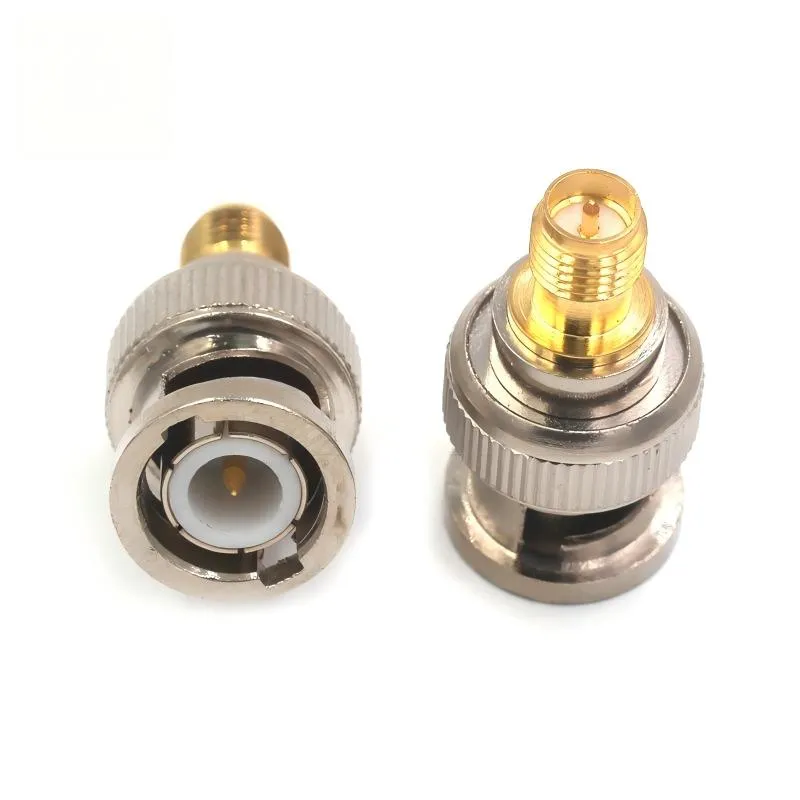
This photograph shows a rigid SMA to BNC adapter, a short metal component with an SMA connector on one end and a BNC connector on the other. It is used to directly mate devices with mismatched connector types in fixed, low-stress environments where ports are perfectly aligned. However, because it lacks flexibility, any cable movement, vibration, or misalignment is transmitted directly to the connector interfaces, which can lead to long-term reliability issues, especially with PCB-mounted SMA jacks.
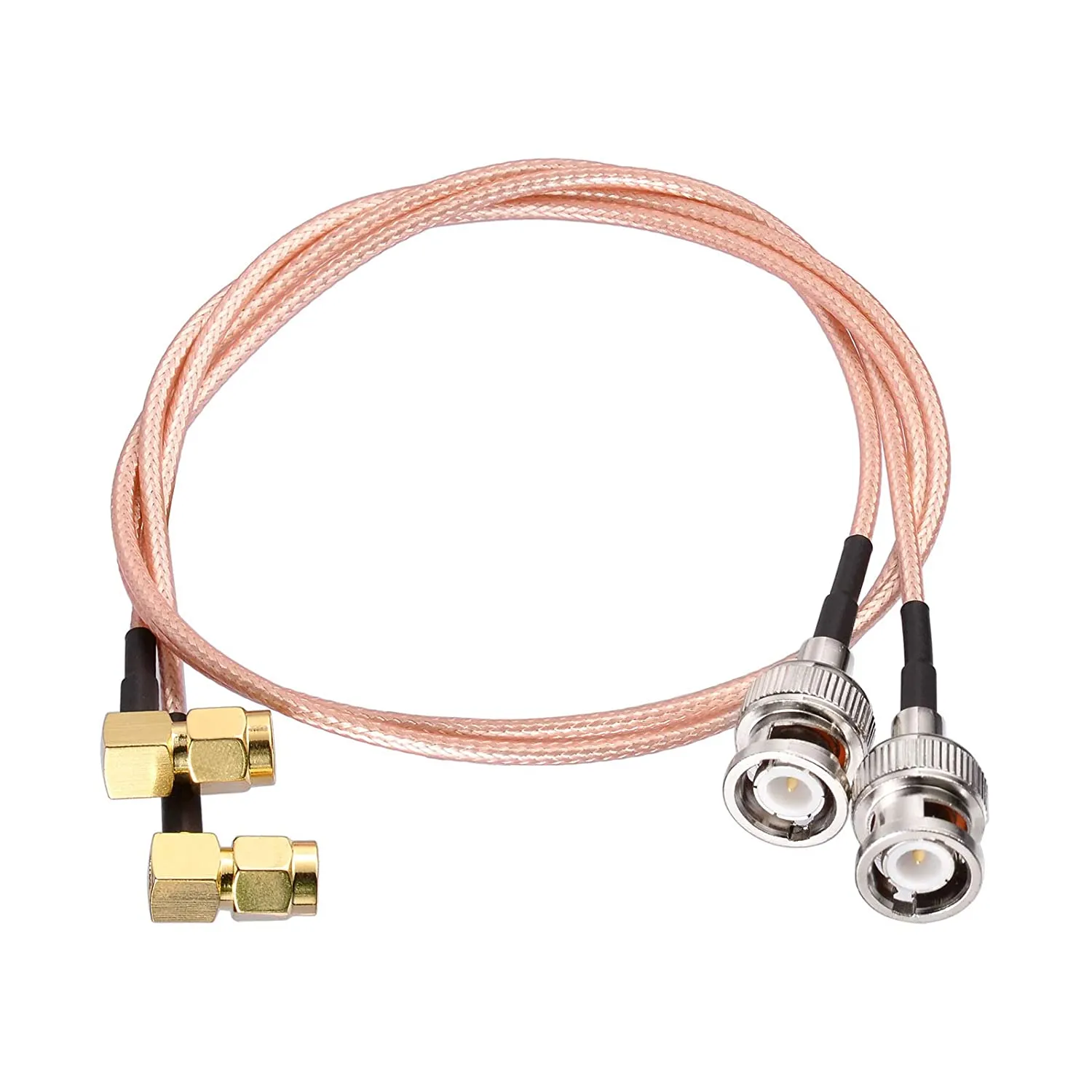
This image depicts a flexible SMA to BNC cable assembly. It consists of a length of coaxial cable (often RG316 for short runs) terminated with an SMA plug on one end and a BNC plug on the other. The flexible section allows it to accommodate slight offsets between ports, absorb vibration, and relieve strain on the connectors. Such cables are preferred over rigid adapters in lab environments where equipment is frequently rearranged or where ports are not perfectly aligned.
There’s another distinction that often gets overlooked:
A SMA to BNC adapter is rigid.
A SMA to BNC cable is flexible.
Electrically, both can perform well when specified correctly. Mechanically, they behave very differently.
Rigid adapters create a direct metal coupling between ports. Any torque, side-load, or bending force transfers immediately to the device connector.
Cable assemblies—especially those built from RG316 coaxial cable—introduce flexibility. They shift mechanical stress away from the mating surface and into the cable body.
When mechanical conditions are stable and aligned, rigid adapters are clean and efficient. When misalignment or movement exists, flexibility often protects your equipment.
The decision isn’t just electrical. It’s structural.
Should you use an SMA to BNC adapter or an SMA to BNC cable?
Switch to a cable when offset, vibration, or handling exists
Now imagine a rack environment.
The instrument port is slightly recessed. The device port sits a few centimeters offset. Cables get moved. Technicians plug and unplug repeatedly.
Rigid adapters under these conditions become stress multipliers.
Most SMA connectors—particularly PCB-mounted jacks—are not designed to carry bending moments. Even modest side-load over time can fatigue solder joints or distort mounting hardware.
A short bnc to sma cable built from RG316 cable absorbs those forces. It relocates mechanical strain away from the device port.
In practice, more SMA failures stem from torque and leverage than from RF power issues. Mechanical stress is the silent killer.
If movement exists, flexibility is not a luxury—it’s insurance.
For a deeper look at how flexible transitions compare to rigid ones, our routing-focused discussion of SMA adapter cable selection explores this tradeoff in more detail.
Avoid stacking multiple adapters in one path
Stacking adapters happens easily in labs.
You start with an SMA-to-BNC transition. Then a BNC barrel. Maybe a T-connector. Suddenly you have three or four interfaces before the signal even reaches the instrument.
Each interface contributes:
- Incremental insertion loss
- Additional return loss variation
- More mechanical looseness
If one adapter contributes roughly 0.15 dB, three might approach 0.45 dB. That may not matter in high-level power measurement—but in low-level signal characterization, it can shift readings.
Beyond electrical impact, stacked adapters behave like a lever arm. Mechanical instability increases with length.
Whenever you see multiple rigid transitions in series, pause and reconsider. Often a single custom-length SMA to BNC cable removes unnecessary joints entirely.
Fewer transitions mean fewer unknowns.
How do you identify SMA and BNC genders correctly before ordering?
Verify SMA thread position and center contact (watch for RP-SMA)
With SMA connectors, two features determine gender:
- Thread orientation (internal vs external)
- Center conductor (pin vs socket)
Standard configuration:
- SMA male → internal threads + center pin
- SMA female → external threads + center socket
Reverse polarity (RP-SMA) swaps the center contact while keeping thread orientation the same. It’s widely used in certain Wi-Fi equipment.
Before ordering a bnc to sma adapter, inspect the actual hardware. Don’t rely on memory or assumptions. Thread location alone is not enough—center conductor matters.
A quick visual confirmation prevents incorrect purchases.
Which impedance and frequency specs should you require?
Match adapter impedance to your system (50 Ω RF vs 75 Ω video)
Start with impedance. Every SMA to BNC adapter must match the system it enters.
Most RF labs operate in a 50 Ω environment. That includes:
- Radios
- Spectrum analyzers
- Power meters
- Most RF signal generators
BNC connectors, however, also serve the broadcast video world, where 75 Ω is standard. Mechanically similar. Electrically different.
When a 75 Ω adapter enters a 50 Ω chain, the mismatch produces reflection. The reflection coefficient is defined by:
[ \Gamma = \frac{Z_L – Z_0}{Z_L + Z_0} ]
Even modest impedance deviation degrades return loss. You may not see immediate failure—but your measurement uncertainty increases.
For background on why 50 Ω became dominant in RF systems, the overview of Coaxial cable theory on Wikipedia provides historical and technical context.
The takeaway is practical:
Never mix 50 Ω and 75 Ω components inside a measurement chain unless intentionally designing a matching interface.
Set realistic frequency and VSWR expectations
Not all adapters are created equal. Some are general-purpose transitions suitable for sub-GHz communication testing. Others are rated for microwave frequencies and tighter return-loss control.
Typical considerations:
- Frequency rating (e.g., up to several GHz)
- VSWR specification
- Insertion loss expectation
At lower frequencies, insertion loss per adapter may remain under 0.2 dB. As frequency increases, tolerances matter more. Small geometric deviations begin to influence return loss more significantly.
If your system operates near the upper limit of an adapter’s rating, you’re working with reduced margin. That may be acceptable in general testing. It’s risky in calibration work.
Engineers sometimes assume “if it fits, it works.” In RF, fit is only half the story.
For formal definitions of return loss and reflection behavior, the IEEE’s treatment of transmission-line theory—summarized publicly in resources like the Return loss article on Wikipedia—helps frame why small discontinuities affect measurement accuracy.
Treat “precision adapters” as a separate class
There’s a difference between a convenience adapter and a calibration-grade adapter.
Precision adapters are typically:
- Built with tighter concentricity tolerances
- Specified with improved VSWR
- Designed for repeatable mating performance
If you’re connecting a device to a vector network analyzer for characterization, the adapter becomes part of your calibration plane. That means its repeatability affects your measurement confidence.
General-purpose adapters are fine for signal routing. They may not be ideal for traceable measurement work.
When precision matters, specify accordingly.
How do materials and plating affect reliability and repeatability?
Choose plating for mating cycles and corrosion
Most adapters use nickel plating on the body and gold plating on center contacts.
Nickel offers mechanical durability. Gold provides stable electrical contact and resistance to oxidation.
In environments with:
- High humidity
- Frequent mating cycles
- Outdoor exposure
Material choice influences long-term stability.
Repeated insertions gradually wear plating layers. Once underlying metal becomes exposed, contact resistance may increase. That may not cause immediate failure—but it introduces variability.
If your environment involves frequent connect/disconnect cycles, specify mating-cycle durability explicitly in procurement documentation.
Prefer mechanically robust bodies when cables will be tugged
A thin-wall adapter may look identical externally to a heavier, more robust design. Internally, wall thickness and structural integrity differ.
If your application involves cable movement, vibration, or field deployment, choose adapters with:
- Solid body construction
- Tight thread engagement
- Minimal play when mated
Even better, consider relocating stress entirely by using a short flexible jumper built from RG316 coaxial cable. That shifts mechanical load away from the rigid transition.
If flexibility is needed, our detailed guide on RG316-based jumpers for strain relief explains when and why this approach reduces long-term connector damage.
Plan compatibility for mixed vendors
Connectors are standardized—but manufacturing tolerances vary.
When mixing adapters and cables from different suppliers, you may observe:
- Slightly tighter mating
- Slightly looser fit
- Different torque feel
Most of the time, these differences are harmless. In precision work, they can affect repeatability.
If your lab depends on consistent measurement results, it’s wise to:
- Standardize vendors where possible
- Perform spot checks for compatibility
- Document torque practices
Small dimensional deviations accumulate over repeated use.
How do you install an SMA to BNC adapter without damaging the SMA side?
Use a two-wrench technique to stop torque from reaching the device jack
When installing a SMA to BNC adapter, never allow rotational force to transfer into the device’s SMA jack.
Instead:
- Hold the device-side connector steady using an appropriate wrench.
- Rotate only the coupling nut of the adapter.
This prevents torque from reaching the PCB-mounted connector.
SMA jacks are often soldered directly to circuit boards. Excess torque can:
- Crack solder joints
- Distort dielectric supports
- Loosen ground connections
Mechanical damage is usually invisible at first—and expensive later.
Apply torque discipline and avoid over-tightening
SMA connectors are designed for controlled torque. Over-tightening doesn’t improve electrical contact. It damages hardware.
Under-tightening, on the other hand, may lead to intermittent contact and fluctuating return loss.
Use proper tools when possible. If torque tools aren’t available, tighten firmly but gently—never forcefully.
Consistency matters more than brute force.
Add strain relief when the adapter becomes a temporary handle
One subtle failure mode appears during troubleshooting.
Engineers sometimes grab a connected cable and use the adapter as a lifting point. It feels harmless in the moment.
But that action transfers bending force directly into the SMA jack.
If a cable must hang freely, support it. If the setup moves frequently, replace the rigid transition with a short SMA to BNC cable.
Adapters are electrical transitions—not structural handles.
How can you predict loss and measurement error from adapters?
Engineers often calculate cable attenuation carefully—then ignore transition losses entirely.
That oversight leads to surprises.
Budget transition loss along with cable loss
Each SMA to BNC adapter typically introduces measurable insertion loss. While small, it adds up.
A simple approach:
Total Loss (dB) = Adapter Loss + Cable Loss
If you use:
- 2 adapters at ~0.15 dB each
- 0.5 m of cable at known attenuation
You should include both in your loss budget.
For background on cable attenuation planning, our discussion of RF coaxial cable families outlines how loss scales with length and frequency.
Ignoring transitions leads to optimistic margin estimates.
Decide when adapter count becomes the real problem
In some systems, adapter count affects performance more than cable length.
High-frequency measurements amplify discontinuities. Even well-made transitions introduce minor impedance deviations.
Three stacked adapters may degrade return loss more noticeably than an additional half-meter of properly matched cable.
If your signal path includes multiple rigid transitions, reduce them. Simplify where possible.
Margin is often consumed quietly—one junction at a time.
Can a structured selection process reduce SMA to BNC adapter mistakes?
Most ordering mistakes don’t happen because engineers lack knowledge. They happen because decisions get made informally.
Someone checks the thread but forgets the center pin.
Someone assumes “it’s probably 50 ohms.”
Someone stacks two adapters because they’re already on the bench.
Nothing looks obviously wrong. But the measurement margin shrinks. Or the SMA jack loosens after a few weeks.
The solution isn’t more theory. It’s a short, repeatable decision process.
When choosing a SMA to BNC adapter, write down the following before approving the part:
- What exactly is the use case? (bench test, rack patch, field service)
- Is the SMA side standard or reverse polarity?
- Is the BNC side plug or jack—and panel or cable-end form?
- Is the entire signal chain confirmed 50 Ω?
- How many total rigid transitions will exist?
- What is the allowable loss margin in this path?
This forces clarity. If the answers feel uncertain, pause. That uncertainty usually predicts a problem later.
A real-world bench example (and why it matters)
Imagine you’re connecting a small SMA-equipped radio module to a BNC input on a spectrum analyzer. The ports aren’t perfectly aligned. There’s slight offset.
You have two choices:
- Install a rigid SMA to BNC adapter directly.
- Use a short SMA to BNC cable, often built from RG316 coaxial cable.
Electrically, the difference may be small. Both introduce some insertion loss. Both maintain impedance continuity if properly rated.
Mechanically, they behave very differently.
A rigid adapter transfers any bending force directly into the SMA jack. If that jack is PCB-mounted, stress accumulates at the solder joints. It may take weeks or months—but eventually something gives.
A short RG316 jumper absorbs that strain instead. The cable flexes. The board does not.
If the setup is perfectly aligned and never moved, the rigid adapter is clean and efficient. If anything shifts—even slightly—flexibility protects hardware.
Engineers often focus on decibels and ignore torque. In practice, torque damages more connectors than RF power ever will.
For deeper background on why short flexible transitions are common in compact systems, see our discussion on RG316 coaxial cable applications.
When does adapter count become the real issue?
Insertion loss per adapter is small. Typically around a few tenths of a decibel. That sounds negligible.
But consider a signal path that includes:
- One SMA to BNC transition
- A BNC barrel
- Another adapter
- A longer cable
Each interface introduces slight discontinuity. Return loss degrades incrementally. Measurement stability shifts just enough to create doubt.
Three adapters rarely cause obvious failure. They cause subtle drift.
If you find yourself stacking more than two rigid transitions, stop and reconsider the layout. A single well-chosen cable assembly can eliminate multiple junctions at once.
Less metal in the path often means more predictable results.
For additional context on how transitions accumulate in RF systems, our overview of RF coaxial cable families explains how loss and reflection scale across real installations.
Precision work vs general lab routing
Not every adapter needs to be calibration-grade. But not every application tolerates generic parts either.
If you’re simply routing a signal for monitoring, general-purpose adapters are often adequate.
If you’re characterizing antenna gain or validating device output on a vector network analyzer, the adapter becomes part of the calibrated path. Its repeatability affects your measurement confidence.
Precision-rated adapters typically offer:
- Better concentricity
- Lower specified VSWR
- More consistent mating behavior
They cost more. But when uncertainty matters, so does the hardware.
If the word “calibration” appears anywhere in your procedure, treat the adapter as measurement equipment—not just a connector.
Installation discipline: where most damage occurs
It’s rarely the RF signal that damages SMA connectors.
It’s torque.
The correct installation approach is simple:
- Hold the device-side connector steady.
- Rotate only the coupling nut.
- Avoid side-loading during tightening.
Many SMA jacks are soldered directly to PCBs. They are not structural supports. Even moderate bending force can weaken solder joints or distort the dielectric.
Another common mistake? Using the adapter as a handle.
During troubleshooting, cables get pulled. Equipment gets moved. If the adapter becomes the mechanical pivot point, stress concentrates at the smallest connector in the chain.
If movement is expected, support the cable body or switch to a short flexible assembly.
Small habits prevent expensive repairs.
Impedance verification: the overlooked detail
BNC connectors come in both 50 Ω and 75 Ω versions. They look nearly identical.
In RF labs, the default assumption is 50 Ω. In video systems, 75 Ω dominates.
Mixing them doesn’t cause instant failure. It causes mismatch.
The reflection coefficient depends on impedance difference. Even modest deviation increases return loss and reduces system margin.
If your chain uses 50 ohm coaxial cable, confirm that your SMA to BNC adapter is also 50 Ω.
For foundational understanding of transmission-line impedance behavior, the publicly accessible overview of Coaxial cable theory summarizes why 50 Ω became the standard compromise between power handling and attenuation.
In short: impedance consistency keeps reflections predictable.
Trends affecting SMA to BNC transitions
Connector ecosystems evolve slowly. SMA remains common in compact RF modules. BNC remains common in test instrumentation.
That coexistence guarantees continued need for SMA to BNC adapters.
What’s changing is the environment:
- More automated testing
- Higher mating-cycle counts
- Increased documentation requirements
- Greater focus on repeatability
As automation grows, repeatability becomes measurable rather than assumed. Slight differences in plating thickness or mechanical tolerance show up under repeated robotic mating cycles.
For manual lab use, these differences may never appear. In production fixtures, they matter.
The adapter is no longer just a convenience—it’s part of a controlled process.
Practical FAQ
When should I choose a rigid SMA to BNC adapter instead of a cable?
Choose rigid when alignment is natural and the setup remains stationary.
Choose flexible when there is offset, vibration, or repeated handling.
How can I confirm my adapter is 50 ohm?
Check manufacturer documentation. Never assume based on appearance.
If the chain is RF-focused and built around 50 Ω components, the adapter must match.
Do right-angle adapters change signal performance?
How many adapters are acceptable in one chain?
As few as possible. Each transition adds measurable insertion loss and slight reflection.
If stacking becomes necessary, consider redesigning the path with a single SMA to BNC cable instead.
What usually causes SMA jack failure?
Over-tightening. Side-loading. Using connectors as structural supports.
RF power rarely causes the damage people expect. Mechanical stress does.
Final reflection
A SMA to BNC adapter doesn’t look important. It’s small. It’s passive. It sits quietly between devices.
But in RF systems, quiet components still matter.
They influence insertion loss.
They shape return loss.
They transfer torque.
They accumulate error over time.
Most RF failures aren’t dramatic. They’re gradual. Margins shrink in fractions of a decibel. Connectors loosen imperceptibly.
Pay attention to the transition.
Because in RF work, transitions define stability.
Bonfon Office Building, Longgang District, Shenzhen City, Guangdong Province, China

A China-based OEM/ODM RF communications supplier
Table of Contents
Owning your OEM/ODM/Private Label for Electronic Devices andComponents is now easier than ever.