
SMA Connector Reliability and Installation Rules
Feb 21,2026
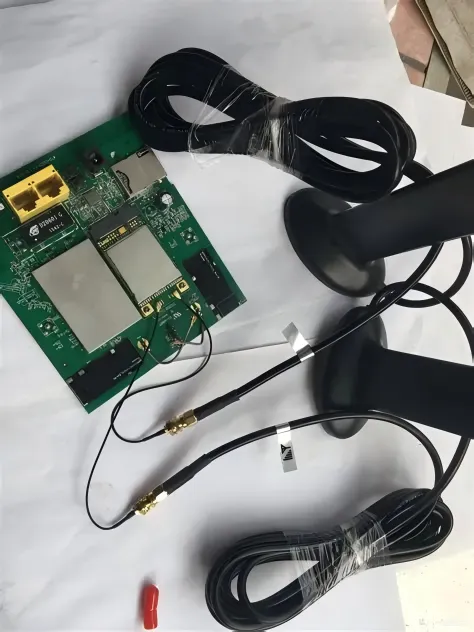
This image shows a typical SMA connector, often treated as a passive component during early RF design. However, as the system matures, the connector becomes a boundary where electrical performance, mechanical stress, and handling practices intersect. Proper selection and installation are essential for long-term reliability.
In many RF systems, the SMA connector enters the design quietly. It is familiar, widely available, and rarely questioned. Engineers spend most of their effort optimizing the RF module, antenna placement, and layout. The SMA interface is assumed to be stable, interchangeable, and largely irrelevant once continuity is confirmed.
That assumption usually survives early bring-up. It often survives the first round of measurements. Where it begins to fail is later—after cable routing is finalized, enclosures are closed, and the system is handled by technicians or users who were not part of the original design. At that point, the SMA connector stops behaving like a neutral interface. It becomes a boundary where electrical performance, mechanical stress, and handling practices intersect.
This guide treats SMA connector reliability as a system-level concern. The goal is not to replace existing connector knowledge, but to show how SMA connectors behave in real RF chains, especially when combined with modern modules, mixed connector types, and flexible coaxial cables.
Map where an SMA connector really belongs in your RF chain
Define SMA connector roles from board to antenna
In practical systems, the SMA connector usually appears in a small number of repeatable roles. It may sit directly at an RF module interface, follow a filter or PA/LNA stage, provide temporary test access, or serve as the final antenna feedthrough on a panel. Each role carries different risks. A board-edge SMA used for production test may see hundreds of mating cycles with little vibration. A panel-mount SMA connected to an external antenna may only be mated a few times, yet experience continuous mechanical loading from the cable and environment.
These roles strongly influence cable selection. Short internal links are often built with RG316 coaxial cable, while external connections typically rely on a thicker sma cable to reduce loss and tolerate handling. Treating every SMA connector as equivalent, regardless of position, is a reliable way to accumulate hidden failure points.
Distinguish SMA connector vs SMA cable vs SMA RF path
A frequent source of confusion in RF discussions is the tendency to collapse three different elements into one. The SMA connector is the mechanical and electrical interface. The SMA cable is the coaxial assembly attached to it. The SMA RF path includes everything in between: launches, adapters, bends, strain relief, and mounting details.
Optimizing only one of these rarely produces a stable result. A high-quality connector cannot compensate for a poorly chosen cable, and a low-loss cable cannot fix a damaged dielectric or bent center pin. This is why connector decisions are inseparable from cable decisions. In practice, many teams only resolve recurring field issues after revisiting how SMA connectors interact with cable assemblies such as those discussed in selecting the right SMA RF cable for loss and power constraints.
Link SMA connector choices to system budget (loss, VSWR, cost)
Every SMA decision touches multiple system budgets at once. Insertion loss reduces link margin. VSWR and return loss influence PA stability and receiver sensitivity. BOM cost scales rapidly in volume production. What looks like a minor connector choice on a schematic can quietly erode margin through small reflections or inconsistent mating once the system leaves the lab.
For this reason, experienced RF teams treat SMA connectors as part of the overall RF budget rather than as fixed, interchangeable parts. A slightly better-matched connector or cable termination often saves far more time and cost than it adds.
How should you match an SMA connector to cable and frequency?
Align SMA connector geometry with 50 Ω coax families
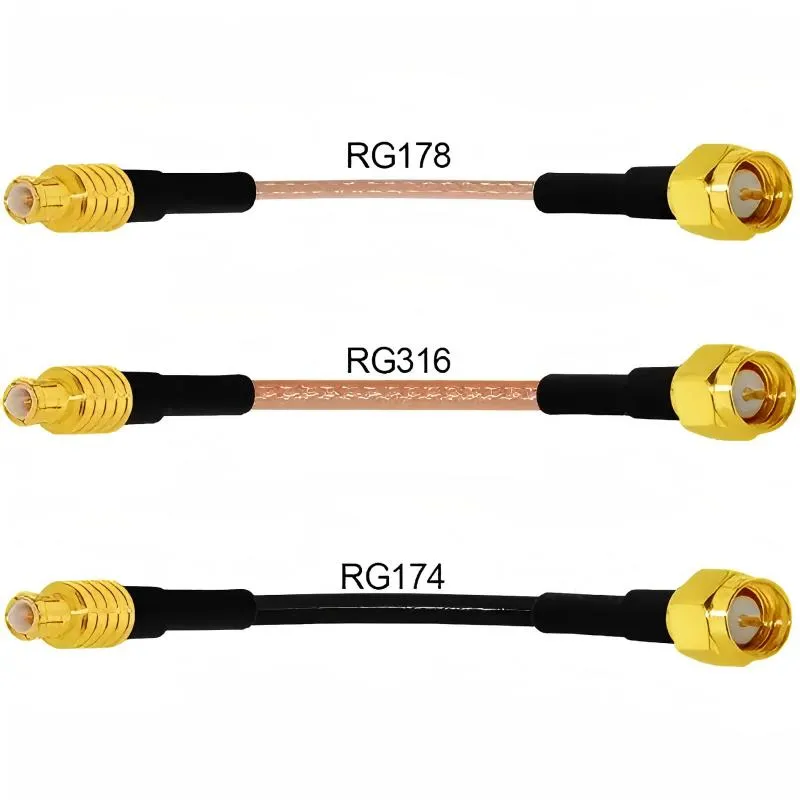
This figure illustrates how the center pin diameter, dielectric support, and crimp geometry of an SMA connector are optimized for specific 50-ohm coaxial cable families. Using a connector outside its intended coax family can degrade VSWR and introduce sensitivity to movement, especially at higher frequencies.
Most SMA connectors are designed around specific 50-ohm coaxial families. The center pin diameter, dielectric support, and crimp or solder geometry are not universal. Common pairings include RG316 cable for compact high-frequency routing, RG174 where flexibility matters more than loss, and larger laboratory cables where attenuation dominates.
Using an SMA connector outside its intended coax family often produces acceptable continuity but degraded VSWR. At lower frequencies this degradation may be subtle. As frequency increases, it becomes visible as ripple, instability, or sensitivity to movement rather than a clean failure.
Decide when RG316 coaxial cable is the right match
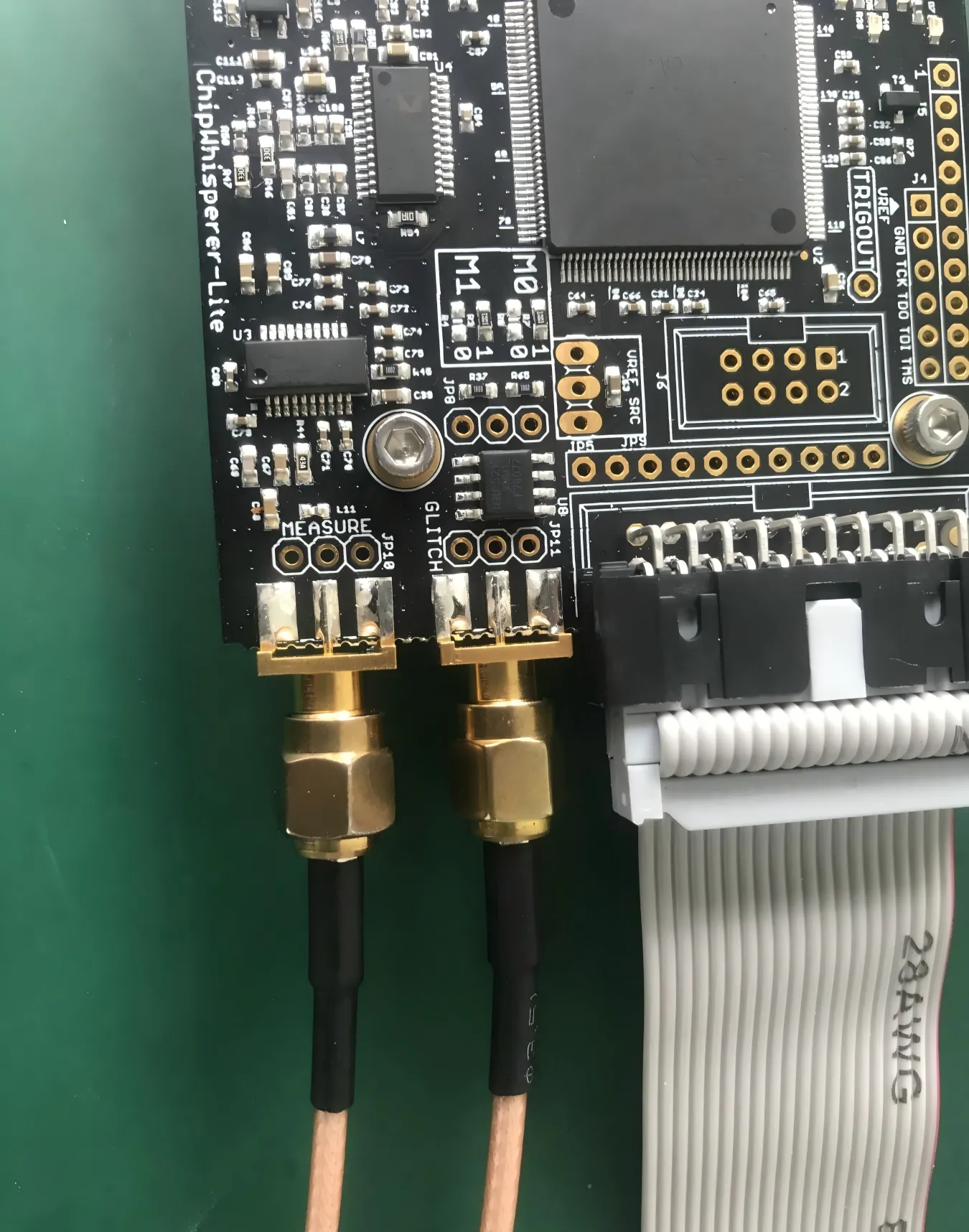
This image shows an SMA connector terminated onto RG316 coaxial cable. RG316 occupies a practical middle ground, supporting high frequencies while tolerating elevated temperatures and repeated bending. It is widely used inside enclosures, test fixtures, and module-to-panel links, though its attenuation limits its length in loss-sensitive paths.
RG316 coaxial cable occupies a practical middle ground in RF design. It supports high frequencies, tolerates elevated temperatures, and survives repeated bending better than many micro-coax options. These characteristics explain why it is common inside enclosures, in test fixtures, and in module-to-panel links.
The trade-off is attenuation. Over longer distances, RG316 loses more signal than thicker cables. In practice, it performs best where space, flexibility, or thermal stability matter more than absolute loss. Once distance becomes the dominant constraint, switching to a larger cable is usually the better decision, as outlined in detailed discussions of RG316 coaxial cable loss and bend limits.
Keep connector choice inside your operating frequency band
Standard SMA connectors are commonly specified up to 18 GHz, but not all implementations behave equally across that range. Sub-6 GHz systems, including most Wi-Fi applications, tend to be forgiving. As operating frequency approaches the upper end of the SMA range, small geometric differences and assembly tolerances become more visible.
If a system routinely operates near the connector’s frequency limit, consistency often matters more than nominal specifications. Variation between connectors that appears harmless on paper can show up as measurement noise or unstable return loss in practice.
Use datasheet limits (VSWR, power, temp) as hard constraints
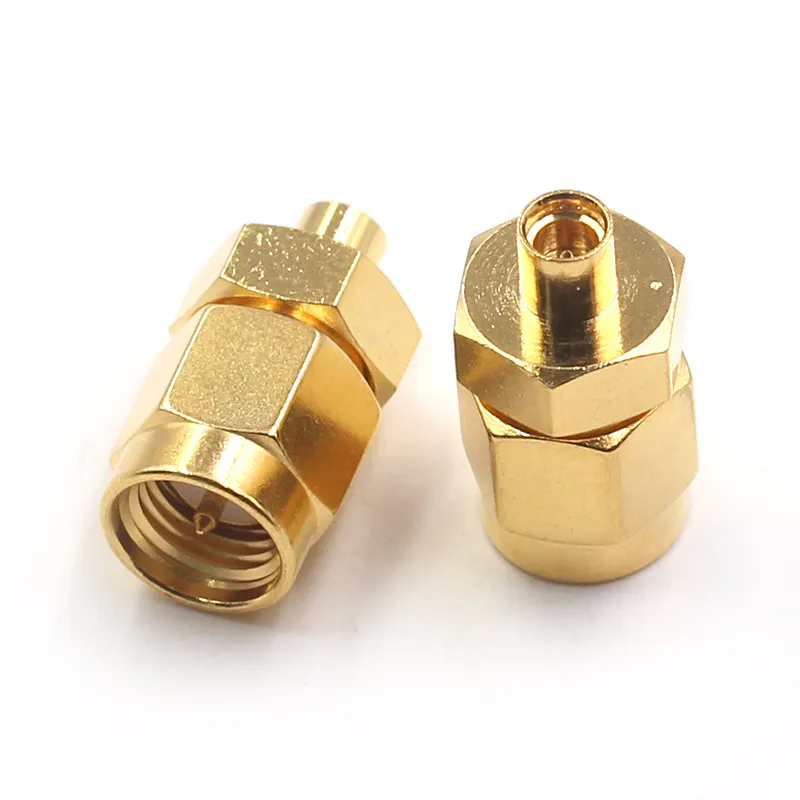
This photograph shows a standalone MMCX to SMA adapter. Such adapters are commonly used in lab setups to connect compact RF modules with MMCX connectors to standard SMA test leads or antennas. While convenient, each adapter introduces a small impedance discontinuity and should be used deliberately, especially in high-frequency or long cable runs.
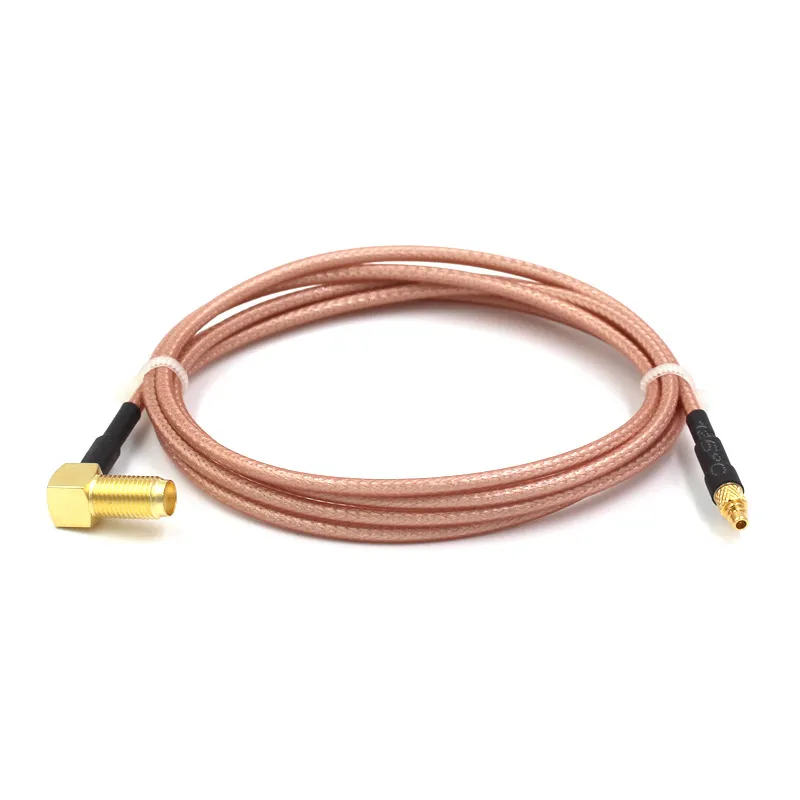
This image shows a complete assembly: an MMCX connector on one end, an SMA connector on the other, with a short length of flexible coaxial cable (often RG316) in between. This type of assembly is used to transition from an internal MMCX module interface to an external SMA panel port. It reduces the number of interfaces compared to using separate adapters, improving mechanical stability and return loss consistency.
Can you mix SMA connectors with MMCX and RG316 links safely?
Map typical SMA connector to MMCX connector signal paths
A common architecture places an mmcx connector directly on the RF module and transitions to an SMA interface at the panel. This approach keeps the module compact while preserving compatibility with standard antennas and test equipment. A typical signal path looks like this: MMCX connector to mmcx cable, then through an mmcx to sma connector or adapter, and finally into a sma cable leading to the antenna or instrument.
Each transition introduces mechanical and electrical complexity. Ignoring that complexity often leads to unstable behavior later, even if initial measurements look acceptable.
Use MMCX to SMA adapter and MMCX to SMA connector without killing return loss
An mmcx to sma adapter is convenient for prototyping and lab setups. In production or harsher environments, a dedicated mmcx to sma connector assembly is usually more stable. Adapters add interfaces, and interfaces add reflections. That does not make adapters inherently wrong, but it does mean they should be used deliberately rather than stacked by default.
Practical handling and retention considerations for MMCX interfaces are covered in depth in design rules around MMCX connector footprints and cable retention, which many teams reference during module integration.
Keep adapter count low in high-frequency RG316 cable runs
Verify impedance continuity across mixed connectors
Avoid common SMA connector failure modes during installation
Most problems blamed on an SMA connector are not design mistakes. They are handling mistakes. The connector itself usually meets spec. What changes is how it is treated once it leaves the schematic.
Early on, everything looks fine. The link closes. Measurements pass. Then someone moves a cable. Or opens the enclosure. Or reinstalls the connector after a test cycle. That is when small mechanical issues start to show up as RF behavior.
Prevent thread damage, over-torque and under-torque
Thread damage rarely announces itself. An SMA interface with slightly worn threads can still mate and still pass a basic check. The symptom shows up later as inconsistency. Numbers shift between measurements. VSWR changes when the cable is touched.
Under-torque allows movement at the mating surface. Over-torque causes different damage: cracked dielectric, distorted threads, or a center pin that no longer sits where it should. Once that happens, the connector is compromised even if it still “works.”
In lab setups, hand-tightening is common. It works until it doesn’t. In production or field installations, relying on feel instead of torque control is usually a mistake. Repeatability matters more than tightening force.
Keep dielectric and pin from bending during repeated mating
Mating cycle ratings assume ideal conditions. Clean threads. Straight insertion. No side load from the cable. Real use is rarely ideal.
Repeated mating at a slight angle slowly deforms the dielectric support and center pin alignment. The connector still mates. Electrically, it is no longer the same connector. This is why frequently used test ports degrade faster than rarely touched antenna ports.
Many labs leave a short adapter permanently installed on critical SMA ports. The adapter takes the wear. When it degrades, it is replaced. The underlying connector stays intact.
Manage strain relief on SMA cable and RG316 cable pigtails
Strain relief is where most “mystery” SMA issues originate. Whether the assembly uses a thick sma cable or a flexible rg316 cable, the failure pattern is similar. The cable bends right at the connector body. Over time, the termination suffers.
The connector is blamed. In reality, the problem is mechanical stress concentration.
Good routing matters more than most people expect. Gentle bend radii. Support close to the connector. No cable weight hanging off the SMA interface. These are simple choices, but they determine whether an assembly stays stable or slowly degrades.
Handle environmental risks: vibration, moisture, temperature
Bench conditions hide problems. Vehicles, outdoor enclosures, and industrial cabinets expose them.
Vibration works loose connectors that were only hand-tightened. Temperature cycling stresses dielectrics and solder joints. Moisture finds its way into interfaces that were never meant to be sealed. In these environments, connector reliability depends as much on mounting and support as on the connector itself.
Ignoring environment does not cause immediate failure. It causes slow drift.
How do you validate SMA connector performance in lab and field tests?
Use VNA sweeps to confirm SMA connector and cable assemblies
Wideband VNA sweeps reveal far more than spot checks. A healthy SMA path usually shows smooth behavior across frequency. Sharp features, unexpected ripple, or sudden changes often point to discontinuities at the connector interface.
Absolute numbers matter, but consistency matters more. Two assemblies built the same way should not behave differently. When they do, the cause is usually mechanical.
Check SMA connector repeatability under cable movement
One of the fastest ways to expose a marginal SMA interface is to move the cable slightly during measurement. If return loss shifts, something is unstable.
This test is crude. It is also effective. It regularly catches issues related to torque, strain relief, or partially damaged connectors that otherwise pass acceptance.
Verify SMA connector integrity in temperature and vibration tests
Thermal cycling and vibration testing change the picture. Expansion and contraction stress the dielectric and center conductor. Vibration amplifies any weakness in mounting or torque.
Assemblies that drift here rarely improve with time. What shows up in environmental testing usually appears again in the field.
Set acceptance criteria for SMA connectors used with MMCX modules
When an mmcx connector on a module transitions to SMA, variation increases. Each interface adds uncertainty, especially when an mmcx to sma adapter is involved.
For that reason, many teams apply tighter acceptance criteria to mixed-connector paths than to pure SMA assemblies. Clear limits on return loss and repeatability prevent borderline assemblies from slipping through simply because they pass a single measurement.
Plan SMA connector choices for long-term service and upgrades
Choose SMA connector genders and orientations for service access
Connector orientation affects how stress accumulates. Straight connectors simplify routing. Right-angle connectors can reduce bending at the interface. Gender choice influences which side absorbs wear during repeated connections.
From a service perspective, the connector that sees the most handling should also be the easiest to replace.
Reserve SMA test ports for future troubleshooting
Adding a dedicated SMA test port often feels unnecessary during early design. Later, it becomes invaluable. A labeled test interface allows diagnostics without disturbing the primary RF path.
Many systems that lack test access end up being opened more often than intended, increasing the risk of connector damage.
Design SMA connector layouts to allow cable replacement
Cables wear out. Even well-managed sma cable and rg316 coaxial cable assemblies eventually need replacement. Designs that trap cables behind boards or structural elements turn routine service into rework.
Space, slack, and access matter. They determine whether maintenance is straightforward or avoided.
Coordinate SMA connector specs with future radio or antenna upgrades
RF systems rarely stay static. Power levels change. Frequency bands shift. Antennas are replaced.
SMA connectors chosen with no margin often become the bottleneck during upgrades. Selecting connectors with modest headroom early is usually cheaper than redesigning interfaces later.
Compare SMA connector options across IoT, 5G and test systems
Map SMA connector usage in IoT and compact RF modules
In small IoT devices, the SMA connector is usually not part of the RF module. The module side exposes an mmcx connector. SMA is pushed out to the enclosure for antennas and test access. That decision is driven by footprint and routing, not by RF performance.
Internally, short mmcx cable or rg316 coaxial cable links absorb tolerances and make assembly easier. Externally, SMA stays because installers expect it. The transition between the two is where problems accumulate. Not immediately. Usually after rework, service access, or a few cable swaps. The mmcx to sma connector ends up taking the abuse, even though it was never designed to.
Evaluate SMA connector roles in 5G small cells and CPE
In sub-6 GHz 5G equipment, SMA connectors are still present, but rarely on the main RF path. High-power outputs tend to use larger interfaces. SMA ends up on secondary radios, monitoring ports, GNSS, or temporary test points.
Those ports get touched more than expected. Commissioning. Field diagnostics. Retrofits. Electrically they are easy to meet spec. Mechanically they age faster than the rest of the system. This is where connector wear shows up as “mysterious” instability later on.
See how labs rely on SMA connector and RG316 coaxial cable
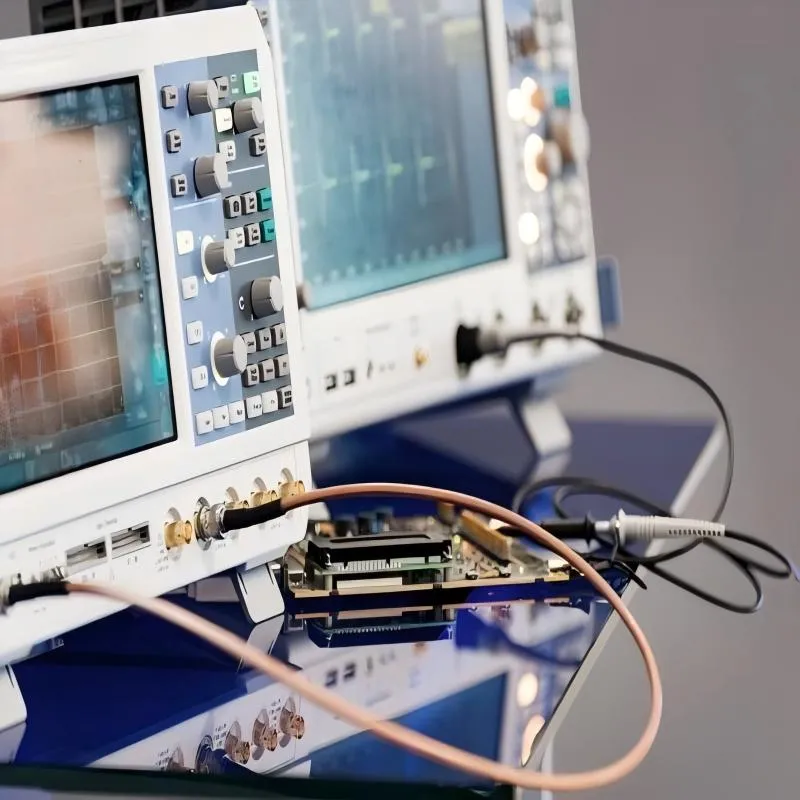
This figure depicts a typical laboratory environment where SMA connectors and RG316 coaxial cables are heavily used. Cables are repeatedly connected, twisted, and moved, leading to gradual wear on connectors and cable terminations. Labs that rotate cables, protect fixed SMA ports with adapters, and accept that connectors wear out see fewer unexplained measurement shifts. The image emphasizes the need for regular inspection and replacement.
Labs are unforgiving, mostly because of how people work.
Cables are reused, twisted, dragged, and connected at odd angles. The RG316 coaxial cable plus SMA combination survives because it is flexible enough to tolerate abuse. It also fails in predictable ways. Center pins loosen. Dielectrics creep. Threads wear down.
Labs that rotate cables, protect fixed SMA ports with adapters, and accept that connectors wear out see far fewer unexplained shifts in measurement results. Labs that treat connectors as permanent fixtures usually chase ghosts.
Add a short snapshot on recent SMA connector trends
SMA connectors have not disappeared. They have been repositioned.
Higher-frequency platforms now rely on smaller or precision interfaces. SMA remains where compatibility, availability, and mechanical robustness matter more than pushing frequency limits. That makes reliability the dominant concern, not peak performance.
Use an SMA connector reliability scorecard to finalize your BOM
Build an SMA connector reliability score for each position
| Item | Comment |
|---|---|
| Connector_ID | J1, J2, TP1 |
| Interface_Type | SMA-F bulkhead, SMA-M edge |
| Mates_with | sma cable, rg316 cable, mmcx to sma adapter |
| Frequency_GHz | Upper operating limit |
| Max_VSWR | Datasheet value |
| Rated_Power_W | Continuous power |
| Mating_Cycles_Rated | Catalog number |
| Torque_Spec_Nm | Target torque |
| Environment_Score (1–5) | Heat, vibration, moisture |
| Serviceability_Score (1–5) | Access, replacement |
| Adapter_Count | Interfaces in path |
A simple combined score is enough for review:
Risk_Score
= (Loss_Score + VSWR_Score + Environment_Score + Serviceability_Score + Adapter_Count) ÷ 5
Anything above ~3.5 usually deserves attention. Not because it is wrong, but because it is where problems tend to show up first.
Walk through an example line with MMCX to SMA connector
Typical path seen in many products:
Module mmcx connector → short mmcx cable → mmcx to sma connector → sma cable → antenna.
No single element is extreme. Risk accumulates through handling, adapters, and access frequency. The scorecard makes that visible without debate.
Use the scorecard in design reviews and factory acceptance tests
FAQ
Q: How tight should an SMA connector really be?
A: Around 0.6–1.0 N·m. Looser than that moves. Tighter than that breaks things. Consistency matters more than chasing a number.
Q: Is it a problem to mix RG316 cable and thicker SMA cables in one system?
A: No. It is common. The transition just needs mechanical support. Most issues blamed on impedance are actually strain problems.
Q: Why do SMA connectors drift even when nothing looks damaged?
A: Wear is mechanical, not electrical. Threads, dielectric support, and terminations change slowly. The connector still works. It just does not behave the same way anymore.
Q: When does an MMCX to SMA adapter stop being acceptable?
A: When vibration, repeated access, or long service life is expected. At that point, a fixed mmcx to sma connector assembly is usually safer.
Q: What goes wrong when too many adapters are stacked?
A: Small discontinuities add up. At higher frequencies or on long rg316 cable runs, the system becomes sensitive to movement.
Q: How do you isolate connector issues quickly?
A: Swap in a known-good sma cable. If behavior changes, it was the cable or termination. If not, look at the connector.
Q: Are SMA connectors still worth using in new designs?
A: Yes, within their range. They are no longer the “everything connector,” but they still work well when used deliberately.
Bonfon Office Building, Longgang District, Shenzhen City, Guangdong Province, China

A China-based OEM/ODM RF communications supplier
Table of Contents
Owning your OEM/ODM/Private Label for Electronic Devices andComponents is now easier than ever.