
SMA Coaxial Cable Structure & Selection

Jan 23,2025

A conceptual image depicting an RF project timeline where major components (radio, antenna, enclosure) are decided early, while the SMA coaxial cable is added later as an afterthought, with a question mark or subtle performance graph drift symbolizing resulting issues.

This image appears at the beginning to visually introduce the core dilemma—the SMA coaxial cable often becomes a problem source due to its underestimated timing and role. It might be presented as a project timeline or mind map: the left side lists and highlights early-decided “main drivers” like “RF chip,” “antenna selection,” “enclosure layout”; on the right or at the end, an icon of an “SMA coaxial cable” is placed in a later box, possibly labeled “afterthought” or “default choice.” An overlay of a downward-trending performance curve or increasing error bars might暗示 performance “drift” or margin reduction due to poor cable selection. This echoes the text: “On paper, the cable looks passive… small compromises quietly eat into margin.”

The Late-Arriving Critical Component
In RF hardware, the sma coaxial cable almost never feels like a design driver. It shows up late, often after the radio already works, the antenna has been selected, and the enclosure layout feels “mostly done.” That timing is exactly why it causes problems. On paper, the cable looks passive. In practice, it sits at a mechanical and electrical boundary where small compromises quietly eat into margin. Engineers usually notice only when performance drifts, measurements become sensitive to touch, or a system that passed early validation starts behaving differently in the field. This guide focuses on how sma coaxial cable actually behaves inside real RF links, how to read its structure correctly from datasheets, and how to turn cable selection into a repeatable workflow instead of a last-minute fix.

Where does an sma coaxial cable actually sit in your RF link?

A block diagram of an RF system showing the SMA coaxial cable as a distinct “transition layer” bridging three domains: the PCB/RF module, the enclosure/panel interface, and the external antenna/instrument.

Following the subheading “Where does an sma coaxial cable actually sit in your RF link?” this should be a clear system architecture block diagram. The diagram might divide the system into three “domains” represented by dashed boxes: PCB/RF Module Domain (containing chips and internal traces), Enclosure Interface Domain (containing bulkhead connectors), and External Environment Domain (containing antenna or test equipment). An SMA coaxial cable is drawn as the central physical link connecting these three domains, specially highlighted or bolded. Annotations like “Transition Layer” or “Impedance Continuity / Mechanical Stress Absorption” might be placed next to the cable, with arrows示意 signal flow and potential mechanical stress paths. This image visually demonstrates the cable’s role as a critical interface component.

The Transition Layer in the RF Chain
Before talking about loss numbers or materials, it helps to be precise about where an sma coaxial cable lives. In most systems, it is not “just a wire.” It forms the transition layer between three RF domains: the PCB and RF module, the enclosure or panel interface, and the external antenna or test equipment. Because it spans those boundaries, it often has a larger impact on stability and margin than its short length suggests.

Separate sma cable, sma coax cable and sma rf cable in real usage

These terms are often used interchangeably, but in day-to-day engineering work they describe different things. sma cable is a loose umbrella term that simply means a cable with SMA connectors on one or both ends. It says nothing about impedance, loss, or RF suitability. sma coax cable narrows the meaning to a coaxial structure, typically intended for controlled-impedance signal paths. sma rf cable is the most precise in practice and usually refers to a 50-ohm coax assembly designed specifically for RF signals. In a real RF link, the distinction matters. A common chain looks like RF module → short internal jumper → sma coaxial cable → antenna or instrument. That middle segment is not filler. It defines impedance continuity, absorbs mechanical stress, and often sets the usable frequency ceiling before margin starts to disappear.

Relate sma coaxial cable to rg316 coaxial cable and other 50-ohm families

An sma coaxial cable is defined by both its connector and its coax family. The SMA connector alone does not tell you how the cable behaves. In practice, several pairings dominate production assemblies. RG316 coaxial cable with SMA is widely used in compact RF hardware thanks to its PTFE dielectric, stable impedance, and high temperature tolerance. RG174 with SMA appears where cost and flexibility matter more than loss, while LMR-100 with SMA is chosen when runs get longer and attenuation becomes critical. In many IoT devices, radios, and lab fixtures, “RG316 plus SMA” is the default assumption unless length or power clearly pushes the design toward a thicker cable. Teams often sanity-check these choices against a broader reference such as an internal or public RG cable guide to avoid re-learning the same tradeoffs on every project.

Decide when sma coaxial cable is the right layer between PCB and antenna

A comparison of two RF product architectures: one uses an SMA coaxial cable to connect an internal RF module to an external antenna via a panel, the other uses a direct PCB trace to an integrated antenna. Highlights the “interface decision” point.

Following the subheading “Decide when sma coaxial cable is the right layer between PCB and antenna,” this is likely a side-by-side comparison. Left Scenario: Shows a typical product interior view: an RF module on a PCB connects via a short SMA coaxial cable to a panel-mount SMA connector, which then connects to an external antenna. This scene might be labeled “Suitable: Modular, Testable, External Antenna”. Right Scenario: Shows a highly integrated device where the antenna element is printed directly on the PCB edge or is a chip antenna, connected to the RF chip via a microstrip line or direct connection. This scene might be labeled “Better: Space-Constrained, Fixed Path, High Integration”. The comparison aims to emphasize that cable use should be based on clear interface needs, not habit.
An Interface Decision, Not a Default
Not every RF path benefits from an sma coaxial cable. It makes sense when the RF module must connect to a panel or bulkhead, when the antenna sits outside the enclosure, when modular testing or serviceability is required, or when lab instruments are part of the workflow. It is less ideal when the antenna is directly on the PCB, when space is extremely constrained, or when the RF path is fixed and never serviced. In those cases, a direct feed or board-level transition often outperforms a cable. Treat sma coaxial cable as an interface decision, not a default habit.

How do you read sma coaxial cable construction from a datasheet?

Most datasheets look deceptively simple: a few dimensions, a loss figure, and a temperature rating. Yet many long-term RF issues trace back to misunderstanding one of those lines. Reading a datasheet correctly means knowing how each layer of the cable contributes to electrical and mechanical behavior.

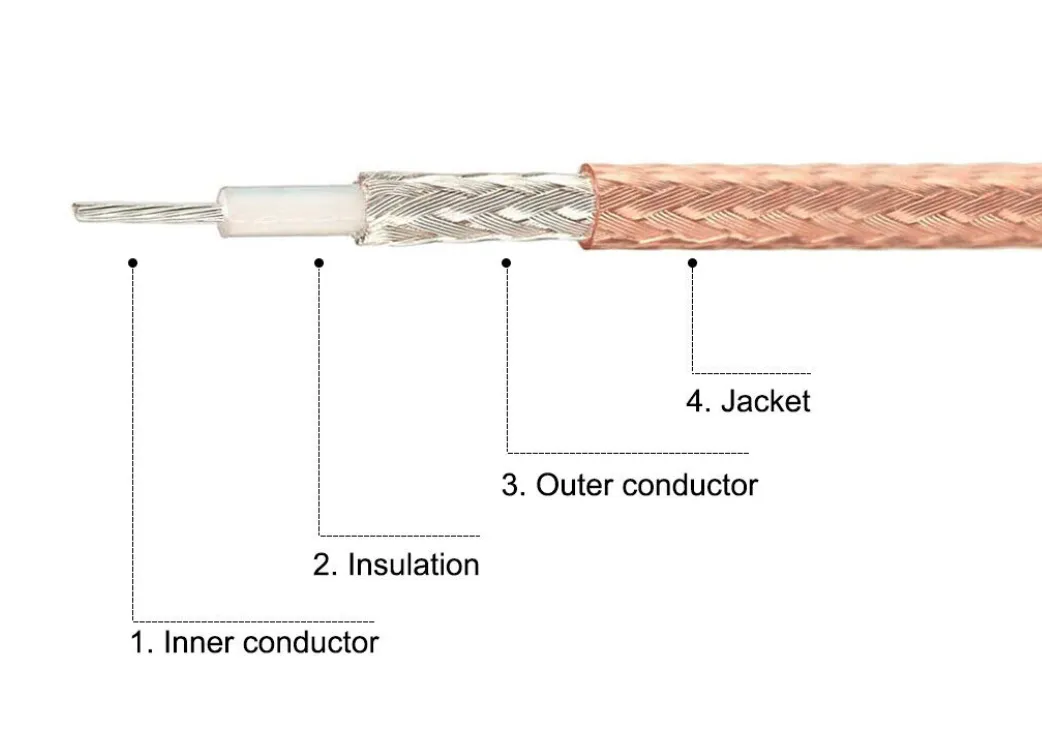
Break down inner conductor, dielectric, shielding and jacket step by step

Schematic diagram of RG316 layered construction and its field failure modes

This is an extension or variant of the structural diagram in Figure 4 or Figure 6, but with a greater focus on field failure mechanisms. It likely uses a vertically arranged exploded view, showing the four layers of RG316 from top to bottom or with arrow indicators: 1) Inner Conductor, 2) Insulation/Dielectric (PTFE), 3) Outer Conductor (Braid Shield), 4) Jacket (FEP). Beside each layer, there might be brief text explaining its primary function and how failure can initiate under stresses like overheating, excessive bending, vibration, or chemical exposure (e.g., excessive bending stresses the dielectric; vibration fatigues the braid; chemical exposure weakens the jacket). This diagram visually explains that RG316 reliability is “layered,” field failures usually begin in one layer and propagate, and the overlap of multiple stressors (bending, heat, vibration) accelerates degradation—interactions that are hidden by looking only at the headline temperature rating.

RG316 Layered Construction and Field Failure
Every sma coaxial cable shares the same basic anatomy, but small differences matter. The inner conductor material affects both resistance and durability; silver-plated copper improves high-frequency performance, while stranded conductors trade a little attenuation for flexibility. The dielectric, most commonly PTFE or FEP, controls impedance stability and temperature range. PTFE, which is standard in rg316 coaxial cable, is a major reason that cable performs reliably near hot RF modules. Shielding structure—single braid, double braid, or foil plus braid—determines EMI containment and susceptibility, with heavier shielding improving isolation at the cost of stiffness. The jacket rarely changes RF specs directly, but it decides whether a cable survives routing, vibration, and repeated handling over the product’s lifetime.

Link 50-ohm impedance to sma rf cable compatibility and VSWR

SMA connectors are part of the 50-ohm RF ecosystem, and that assumption runs through antennas, modules, and test equipment. Using a 75-ohm coax, even if it terminates in SMA connectors, introduces an impedance mismatch. At short lengths and low frequencies, the effect can be subtle. At higher frequencies, it shows up as increased VSWR, reduced link margin, and sensitivity to cable movement. This is why sma rf cable almost always implies 50-ohm impedance end-to-end, not just “SMA on the outside.”

Compare sma coax cable OD and bend radius with rg316 coaxial cable

Outer diameter and bend radius quietly govern long-term reliability. RG316 coaxial cable is popular because its OD fits tight layouts while maintaining a manageable minimum bend radius. That balance explains why it appears so often between RF modules and SMA panel connectors. Ignoring bend-radius limits leads to slow, cumulative failures such as dielectric deformation, shield fatigue, and impedance drift. A cable that measures fine during bring-up can age poorly if it is forced into sharp corners during assembly.

How can you plan sma coaxial cable loss before you lock the length?

Loss is where many RF designs quietly fail. Not through obvious breakage, but through small compromises that accumulate late in the project. A short sma coaxial cable often looks harmless by itself, yet at higher frequencies even fractions of a decibel can decide whether a link feels robust or fragile. Treating cable loss as something to estimate early, rather than something to measure after assembly, usually prevents painful redesigns.

From a fundamentals standpoint, coaxial cable attenuation is driven by conductor loss, dielectric loss, and frequency-dependent skin effects. These mechanisms are well explained in general RF references such as the overview of coaxial cable. What matters in day-to-day engineering work is turning those physical principles into a simple planning habit for sma coaxial cable runs, rather than relying on intuition or rules of thumb.

Define the key inputs for a sma coaxial cable loss planner

A practical loss planner does not require a full RF simulator or a network analyzer. It only needs a small set of inputs that most engineers already know. Operating frequency in gigahertz sets the loss regime. Planned length defines how much attenuation accumulates. Cable type—such as rg316 coaxial cable, RG174, or LMR-100—determines the attenuation constant. Typical attenuation values can be taken from datasheets or conservative reference figures, while target link margin comes from the system-level RF budget. This way of thinking aligns closely with how loss is introduced in basic transmission-line discussions such as transmission line theory, but applied at the component level.

Calculate total loss, margin and maximum recommended length

Once the inputs are defined, the calculations are intentionally straightforward. Total cable loss equals attenuation per meter multiplied by planned length. Effective margin equals the original link margin minus that loss. From the same relationship, a maximum recommended length can be derived by dividing the available margin by the attenuation per meter of the selected cable. This logic follows the same principles used in insertion-loss budgeting described in measurement guidance from institutions like the National Institute of Standards and Technology, even though the planner itself remains lightweight.

The outputs are more valuable than the formulas. Total loss shows how much of the RF budget the cable consumes. Effective margin reveals whether the design still has room to breathe. Maximum length creates a hard boundary that helps prevent late-stage decisions that quietly push a design over the edge.

Turn planner results into simple “go / shrink / upgrade” decisions

The real value of a planner is decision clarity. If effective margin stays comfortably above a few decibels, the design can move forward without anxiety. If the margin is thin but positive, shortening the sma coaxial cable or switching to a lower-loss option becomes an informed trade-off. If the margin drops below zero, the conclusion is unambiguous: the cable choice or routing must change. This mirrors how link budgets are treated in formal communications planning frameworks discussed by the International Telecommunication Union, scaled down to a single RF interconnect.

How should you pair sma coaxial cable with antennas, modules and jumpers?

A cable almost never exists in isolation. In real hardware, sma coaxial cable is chained with RF modules, panel interfaces, and external antenna leads. Each transition introduces loss, mismatch risk, and mechanical stress, which means pairing decisions often matter more than any single specification line.

Connect sma coaxial cable segments to external sma antenna cable wisely

A system diagram showing the cascaded connection of RF module -> internal SMA coaxial cable -> panel bulkhead -> external SMA antenna cable -> antenna. Loss dB values are indicated for each segment, emphasizing the “sum of all losses.”

Following the subheading “Connect sma coaxial cable segments to external sma antenna cable wisely,” this should be a system-level connection diagram showing the complete path from source to radiation: RF Module -> (Loss: ? dB) -> Internal SMA Coaxial Cable -> (Connector Loss) -> Panel Bulkhead Connector -> (Loss: ? dB) -> External SMA Antenna Cable -> Antenna. Crucially, typical loss values might be annotated below each cable segment (e.g., Internal: 0.5 dB, External: 1.2 dB), with a calculation like “Total Loss = 0.5 + 0.2 + 1.2 = 1.9 dB” next to the overall path. An arrow or highlight might circle the “Internal SMA Coaxial Cable” segment with an annotation: “Optimizing this segment often yields the highest benefit.” This image emphasizes the importance of considering cable selection within the context of a system-level loss budget, not in isolation.

Cascaded Losses: Integrating Cable Segments
A common architecture looks like RF module → internal sma coaxial cable → panel bulkhead → external sma antenna cable. The mistake is treating each segment as independent. Electrically, the RF system only sees the sum of all losses and reflections. Shortening the internal cable often recovers more margin than upgrading the external antenna lead, especially when the internal run uses a small-diameter coax. This cascaded-loss mindset is consistent with classical RF system analysis described in resources such as microwave engineering.

Decide when internal jumpers should be rg316 coaxial cable

Internal jumpers live in harsher conditions than most lab cables. They are exposed to heat from regulators and RF power amplifiers, vibration from fans or vehicles, and repeated handling during assembly. RG316 coaxial cable is frequently chosen here because its PTFE dielectric maintains stable impedance across temperature and time. That stability explains why RG316 appears so often in industrial and aerospace RF discussions, and why it remains a default choice for internal SMA jumpers in commercial hardware.

Avoid impedance and connector mismatches when mixing sma rf cable with BNC, N, MCX or MMCX

Mixed-interface systems are common, especially when lab instruments or legacy antennas are involved. Problems arise when adapters are stacked or impedance families are mixed without noticing. SMA, BNC, N, MCX, and MMCX connectors all exist in defined impedance variants, and mixing 50-ohm and 75-ohm components introduces reflections that worsen as frequency increases. General connector behavior and impedance conventions are clearly summarized in the overview of RF connectors, which emphasizes impedance continuity as a core design rule. In many cases, a purpose-built cable with the correct connector on each end is electrically cleaner and mechanically more reliable than an adapter chain.

How can you check sma coaxial cable assembly quality without a full RF lab?

Most engineering teams do not have a VNA available at every stage of a project. In reality, many issues related to sma coaxial cable assemblies surface well before any formal RF measurement takes place. What matters is knowing which quick checks actually correlate with real failures, instead of relying on tests that look rigorous but miss practical problems.

Build a visual inspection checklist for sma cable ends

A careful visual inspection often catches the most common assembly defects. Start by looking at strip length consistency on both ends of the sma coaxial cable. If the strip length varies, the braid is often pushed back unevenly or compressed poorly under the ferrule. Pay attention to the braid itself. Stray strands, uneven compression, or braid intrusion into the dielectric usually lead to unstable impedance later on. The transition area between the SMA connector body and the cable jacket deserves special attention. Without proper strain relief, this junction becomes the mechanical weak point once the cable is routed inside an enclosure. These checks align closely with the same practical concerns discussed when planning SMA jumper routing and termination in articles like SMA RF Cable: Length, Loss Planning, and Practical Design, even though no RF instrument is involved at this stage.

Use basic continuity and isolation tests before RF measurements

Before a cable ever touches a radio or spectrum analyzer, simple electrical checks eliminate the most obvious faults. A continuity test verifies that the center conductor connects cleanly from end to end. An isolation test confirms there is no short between the center conductor and the shield. These tests take only seconds with a multimeter but catch a large percentage of assembly errors. When multiple sma coaxial cable assemblies are used in a system, sampling a few cables from each batch is often enough to reveal process issues early. This approach is consistent with how teams handle small-diameter RF cables such as RG316 in day-to-day work, especially when cable loss and reliability are already being managed carefully elsewhere in the design.

Recognize real-world symptoms of a bad sma coaxial cable

Some cable problems only show up once the system is powered and operating near its limits. If lightly touching or flexing the sma coaxial cable causes signal strength, data rate, or error rate to change, the cable or its termination is likely at fault. Another warning sign is a system that behaves normally at low data rates but becomes unstable at higher throughput or higher transmit power. In these cases, replacing the RF module often has little effect, while swapping the cable restores normal behavior immediately. Experienced engineers tend to check the cable early, especially when similar symptoms have already been seen in previous SMA-based builds.

What recent industry trends are changing sma coaxial cable decisions?

Cable selection today is shaped not only by RF theory but also by how products are built and scaled. Over time, these shifts have subtly changed how teams approach sma coaxial cable choices, even when the electrical requirements remain the same.

Finished RF cable assemblies are becoming the default

More teams now rely on finished RF cable assemblies rather than terminating coax in-house. The driver is consistency rather than performance alone. Pre-assembled sma coaxial cable options reduce unit-to-unit variation and simplify quality control during production. This trend fits naturally with a broader move toward standardizing RF interconnects early in the design process, a theme that also appears in general RF cable selection discussions on tejte.com, such as Understanding RF Cables – The Ultimate Guide.

SMA interfaces continue to define the RF boundary

Despite the availability of smaller board-level connectors, SMA remains common wherever an RF path crosses an enclosure boundary. That persistence reinforces the importance of treating sma coaxial cable as part of the RF system, not as an afterthought. In many designs, the SMA cable quietly defines the handoff between internal RF routing and the external antenna environment, which is why cable length, loss, and routing constraints are often evaluated together with antenna placement, as seen in practical deployment-focused discussions like SMA Antenna Cable Length, Loss & Use Cases.

Standard cable recipes reduce design friction

As product families grow, re-evaluating cable choices for every new revision becomes inefficient. Defining a small set of standard sma coaxial cable recipes—each with known length limits, bend-radius guidance, and connector combinations—reduces uncertainty and speeds up reviews. Over time, these recipes replace informal habits and help new engineers avoid repeating earlier mistakes.

How can your team turn sma coaxial cable know-how into a repeatable workflow?

Experience only scales when it is captured. Treating sma coaxial cable decisions as tribal knowledge almost guarantees that the same issues will resurface in future projects.

Start every design with impedance, frequency, and environment

Reliable workflows begin with fundamentals. Lock impedance, operating frequency, power level, and environmental constraints first. Only after those are clear should cost or inventory influence the cable choice. This mirrors how antennas and RF modules are typically selected and prevents last-minute compromises that quietly reduce margin.

Create standard sma coaxial cable recipes for common scenarios

Most teams benefit from defining a few clear cable recipes: one for lab jumpers, one for internal enclosure wiring, and one for external or higher-stress applications. Each recipe should document cable type, typical length range, connector pairing, bend-radius limits, and temperature range. Over time, these recipes become faster to apply than re-reading datasheets or debating options from scratch.

Link sma coaxial cable decisions back to existing RF knowledge

Finally, cable decisions should connect back to the broader RF knowledge base already in use. When sma coaxial cable guidance aligns with RG-family behavior and SMA interface practices documented elsewhere on the site, design reviews become shorter and decisions easier to defend.

Frequently Asked Questions

When does a sma coaxial cable become the bottleneck in an RF link?

It often becomes the bottleneck as frequency increases, cable length grows, or multiple cable segments are chained together. In marginal designs, even short runs can dominate the loss budget.

Is rg316 coaxial cable always the safest choice for sma rf cable runs?

RG316 is a strong default for short, reliable jumpers, but it is not ideal for long runs or higher power. Thicker 50-ohm cables are often more appropriate in those cases.

Can the same sma coaxial cable recipe be reused for lab and production hardware?

Sometimes, but lab cables emphasize flexibility and durability, while production wiring often prioritizes space and routing stability. Separate recipes usually work better.

How should sma coaxial cable choices be documented for reuse?

Short, recipe-style documentation works best. List cable type, length limits, connector pairs, frequency range, and typical loss, and reference related RF cable guidance where appropriate.

Bonfon Office Building, Longgang District, Shenzhen City, Guangdong Province, China

customer service