
SMA Coax Cable Specs, Loss and Layout
Feb 19,2026
Map sma coax cable into your RF signal chain
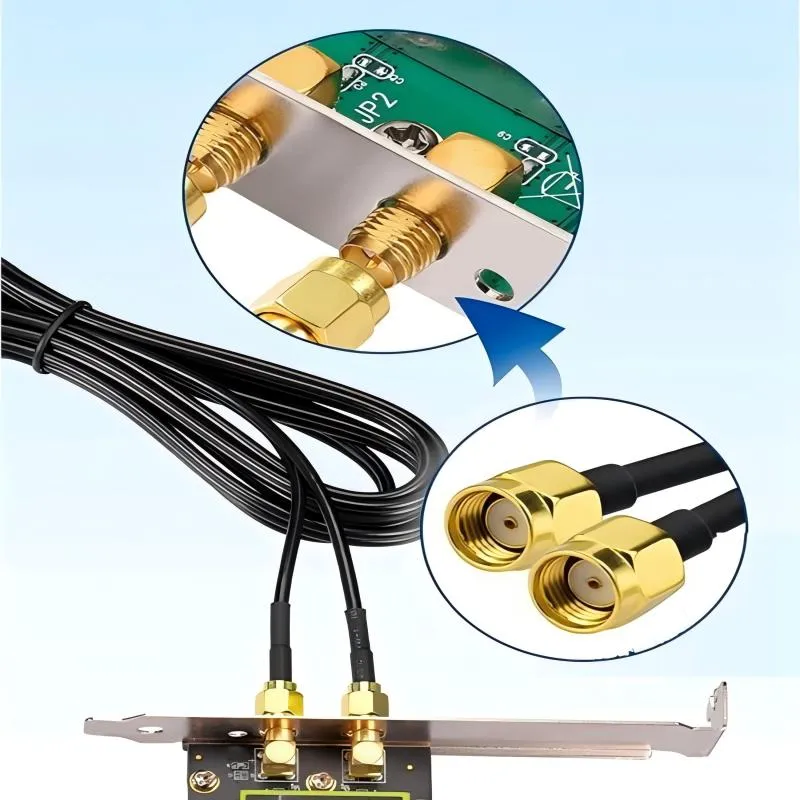
This figure illustrates where an SMA coaxial cable typically fits within an RF system: between a radio module and an antenna, or between test equipment and a device under test. It emphasizes that cables are not neutral accessories; they contribute to loss, phase shift, and overall link margin.
In many RF systems, the sma coax cable shows up later than it should.
The radio works. The antenna choice is locked. Early bench tests pass. At that point, the cable is added almost as an afterthought—something short, something convenient, something that “shouldn’t matter much.”
That assumption holds just long enough to be dangerous.
A coaxial jumper is not neutral hardware. Once it is installed, it becomes part of the RF signal chain in the same way a filter, a connector launch, or even a short trace does. It shapes loss, repeatability, and how stable your measurements remain once the setup leaves the lab.
Engineers who treat cables as system elements—rather than accessories—tend to debug fewer “mystery” issues later. The broader system view outlined in the RF cable guide applies here directly: cables belong in the architecture, not at the end of procurement.
Clarify roles of SMA connectors versus sma coax cable
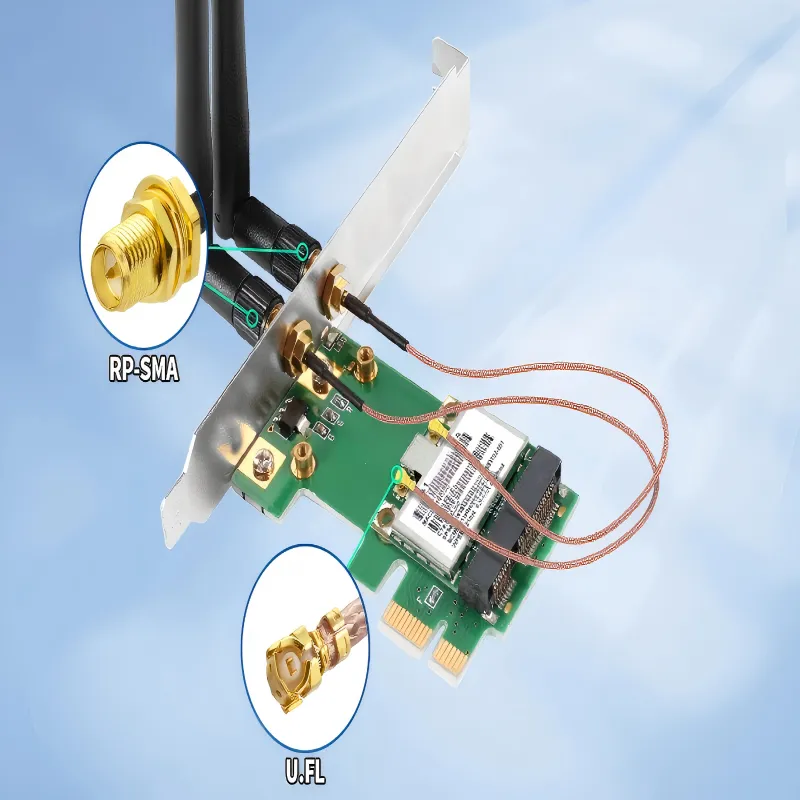
This diagram separates the mechanical and electrical functions of the SMA connector (mating, impedance transition, shielding) from those of the coaxial cable (attenuation, phase stability, bend sensitivity). It helps engineers target troubleshooting efforts more accurately.
It helps to draw a clean line between the connector and the cable.
An SMA connector defines the interface. It controls mating geometry, impedance continuity at the transition, shielding integrity, and mechanical repeatability. Torque, thread engagement, and launch quality all live here.
The sma coax cable does something different. It carries energy between interfaces. Its contribution shows up as attenuation, phase shift, bend sensitivity, and long-term drift under temperature or motion.
In troubleshooting, these roles often get blurred. A link degrades and the instinct is to blame “the SMA.” In practice, the connector may be fine, while the cable length, dielectric, or routing is quietly consuming margin. Separating these responsibilities early keeps fixes targeted instead of speculative.
Identify typical sma coax cable paths in radios, antennas and test gear
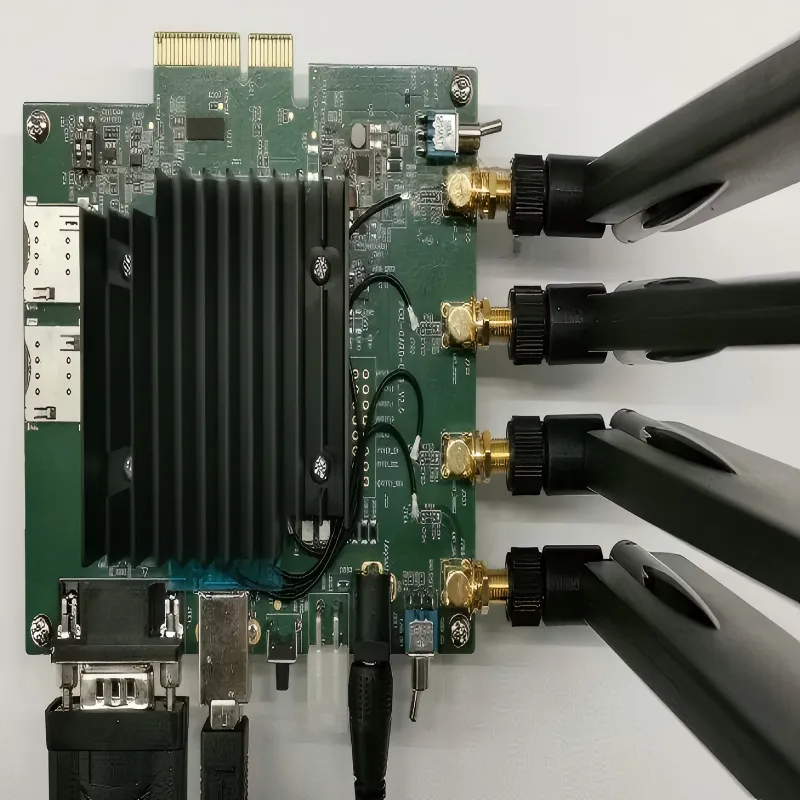
This image depicts three common use cases for SMA coaxial cables: as a bench test lead connecting an instrument to a DUT, as an internal jumper between modules inside an enclosure, and as a panel-mounted cable linking an internal radio to an external antenna. Each environment stresses the cable differently.
Most sma coax cable runs fall into familiar patterns, even if they look different on paper.
Some connect an RF module to a panel-mounted SMA before heading out to an antenna. Others live entirely on the bench, running from an instrument to a DUT. Internal jumpers inside racks or enclosures form another category, often overlooked because they are “out of sight.”
Each path stresses the cable differently. Bench cables see constant handling and reconnection. Panel jumpers live with vibration and strain. Internal runs deal with tight bends and proximity to digital noise. Treating all of them as interchangeable usually works—until it doesn’t.
Link sma coax cable choices to system-level specs (EIRP, NF, sensitivity)
Cable loss rarely announces itself as a failure.
Instead, it chips away at system metrics engineers already care about. On the transmit side, feeder loss reduces EIRP directly. On the receive side, loss ahead of the LNA effectively degrades noise figure, even though the radio itself has not changed.
What disappears first is margin. Sensitivity numbers still look fine on paper, but real links become less tolerant of temperature, installation variance, or minor mismatches. Thinking about the sma coax cable in terms of margin—not just dB—sets the tone for every decision that follows.
How should you size sma coax cable for frequency and power?
Cable selection often starts with mechanics. What fits the enclosure. What bends easily. What is already stocked.
Frequency and power deserve to be considered first, even if they complicate the decision.
Relate sma coax cable diameter and dielectric to cutoff frequency
Smaller coax is convenient, but physics does not negotiate.
As diameter shrinks, conductor resistance rises and dielectric loss becomes more visible at higher frequencies. That is why RG316 coaxial cable behaves very differently from thin micro-coax, even when both are nominally 50 Ω.
Dielectric choice matters just as much. PTFE-based constructions generally hold up better as frequency and temperature increase. Polyethylene options can be perfectly adequate at lower bands, but they show their limits sooner than many designers expect.
The point is not to memorize cutoffs. It is to recognize that cable geometry quietly sets frequency boundaries long before connectors do.
Check power handling and temperature rise limits for sma coax cable
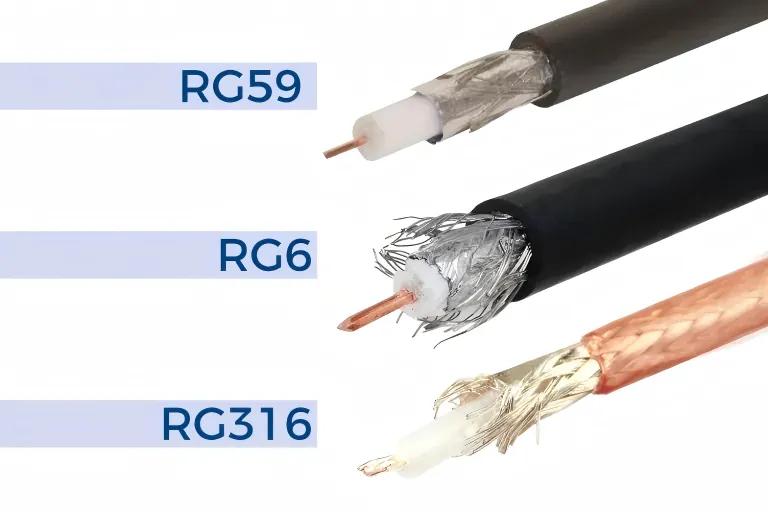
This image compares three common coaxial cable types used with SMA connectors: RG58 (thicker, lower loss), RG6 (often used in video, higher power handling), and RG316 (flexible, PTFE dielectric, common in compact RF). The side-by-side view highlights differences in conductor gauge, dielectric material, and shielding construction, which influence cutoff frequency, attenuation, and thermal limits in real installations.
Power handling is another area where datasheets tell only part of the story.
Rated limits usually assume straight runs, controlled ambient temperature, and continuous airflow. Real installations introduce bends, clamps, nearby heat sources, and intermittent duty cycles.
In small-diameter sma coax cable, resistive heating can become the constraint even when average power looks modest. Problems rarely appear immediately. They surface later as drift, jacket hardening, or subtle performance changes that are difficult to trace back to thermal stress.
Leaving margin here is not overdesign. It is an acknowledgment of how cables actually live in products.
Decide when a semi-rigid or low-loss alternative is needed
There is a point where flexible jumpers stop being the right tool.
As frequencies climb or loss budgets tighten, semi-rigid coax or lower-loss assemblies offer better stability at the expense of flexibility and assembly convenience. Many high-frequency designs migrate in this direction not because flexible cables “fail,” but because they stop scaling cleanly.
This transition shows up clearly in more system-focused discussions such as the SMA RF cable selection and application guide, where cable choice follows system limits rather than convenience.
Estimate sma coax cable loss and link margin step by step
Loss estimation does not need to be elaborate to be useful.
What matters is consistency.
Read attenuation specs for rg316 coaxial cable and similar types
Datasheets typically list attenuation as dB per unit length at discrete frequencies. For RG316 coaxial cable, the trend is predictable: loss increases steadily with frequency.
Two habits make these numbers more reliable in practice. First, interpolate at the actual operating band instead of relying on headline values. Second, assume real installations perform slightly worse than catalog conditions. That small pessimism usually aligns better with measured results.
Combine cable loss with connector and mismatch loss
Cable loss alone rarely explains everything.
Each connector introduces a small discontinuity. A common engineering estimate assigns 0.1–0.3 dB per SMA-class interface, depending on quality and frequency. Add mismatch loss from non-ideal VSWR, and the total feeder loss grows faster than expected.
None of these penalties are dramatic on their own. Together, they decide whether a link feels solid or temperamental.
Translate total feeder loss into dB of link margin
At system level, everything reduces to a familiar budget:
Transmit Power − Feeder Loss + Antenna Gain − Path Loss = Received Level
Comparing received level to receiver sensitivity yields link margin. That number explains why a system tolerates cable swaps, routing changes, or environmental stress—or why it does not.
Once margin becomes the focus, sma coax cable choices stop being arbitrary. They become part of the design logic.
When does rg316 coaxial cable become the right sma jumper?
In practice, many discussions about sma coax cable end up circling around one specific implementation: RG316 coaxial cable. Not because it is perfect, but because it sits at a workable intersection of size, loss, flexibility, and thermal stability.
That does not mean it is always the right choice. It means it is often the default—and defaults deserve scrutiny.
Compare rg316 cable, thicker 50 Ω cables and micro-coax
Engineers typically choose between three categories when building SMA jumpers:
- RG316 cable
A PTFE dielectric, silver-plated conductors, and moderate diameter make RG316 a stable option across a wide temperature range. Loss is acceptable for short to medium runs, and flexibility is good enough for most enclosures.
- Thicker 50 Ω cables (for example, RG58-class)
These reduce attenuation and improve power handling, but at the cost of bend radius and routing freedom. They behave well electrically, yet quickly become awkward in dense layouts.
- Micro-coax (0.81 mm, 1.13 mm class)
Chosen when space is tight. Loss rises quickly with frequency, and mechanical durability is limited. These cables work best when length is short and expectations are clear.
RG316 often wins because it fails gracefully. It rarely produces dramatic problems, but it also rarely surprises you with exceptional performance. That predictability is valuable.
For background on how coaxial construction influences impedance and shielding behavior, the overview on coaxial cable construction and impedance is a useful refresher, especially when comparing dielectric and braid choices.
Decide between rg316 coaxial cable and rg316 coax cable assemblies
Once RG316 is selected, the next decision is whether to build cables in-house or buy finished assemblies.
Hand-terminated cables offer flexibility. Lengths can be adjusted late, connector orientation can be customized, and small batches are easy to produce. The downside is variability. Crimp quality, strip length, and even operator fatigue show up as inconsistent loss and return loss.
Pre-terminated sma coax cable assemblies trade flexibility for consistency. For test setups, production fixtures, or systems that will be replicated, that consistency often matters more than saving a few minutes per cable.
Teams that ship products tend to converge on assemblies not because crimping is difficult, but because repeatability becomes part of system reliability.
Plan jumper length and SMA gender to minimize adapters
Adapters solve immediate mismatches. They also accumulate quietly.
Each mmcx to sma adapter, gender changer, or series transition adds loss, mismatch, and mechanical leverage at the connector. None of these effects are dramatic in isolation. Stacked together, they become a maintenance issue.
Choosing the correct sma connector gender and jumper length early often eliminates entire adapter chains. This is one of the few RF decisions that costs nothing and pays dividends for years.
A concise reference on SMA interface characteristics and mechanical limits can be found in the summary of SMA connector characteristics, which helps explain why minimizing stacked interfaces improves repeatability.
How do you integrate mmcx connector, adapters and sma coax cable in RF modules?
Map a typical mmcx connector to sma coax cable signal path
A typical chain looks like this:
RF module (MMCX) → short mmcx cable → mmcx to sma adapter → sma coax cable → antenna or instrument
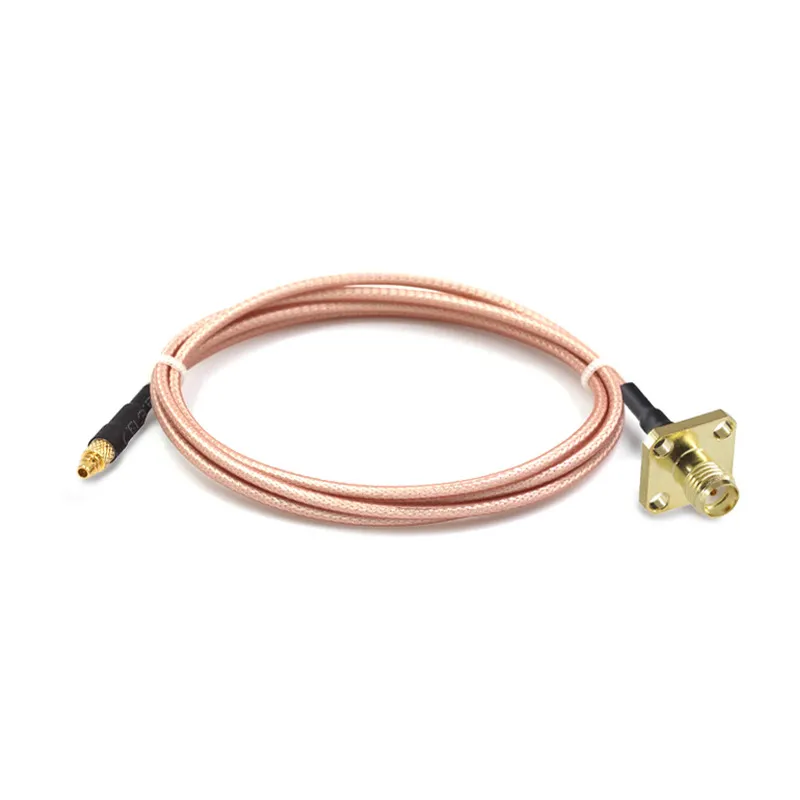
This photograph shows a complete assembly: an MMCX connector on a module, a short length of RG316 coaxial cable, and an MMCX-to-SMA bulkhead adapter with a flange for panel mounting. It highlights how multiple interfaces are chained together, and why controlling strain and rotation at each junction is critical for repeatability.
On paper, each step preserves 50 Ω impedance. In reality, each interface adds tolerance, loss, and mechanical freedom. The total effect depends less on any single part and more on how the chain behaves as a unit.
Thinking in terms of the entire path—not just the SMA jumper—helps prevent over-optimizing one segment while ignoring others.
Control rotation, mating cycles and strain at the mmcx interface
MMCX connectors are small and forgiving in rotation, but they are not designed for unlimited mating cycles or sustained side load.
Problems rarely appear immediately. They show up later as intermittent contact, subtle return loss changes, or sensitivity to cable movement. Supporting the cable close to the MMCX interface often doubles its service life.
This is one of those lessons most teams learn from field experience rather than specifications.
Standardize sma coax cable specs used with mmcx-based modules
For teams working across multiple products, standardization pays off quickly.
Defining a small set of approved sma coax cable types, lengths, and connector genders simplifies testing, documentation, and spares. It also makes regression testing more meaningful, because cable variability is no longer a hidden variable.
Many organizations discover—sometimes reluctantly—that standardizing cables improves RF consistency more than incremental tuning changes elsewhere.
Control mechanical routing and strain on sma coax cable runs
Electrical specifications assume ideal geometry. Real hardware rarely provides it.
Mechanical routing choices often determine whether a cable behaves like its datasheet—or slowly drifts away from it.
Respect minimum bend radius and avoid sharp panel edges
Every coaxial cable has a minimum bend radius for a reason. Exceeding it deforms the dielectric and shifts impedance locally. The effect may not be visible on a schematic, but it shows up in return loss and long-term stability.
Sharp metal edges are especially unforgiving. A cable that “just fits” during assembly may become the source of intermittent faults months later.
Add strain relief and clamps near sma connector interfaces
Strain rarely distributes evenly along a cable. It concentrates near connectors.
Simple measures—clips, tie-downs, or printed brackets—placed close to the sma connector reduce stress on the termination and preserve shielding continuity. These details are easy to skip in prototypes and expensive to retrofit later.
Keep sma coax cable away from hot spots and noisy digital bundles
Heat accelerates aging. Proximity to high-speed digital harnesses increases coupling risk.
Routing sma coax cable away from regulators, processors, and dense digital bundles is not just about EMI compliance. It is about preserving predictable behavior over time, especially in enclosures where airflow is limited.
How do you verify sma coax cable in test and field use?
Most RF teams spend more time selecting radios and antennas than validating cables. That imbalance shows up later, usually when a system behaves differently outside the lab.
Verification does not need to be exhaustive. It needs to be consistent.
Use simple S-parameter or return loss checks on critical links
A full characterization is rarely necessary. A basic sweep tells you most of what you need to know.
Checking S11 or return loss on a sma coax cable quickly reveals damaged connectors, crushed dielectric, or unexpected impedance discontinuities. For feedlines that matter—those close to sensitivity limits or regulatory thresholds—a quick S21 insertion loss check is often enough.
What matters more than the exact numbers is having a pass/fail expectation. If a cable used to meet it and no longer does, something changed. That alone justifies replacement.
For readers who want a refresher on how these parameters relate to real-world behavior, the discussion of scattering parameters in network analysis fundamentals provides helpful context without diving into math-heavy territory.
Build a golden sma coax cable set for regression tests
Many experienced teams quietly rely on a “golden” cable set.
These are known-good sma coax cable assemblies that are used only for verification. When results drift, swapping in the golden cable isolates whether the issue lives in the DUT or in the test setup.
This practice sounds informal, but it works. It removes one variable quickly and avoids wasting hours chasing phantom issues caused by aging or damaged jumpers.
Inspect and replace sma coax cable based on wear indicators
Cables rarely fail dramatically. They fade.
Loose threads, inconsistent torque feel, cracked jackets, or visible braid exposure are all early warnings. In test environments, high mating counts alone justify scheduled replacement, even if performance still looks acceptable.
Treating sma coax cable as a consumable—rather than permanent infrastructure—reduces downtime and improves confidence in measurements.
Standardize sma coax cable planning with this verification asset
Build a sma coax cable planning & verification sheet
| Field | Description |
|---|---|
| Link_ID | Unique identifier for the RF path |
| Band_GHz | Operating frequency band |
| Cable_Type | Example: RG316 coaxial cable, mmcx cable + sma coax cable |
| Length_m | Total cable length |
| Atten_dB_per_m_at_Band | Datasheet attenuation at band |
| Conn_Count | Number of connectors in series |
| Conn_Loss_dB_per_piece | Estimated loss per connector |
| Cable_Loss_dB | Attenuation × length |
| Conn_Loss_dB | Connector count × loss |
| Feeder_Loss_dB | Total cable + connector loss |
| Tx_Power_dBm | Transmit power |
| Antenna_Gain_dBi | Antenna gain |
| Path_Loss_dB | Estimated propagation loss |
| Rx_Level_dBm | Calculated receive level |
| Rx_Sensitivity_dBm | Receiver sensitivity |
| Link_Margin_dB | Rx level − sensitivity |
| Min_Bend_Radius_mm | Specified minimum |
| Actual_Min_Radius_mm | Measured in layout |
| Pass_Fail | Automated decision |
Define accept/reject criteria for new sma coax cable routes
Rules do not need to be complicated to be effective.
Many teams define acceptance around two numbers: link margin and mechanical compliance. For example, a route might be approved only if margin exceeds a defined threshold and the actual bend radius meets or exceeds specification.
Writing these criteria down avoids case-by-case debates and keeps reviews focused on real risk.
Use the asset as a checklist across design, lab and installation
The same sheet can serve multiple phases.
During design, it highlights risky links. In the lab, it provides expected values for comparison. In the field, it becomes a record of what was actually installed.
Using one consistent framework across stages improves traceability and reduces the “tribal knowledge” effect that often surrounds cable decisions.
FAQ
How far can I run an sma coax cable before loss becomes a problem?
Can I mix different 50 Ω sma coax cable types in the same RF link?
Is rg316 coaxial cable always the best choice for sma jumpers?
When should I replace an sma coax cable instead of re-using it?
Do mmcx to sma adapters significantly degrade sma coax cable performance?
How can I quickly tell whether a suspect sma coax cable is hurting my link margin?
What should I record in a sma coax cable log for long-term maintenance?
Closing note
The sma coax cable rarely gets credit when a system works—and rarely gets blamed first when it does not. Treating it as part of the RF architecture, rather than background hardware, closes that gap.
Margin, repeatability, and confidence are usually decided long before the cable is installed. They are decided when the cable is planned.
Bonfon Office Building, Longgang District, Shenzhen City, Guangdong Province, China

A China-based OEM/ODM RF communications supplier
Table of Contents
Owning your OEM/ODM/Private Label for Electronic Devices andComponents is now easier than ever.