
RF Coaxial Cable Selection & Application Guide
Mar 16,2026
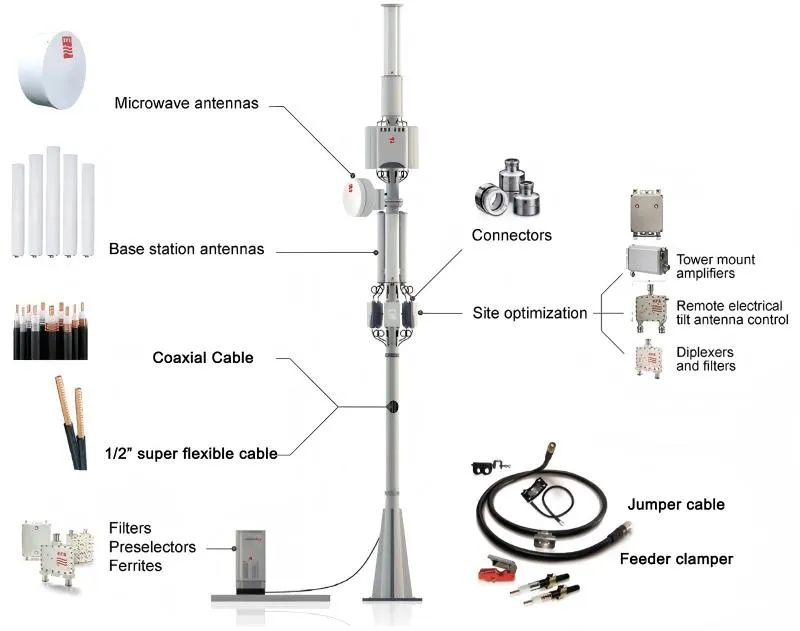
This figure illustrates a simplified RF system where a coaxial cable connects a radio module to an antenna. It represents the common use of coaxial cable as the medium that carries RF energy between components. The image emphasizes that the cable is not a passive accessory but an integral part of the transmission line, affecting impedance continuity and signal loss. Early design stages often overlook these effects, leading to later margin erosion.
In RF design reviews, cables rarely start the conversation. Engineers usually focus on radios, antennas, or modulation schemes. Firmware timing sometimes becomes the main suspect when something goes wrong.
The cable between those components often slips into the background.
At first, that assumption seems harmless. During early testing a short RF coaxial cable connects a radio module to an antenna on the bench. The system powers up, measurements look stable, and the signal chain appears healthy.
Only later—after the device moves into an enclosure or out into the field—do subtle issues start to appear. Link margins shrink slightly. Measurements drift by a fraction of a decibel. Occasionally a connector loosens and a signal becomes intermittent.
None of those problems originate from the radio itself.
More often, they trace back to the transmission line connecting everything together.
That transmission line is the RF coaxial cable.
Engineers who work with wireless hardware eventually learn the same lesson: the cable is part of the RF system. It influences attenuation, impedance continuity, and mechanical reliability. Ignore it long enough and it will eventually remind you why it matters.
This guide walks through how RF coaxial cable actually fits into real signal chains, why most RF systems rely on 50 ohm coaxial cable, and how compact assemblies such as RG316 coaxial cable or connector transitions like SMA-to-BNC cables appear in practical hardware. For readers who want a broader overview of coaxial cable families before diving deeper, the reference article on RF coaxial cable families explained provides additional context on how different RG cables are typically used in RF systems.
Where does RF coaxial cable sit in a real signal chain?
When people first encounter RF hardware, they often think of radios and antennas as the core of the system.
Technically that is true—but signals never jump directly from one device to another. Something has to carry them.
That job belongs to RF coaxial cable.
Map RF coaxial cable from radios to antennas and instruments
In a practical RF system, the signal path usually looks something like this:
- RF module or transceiver
- short internal jumper cable
- enclosure bulkhead connector
- external feeder cable
- antenna or measurement instrument
Every transition in that chain depends on RF coaxial cable.
From an electrical perspective, those cable segments behave as one continuous transmission line. The radio does not care where one cable ends and another begins. It simply sees impedance changes and signal attenuation along the path.
Take a small IoT gateway as an example. Inside the enclosure, a short rg316 cable might connect a PCB-mounted SMA connector to a panel bulkhead. Outside the enclosure, a larger feeder cable continues toward the antenna.
The physical cables are different. The RF signal sees them as a single path.
That is why experienced RF engineers evaluate cable routing, connector transitions, and cable loss together rather than treating each segment independently.
Separate RF coaxial cable from video or CATV coax
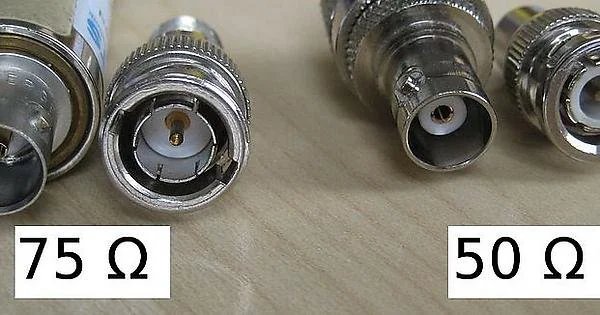
This image provides a visual comparison between 50-ohm and 75-ohm coaxial cables. While physically similar, the two types have different dielectric properties and conductor dimensions to achieve the required characteristic impedance. The 50-ohm version is standard for RF communication and test equipment, while the 75-ohm version is common in video and broadcast systems. The figure helps engineers recognize that impedance consistency must be maintained throughout the signal path to avoid mismatch and signal degradation.
The phrase “coaxial cable” often causes confusion because it describes a physical structure rather than a specific electrical standard.
Video distribution systems such as broadcast television commonly use 75-ohm coaxial cable. Wireless communication equipment and RF test instruments almost always use 50-ohm coaxial cable.
Those two systems look similar, but they behave differently.
The difference becomes important when connectors appear identical. BNC connectors, for instance, exist in both 50Ω and 75Ω versions. From the outside they look nearly the same.
Because of that similarity, mismatches sometimes occur in mixed environments.
If a 50 ohm coaxial cable system is connected to a 75Ω component, reflections appear at the impedance boundary. At lower frequencies the effect may be small. As frequency increases, however, those reflections begin to degrade signal integrity and measurement accuracy.
For readers interested in the physical construction that allows coaxial cables to maintain controlled impedance, the background explanation provided in the technical article on coaxial cable theory offers a useful overview.
The practical takeaway is simple: matching connectors does not guarantee matching impedance.
Link RF coaxial cable to connector ecosystems like SMA and BNC
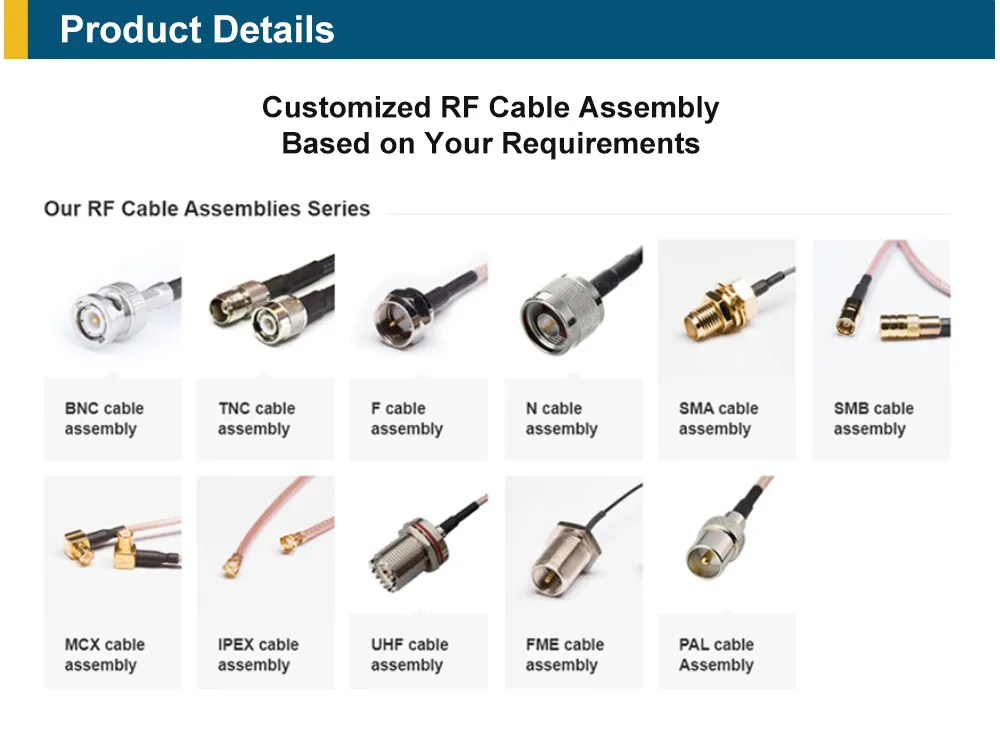
This figure depicts several common RF connector families: SMA (compact, threaded, used in modules), BNC (bayonet, common in test equipment), N-type (rugged, outdoor), and MMCX (miniature, snap-on, for board-level connections). It highlights that regardless of connector type, each terminates a length of RF coaxial cable and becomes part of the transmission line. The image reinforces that connectors are visible interfaces, but the cable between them determines electrical behavior.
In real RF hardware, cables rarely exist without connectors attached to them.
Instead, they belong to connector ecosystems.
Several connector families dominate modern RF systems:
| Connector | Typical Application | Frequency Capability |
|---|---|---|
| SMA | RF modules, compact radios, IoT devices | Up to ~18 GHz |
| BNC | Laboratory instruments and legacy RF equipment | Up to ~4 GHz |
| N-type | Outdoor antenna systems | Up to ~11 GHz |
| MCX / MMCX | Embedded wireless modules | Several GHz |
Each connector simply terminates a length of RF coaxial cable.
Once assembled, the cable and connectors form a single RF component. This is why assemblies such as sma adapter cable, sma to bnc cable, or bnc to sma cable should be viewed as variations of the same transmission line rather than completely different products.
For example, engineers frequently connect modern SMA-based radios to older laboratory equipment using a short bnc to sma cable. The cable itself remains a section of RF coaxial cable—only the connector type changes.
Understanding that relationship helps engineers evaluate RF systems more realistically. The connectors are visible, but the transmission line between them often determines the electrical behavior.
Why do so many RF systems default to 50-ohm practice?
One pattern quickly becomes obvious in RF hardware: almost everything assumes 50 ohm coaxial cable.
That standard did not appear randomly.
Avoid mixing 50Ω and 75Ω parts unless the mismatch is intentional
Despite the dominance of 50 ohm coaxial cable, other impedance systems still exist.
Video infrastructure and broadcast networks often rely on 75Ω coaxial cable. When these ecosystems overlap, impedance mismatches can occur.
Even when connectors mate mechanically, the electrical discontinuity remains.
Common consequences include:
- Increased insertion loss
- Higher return loss
- Measurement inaccuracies
- Reduced signal range
In controlled lab environments these problems appear quickly on measurement equipment. In field deployments they sometimes appear gradually as reduced link performance.
Because of that, engineers usually avoid mixing impedance standards unless the transition is carefully designed.
Decide when a dedicated transition is safer than direct mating
Some systems inevitably require transitions between connector ecosystems.
Legacy instruments may expose BNC ports while modern RF modules rely on SMA connectors. In those cases, engineers rarely force a direct connection.
Instead they introduce transition components such as sma to bnc adapter, bnc to sma adapter, or short transition cables.
These components allow the system to operate without placing unnecessary stress on instrument connectors.
They also keep the RF transmission line predictable—a detail that becomes increasingly important as frequency increases.
How should you group RF coaxial cable families before choosing one?
Engineers rarely choose a cable by name alone.
Someone new to RF hardware might open a catalog and compare model numbers: RG174, RG316, RG58, and so on. It feels logical to assume one of them must be “better.”
But that’s not really how cable decisions happen in practice.
The real starting point is the role the RF coaxial cable will play in the system.
A short jumper inside a metal enclosure has very different requirements compared with a feeder cable running to an antenna mast. The first cares about flexibility and routing. The second cares about attenuation and mechanical durability.
Once that distinction is clear, the cable family usually becomes obvious.
Group cables by role: jumper, patch, feeder, or test lead
| Role | Typical Length | Where It Appears |
|---|---|---|
| Module jumper | 5–30 cm | Inside electronics |
| Patch cable | 0.3–1 m | Between devices |
| Feeder cable | Several meters | Antenna runs |
| Test lead | 20–80 cm | Measurement setups |
The interesting part is that none of these categories depend on cable model numbers.
They depend on how the cable is used.
A cable buried inside an enclosure must tolerate heat and tight bends. A feeder cable climbing a tower cares far more about minimizing signal loss over distance.
Treating both situations with the same RF coaxial cable rarely produces good results.
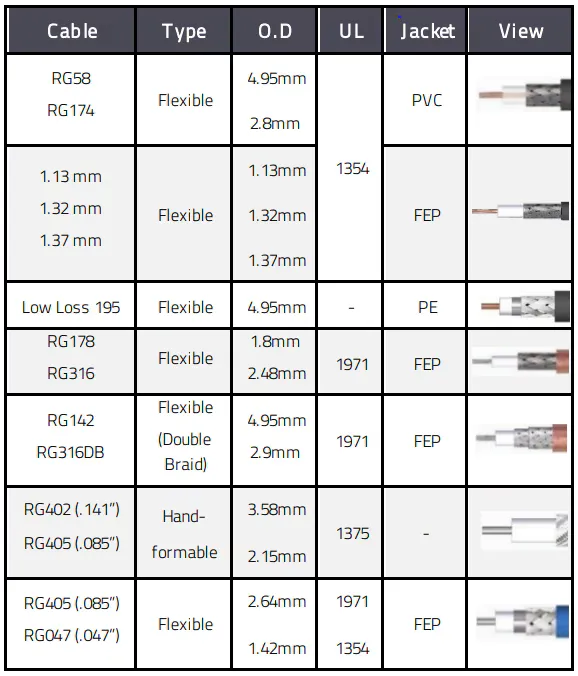
Use RG316 coaxial cable as the compact jumper reference point
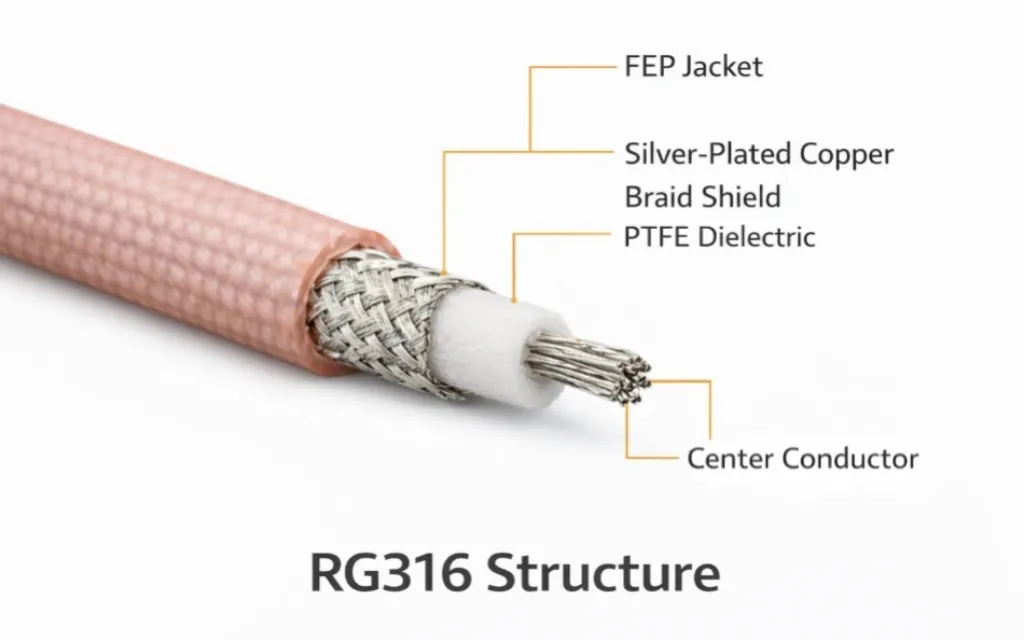
This image provides a detailed view of an RG316 coaxial cable, likely with a section of the jacket removed to reveal the inner conductor, PTFE dielectric, and braided shield. With an outer diameter of approximately 2.5 mm, RG316 is flexible and heat-resistant, making it ideal for routing inside compact enclosures. It is frequently used as short jumpers between RF modules and panel connectors, or as the core of adapter cables such as SMA to BNC assemblies where flexibility and moderate frequency performance are required.
Inside compact RF devices, one cable shows up over and over again: RG316 coaxial cable.
There are practical reasons for that.
The cable is thin—roughly a few millimeters in diameter—so it can snake around components without putting stress on connectors. The dielectric is typically PTFE, which maintains stable electrical properties even when temperatures climb.
A few typical characteristics illustrate why engineers reach for it:
| Property | Typical RG316 Characteristic |
|---|---|
| Diameter | about 2.5 mm |
| Characteristic impedance | 50 Ω |
| Dielectric | PTFE |
| Temperature capability | ~200°C range |
None of these numbers are particularly dramatic on their own. The combination, however, works well inside RF assemblies.
If you open a wireless router, a GNSS receiver, or many small RF modules, there is a good chance a short rg316 cable connects the PCB connector to a panel bulkhead.
The geometry of coaxial cable—central conductor, dielectric spacing, and outer shield—is what keeps impedance controlled. The basic principle is described in the technical overview of coaxial transmission lines in the article on coaxial cable in Wikipedia, which explains why consistent geometry produces stable impedance.
In short: RG316 coaxial cable behaves predictably, bends easily, and survives heat. That makes it ideal for internal RF connections.
Step up to thicker 50Ω families when distance or power becomes dominant
This figure compares three common 50-ohm coaxial cables side by side: RG316 (approx. 2.5 mm), RG58 (approx. 5 mm), and LMR-400 (approx. 10 mm). The visual highlights the trade-off between cable diameter and attenuation: thicker cables generally have lower loss per meter but are stiffer and harder to route in tight spaces. RG316 is suitable for short internal jumpers, RG58 for general lab use, and LMR-400 for long outdoor feeder runs. This comparison helps engineers select the appropriate cable based on length, frequency, and mechanical constraints.
Miniature cables solve routing problems, but they do not solve everything.
As cable length increases, attenuation becomes more important than flexibility.
Every RF coaxial cable introduces some loss. With small-diameter cables such as RG316, that loss rises fairly quickly as frequency increases.
A short jumper inside a device may contribute almost nothing to the link budget. A multi-meter run of the same cable would be a different story.
That is why many RF systems quietly adopt a layered cable structure:
- internal jumper → RG316 cable
- moderate patch cable → mid-size coax
- antenna feeder → low-loss cable
The system ends up using several cable sizes, each chosen for its particular job.
How do you estimate loss before choosing an RF coaxial cable?
Loss calculations often happen later in the design process than they should.
Signals moving through RF coaxial cable lose power continuously along the length of the cable. The amount depends mostly on frequency, cable construction, and length.
Ignoring those factors can quietly erode link margin.
Use attenuation-per-meter data instead of guessing
Cable datasheets normally list attenuation values at several frequencies. The numbers appear as dB per meter or dB per foot.
Those values make quick estimates possible.
A simplified calculation looks like this:
Cable loss ≈ attenuation × length
Example:
| Parameter | Value |
|---|---|
| Cable attenuation | 0.65 dB/m |
| Cable length | 1.4 m |
Estimated cable loss:
0.65 × 1.4 ≈ 0.91 dB
The number will not be perfect—connectors and temperature also matter—but it is accurate enough to evaluate cable choices.
Engineers interested in the physics behind these attenuation values often refer to the discussion of transmission line losses described in the Transmission line entry in Wikipedia, which explains how conductor resistance and dielectric losses increase with frequency.
Add connector and adapter transitions into the same budget
Cable attenuation is only one part of the signal path.
Connectors also introduce small losses.
A single RF connector might contribute around 0.1–0.2 dB of insertion loss depending on quality and frequency. That number is small, but several transitions in series can accumulate.
A quick engineering estimate might look like this:
| Parameter | Example |
|---|---|
| Cable length | 1.2 m |
| Cable attenuation | 0.7 dB/m |
| Connector count | 2 |
Cable loss:
0.7 × 1.2 ≈ 0.84 dB
Connector loss:
0.15 × 2 ≈ 0.3 dB
Total estimated loss:
≈ 1.14 dB
Calculations like this are not meant to replace full RF simulation. They simply help engineers decide whether a cable segment will meaningfully affect system performance.
Define practical tiers for jumper, patch, and feeder segments
One useful mental shortcut is to divide cable runs into rough categories.
Short jumper
Usually below about 30 cm. Loss is rarely significant.
Patch cable
Typically around half a meter to two meters. Cable attenuation begins to matter.
Feeder cable
Several meters or more. Loss becomes a central design constraint.
When cable runs move into feeder territory, designers usually shift toward larger 50 ohm coaxial cable families specifically designed to minimize attenuation.
How do you decide when RG316 is enough and when it is not?
Because RG316 coaxial cable appears so frequently in compact RF hardware, it sometimes gets used in situations where it is not ideal.
Most engineers eventually learn where its strengths end.
Choose RG316 when routing density and temperature matter most
Inside electronic equipment, RG316 coaxial cable solves a number of practical problems.
Its small diameter allows it to route through crowded assemblies. The PTFE dielectric tolerates heat from nearby components. And the cable remains flexible enough to avoid stressing connectors during installation.
Common uses include:
- internal RF module connections
- antenna jumpers inside enclosures
- compact RF test fixtures
In these situations the cable’s mechanical behavior is usually more important than the last fraction of a decibel of attenuation.
Move away from RG316 when feeder loss dominates the link budget
Longer RF paths change the priorities.
Signal loss begins to dominate the design.
Outdoor antenna installations, measurement cables, and long RF links often rely on thicker cable families with lower attenuation.
Using miniature coax for those runs would simply waste signal power.
Standardize “short RG316 plus feeder cable” as a practical architecture
In many systems the final design ends up combining both approaches.
A short RG316 coaxial cable jumper connects the RF module to a panel connector. Outside the enclosure, a larger feeder cable carries the signal toward the antenna.
This layered approach solves several practical problems simultaneously:
- flexible routing inside electronics
- lower attenuation over longer distances
- reduced stress on device connectors
Once you start looking for this pattern, it appears almost everywhere—from wireless gateways to laboratory RF setups.
How RF coaxial cable becomes cable assemblies in real systems
So far the discussion has treated RF coaxial cable mostly as a transmission medium. In real hardware, however, engineers almost never handle bare cable for long.
What appears in equipment racks or embedded devices are cable assemblies.
A cable assembly is simply a piece of RF coaxial cable terminated with connectors and prepared for installation. Electrically nothing magical happens—the transmission line is still the same—but the mechanical interface becomes usable.
Most RF systems depend heavily on these assemblies because they simplify installation and make system integration predictable.
SMA adapter cable as a practical example
A common assembly format is the SMA adapter cable.
From the outside it looks trivial: two SMA connectors connected by a short coaxial segment. Yet that small assembly often becomes a permanent part of the RF signal chain.
In many embedded systems the radio module sits on a PCB, while the antenna connector must appear on the device enclosure. Instead of mounting the connector directly on the board edge, engineers frequently route the signal using a short cable.
That cable is often RG316 coaxial cable.
The arrangement is simple:
radio → internal cable → panel connector → external antenna
Once installed, the short RF coaxial cable effectively extends the RF port to a more convenient mechanical location.
The same idea shows up repeatedly in measurement setups, especially when test equipment needs flexible connections.
Why engineers sometimes choose cable transitions instead of rigid adapters
Connector transitions illustrate another practical detail.
Imagine a lab bench where a radio module exposes an SMA connector but the available spectrum analyzer uses BNC. The connectors do not match, yet both devices must be connected.
Two solutions exist.
One option is a rigid SMA to BNC adapter.
Another option is a short SMA to BNC cable.
Electrically both approaches create the same transition. Mechanically they behave very differently.
Rigid adapters place the entire load directly on the instrument port. A cable assembly introduces flexibility, which reduces mechanical stress.
Many engineers prefer the cable approach when connections are made repeatedly during testing.
You will see the same reasoning when using a bnc to sma cable. The direction in the product name mostly reflects catalog conventions rather than electrical behavior.
Connector direction is a naming convention, not a signal rule
One detail sometimes confuses newcomers.
Product listings often distinguish between sma to bnc adapter and bnc to sma adapter. From a search perspective those look like different items.
In RF terms the distinction is largely semantic.
Signals travel through the same transmission line either way. The important point is that the connectors match the equipment ports and the cable maintains the correct impedance.
Understanding this prevents unnecessary confusion when selecting RF cable assemblies.
Routing considerations that affect RF coaxial cable reliability
This figure illustrates a critical mechanical consideration for RF coaxial cables: the region immediately behind the connector. It likely contrasts a correctly routed cable with a gentle radius against one with a sharp, forced bend near the connector. The image emphasizes that bending within this critical zone—typically the first 15-20 mm—concentrates mechanical stress, deforms the dielectric, and gradually degrades impedance continuity. Such damage may not cause immediate failure but leads to intermittent performance and reduced service life. Proper bend radius discipline is essential for long-term reliability.
Electrical specifications are only half the story. Many real failures originate from mechanical routing decisions.
An RF cable might meet all electrical requirements yet still fail early if it is installed poorly.
The first bend after a connector matters more than people expect
One of the most common damage points appears close to the connector body.
The cable leaves the connector and immediately bends. If the bend radius is too tight, the internal conductor and dielectric structure experience repeated stress.
Over time this can change impedance or weaken the cable shield.
Cable datasheets normally specify a minimum bend radius. Engineers do not always measure it precisely, but they usually avoid sharp bends immediately after the connector.
Leaving a short straight section of cable before the first bend helps distribute mechanical stress.
Shifting mechanical load away from RF connectors
Connectors themselves are not designed to carry large mechanical loads.
If a heavy cable pulls directly on a device connector, the connector solder joints—or the connector body itself—can fail.
A common solution is to use a bulkhead connector mounted on the enclosure. The cable connects to that bulkhead rather than directly to the PCB connector.
This arrangement allows the enclosure to absorb mechanical forces instead of the electronic component.
A simple planning matrix engineers use when selecting RF coaxial cable
Cable selection becomes easier when engineers write down a few key parameters before ordering parts.
A small planning table often reveals whether a cable choice is reasonable.
Example planning matrix
| Parameter | Example value |
|---|---|
| Application | Module jumper |
| Impedance | 50 Ω |
| Cable type | RG316 |
| Length | 0.3 m |
| Attenuation | 0.8 dB/m |
| Connector count | 2 |
From these values an approximate loss calculation becomes straightforward.
Cable loss:
0.3 × 0.8 ≈ 0.24 dB
Connector loss (approximate):
2 × 0.15 ≈ 0.3 dB
Total estimated loss:
≈ 0.54 dB
For a short internal connection this level of loss is usually acceptable.
If the cable length increased to several meters, the same table would quickly show that a thicker 50 ohm coaxial cable family would reduce attenuation.
Using the same matrix for incoming inspection
The same planning sheet can also serve another purpose.
During procurement or incoming inspection, engineers can verify that delivered cable assemblies match the design assumptions.
Typical checks include:
- cable impedance
- connector type
- assembly length
- bend radius capability
Even a simple checklist prevents installing cables that technically fit but do not match the intended RF design.
Industry developments affecting RF coaxial cable design
Expanding RF interconnect demand
Wireless infrastructure, satellite communication, and IoT deployments all rely on RF interconnect components. These include connectors, adapters, and cable assemblies.
Industry analyses such as those published by Grand View Research indicate continued growth in the RF interconnect market over the coming years.
Increasing numbers of connected devices naturally lead to increased demand for cable assemblies and connectors.
Material considerations in modern RF components
Another topic gaining attention involves materials used in RF components.
Some PTFE-based materials belong to a chemical category often discussed in environmental regulations. As a result, manufacturers have begun exploring alternative materials for connectors and cable insulation.
Engineering publications such as Microwave Journal occasionally discuss new connector designs intended to address these regulatory pressures while maintaining RF performance.
Higher-frequency systems pushing cable tolerances
Finally, the frequency range of RF systems continues to increase.
Connector families designed for millimeter-wave applications now operate far beyond the frequencies once typical for coaxial systems. Component distributors regularly introduce connectors rated for tens of gigahertz.
As these systems become more common, RF coaxial cable assemblies must maintain tighter mechanical tolerances to preserve signal integrity.
Questions engineers often ask about RF coaxial cable
What makes RF coaxial cable different from ordinary coax?
How can I distinguish 50Ω cable from 75Ω video cable?
At what length does cable loss become important?
Adapter or cable assembly — which is better?
Why can impedance mismatch appear even when connectors fit?
Bonfon Office Building, Longgang District, Shenzhen City, Guangdong Province, China

A China-based OEM/ODM RF communications supplier
Table of Contents
Owning your OEM/ODM/Private Label for Electronic Devices andComponents is now easier than ever.