
50 Ohm Coaxial Cable Selection & Application Guide
Mar 11,2026
This figure illustrates a simplified RF signal chain where a 50-ohm coaxial cable connects a radio module to an antenna. It represents the common use of coaxial cable as the medium that carries RF energy between components. The image emphasizes that the cable is not a passive accessory but an integral part of the transmission line, affecting impedance continuity and signal loss.
Most RF systems do not fail because of antennas.
And surprisingly, they rarely fail because of radios either.
More often, the quiet component between them is responsible.
The 50 ohm coaxial cable linking devices inside a system tends to be treated as background hardware. If the connectors mate and the signal appears to pass, the cable usually escapes further scrutiny. Engineers move on to firmware, modulation schemes, or antenna placement.
Later—sometimes months later—unexpected issues begin to appear. Measurements drift. Link margins shrink. A system that worked perfectly in the lab behaves slightly differently in the field.
At that point the cable suddenly becomes relevant.
A coaxial line is not simply a passive piece of wire. It defines impedance continuity across the RF chain. It contributes attenuation that grows with frequency and distance. It also determines how reliably power transfers between components.
Understanding how 50 ohm coaxial cable fits into a real RF architecture helps avoid many of those quiet problems.
This guide focuses on practical engineering questions:
- Why most RF systems standardize on 50Ω impedance
- How to decide when RG316 coaxial cable is appropriate
- When thicker cable families become necessary
- How real assemblies like SMA adapter cable, SMA to BNC cable, or BNC to SMA cable appear in working systems
If you design wireless hardware, build test fixtures, or integrate antennas into equipment racks, these decisions appear more often than expected.
Why does 50 ohm coaxial cable dominate RF system design?
The choice of 50 ohm coaxial cable sometimes feels arbitrary until you look at the physics behind transmission lines.
Two electrical characteristics compete inside any coaxial cable:
- attenuation (signal loss)
- power handling capability
Higher impedance transmission lines generally minimize attenuation. Lower impedance lines tolerate higher power levels before overheating or breaking down.
Engineers discovered long ago that these two curves intersect around 50 ohms.
It is not a perfect optimum for either property. But it is close enough to both that it became a useful compromise.
Once early radio systems adopted that impedance, the rest of the ecosystem followed.
Today the vast majority of RF equipment assumes 50Ω transmission lines.
Place 50-ohm cable between radios, instruments, and antennas
Consider a typical RF signal chain used in wireless testing.
A simplified setup might look like this:
radio module → coaxial jumper → panel connector → feeder cable → antenna
Every interface along that chain is designed around the same impedance environment.
When the cable impedance matches the impedance of both the transmitter and the load, energy flows through the system with minimal reflection.
That is where 50 ohm coaxial cable becomes important.
Most RF measurement instruments—spectrum analyzers, vector network analyzers, and signal generators—expect 50Ω ports. Wireless modules and front-end amplifiers usually follow the same design rule.
Even antenna feed networks are typically tuned for this impedance.
Because all of these devices share a common standard, engineers can connect them together without constantly recalculating matching networks.
In practice, that consistency is the real reason the 50Ω ecosystem persists.
Readers interested in how coaxial cables fit into the larger RF hardware landscape may also find useful background in this overview of RF coaxial cable systems, which explains how connectors and cable families interact across typical RF installations.
Separate 50-ohm RF practice from 75-ohm video practice
One of the most common mistakes new engineers make is assuming that all coaxial cables behave the same way.
They do not.
Television and broadcast networks often rely on 75-ohm coaxial cable instead of 50Ω lines. The reason is straightforward: at longer distances, 75Ω cables exhibit slightly lower attenuation.
For distributing video signals across buildings or cities, that advantage matters.
RF transmission systems prioritize different characteristics. Power handling, impedance matching, and measurement accuracy tend to dominate design decisions.
As a result, RF hardware typically remains standardized around 50 ohm coaxial cable.
The confusing part is that both environments frequently use similar connectors.
A BNC connector, for example, exists in both 50-ohm and 75-ohm versions. From the outside they appear almost identical.
Internally the geometry differs just enough to produce the correct impedance.
When a 50Ω device connects to a 75Ω cable, a mismatch occurs along the transmission line. Some energy reflects back toward the source rather than continuing toward the load.
The system still functions, but measurement accuracy suffers.
That is why RF engineers try to keep impedance consistent throughout the signal path whenever possible.
Connect 50-ohm cable decisions to the RG and connector ecosystem
This figure likely shows a diagram or table mapping different 50-ohm coaxial cable families (such as RG316, RG58, LMR-240, LMR-400) to their typical connector interfaces (SMA, BNC, N-type). It highlights how the 50-ohm standard allows interoperability across various cable types and connectors, enabling engineers to mix and match components while maintaining impedance consistency. The visual reinforces that the choice of cable and connector is driven by mechanical and environmental factors, not just electrical specs.
Once you start looking for it, the 50-ohm standard appears everywhere in RF hardware.
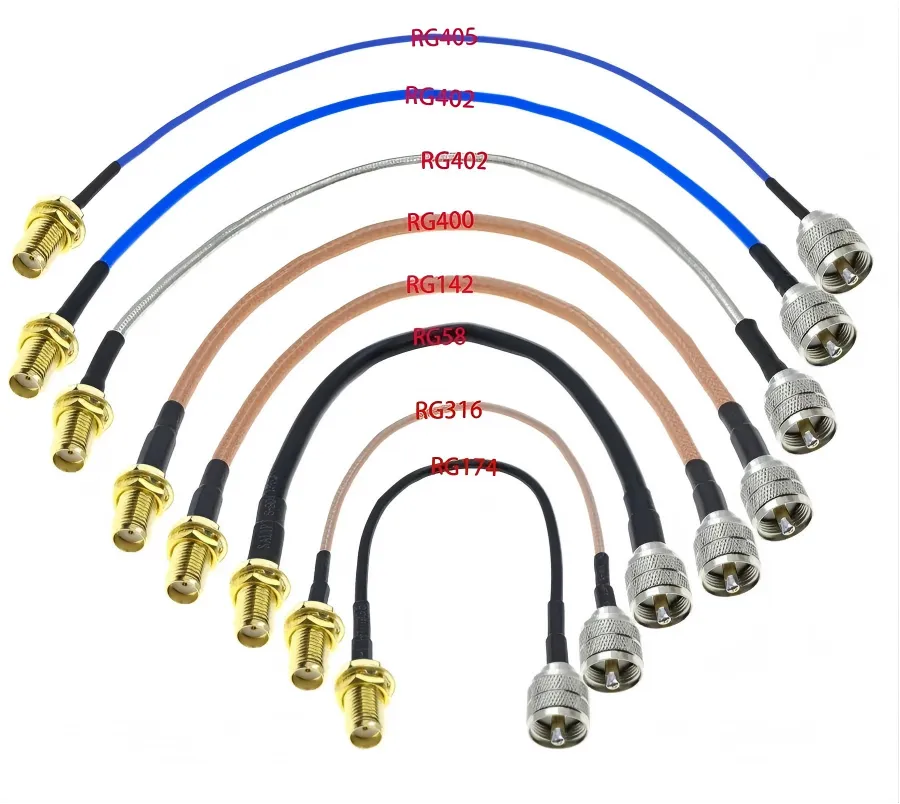
Many familiar cable families are built specifically for that impedance:
| Cable family | Typical role |
|---|---|
| RG316 | miniature RF jumpers |
| RG58 | general laboratory cables |
| LMR-240 / LMR-400 | lower-loss feeder lines |
Connector families follow the same pattern.
SMA connectors, for example, are designed for precision microwave connections in 50Ω transmission systems. Larger connectors such as N-type handle higher power and outdoor installations but still maintain the same impedance.
This compatibility allows engineers to mix cable families and connectors without constantly worrying about impedance transitions.
In real systems the result is a modular architecture.
A compact device might connect to a panel through a short RG316 coaxial cable. That panel connector then feeds a longer low-loss cable that runs to the antenna.
Occasionally connector standards need to change along the way. Test equipment may expose BNC interfaces while RF modules use SMA ports.
Assemblies like SMA to BNC cable or BNC to SMA cable solve those transitions without altering the impedance environment.
If you want to explore those practical transition scenarios further, the guide on SMA adapter cable selection and routing provides several examples of how adapter cables appear in real RF signal chains.
How do you decide whether 50 ohm coaxial cable is the right standard for your link?
In many projects the decision has already been made before the cable is even considered.
Still, verifying the impedance environment prevents mistakes later in the design process.
A few practical questions usually reveal the answer.
Use 50Ω cable for RF transmission, wireless devices, and test equipment
If your signal chain includes any of the following components, 50 ohm coaxial cable is almost certainly the correct choice:
- RF transmitters or receivers
- wireless communication modules
- RF measurement instruments
- antenna feed networks
- microwave amplifiers or filters
These devices are built around 50-ohm impedance assumptions. Maintaining that impedance across cables and connectors ensures predictable performance.
This becomes especially important in laboratory measurements.
When every device in the chain shares the same impedance, calibration remains valid across the entire system. Test results reflect the actual behavior of the hardware rather than artifacts introduced by mismatched cables.
Avoid mixing 50Ω and 75Ω parts unless the mismatch is intentional
Physical compatibility sometimes hides electrical differences.
A 50Ω BNC connector can mate with a 75Ω BNC port without difficulty. At first glance nothing appears wrong.
The electrical behavior tells a different story.
A 50Ω-to-75Ω transition creates a reflection coefficient close to 0.2, which corresponds to roughly −14 dB return loss. In casual signal paths that reflection may be tolerable.
In precision RF measurements it becomes noticeable.
Reflections distort amplitude readings, alter standing-wave ratios, and sometimes introduce small frequency-dependent artifacts in measurement data.
Because of this, experienced RF engineers try to maintain impedance consistency across the entire signal chain.
Decide when a dedicated transition is safer than a direct connection
Some systems still need to connect equipment built for different impedance standards.
In those cases engineers usually introduce controlled transitions rather than relying on direct connections.
Typical solutions include:
- impedance-matching pads
- specialized RF adapters
- short transition cables
For example, a bnc to sma adapter might connect two devices with different connector styles while preserving the underlying 50-ohm transmission line.
If routing space is limited, a short SMA adapter cable built from RG316 cable can accomplish the same transition while relieving mechanical strain on the connectors.
Choosing the right transition device helps maintain both mechanical reliability and electrical performance.
Which 50 ohm coaxial cable families should you compare first?
Once the impedance decision is settled, cable selection stops being a theoretical discussion and becomes a mechanical one.
Engineers quickly discover that 50 ohm coaxial cable does not refer to a single type of cable. It describes an electrical standard shared by dozens of physical designs.
Some cables are thin enough to disappear inside a handheld device. Others are thick, stiff, and designed to run across rooftops toward antennas.
All of them may still be 50Ω transmission lines.
That is why the real question usually becomes:
Which cable family fits the job?
In practice, engineers compare three things first:
- cable diameter
- flexibility and routing constraints
- attenuation at the operating frequency
Once those factors are clear, the list of candidates becomes much shorter.
Start with RG316 for compact, high-temperature jumpers
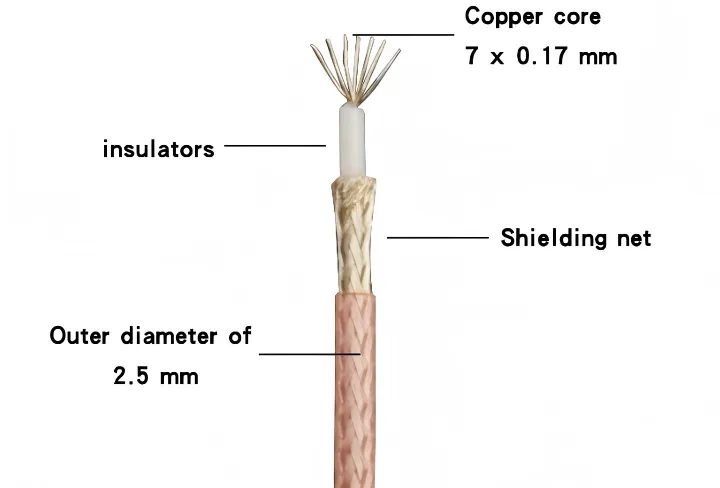
This image provides a detailed view of an RG316 coaxial cable, likely with a section of the jacket removed to reveal the inner conductor, PTFE dielectric, and braided shield. With an outer diameter of approximately 2.5 mm, RG316 is flexible and heat-resistant, making it ideal for routing inside compact enclosures. It is frequently used as short jumpers between RF modules and panel connectors, or as test leads in laboratory setups.
When space is limited, RG316 coaxial cable is often the first cable engineers reach for.
You see it constantly in RF hardware. Open almost any wireless device or test fixture and chances are good that a short section of RG316 cable is hiding somewhere inside.
The reason is partly mechanical.
The cable’s outer diameter is only about 2.5 mm, which makes routing inside enclosures much easier than with thicker cables. Tight bends are possible without stressing the dielectric too severely.
Material choice also plays a role. Most RG316 coaxial cable designs use a PTFE dielectric and an FEP jacket, both of which tolerate elevated temperatures better than many other plastics used in coaxial cables.
Those materials are one reason the cable appears frequently in equipment operating near power amplifiers or other warm components.
Typical use cases include:
- internal RF jumpers
- module-to-panel transitions
- short instrument patch leads
- compact antenna connections
In many of these situations the cable length is short enough that attenuation does not dominate the design decision.
Instead, flexibility and temperature tolerance become more important.
Readers curious about the underlying transmission-line physics—why coaxial geometry produces a specific impedance—may find useful background in the Wikipedia entry on Coaxial Cable, which explains how conductor spacing and dielectric materials define impedance.
Step up to larger 50Ω coax when distance begins to matter
Small cables solve routing problems, but they are not always ideal for signal integrity.
As cable length increases, attenuation becomes harder to ignore.
At microwave frequencies a meter of RG316 coaxial cable can easily introduce close to a decibel of loss. For short jumpers that is acceptable. For longer runs the numbers add up quickly.
That is why larger 50 ohm coaxial cable families appear in many RF installations.
Examples include:
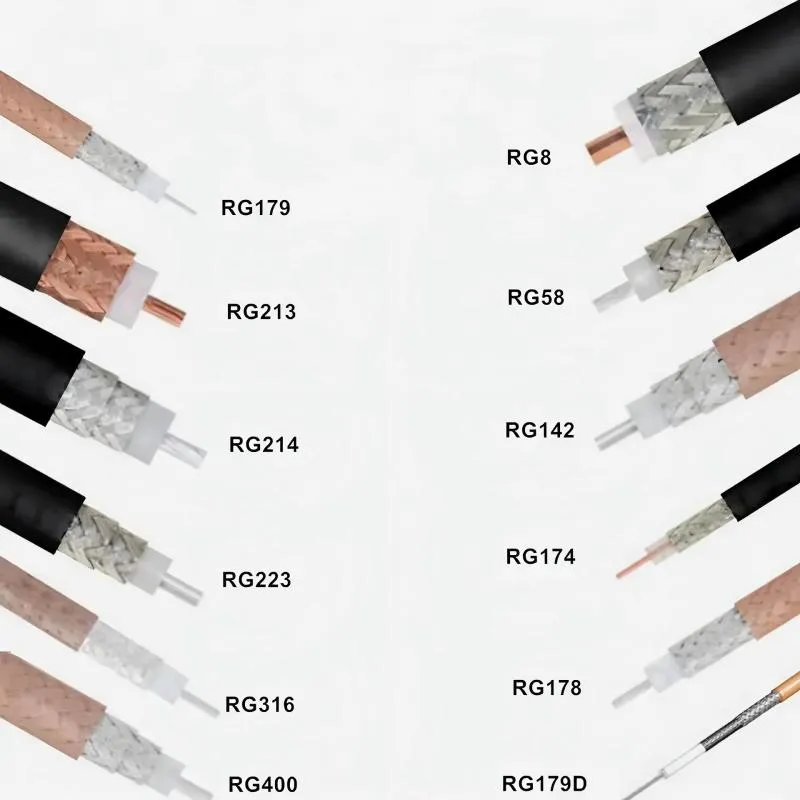
| Cable type | Approx. diameter | Typical use |
|---|---|---|
| RG316 | ~2.5 mm | short RF jumpers |
| RG58 | ~5 mm | general lab connections |
| LMR-240 | ~6 mm | medium feeder lines |
| LMR-400 | ~10 mm | long antenna runs |
This figure compares three common 50-ohm coaxial cables side by side: RG316 (approx. 2.5 mm), RG58 (approx. 5 mm), and LMR-400 (approx. 10 mm). The visual highlights the trade-off between cable diameter and attenuation: thicker cables generally have lower loss per meter but are stiffer and harder to route in tight spaces. RG316 is suitable for short internal jumpers, RG58 for general lab use, and LMR-400 for long outdoor feeder runs. This comparison helps engineers select the appropriate cable based on length, frequency, and mechanical constraints.
Each step upward in cable diameter generally reduces attenuation.
The trade-off is obvious the moment you try to route the cable.
Thicker coax does not bend easily. Inside a compact enclosure it may simply refuse to cooperate.
That mechanical limitation explains why RF systems often combine multiple cable families rather than relying on one universal solution.
Treat RF coaxial cable as a system rather than a single component
A useful mental model is to think of RF coaxial cable as a layered system.
Different cable types serve different sections of the signal path.
For example:
device internals → miniature cable
equipment rack → medium cable
antenna feedline → low-loss infrastructure cable
This layered approach appears in many RF installations.
A short RG316 cable might connect a radio module to a panel connector. Outside the enclosure, the signal continues through a thicker feeder cable toward the antenna.
Each segment uses the cable most appropriate for its environment.
The connector ecosystem surrounding 50 ohm coaxial cable reinforces this pattern.
Compact connectors such as SMA appear frequently on modules and small devices. Larger connectors—N-type, for example—handle higher power levels and outdoor conditions more comfortably.
When connector standards differ between devices, transition assemblies fill the gap.
A short SMA adapter cable, for instance, can bridge two devices without forcing a rigid adapter into a cramped mechanical space. Situations like this are discussed in the routing guide for SMA adapter cable selection and routing, which shows how small assemblies fit into real RF signal chains.
How do you estimate loss and length limits for 50-ohm runs?
Engineers sometimes debate cable choices for longer than necessary.
A quick calculation usually resolves the question.
Once attenuation numbers appear on paper, the appropriate cable becomes obvious.
Use attenuation-per-length data from the datasheet
Every coaxial cable specification includes attenuation data. Manufacturers usually provide the numbers in dB per meter or dB per 100 feet across several frequencies.
Typical values might resemble the following:
| Cable | Loss @1 GHz | Loss @3 GHz |
|---|---|---|
| RG316 | ~0.6 dB/m | ~1.1 dB/m |
| RG58 | ~0.4 dB/m | ~0.8 dB/m |
| LMR-400 | ~0.22 dB/m | ~0.39 dB/m |
Exact numbers vary slightly by manufacturer, but the relative differences remain consistent.
Once the attenuation value is known, estimating cable loss becomes straightforward.
Cable loss ≈ attenuation × cable length
A two-meter run of RG316 coaxial cable carrying a multi-gigahertz signal can easily introduce a couple of decibels of attenuation.
That might be perfectly acceptable—or completely unacceptable—depending on the system’s link budget.
Remember that connectors contribute loss as well
One detail that occasionally surprises new engineers is how much connectors contribute to total insertion loss.
A single RF connector may add 0.1–0.3 dB depending on frequency and design quality.
That number seems small, but multiple transitions accumulate quickly.
A simple SMA adapter cable might contain:
- two SMA connectors
- one short cable segment
In some cases the connectors contribute nearly as much loss as the cable itself.
For high-frequency measurement systems, ignoring connector loss can produce misleading expectations about system performance.
Divide cable runs into practical categories
Instead of analyzing every cable individually, many RF engineers categorize cable runs by length.
A typical classification looks something like this:
| Installation scenario | Typical length | Common cable |
|---|---|---|
| device jumper | <0.5 m | RG316 |
| rack interconnect | 0.5–3 m | RG58 |
| antenna feeder | >5 m | LMR-240 / LMR-400 |
The goal is not perfect precision. It is simply a way to focus attention where cable loss actually matters.
Short jumpers rarely dominate the link budget. Long feeder cables often do.
Recognizing this difference keeps cable selection practical rather than theoretical.
How do you choose RG316 instead of other 50-ohm cables?
Most cable choices in RF systems do not begin with calculations.
They begin with physical constraints.
A connector sits on the edge of a radio board. The enclosure wall is nearby. Between those two points the cable has to turn, bend, and avoid other hardware. A thick feeder cable simply will not fit.
That is usually the moment RG316 coaxial cable appears in the design.
It is small enough to route through crowded layouts, flexible enough to tolerate tight bends, and electrically stable across a wide frequency range. Because of those traits, engineers often use RG316 cable as an internal jumper rather than a long transmission line.
Open many RF devices and you will see the pattern immediately.
Short cable.
Small connector.
Very little distance between endpoints.
Under those conditions attenuation is rarely the dominant issue. Routing is.
Where RG316 actually works best
In practice, RG316 coaxial cable shows up most often in three situations.
First, board-to-connector transitions. RF modules frequently use small connectors such as SMA or MMCX. A short coax jumper bridges the module and the enclosure wall.
Second, test ports inside equipment. Measurement points are sometimes routed to external connectors so technicians can probe the signal path without opening the device.
Third, compact antenna connections inside small radios.
None of these paths are long. Most are measured in centimeters rather than meters.
Because of that, the slightly higher attenuation of RG316 cable rarely creates problems.
When engineers stop using RG316
The moment the cable leaves the enclosure, priorities shift.
Distance begins to matter.
Signal loss begins to accumulate.
A few meters of RG316 coaxial cable at microwave frequencies can easily introduce several decibels of attenuation. In many RF systems that is unacceptable.
Engineers usually transition to thicker 50 ohm coaxial cable families at that point. Larger cables reduce attenuation and protect the link budget.
The result is a pattern seen across countless RF installations:
short jumper inside the device → thicker feeder cable outside
It is not an elegant theory. It is simply what works.
Background on why transmission lines behave differently across frequency and distance is explained in the overview of Transmission line theory, which describes how impedance and attenuation evolve along real cables.
Routing 50-ohm cable inside equipment
Electrical design often receives the attention in RF systems.
Mechanical routing sometimes gets less discussion.
Yet many cable failures start as mechanical problems rather than electrical ones.
After years of assembling RF equipment, technicians notice the same weak points again and again.
The first bend behind the connector
If a coaxial cable fails, the damage frequently appears a few millimeters behind the connector.
Sharp bends concentrate stress in that area. Over time the shield weakens and the center conductor fatigues.
The simplest fix is also the most effective: leave a short straight section behind the connector before the cable bends.
Many technicians follow this rule instinctively.
Abrasion and heat
Coaxial cable jackets look durable, but constant rubbing against metal eventually cuts through the insulation.
Heat accelerates the process.
Even a high-quality 50 ohm coaxial cable can degrade if it spends years vibrating against a sharp bracket or sitting beside a hot amplifier.
Cable clamps or protective sleeves usually solve the problem.
Let the enclosure carry the load
Another common mistake is allowing the cable to support its own weight through the connector.
Connectors were designed for electrical contact, not structural support.
Bulkhead connectors or strain-relief brackets allow the enclosure to carry the mechanical load instead. The connector remains electrically stable while the cable moves slightly with vibration.
It is a small detail, but it greatly extends cable life.
From coaxial cable to real RF assemblies
In theory engineers talk about coaxial cable.
In practice they work with cable assemblies.
A finished assembly combines cable and connectors into a component that solves a specific interface problem.
Internal RF jumpers
Inside embedded RF hardware, RG316 cable often acts as a small bridge between circuit boards and connectors.
The path might look like this:
radio module → RG316 jumper → panel SMA connector
Once the signal reaches the panel connector, a larger feeder cable carries it toward the antenna.
Manufacturers like this layout because it simplifies assembly and keeps sensitive electronics inside the enclosure.
Connector transitions
Different equipment often uses different connector types.
Test instruments frequently rely on BNC connectors, while RF modules typically expose SMA ports.
Rather than replacing connectors, engineers introduce transition assemblies:
- SMA to BNC cable
- BNC to SMA cable
- SMA to BNC adapter
- BNC to SMA adapter
These components allow both systems to coexist without changing the electrical behavior of the 50 ohm coaxial cable path.
Practical examples appear in the guides for SMA to BNC cable selection and BNC to SMA adapter installation.
A simple planning matrix for cable decisions
Cable selection becomes easier when the decision process is written down.
Many engineering teams use a small planning table before ordering cable assemblies.
50-Ohm Cable Planning Matrix
| Parameter | Example |
|---|---|
| Application | module jumper |
| Frequency | 2.4 GHz |
| Cable type | RG316 |
| Length | 0.3 m |
| Attenuation | 0.9 dB/m |
| Cable loss | 0.27 dB |
| Connectors | 2 |
| Connector loss | ~0.3 dB |
| Total loss | ~0.57 dB |
The table quickly shows whether the cable still fits within the system’s loss budget.
If the margin disappears, the cable choice probably needs reconsideration.
Common questions about 50-ohm coaxial cable
Why is 50-ohm coaxial cable so common in RF systems?
How can you tell whether a cable is 50Ω or 75Ω?
When is RG316 cable the right choice?
How long can a 50-ohm cable run be?
Adapter or cable assembly?
Bonfon Office Building, Longgang District, Shenzhen City, Guangdong Province, China

A China-based OEM/ODM RF communications supplier
Table of Contents
Owning your OEM/ODM/Private Label for Electronic Devices andComponents is now easier than ever.