We share everything about Electronic Components OEM, ODM, or private label solutions...

We continuously share and publish original articles about electronic components and OEM/ODM/private label solutions. We hope these articles provide you with valuable insights to support your private label electronic components business.

If you don’t want to miss our article, please subscribe to our newsletter. 

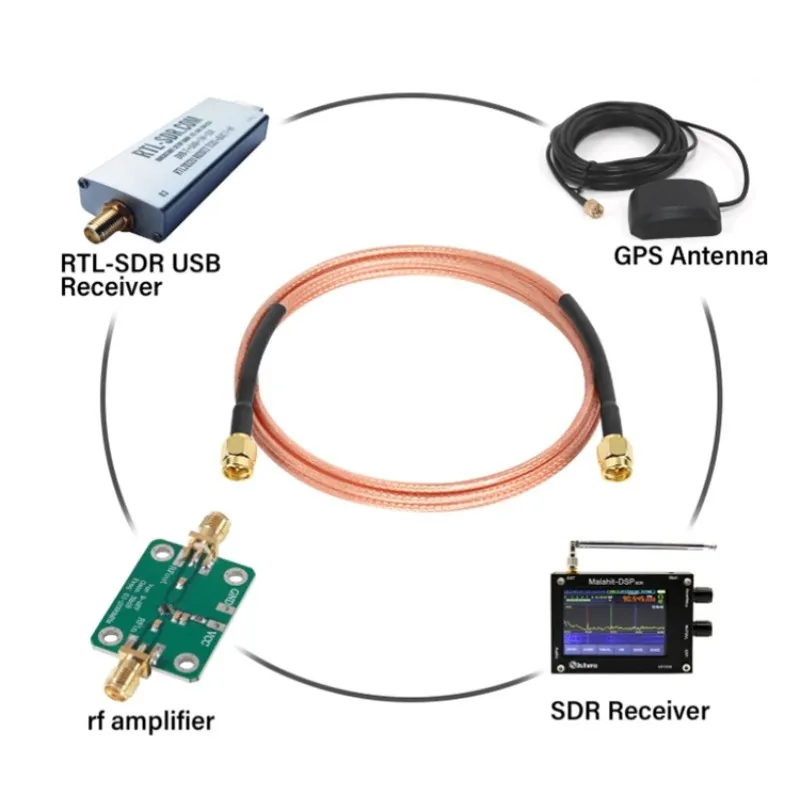
A more robust RG316 cable with an SMA connector used in an outdoor or lab setting, perhaps connecting an antenna to an SDR radio or test equipment.

RG316 vs RG174: Loss, Power & Best Uses

Which cable gives you lower loss at your frequency? When engineers compare RG316 vs RG174, the discussion usually starts with signal loss. Both belong to the 50 ohm coax cable family, but their internal design makes them behave differently. An RG174 cable uses a PVC jacket, PE insulation, and a single bare copper braid, which keeps it light and flexible. In contrast, an RG316 cable is built with PTFE dielectric, an FEP jacket, and silver-plated copper shielding—features that give it better thermal and mechanical stability. Those differences show up clearly once you push into higher frequencies.
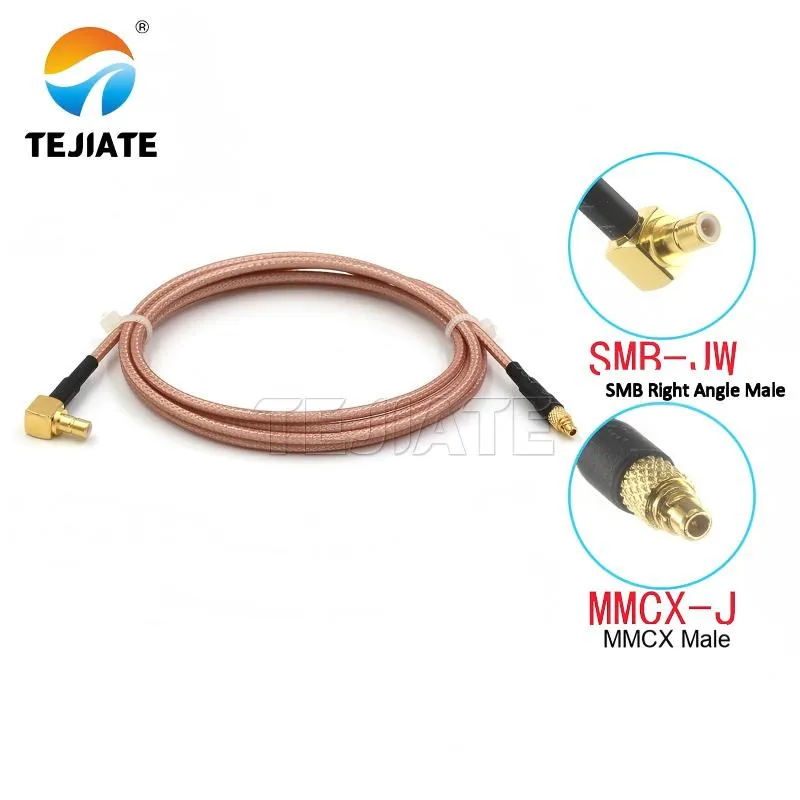
SMB right-angle male and MMCX male connectors compatible with RG316 cable

RG316 Coaxial Cable Guide: Specs, Loss & Use

How can you identify RG316 coaxial cable specifications? At first glance, many coaxial cables look almost the same, which makes it tricky to tell them apart. So how can you identify RG316 coaxial cable specifications with certainty? The easiest way is to look at how the cable is built. Inside you’ll find a seven-strand silver-plated copper conductor, with each strand measuring about 0.175 mm. This conductor is wrapped in a PTFE dielectric layer roughly 1.53 mm thick, giving the cable excellent insulation and keeping signals stable. Over the dielectric sits a silver-plated copper braid of about 1.95 mm, which serves as the shield. Finally, everything is protected by a brown FEP jacket, bringing the overall diameter to approximately 2.50 mm and giving the cable solid resistance to heat and chemicals.

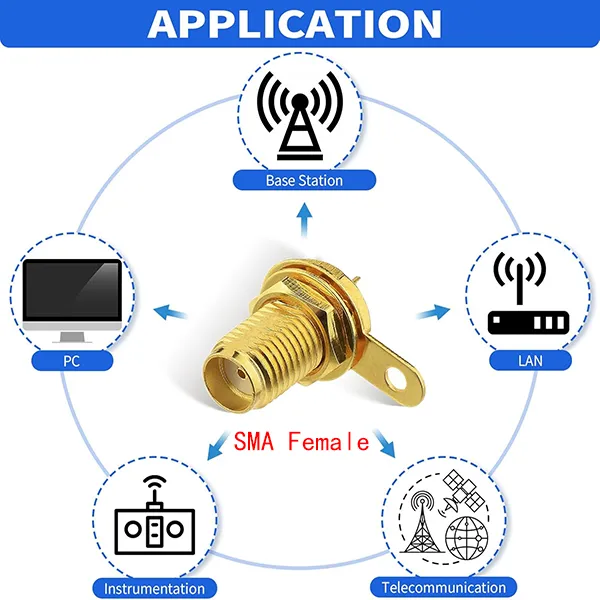
Application scenarios of SMA adapters in base stations, PCs, instrumentation, and telecommunications equipment

SMA Male to Female Adapter Buying Guide: Angles, Feedthroughs & Loss

Which SMA male-to-female do you actually need? Picking the right SMA male to female adapter isn’t only about checking labels—it’s about making sure your ports line up, your enclosure fits, and your signal chain stays clean. Many engineers waste time on trial and error when a closer look at the connector’s gender and form factor would solve the issue right away.

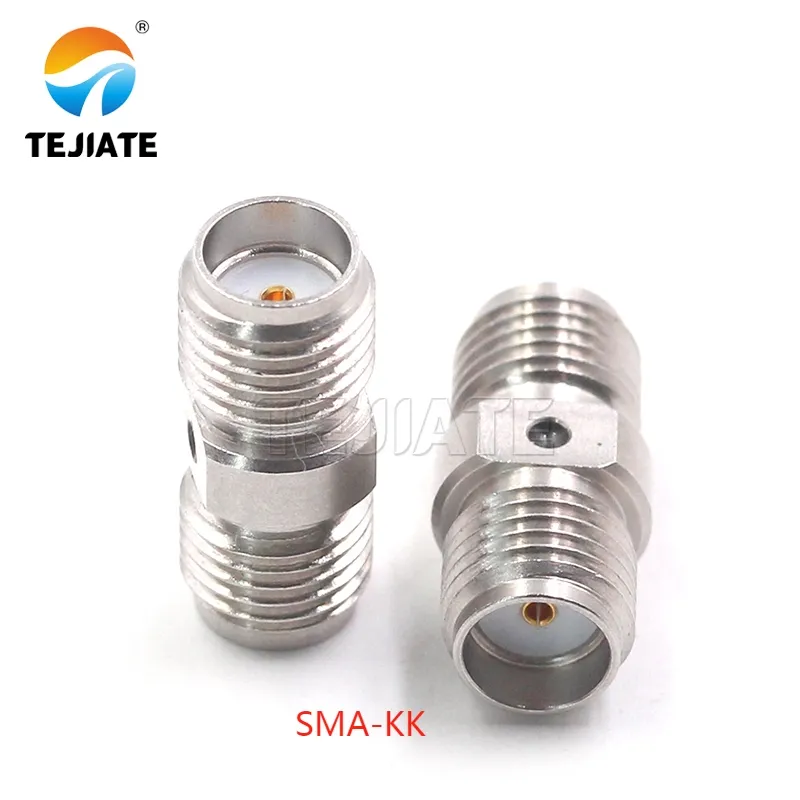
Examples of various SMA female-to-female adapters from TEJTE brand, including SMA-KK and other models

SMA Female to Female Adapter Guide: Types, Specs & Applications

Introduction Think about those moments when your cable falls just a little short or when you need to route a signal cleanly through a panel. In such cases, the SMA female to female adapter—often marked SMA-KK—is the quiet solution that keeps everything working. It may look like nothing more than a tiny metal coupler, yet in practice it often decides whether your system delivers a stable signal or suffers from frustrating mismatches. Engineers reach for these adapters constantly. They serve as couplers for quick cable extensions, as feedthrough connectors when passing signals through an enclosure, and as links in test setups where flexibility matters more than aesthetics. If you’ve ever scrambled in the lab because the cable didn’t quite reach, an F–F adapter probably saved the day.

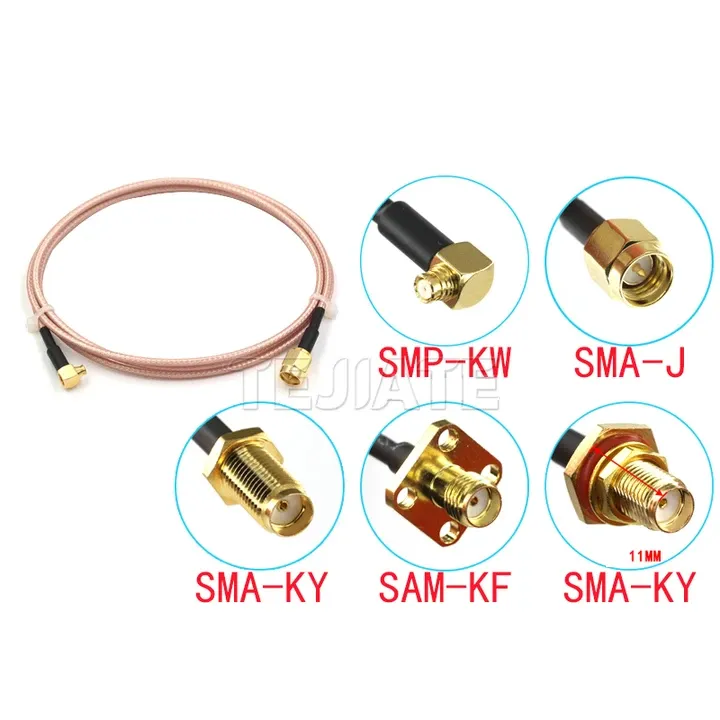
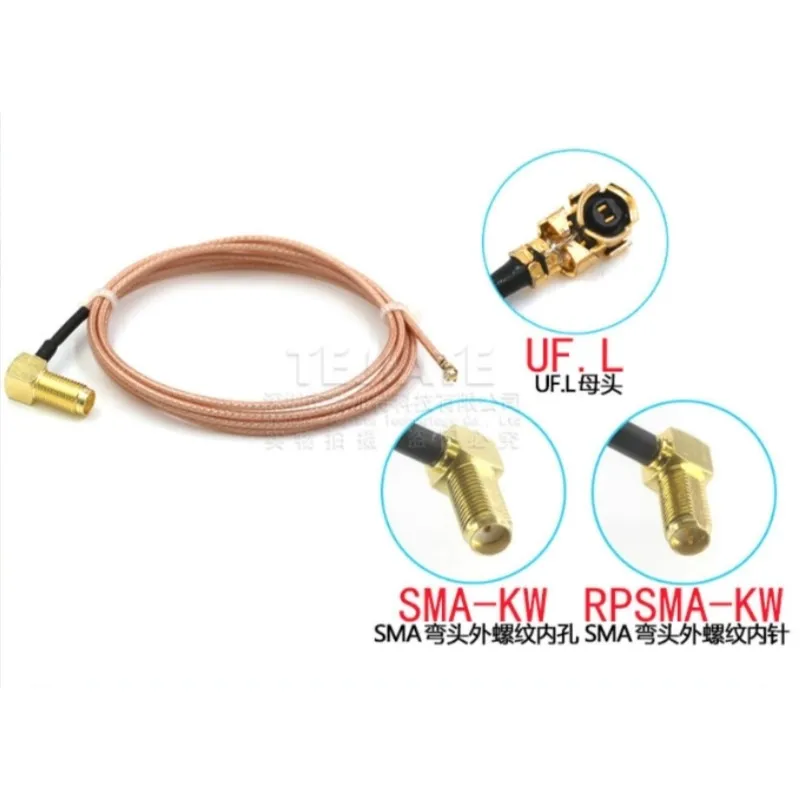
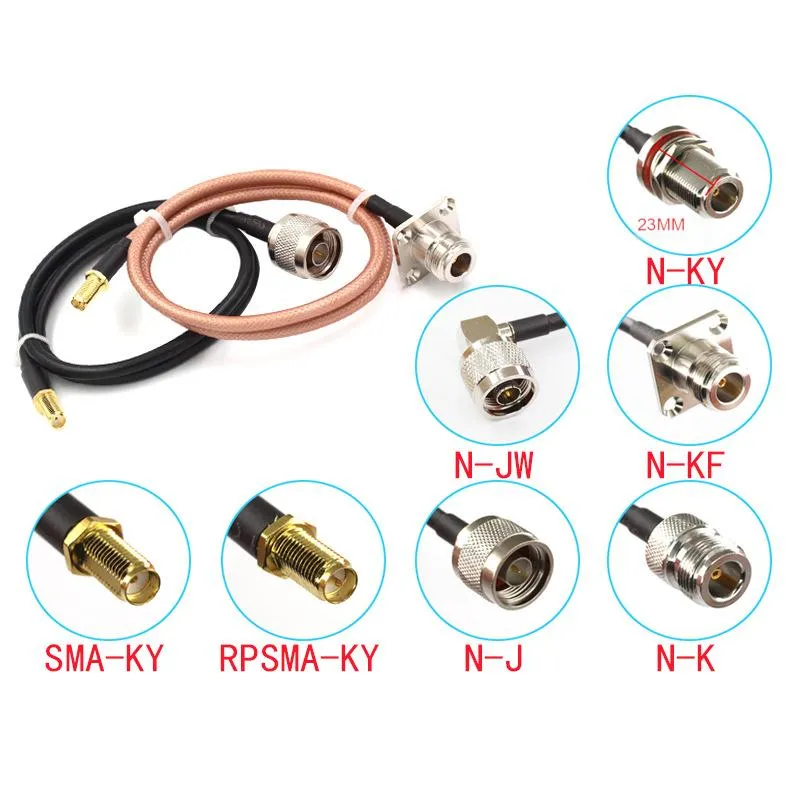
SMP-KW, SMA-J, SMA-KY, SAM-KF / Examples of different types of SMA adapter cables: SMP-KW, SMA-J, SMA-KY, SAM-KF

SMA Adapter Cable Guide: Types, Length & Right Angles

Introduction In RF design, small details can decide whether a system performs flawlessly or struggles with interference. One of the most overlooked points is the short link between a device and its antenna. Instead of relying on rigid adapters, many engineers choose an SMA adapter cable (pigtail). It’s flexible, easy to route inside an enclosure, and helps keep insertion loss under control. When selecting a pigtail, focus on three essentials: the cable type—whether that’s RF0.81, RF1.13, RG178, or RG316—the length, and the connector style (straight, right-angle, bulkhead, or panel mount). A shorter jumper usually means lower loss, and the fewer adapters you add in series, the less chance of mismatch.

Standard UHF connector (SO-239/PL-259) size reference chart

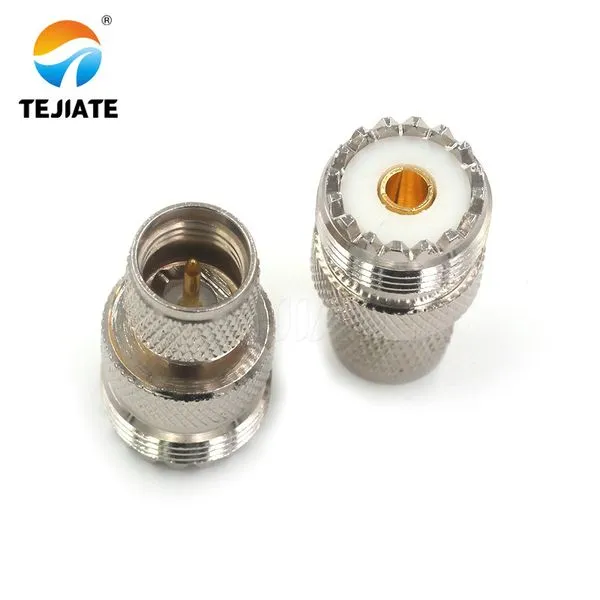
SMA to UHF Adapter Guide: Types, Gender & Ham Radio Tips

Introduction Every radio operator eventually runs into the same challenge: how do you link compact SMA connectors with the bulkier UHF series? The most common piece you’ll see is the sma male to uhf female adapter, yet that’s far from the only combination you might need. Depending on the equipment, sometimes the reverse works better, and in other cases a short coax jumper outperforms a rigid block. Getting this choice right can mean the difference between a solid, low-loss connection and a setup plagued by weak joints or cracked ports. From experience, one of the easiest mistakes is overlooking stress on the SMA jack. A heavy PL-259 hanging directly off a small radio can act like a lever, gradually loosening the board-mounted connector. Using the right adapter—or even better, a short pigtail—prevents those issues before they show up.

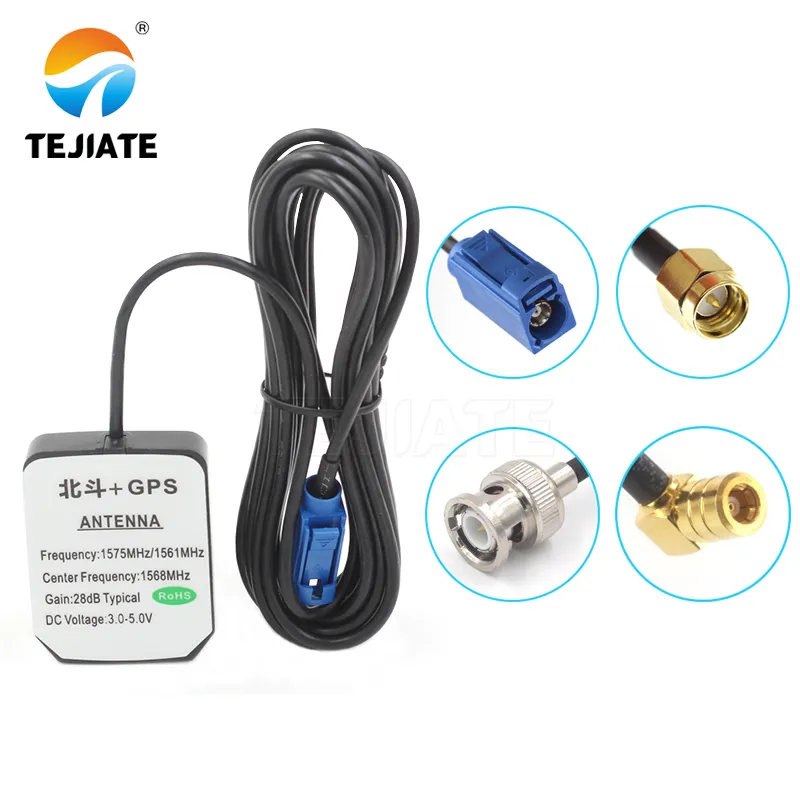
SMA、MCX、MMCX、U.FL和FAKRA / Common GPS antenna connector types: SMA, MCX, MMCX, U.FL, and FAKRA

The Ultimate GPS Antenna Cable Guide Active vs Passive, Loss & Types

Introduction A GPS or GNSS system is only as good as the chain that ties it together. Think of it as three links—antenna, gps antenna cable, and receiver. If one link is weak, the entire system suffers. Even the most advanced antenna can’t perform well if the cable adds too much attenuation or mismatched impedance. You’ll notice this in everyday use. A vehicle gps antenna might lose lock just as you’re driving through a tunnel. A gps timing PPS installation may drift slightly if the coax run is too long. And with RTK GNSS surveying, even a fraction of a decibel in extra line loss can throw off centimeter-level precision. These aren’t rare glitches; they’re the natural result of treating the cable as “just a wire.”

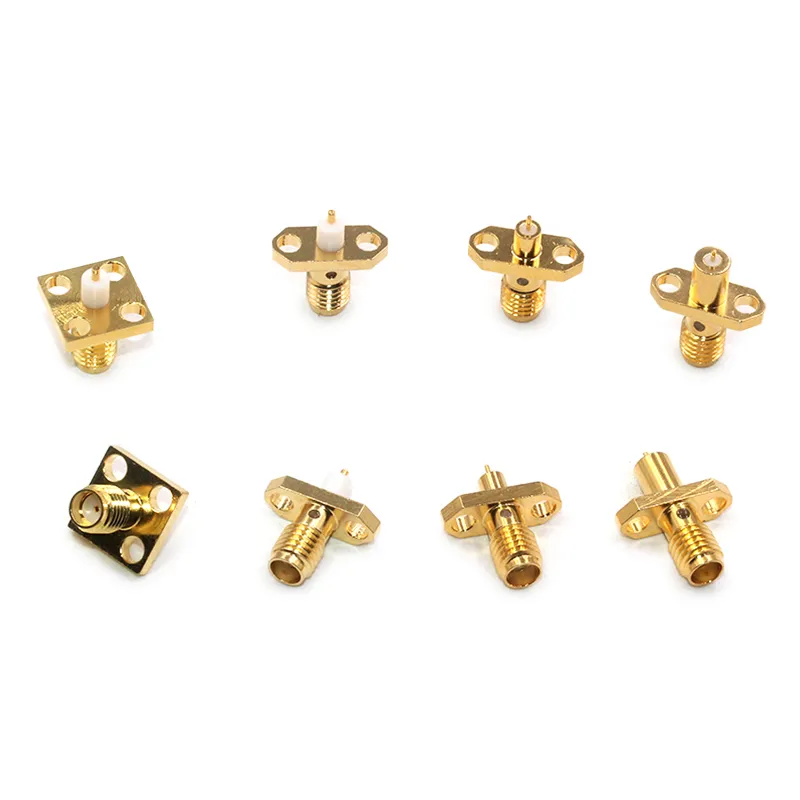
SMA flange mount connector types

SMA Bulkhead Connector Guide: Panel Mount & IP67 Flange

Introduction Think about a Wi-Fi router sitting on your desk or a GPS receiver mounted in a car dashboard. Both rely on antennas that must live outside their housings. The bridge between those enclosed electronics and the external antenna is the SMA bulkhead connector. By threading through a panel wall, this small yet essential part allows the RF signal to exit the device cleanly, while still maintaining shielding and grounding integrity. This guide explores the practical details that engineers and installers often ask about: what exactly an SMA bulkhead connector does, how to choose between 11 mm and 13 mm thread lengths, and why an IP67 waterproof bulkhead is often critical for outdoor gear. We’ll also look at flange and right-angle versions that help when space is limited or vibration resistance is a priority.

MHF4 to SMA coaxial cable pigtail

MHF4 to SMA Cable (IPEX 4): 0.81 vs 1.13, Thread Length & Uses

Introduction — Why These Cables Matter Open up a Wi-Fi card, 4G/5G modem, or GPS receiver, and you’ll rarely find a full-size SMA jack. Instead, what greets you is a tiny MHF4 (IPEX 4) socket tucked onto the module’s edge. It’s so small that even steady hands often reach for tweezers to snap it in place. Convenient for saving board space, yes—but it’s far too delicate for a direct external antenna.

Illustration of a U.FL/IPX to SMA cable assembly

U.FL to SMA Cable Guide – Types, Length, Loss & Mounting Tips

1) Introduction In many wireless designs, the challenge isn’t the chip or the antenna—it’s getting the signal out of the enclosure. That’s where a U.FL to SMA cable comes in. By linking the delicate on-board U.FL/IPX port to a rugged SMA bulkhead on the housing, you can mount antennas exactly where they work best. This approach is common across Wi-Fi and Bluetooth modules, LTE/5G CPEs, GPS receivers, and IoT gateways that sit inside metal cases. What readers gain here is clarity: how MHF1 (U.FL) differs from MHF4, why coax diameter and length dictate signal loss, and which SMA vs RP-SMA orientation suits each scenario. We’ll also cover bulkhead threads, waterproof sealing, and a quick selection checklist that helps avoid mismatches.

Single product photo of a WiFi antenna extension cable, typically RP-SMA male to female, with clear labels on length and connector type

WiFi Antenna Extension Cable Guide: Types, Length & Performance

Introduction Anyone who has tried streaming in a back room or setting up a Wi-Fi camera outdoors knows the pain: the router stays inside, but the antenna ends up stuck in a poor spot. That’s when a WiFi antenna extension cable can save the day. Instead of relocating the entire device, you simply shift the antenna to a higher or clearer location—and often the difference in coverage is immediate. Naturally, people ask the same questions: Do WiFi router antenna extension cables really work? and Are they worth it? The answer is yes, when chosen correctly. The details matter though—things like RP-SMA vs SMA polarity, coax construction, and how much loss comes with each cable type. For instance, an rg174 extension cable (2.85 mm OD, 50 ±2 Ω) is flexible and widely available, but it introduces about 0.82 dB of loss per meter at 2.4 GHz. RG178, slimmer at 1.8 mm, handles –55 °C to +200 °C and uses silver-plated copper conductors, while LMR-100 keeps loss much lower (roughly 0.49 dB per meter at 2.4 GHz) thanks to its dual shielding.

Using an antenna extension cable to relocate a Wi-Fi router antenna from a low, obstructed position to a high, open shelf for better signal coverage

Antenna Extension Cable Guide: Types, Length & Loss

ntroduction When your Wi-Fi cuts out during a call or your GPS suddenly drifts off course, the antenna itself isn’t always to blame. More often, the weak link is the cable connecting the antenna to the device. Adding an antenna extension cable gives you the freedom to place the antenna where it works best—higher on a wall, above a cabinet, or even outdoors. That extra height can dramatically improve line of sight (LoS) and reduce the multipath reflections that plague indoor signals. Of course, nothing in RF is free. Every coax introduces loss. A slim option like RG174, just 2.85 mm in diameter, can drop about 1.5 dB per meter at 2.4 GHz and closer to 2.5 dB at 5.8 GHz. Stretch it to 3 m, and you’ve already given up a significant share of usable power. By comparison, LMR200 holds losses to roughly 0.5 dB/m, while LMR240 trims it further to just 0.25 dB/m at 2.4 GHz. In practice, that difference can decide whether a 10 m