
A replacement fuse can look correct and still be the wrong part.
That mistake happens often with high-current automotive circuits. A blown 40 A fuse is pulled from a power distribution point, a similar large blade fuse is installed, and the circuit comes back to life. The buyer sees the same general MAXI shape. The technician sees the same amp marking. The problem may not show up until the load heats the terminals, the fuse opens again, or a 32 V part is placed into a system that needed a different voltage family.
A MAXI fuse should not be selected by color and amp rating alone. It is a mechanical part, a thermal part, and a circuit-protection device at the same time.
Which MAXI fuse family fits the protected branch?
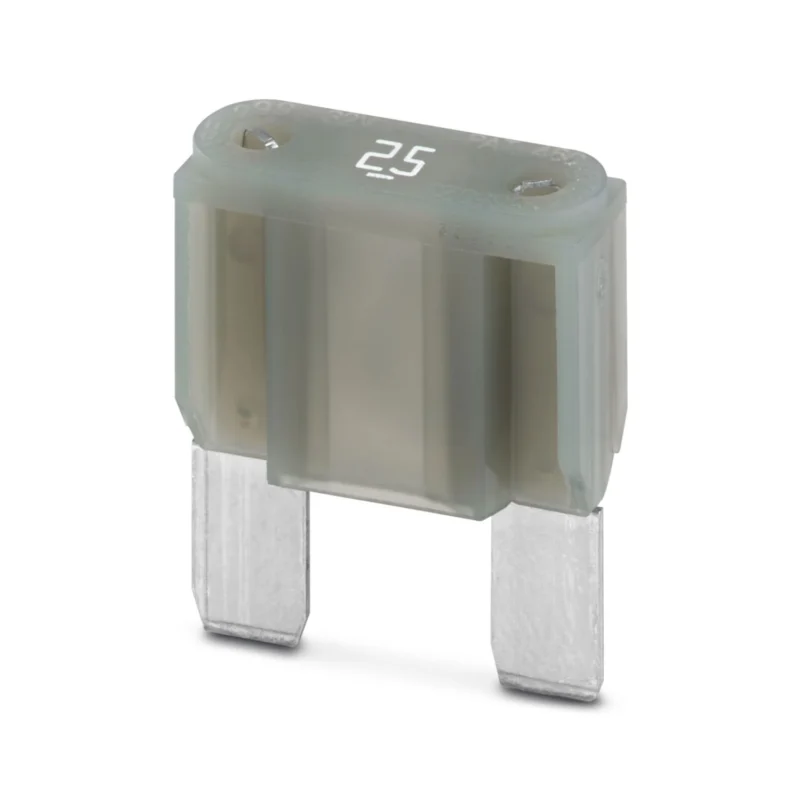
Start with the fuse family before comparing current ratings. MAXI fuses belong to the larger automotive blade fuse group, but they should not be treated as enlarged versions of MINI, ATO/ATC, MIDI, or MEGA fuses. Those families may serve similar vehicle or equipment circuits, but their body size, blade geometry, holder interface, and approved ratings are not interchangeable.
For service work, the first question is simple: is the installed part actually a MAXI blade fuse? For purchasing work, the question is a little sharper: which MAXI series, voltage family, opening characteristic, and approved holder does the circuit require?
A product photo is not enough. A fuse with the correct visible amp number may still differ in voltage rating, time-current behavior, interrupting capacity, or mechanical keying. This is especially important when the fuse is used in an electrical center, battery accessory branch, vehicle harness, or equipment distribution point where repeated replacement is expected. If the fuse belongs inside a larger vehicle fuse-box layout, it should also be checked against the surrounding architecture; a related guide such as Automotive Fuse Box Guide can help separate fuse identification from fuse-box service decisions.
Confirm the MAXI blade format before comparing ampere ratings
A MAXI fuse is typically used where the circuit current is higher than small blade-fuse positions can handle. That does not mean every high-current automotive fuse is MAXI. MIDI and MEGA fuses may also appear in power distribution systems, but their mounting method and protection role are different.
This identity card prevents the common “same amp, same color” shortcut. It also gives procurement a cleaner RFQ line: not just “MAXI fuse 60 A,” but a defined part with the right electrical and mechanical boundary.
Keep MAXI separate from similar automotive fuse architectures
Do not approve a substitute because another automotive fuse has a similar current rating. A 60 A fuse from another family may protect a circuit, but it may not fit the same cavity, clamp with the same terminal force, or clear a fault the same way.
This matters in harness production too. If a BOM states only “large blade fuse,” buyers may source a part that looks suitable but fails fit inspection later. If a work order states only “80 A automotive fuse,” the assembly team may receive a part from the wrong architecture.
Use “MAXI blade fuse” as the family description, then add the required current, voltage, opening characteristic, and accepted series.
Recognize that MAXI does not prove one opening characteristic
Do not assume every MAXI fuse is slow-blow. Current product families differ. Some MAXI products are offered as Slo-Blo or time-delay designs, while other MAXI automotive blade products are described as fast-acting. The family name describes the blade-fuse format, not the full time-current curve.
That difference is not a small catalog detail. A motor, pump, compressor, or high-inrush accessory may need a fuse that tolerates a short startup peak. A different circuit may need faster interruption. The same amp rating can behave differently if the selected series changes.
How do 40A, 50A, 60A, and 80A ratings change the protection plan?
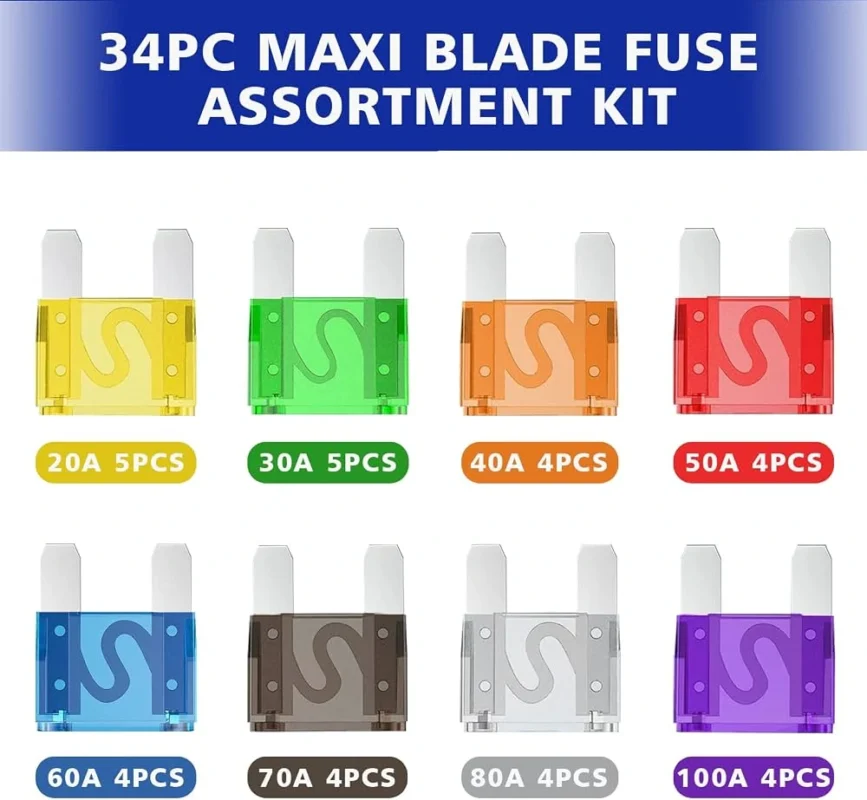
A higher amp number is not a repair method.
If a 40A MAXI fuse opens repeatedly, installing a 50A MAXI fuse may only hide the real problem. If a 60A MAXI fuse is replaced by an 80A MAXI fuse without checking the conductor, terminal, holder, and load, the protected wire may no longer be protected correctly.
The fuse rating belongs to the whole current path. Start from the circuit load, then validate the wire and terminal system. Only after that should the fuse curve and holder capability be confirmed.
Start from load and conductor requirements
A practical selection chain looks like this:
Load → Conductor → Inrush → Fuse curve → Holder / terminal → Final MAXI rating
The fuse should allow normal operation, tolerate expected short-duration startup current where applicable, and still open before the protected conductor or equipment is placed at unacceptable risk. That balance cannot be judged from color coding.
For example, a 60 A mark does not mean the circuit should continuously draw 60 A. It means the fuse belongs to a protection plan built around a conductor, terminal interface, ambient condition, and time-current curve. In a hot engine-bay area or a sealed electrical enclosure, the margin may be different from a short lab test on an open bench.
Use a current selection worksheet before changing ratings
For replacement, purchasing, or first-article approval, use a worksheet instead of a guess.
This worksheet is especially useful when a customer asks for a rating increase because “the original fuse keeps blowing.” The repeated opening may come from a damaged load, undersized wiring, abnormal inrush, wrong fuse characteristic, poor terminal contact, or a short in the branch. A higher fuse rating should be the result of validation, not the first troubleshooting step.
If the fuse sits in a multi-circuit distribution layout, the block also needs to be checked. The fuse may be acceptable, but the bus, feed terminal, or cavity rating may not be. For centralized layouts, see Fuse Block Selection Guide before treating the MAXI fuse as an isolated component.
What do MAXI fuse dimensions tell you before replacement?
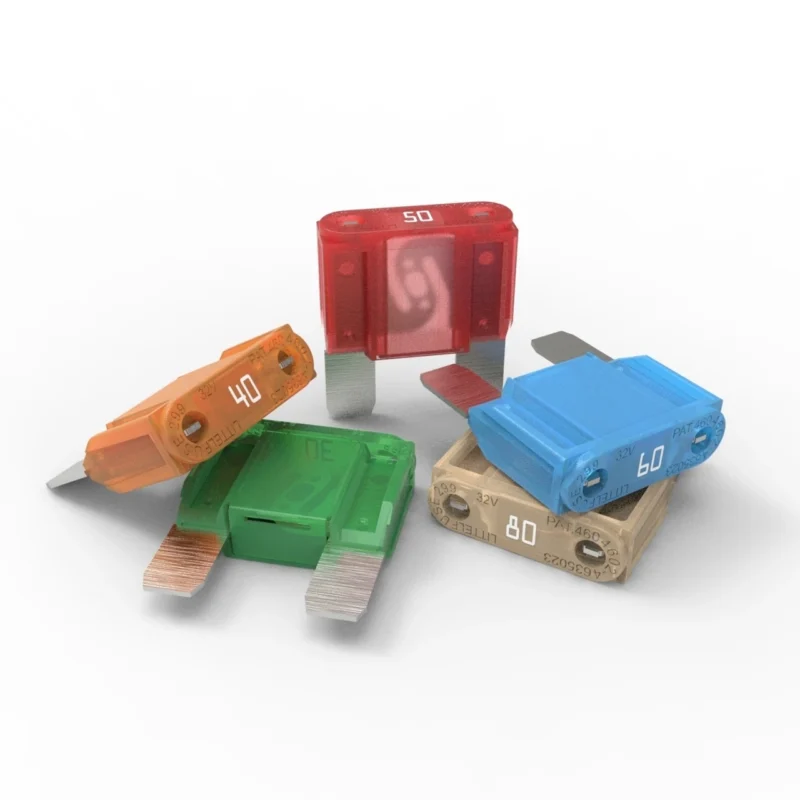
Dimensions confirm the family and fit. They do not prove electrical equivalence.
A MAXI blade fuse is larger than common small automotive blade fuses, but exact dimensions still belong to the selected part number and series. Replacement checks should include body width, body height, exposed blade length, blade center spacing, blade width, blade thickness, and any keying feature. Approximate fit is not enough for a high-current path.
Use dimensions to confirm family identity, not full compatibility
A current MAXI drawing may show values such as body width, body height, blade spacing, blade thickness, and exposed blade length. Those numbers help identify the format, but they should not be copied into every procurement case as universal limits. The correct drawing is the one attached to the approved P/N.
A fuse can slide into a cavity and still be wrong because of voltage family, opening characteristic, or terminal engagement. Fit is only the first gate.
Check keying as well as nominal dimensions
Some higher-voltage MAXI designs may use mechanical features to prevent incorrect substitution. That means a buyer should not force a “same size” replacement into a different voltage-family position. If the fuse does not match the holder smoothly, stop and verify the series.
For holder selection, do not reduce the decision to “the blades fit.” Blade contact force, terminal material, temperature rise, housing rating, and environmental protection all affect the final result. If the next decision is holder selection rather than fuse identification, a related article such as Blade Fuse Holder Selection Guide should be used to check the mounting and terminal side of the design.
How should 32V and 58V MAXI versions be separated?
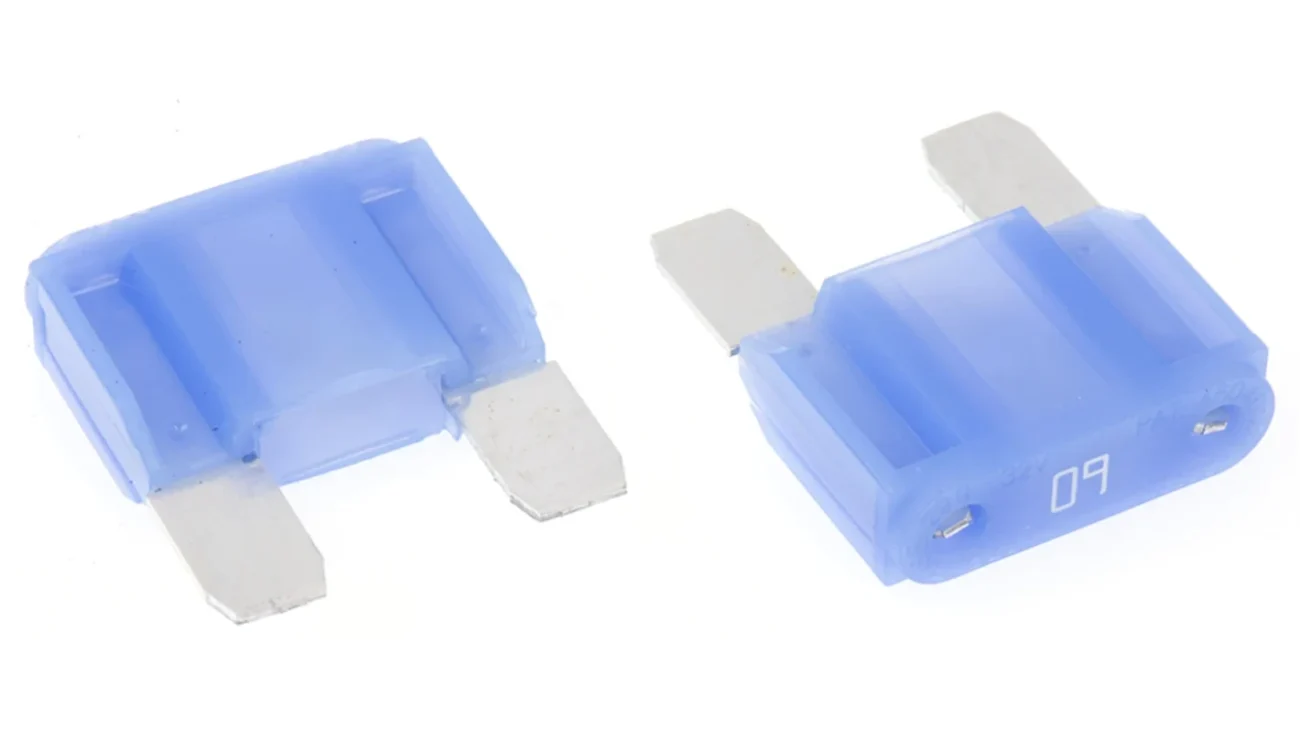
Voltage family is not a footnote on a MAXI fuse order. It is one of the fields that decides whether the part belongs in the circuit at all.
A 32 V MAXI fuse may be common in traditional automotive electrical systems, but current vehicle and equipment designs are no longer limited to that simple assumption. Some MAXI fuse families are available in higher voltage versions, including 58 VDC designs intended for automotive systems up to 42 V. That changes the replacement question. A buyer should not ask only for “60 A MAXI.” The RFQ should state the current rating, voltage family, approved series, and holder or block requirement.
Do not infer voltage compatibility from the amp rating, fuse color, or MAXI name. A 60 A fuse and another 60 A fuse may not belong in the same voltage environment.
Treat voltage family as a purchasing field
For replacement work, check the system voltage first. For production work, the engineering drawing or BOM should clearly state whether the circuit requires a 32 V or 58 V MAXI fuse. If this is left blank, procurement may source a familiar-looking part that passes a visual check but fails the actual design requirement.
Use a simple voltage gate before approving substitution:
| Check | Requirement / Result |
| Vehicle or system nominal voltage | |
| Maximum system voltage | |
| Required MAXI voltage family | 32 V / 58 V |
| Mechanical keying verified | Yes / No |
| Interrupting rating verified | Yes / No |
| Holder or block voltage verified | Yes / No |
| Direct substitution confirmed? | PASS / HOLD |
The interrupting rating also belongs in this check. A fuse must not only carry the normal load and open under overload; it also has to interrupt the available fault current under its rated voltage condition. That detail is easy to miss when the buying request is written around ampere rating only.
Check mechanical keying before forcing a replacement
Some higher-voltage MAXI designs may use housing features to prevent incorrect installation of a lower-voltage fuse. That is not an inconvenience. It is part of the safety and compatibility design.
If a replacement fuse does not sit correctly in the holder, do not trim, force, or “adjust” the housing. Stop and verify the exact series. Mechanical resistance may be the only warning that the candidate part belongs to a different voltage family.
This is also why holder and block compatibility must be treated as independent fields. A fuse block used for multiple protected circuits should be checked for bus rating, cavity rating, feed-terminal capability, and voltage family. The fuse and the distribution hardware have to be approved together.
When does time-delay behavior help instead of hiding a wiring problem?
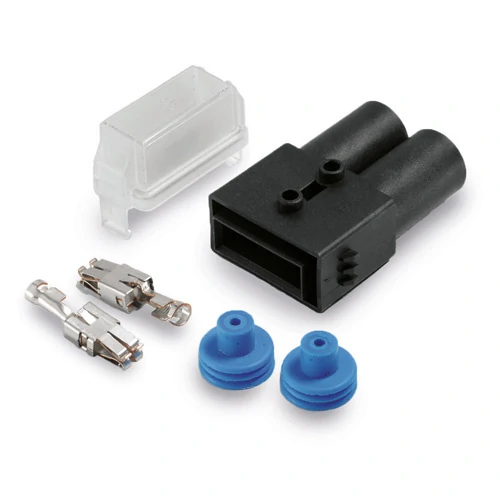
This image shows a MAXI fuse holder kit including the black fuse housing, clear cover, metal terminals and blue sealing parts. It supports the article section about matching MAXI fuse ratings with holder capability, terminal fit, wire range and environmental protection.
Time-delay behavior is useful only when the circuit actually needs it.
Motors, pumps, compressors, and some capacitive loads can pull a short startup current that is much higher than their running current. If the fuse opens during that normal startup event, the protection choice may need to account for inrush. In that case, the time-current curve matters more than the amp number printed on the body.
But time-delay should not become a way to ignore a fault. If the load is damaged, the wiring is undersized, or the holder terminal is overheating, changing to a slower fuse may make the failure less visible while leaving the real problem in the circuit.
Separate normal inrush from sustained overload
A good diagnosis starts with measured current behavior. Record the normal running current, the startup peak, and how long that peak lasts. Then compare those values with the fuse series data.
Use this decision record before changing fuse speed or current rating:
| Condition | Value / Result |
| Normal current | |
| Peak startup current | |
| Startup duration | |
| Existing fuse characteristic | Fast / Time-delay |
| Candidate time-current curve checked | Yes / No |
| Repetitive overload present? | Yes / No |
| Circuit fault ruled out? | Yes / No |
| Time-delay justified? | PASS / HOLD |
If the fuse opens after the equipment has already started and stabilized, the problem may not be inrush. It may be overload, a short, a mechanical jam, damaged insulation, a relay fault, or an accessory drawing more current than expected.
Do not assume every MAXI fuse is slow-blow
Different MAXI fuse manufacturers and series can use different opening characteristics. Some current MAXI products are built as time-delay designs. Others are sold as fast-acting large blade fuses. The same MAXI blade format does not guarantee the same response under overload.
That matters for service replacement. A fuse may fit into the same cavity and carry the same printed current rating, yet open differently during a fault. For production purchasing, the BOM should avoid vague wording such as:
MAXI fuse, 40 A
A stronger line is:
MAXI blade fuse, 40 A, 32 VDC, time-delay or fast-acting as specified, approved series/P/N, for approved holder/block.
That wording gives purchasing less room to substitute the wrong protection behavior.
Why can a MAXI fuse run hot without opening?
A hot fuse is not always a blown-fuse problem.
The current path is not just the fuse element. It is:
terminal → fuse blade → fuse element → fuse blade → terminal
A local connection can overheat even when the current remains below the opening threshold of the fuse. At MAXI fuse current levels, a small increase in contact resistance can create a noticeable temperature rise.
Separate fuse-element heating from contact heating
The fuse element heats as part of normal protection behavior. The blade and terminal interface should not become a separate hot spot because of weak contact force, oxidation, corrosion, poor fit, damaged plating, or a loose crimp.
The calculation is simple:
Vdrop = I × R
Pheat = I² × R
The second formula is the one buyers and technicians should respect. Current is squared. At 60 A or 80 A, a very small added resistance at the terminal can create meaningful heat. The fuse may remain electrically closed while the holder, blade, or nearby plastic begins to discolor.
Inspect discoloration and distortion as connection clues
A fuse body that looks browned near one blade deserves a different diagnosis from a fuse that opened cleanly at the element. Check both sides of the fuse. A single hot blade often points toward a local terminal problem.
Useful inspection points include:
| Inspection Point | What To Look For | Possible Meaning |
| Left blade | Darkening, pitting, softened plastic nearby | Local contact heating |
| Right blade | Similar or uneven discoloration | Terminal imbalance |
| Holder cavity | Loose fit, corrosion, melting | Weak contact or poor material match |
| Crimp terminal | Heat marks, movement, strand damage | High resistance outside the fuse |
| Loaded voltage drop | Higher than expected | Resistance in fuse or contact path |
Do this under representative load where safe and permitted. A cold continuity test may pass even when the circuit fails thermally after several minutes.
How should wire, terminal, and holder capability be coordinated around MAXI?
A MAXI fuse is one part of a high-current path. It cannot protect the branch correctly if the rest of the path is not designed around the same current and voltage requirements.
The protected circuit should be reviewed from source to load:
source conductor → terminal → holder/block → MAXI fuse → output terminal → load conductor
Every element needs a validated rating. If one part of the path is weaker than the fuse plan assumes, the system may heat before the fuse opens.
Do not use datasheet test cable size as a universal wire rule
Fuse datasheets may list defined test cable sizes for qualification. Those values are useful for understanding test conditions, but they should not be copied directly as a universal installation rule. Actual wire selection depends on conductor material, insulation temperature rating, bundle condition, ambient temperature, routing, allowable voltage drop, and equipment requirements.
A high-current fuse branch inside an engine bay is not the same as a short test lead on an open bench. A harness passing through a hot enclosure is not the same as a ventilated accessory circuit. The fuse rating has to be coordinated with the installed condition.
Match holder capability to the selected fuse rating
A holder that accepts a MAXI blade fuse physically is not automatically approved for every MAXI rating. Check continuous current capability, voltage rating, terminal design, wire range, environmental sealing, and temperature rise.
This is where a dedicated holder guide becomes useful. For now, keep the boundary clear: this article selects the MAXI fuse; the holder must still be validated separately. For broader mounting and terminal checks, refer to Blade Fuse Holder Selection Guide.
Can you verify a blown MAXI fuse without pulling it first?
Visual inspection is useful, but it is not final proof.
Some MAXI fuses make the opened element easy to see through the housing. If the internal link is clearly broken, burned, or separated, the fuse has opened. In other cases, the body may look normal even when the circuit is not receiving power. Dirt, housing color, lighting, and partial element damage can make visual inspection uncertain.
That is why the question is not only how to tell if a MAXI fuse is blown. The better question is: can you confirm the fuse condition without creating a new service risk?
Use visible housing only as the first clue
Look for:
| Visible Sign | Likely Meaning | Next Action |
| Broken internal link | Fuse opened | Diagnose cause before replacement |
| Burned or darkened element | Overcurrent or fault event | Check load and wiring |
| Melted body near blade | Contact heating possible | Inspect holder terminal |
| No visible damage | Fuse may still be open | Continue with approved electrical test |
| Repeated fuse opening | Root cause still present | Do not increase rating blindly |
A fuse can open because it did its job. Replacing it without finding the overload may only reset the failure for a short time.
Use test points only when the fuse and service procedure allow it
Some MAXI fuse designs include top checkpoints that allow resistance or circuit checks without removing the fuse. Use them only when the exact fuse design provides those test points and the equipment or vehicle service procedure permits that method.
Avoid universal live-circuit probing advice. Vehicle electrical centers and high-current equipment branches may have different isolation requirements, meter requirements, and service risks. If removal is required, isolate the circuit safely, pull the fuse, and check continuity across the fuse itself.
A continuity pass only confirms that the element is not open. It does not prove the fuse is the correct rating, correct voltage family, correct speed, or correct replacement series.
When should a MAXI fuse move from a single holder into a fuse block?
A single MAXI holder is usually easier to understand. One source, one protected branch, one fuse, one load.
That arrangement works well for a dedicated high-current circuit, especially when the load is physically separate from the main electrical center. The wiring path is clear, inspection is simple, and replacement can be managed without disturbing several other circuits.
A fuse block becomes stronger when several protected branches share one distribution point. In that case, the question is no longer only “which fuse rating?” It becomes a distribution architecture decision.
Use an individual holder for one dedicated branch
A typical single-branch layout may look like:
source → upstream protection → MAXI holder → high-current load
This can be appropriate for one accessory, one equipment branch, or one harness segment where the service team needs a clear fuse point. The holder still needs to match the MAXI fuse rating, voltage family, wire range, terminal design, and temperature condition.
Do not stack several individual high-current holders just because each one works alone. That can create messy wiring, uneven heat distribution, poor service access, and unclear responsibility for the main feed.
Use a fuse block when multiple protected circuits share a source
A fuse block is usually the better candidate when the design needs:
| Design Need | Better Candidate | Reason |
| One remote high-current branch | Single MAXI holder | Simple wiring and service |
| Several fused outputs | Fuse block | Cleaner distribution |
| Common bus from one feed | Fuse block | Controlled main-feed path |
| Frequent service access | Depends on layout | Access may matter more than size |
| Tight enclosure space | Depends on heat and wiring | Validate temperature rise |
| Mixed current ratings | Fuse block | Easier circuit organization |
For a larger distribution decision, refer to Fuse Block Selection Guide. The fuse rating should be selected before the block is finalized, but the block’s bus, cavity, feed terminal, and environmental rating must also support the design.
Validate the replacement under load before release
A MAXI fuse replacement should not be released only because the circuit powers on.
The more useful check is how the replacement behaves under representative load. A fuse may pass cold continuity, fit the holder, and carry current for a short test. It can still run hot at one blade, show excessive voltage drop, or open again after the load warms up.
Confirm exact P/N and rating before energizing
Before the circuit is powered, confirm:
- MAXI fuse family
- Current rating
- Voltage family
- Fast-acting or time-delay characteristic
- Dimensions and keying
- Holder or block compatibility
- Approved part number or series
Then check loaded voltage drop and temperature after the circuit has stabilized. Compare cold, warm, and post-service readings where possible.
If the new fuse opens again, stop treating the fuse as the main suspect. The circuit is giving you information. Check the load, wiring, relay, accessory condition, holder terminal, and actual current profile.
Specify MAXI fuses by P/N, rating, and acceptance criteria
A weak purchasing note creates weak replacement control.
Avoid vague lines such as:
Need 80A MAXI fuse.
That wording leaves too much room for substitution. It does not identify voltage family, opening characteristic, approved series, interrupting rating, terminal material, dimensions, keying, or holder compatibility.
A stronger RFQ line is:
MAXI blade fuse, 80 A, specified voltage family, fast-acting or time-delay as required, approved series/P/N, matched to approved holder or fuse block.
For production orders, add inspection requirements. For replacement sourcing, request an outline drawing when fit matters.
Incoming checks should include current marking, housing condition, terminal condition, dimensions, keying, continuity, lot traceability, and risk-based loaded testing. If the supplier changes series, plating, production origin, or packaging, increase inspection until the new supply is proven stable.
For buyers sourcing broader electrical protection parts, TEJTE can support fuse-related selection together with automotive wiring, holders, and connector-side assembly checks. The safest purchasing habit is simple: define the fuse as part of the protected circuit, not as a loose amp-rating commodity.
FAQ
Is every MAXI fuse a slow-blow or time-delay fuse?
No. Some MAXI fuse families are time-delay designs, while others are fast-acting. Verify the opening characteristic from the exact series or part number.
Can a 32V MAXI fuse and a 58V MAXI fuse be interchanged if the amp rating matches?
Do not assume so. Voltage rating, interrupting capability, holder design, and mechanical keying all matter.
Can I replace a 60A MAXI fuse with an 80A fuse if the 60A fuse keeps blowing?
Not simply to stop the fuse from opening. First diagnose load current, startup current, wiring, holder condition, and possible faults.
Do all MAXI fuses have exactly the same dimensions?
No. Check the exact outline drawing, voltage-family design, and keying features before approving replacement.
Can any MAXI fuse holder be used with any MAXI fuse?
No. Mechanical fit alone is not enough. Verify current rating, voltage family, terminal system, temperature rise, wire range, and environmental requirements.