
BNC to SMA Cable Selection & Use Guide
Mar 10,2026
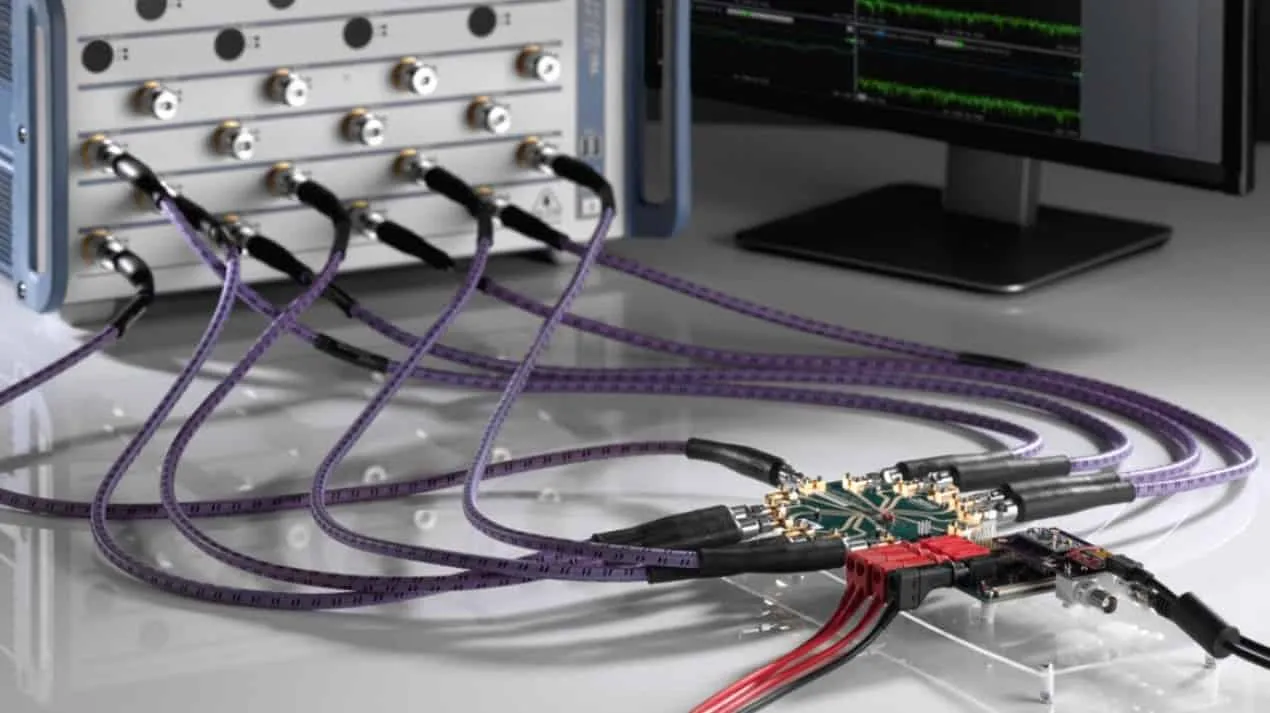
This figure shows a typical BNC to SMA cable assembly, consisting of a length of coaxial cable (often RG316) terminated with a BNC plug on one end and an SMA plug on the other. It is used to connect test equipment with BNC ports (such as oscilloscopes or older spectrum analyzers) to devices with SMA connectors (such as compact radios or RF modules). Once installed, the cable contributes insertion loss and must maintain 50-ohm impedance continuity throughout the path.
Most RF systems do not begin with a connector problem.
The radio gets chosen first. The antenna comes next. Early bench tests usually run using whatever cables happen to be available. As long as the signal appears stable, nobody worries much about the interconnect.
Then someone notices the ports.
The instrument sitting on the bench might expose a BNC connector, while the device being tested expects SMA. Suddenly a transition is required, and the quickest fix becomes a bnc to sma cable.
At first glance it feels trivial. One connector on each end. A short piece of coax in between. Done.
But RF engineers learn fairly quickly that even a small jumper becomes part of the signal path. The cable contributes insertion loss. It affects impedance continuity. And mechanically, it may end up protecting — or damaging — the connectors it attaches to.
A poorly chosen cable might not break the system immediately. Measurements still appear reasonable. Yet small mismatches can introduce reflections or amplitude errors that only become obvious later, especially at higher frequencies.
That’s why the bnc to sma cable deserves more attention than it usually gets.
This guide focuses on the practical side of the problem: where these cables appear in real RF work, how to decide between a cable and an adapter, and how to choose the right 50 ohm coaxial cable so the transition behaves predictably.
Where does a BNC to SMA cable show up in real RF work?
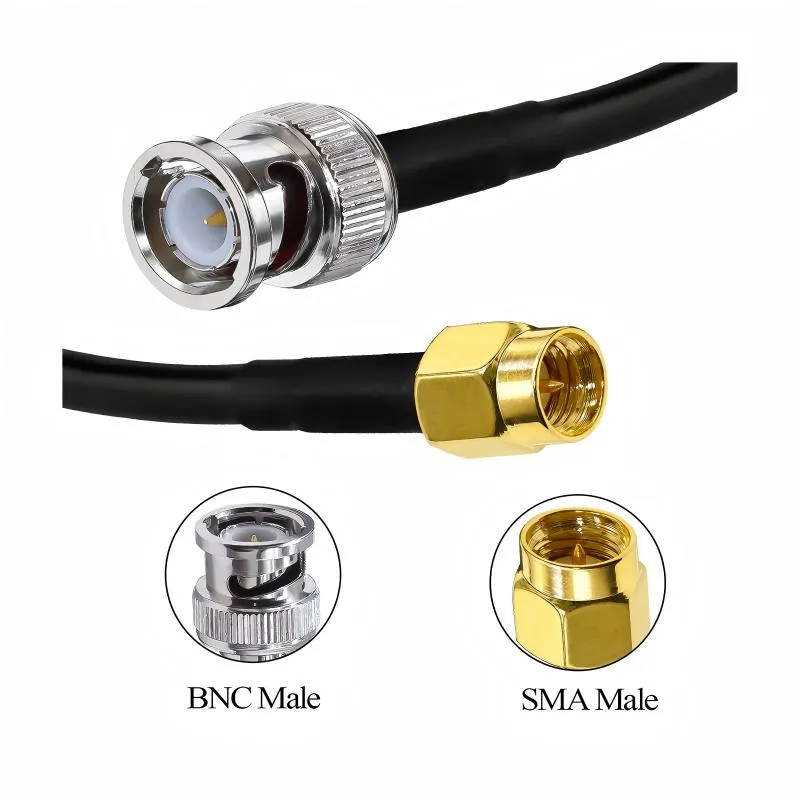
This figure illustrates a typical lab setup where a signal generator or instrument with a BNC output is connected via a BNC to SMA cable to an RF module or device under test with an SMA input. It highlights the role of the cable as a bridge between different connector ecosystems, and emphasizes that the cable becomes an integral part of the RF signal path, affecting loss and impedance continuity.
Connector transitions usually appear late in a project. They rarely show up on the first schematic.
Instead, they emerge when equipment from different generations meets on the same bench.
Mapping BNC instruments to SMA radios and modules
Many laboratories still rely on instruments that were designed long before compact RF modules became common. Those instruments often use BNC connectors.
There are practical reasons for that. BNC connectors are easy to connect quickly, mechanically strong, and widely available.
Modern RF hardware, however, tends to use SMA connectors. They occupy less space and support higher frequencies more consistently.
So a common signal path ends up looking something like this:
Signal generator or instrument (BNC)
↓
BNC to SMA cable
↓
RF module or antenna port (SMA)
You see this configuration in places such as:
- SDR development benches
- IoT module testing
- GPS receiver evaluation
- wireless product prototyping
In these environments, a bnc to sma cable quietly becomes the bridge between legacy test equipment and modern RF hardware.
Keeping the RF chain aligned with 50-ohm coaxial practice
This image provides a side-by-side comparison of 50-ohm and 75-ohm BNC connectors. While mechanically similar, the two variants differ in dielectric design to achieve the required impedance. The 50-ohm version is standard for RF test equipment, while the 75-ohm version is common in video and broadcast systems. The visual reference helps engineers verify they are using the correct impedance for their application, preventing reflections and signal degradation.
RF measurement systems almost always operate at 50 ohms.
That standard applies to transmitters, receivers, antennas, and most RF instruments. The entire chain assumes that impedance.
BNC connectors complicate things slightly.
Unlike SMA, BNC exists in both 50 Ω and 75 Ω versions. The difference originated from two industries developing in parallel. RF laboratories standardized on 50 ohms, while broadcast video systems adopted 75 ohms.
In practice, the two connectors look nearly identical. The mismatch often goes unnoticed until measurements begin to behave strangely.
A quick comparison helps clarify the situation:
| Application | Typical Impedance |
|---|---|
| RF instruments and radios | 50 Ω |
| Video equipment | 75 Ω |
If a 75-ohm BNC cable enters a 50-ohm RF path, the result is reflection. The system still works, but the signal no longer behaves ideally.
Engineers sometimes interpret this as calibration drift or device instability when the real cause is simply the wrong cable.
So when selecting a bnc to sma cable, confirming that the assembly uses 50 ohm coaxial cable is critical.
Understanding the difference between cables and adapters
| Hardware type | Typical purpose |
|---|---|
| Cable assembly | Flexible connection and strain relief |
| Adapter | Direct rigid connector transition |
| Coupler | Extends a connector interface |
A bnc to sma cable introduces flexibility. That flexibility matters more than many engineers expect.
Without it, the entire mechanical load of the cable transfers directly to the device connector.
Adapters behave differently. A bnc to sma adapter creates a rigid metal bridge between two connectors. When both ports align perfectly and the setup remains stationary, adapters work well.
Problems begin when multiple adapters get stacked together. Every additional connector interface adds insertion loss and another potential reflection point.
In many cases, replacing several adapters with a single cable produces a cleaner RF path.
For a broader look at how transition cables behave in RF systems, the SMA adapter cable routing guide explains how adapter cables influence mechanical strain and signal stability.
Should you use a BNC to SMA cable or a BNC to SMA adapter?
Use a cable when movement or offset exists
In real laboratories, connectors rarely align perfectly.
An instrument might sit higher on the bench. A module could be mounted inside a small enclosure. The cable route might need to turn immediately after the connector.
These are situations where a bnc to sma cable performs better.
The coax provides flexibility, which absorbs small movements and prevents torque from reaching the connectors. This is particularly important for SMA interfaces, which use fine threads that can wear or strip if overloaded.
Experienced engineers tend to choose cables whenever equipment gets moved frequently or when the connection must tolerate repeated handling.
Use an adapter when the connection remains rigid
There are cases where a cable adds unnecessary complexity.
Calibration fixtures are a good example. When connectors align directly and the system remains fixed, a bnc to sma adapter creates a short and tidy connection.
Because the signal path is shorter, insertion loss may also be slightly lower.
A more detailed comparison of adapter behavior appears in the BNC to SMA adapter selection guide, which explores how connector transitions influence RF measurements.
Avoid stacking adapters whenever possible
A surprisingly common RF bench configuration looks like this:
BNC instrument
↓
adapter
↓
adapter
↓
adapter
↓
SMA device
The setup works, but the signal path becomes unnecessarily complicated.
Each connector transition adds a small amount of loss. More importantly, mechanical stability decreases with every additional interface.
Replacing the stack with a single sma adapter cable or bnc to sma cable usually produces a more reliable setup.
Understanding reverse connector terminology
One last detail often causes confusion when ordering cables.
Some engineers search for bnc to sma cable, while others search for sma to bnc cable. The two terms often describe the same cable assembly.
The difference simply reflects which side of the connection the user focuses on.
Many technical catalogs include both phrases to match different search habits. A deeper explanation of connector direction appears in the SMA to BNC cable guide, which discusses how connector orientation influences cable selection.
How do you identify SMA and BNC genders correctly before ordering?
Most connector problems in RF labs have nothing to do with frequency limits or signal loss. They come from ordering the wrong connector.
It happens more often than people admit.
A cable shows up. The coax is correct. The length is right. Yet the connectors refuse to mate with the equipment. Someone looks again at the ports and realizes the mistake.
The issue is usually SMA.
BNC connectors are fairly forgiving. SMA connectors are smaller and more precise, and their gender definitions sometimes confuse even experienced engineers.
Before purchasing a bnc to sma cable, it helps to check three details carefully:
- the BNC connector type
- the SMA connector orientation
- whether the cable needs a straight or angled exit
Skipping one of these checks is usually how ordering errors happen.
Confirming the BNC side of the cable
BNC connectors use a bayonet locking mechanism rather than threads. Two small pins slide into slots on the mating connector, and a short twist locks the connection.
The design is quick and convenient. That convenience explains why BNC connectors became common in oscilloscopes, signal generators, and other test instruments.
In most RF systems you encounter two forms.
| Connector | Typical location |
|---|---|
| BNC plug | cable assembly |
| BNC jack | instrument panel |
Laboratory equipment typically exposes BNC jacks. That means a bnc to sma cable almost always uses a BNC plug on the instrument side.
If you look around a test bench, you will notice this configuration almost everywhere.
The mechanical background of the connector is described in the BNC connector article on Wikipedia, which explains why the bayonet coupling became popular in measurement equipment.
SMA connectors require a closer look
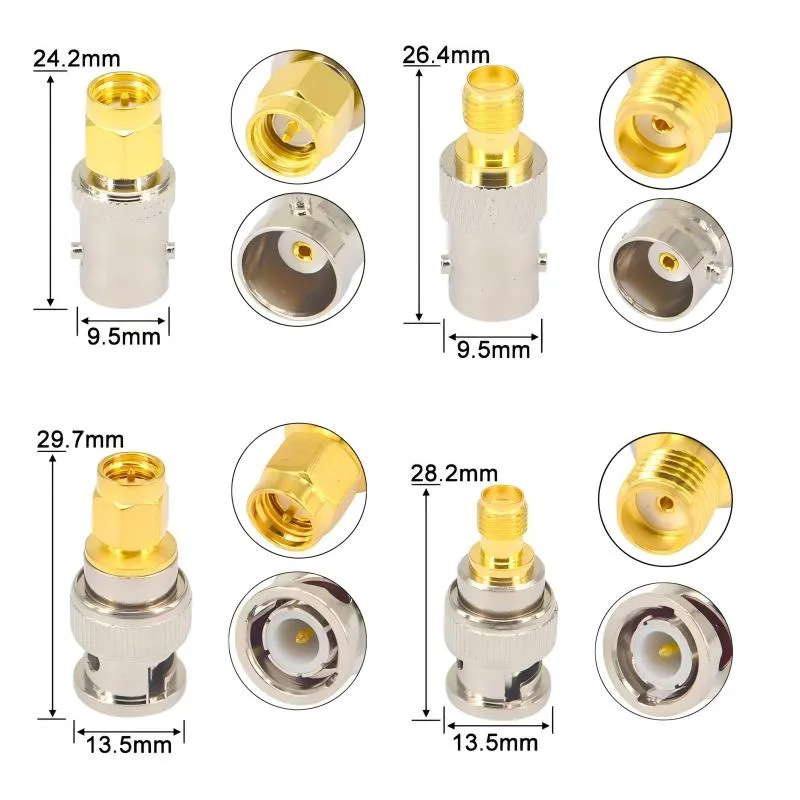
This figure provides a clear visual comparison between SMA male and female connectors. The male connector (likely shown on one side) features internal threads and a protruding center pin. The female connector (on the other side) has external threads and a recessed center socket. The image also serves as a reminder to check for reverse-polarity (RP-SMA) variants, where the center conductor gender is swapped, commonly found in Wi-Fi equipment. Correctly identifying SMA gender prevents ordering mistakes.
SMA connectors look simple. The threaded interface seems obvious, and most engineers recognize the connector immediately.
The difficulty appears when determining the actual gender.
With SMA connectors, gender is defined by two elements together:
- thread orientation
- center contact
Ignoring one of them can lead to mistakes.
| Connector | Thread position | Center contact |
|---|---|---|
| SMA male | internal | pin |
| SMA female | external | socket |
Most people look only at the threads. In many cases that works.
But not always.
Wireless equipment sometimes uses RP-SMA connectors. These connectors reverse the center contact while keeping the thread orientation unchanged.
The design originally appeared in consumer Wi-Fi hardware and still shows up in routers, antennas, and wireless modules.
When ordering a bnc to sma cable for Wi-Fi or antenna testing, confirming whether the port uses standard SMA or RP-SMA prevents a common ordering mistake.
Straight connectors or right-angle connectors?
This decision is mostly mechanical.
Electrically, straight and right-angle connectors behave almost the same for short cables. The difference becomes noticeable only in specialized microwave assemblies.
In everyday RF setups, the reason for choosing a right-angle connector is space.
Consider a few common situations:
- equipment installed in a rack
- devices mounted inside small enclosures
- connectors located close to a rear panel
In those cases, a cable leaving the connector straight out may have to bend sharply. Over time that bend stresses the cable near the connector body.
A right-angle connector lets the cable exit in a more natural direction.
It is a small detail, but one that often extends cable life.
Choosing the coaxial cable for a BNC to SMA assembly
Once the connectors are selected, the next question usually involves the coax itself.
Many engineers instinctively focus on the connector transition. In practice, the rf coaxial cable between them determines most of the electrical behavior.
Cable type affects attenuation, flexibility, shielding effectiveness, and temperature tolerance.
Why RG316 is commonly used
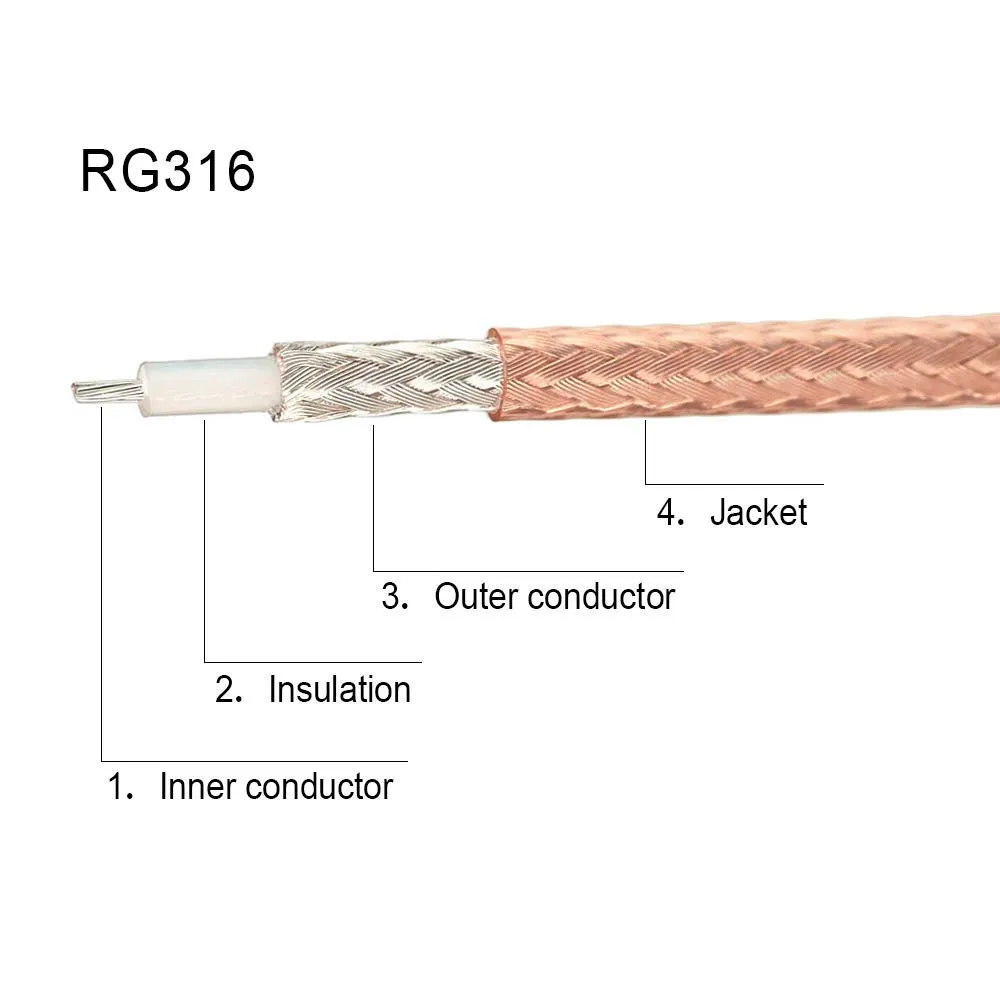
This image shows a detailed view of RG316 coaxial cable, likely with layers exposed to reveal construction: a silver-plated copper inner conductor, a PTFE dielectric (known for thermal stability and low loss), a braided shield (often silver-plated copper), and a protective outer jacket. With an outer diameter of approximately 2.5 mm, RG316 balances flexibility and durability, making it a common choice for short SMA adapter cables in lab equipment, industrial enclosures, and IoT hardware where predictable performance and heat tolerance are required.
One cable appears repeatedly in short RF jumper assemblies: RG316 coaxial cable.
It is not the lowest-loss coax available. Nor is it the smallest.
Its popularity comes from balance.
Typical properties look like this:
| Parameter | RG316 |
|---|---|
| Characteristic impedance | 50 Ω |
| Outer diameter | about 2.5 mm |
| Dielectric | PTFE |
| Shield | braided copper |
The PTFE dielectric is one of the reasons rg316 cable remains common in laboratory cables. PTFE tolerates heat well and maintains stable electrical characteristics.
That combination works well for short jumper cables, which is exactly the role most bnc to sma cable assemblies play.
Situations where larger coax is preferable
RG316 works well in short runs. Over longer distances, attenuation becomes more noticeable.
As cable length increases, engineers sometimes move to larger coax types.
Examples include:
| Cable | Typical use |
|---|---|
| RG316 | short RF jumper |
| RG58 | general test cables |
| LMR-240 | lower-loss runs |
These cables share the same 50 ohm coaxial cable impedance but differ in diameter and attenuation.
In many RF labs the bnc to sma cable acts only as a short transition between instruments and devices. In that situation, flexibility matters more than achieving the lowest possible attenuation.
For readers interested in how coaxial transmission lines work in general, the Coaxial cable overview on Wikipedia provides a useful explanation of impedance and shielding structure.
Thinking about coax in terms of system roles
Instead of thinking about cable types individually, it often helps to think about their roles in the RF system.
Most setups naturally fall into three categories:
- bench test jumpers
- internal equipment wiring
- external antenna feedlines
A bnc to sma cable normally belongs to the first category.
Bench jumpers tend to be short. They are moved frequently. They are plugged and unplugged often during testing.
Because of this, durability and flexibility usually matter more than extremely low attenuation.
That environment is exactly where rg316 coaxial cable performs well.
Estimating signal loss in a BNC to SMA cable
Before installing a cable into an RF path, engineers often estimate the expected attenuation.
The calculation is simple.
Cable manufacturers publish attenuation values as decibels per meter at different frequencies. Once the attenuation is known, the approximate loss can be estimated.
Cable Loss ≈ attenuation × length
For RG316, typical values are roughly:
| Frequency | Attenuation |
|---|---|
| 1 GHz | about 0.6 dB/m |
| 3 GHz | about 1.1 dB/m |
If a bnc to sma cable uses RG316 and measures half a meter long, the estimated loss at 3 GHz becomes:
1.1 × 0.5 ≈ 0.55 dB
That amount of loss is acceptable for most bench testing setups.
Connector transitions also introduce loss
Cables are not the only contributors to signal attenuation.
Each connector interface introduces a small additional loss. Engineers often estimate it using a simple rule.
Each transition adds roughly 0.1–0.3 dB.
A typical bnc to sma cable contains two transitions:
- the BNC connector
- the SMA connector
Using a middle estimate of 0.15 dB per interface produces about:
0.15 × 2 = 0.30 dB
When combined with cable attenuation, the total loss of a short jumper cable usually remains below one decibel.
Avoid mixing 50-ohm and 75-ohm components
BNC connectors exist in both 50-ohm and 75-ohm versions.
Mixing these inside an RF system introduces an impedance mismatch. The signal still propagates through the cable, but part of the energy reflects back toward the source.
In routine testing the effect may not be obvious. In precision measurements it can influence amplitude accuracy and return-loss readings.
For this reason, verifying that the bnc to sma cable uses 50 ohm coaxial cable remains an important step when assembling RF test setups.
Routing a BNC to SMA cable so it survives real lab use
When RF jumper cables fail, they rarely fail in the middle.
The break usually appears right behind the connector.
Anyone who has repaired coax jumpers will recognize the pattern. The outer jacket still looks intact, yet the signal becomes intermittent. Inside the cable, the conductor has fatigued after repeated bending near the connector.
That area — just a few centimeters behind the connector body — is where most bnc to sma cable assemblies eventually give up.
The first bend matters more than the rest of the cable
If you watch how cables are installed on real benches, the same thing happens again and again.
The connector gets tightened. The cable immediately turns downward. Sometimes the bend angle is sharp enough that the coax almost folds at the connector exit.
That shape may work for a while. Over time it weakens the internal conductors.
A safer approach is simple: let the cable leave the connector with a small radius before it changes direction. The first few centimeters should not carry mechanical stress.
This matters especially for rg316 cable, since the diameter is small and the conductor can fatigue sooner than in thicker coax.
Routing around equipment edges
Equipment racks and lab benches are rarely designed with cable routing in mind.
Cables end up squeezed between power supplies, fan housings, and sheet-metal edges. The outer jacket of the cable slowly rubs against these surfaces every time the cable moves.
Months later the shielding braid becomes visible.
Once that happens, signal shielding may degrade and the cable becomes more vulnerable to interference.
A bnc to sma cable used in a test environment benefits from simple routing discipline:
- avoid sharp chassis edges
- keep cables away from moving hardware
- add a strain-relief clip if the cable moves frequently
These small precautions extend cable life surprisingly well.
Protect the first bend radius
Even flexible rf coaxial cable has a minimum bend radius. The first centimeter near the connector is structurally sensitive.
Sharp bends right at the connector exit:
- Stress the crimp or solder joint
- Shift internal geometry
- Increase long-term failure risk
If routing requires a tight turn, choose a right-angle adapter or use a short flexible jumper instead of forcing the cable to bend immediately.
Mechanical discipline equals electrical stability.
Let the chassis take the mechanical load
Many instruments use panel-mounted BNC connectors. The reason is partly mechanical.
If a cable is pulled sideways, the chassis absorbs the force instead of the internal circuit board.
Some RF systems extend the same idea further. Instead of connecting cables directly to internal modules, engineers place bulkhead connectors on the enclosure panel.
External cables connect to the bulkhead interface. Internal wiring stays protected inside the enclosure.
This approach isolates the electronics from mechanical stress.
How BNC to SMA cables fit into typical RF bench setups
In practice, RF labs accumulate a collection of small transition cables.
Over time the drawer begins to contain several familiar combinations:
- SMA to N
- SMA to BNC
- SMA to TNC
- SMA to MMCX
These cables share the same basic idea: a short coax jumper linking two connector standards.
A bnc to sma cable is simply one member of that group.
Cable transitions vs rigid adapters
RF transitions can be created either with a cable or with a rigid adapter.
Both solutions appear in laboratories.
A bnc to sma adapter forms a solid connector bridge. The two connectors mate directly without coax between them.
A cable assembly behaves differently. The short section of rf coaxial cable introduces flexibility, which can reduce stress on the connectors.
When equipment remains stationary and connectors align perfectly, adapters often work well. If the devices move even slightly, a cable usually survives longer.
For engineers who want a deeper discussion of cable routing strategies, the SMA adapter cable routing guide describes how short transition cables influence mechanical reliability.
Why naming sometimes appears reversed
Ordering cables can be confusing because connector direction is described in two ways.
Some engineers search for bnc to sma cable. Others search for sma to bnc cable.
Most of the time these phrases describe the same cable.
The wording simply reflects which connector the user is thinking about first.
Because of this, suppliers often list both descriptions in their catalogs.
A discussion of this naming difference appears in the SMA to BNC cable selection guide, which explains how connector orientation influences purchasing terminology.
Estimating signal loss before installing the cable
Before adding a cable to an RF signal path, engineers often make a quick attenuation estimate.
The calculation does not require much detail. An approximate result is usually sufficient.
Cable attenuation is typically specified in decibels per meter. Once that number is known, estimating the loss becomes straightforward.
For example, typical attenuation values for RG316 coaxial cable look roughly like this:
| Frequency | Attenuation |
|---|---|
| 1 GHz | about 0.6 dB/m |
| 3 GHz | about 1.1 dB/m |
Suppose a bnc to sma cable is half a meter long.
The estimated loss at 3 GHz becomes:
1.1 dB/m × 0.5 m ≈ 0.55 dB
That number is not exact. It is simply close enough to determine whether the cable is acceptable for the system.
Connector transitions also contribute small losses
Cables are not the only contributors to attenuation.
Every connector interface introduces a small additional loss.
A simple rule used in many RF labs estimates roughly 0.1–0.3 dB per transition.
A typical bnc to sma cable includes two transitions:
- one BNC connector
- one SMA connector
If each interface contributes around 0.15 dB, the connector loss becomes:
0.15 × 2 ≈ 0.30 dB
Adding that to the cable attenuation provides a rough estimate of total signal loss.
Using a simple matrix to avoid ordering mistakes
Some engineers rely on a small checklist before ordering RF cables.
The idea is not complicated. It simply ensures that the important details are confirmed in advance.
A basic selection matrix might look like this:
| Parameter | Example |
|---|---|
| Use case | lab measurement |
| Impedance | 50 Ω |
| BNC side | plug |
| SMA side | male |
| Cable length | 0.5 m |
| Coax type | RG316 coaxial cable |
Turning the matrix into an inspection routine
Once the cable arrives, the same information can be used during inspection.
Engineers usually check a few straightforward things:
- connector orientation
- cable length
- jacket condition
- connector locking feel
Occasionally a lab will also verify the cable using a network analyzer to confirm return loss.
For most bench cables, however, a visual inspection is sufficient.
Industry trends affecting BNC and SMA transitions
Connector standards evolve slowly, but the test environment around them continues to change.
Modern RF devices increasingly expose SMA connectors, particularly in compact wireless modules.
Test instruments, on the other hand, still commonly use BNC interfaces.
As long as both connector standards remain in use, transition cables such as bnc to sma cable assemblies will continue to appear in laboratory setups.
Wireless development has also expanded rapidly. IoT devices, cellular modules, and embedded radios now appear in many engineering labs that previously worked only with baseband electronics.
These systems often combine older test equipment with newer RF modules.
Connector transitions are therefore unavoidable.
Practical questions engineers often ask
When should a cable be used instead of an adapter?
Are BNC to SMA cables always 50 ohm?
Is RG316 suitable for short RF jumpers?
How long can a BNC to SMA cable be at microwave frequencies?
Short cables under one meter normally introduce less than one decibel of attenuation when using RG316. Longer runs may require lower-loss coax.
Is RG316 suitable above 3 GHz?
Yes, but attenuation increases quickly compared with thicker coax.
Closing observation
A bnc to sma cable may look like a small accessory compared with radios or antennas.
Yet small details in RF systems often have outsized consequences.
Connector orientation, impedance matching, coax selection, and careful cable routing all influence how stable a measurement setup becomes.
In many laboratories, these quiet details determine whether a test system behaves predictably — or produces confusing results that waste hours of troubleshooting.
Bonfon Office Building, Longgang District, Shenzhen City, Guangdong Province, China

A China-based OEM/ODM RF communications supplier
Table of Contents
Owning your OEM/ODM/Private Label for Electronic Devices andComponents is now easier than ever.