
BNC to SMA Adapter Selection & Install Guide
Mar 09,2026
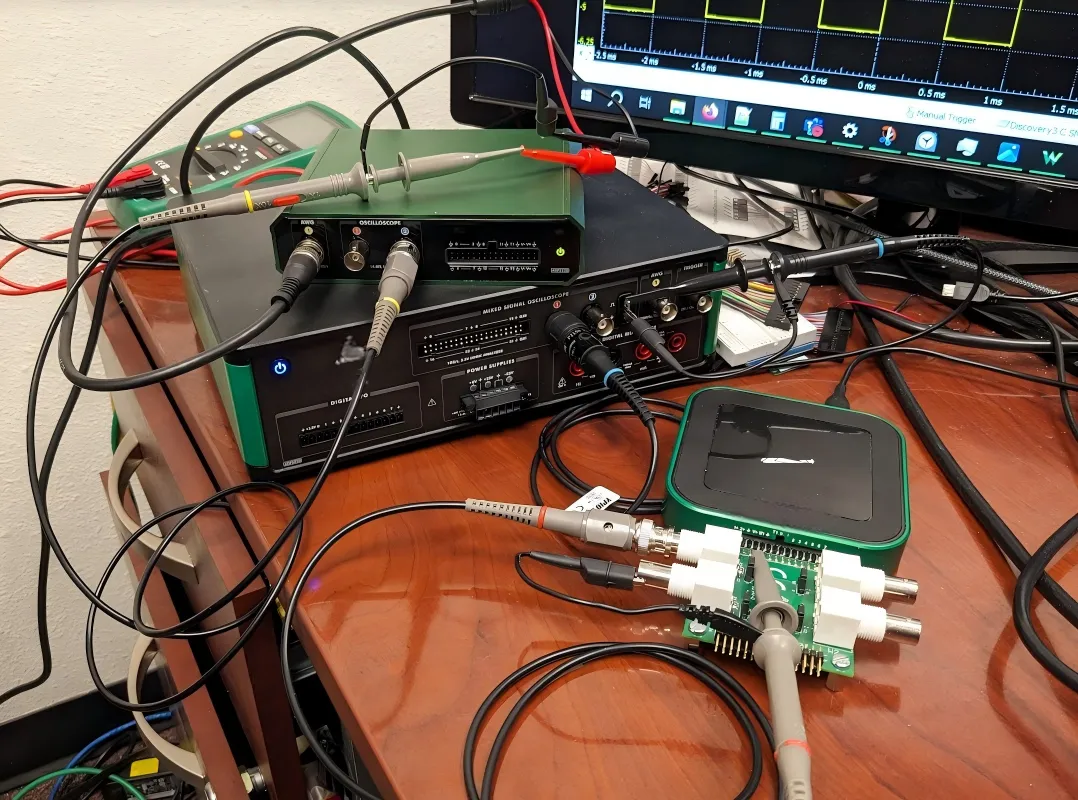
This figure shows a typical BNC to SMA adapter, a small passive component with a BNC connector on one end and an SMA connector on the other. It is used to connect test equipment with BNC ports (such as oscilloscopes or older spectrum analyzers) to devices with SMA connectors (such as compact radios or RF modules). Once installed, the adapter contributes insertion loss and impedance transitions that must be accounted for, especially at higher frequencies.
A bnc to sma adapter looks harmless. Two connectors, one transition, done. But in real RF environments—especially mixed benches where legacy BNC instruments meet modern SMA radios—that tiny piece of hardware becomes part of your signal chain. It affects impedance continuity, insertion loss, mechanical stress, and sometimes calibration repeatability.
Most problems don’t show up immediately. Early measurements look fine. The link “works.” Only later—at higher frequencies, during repeat testing, or after a few dozen mating cycles—does performance drift. When that happens, the adapter is rarely the first suspect.
It should be.
This guide is written for engineers and procurement teams who need to:
- Confirm the correct BNC/SMA gender combination
- Match 50Ω vs 75Ω impedance correctly
- Decide between a rigid adapter and a short cable
- Install without damaging SMA jacks
- Budget loss realistically before ordering
If your goal is to select once and avoid rework, read carefully.
Where does a BNC to SMA adapter belong in your RF setup?
Map BNC instruments to SMA radios and modules
Walk into almost any established RF lab and you’ll see the same pattern: oscilloscopes and older spectrum analyzers expose BNC ports. Many legacy fixtures do as well. Meanwhile, newer IoT radios, compact RF modules, and embedded wireless devices almost always use SMA.
That mismatch is where a bnc to sma adapter lives.
Typical transitions include:
- BNC instrument → SMA radio module
- BNC fixture → SMA panel connector
- BNC legacy system → SMA-based wireless node
The key point: this adapter isn’t “temporary.” Once inserted, it becomes part of the RF path just like a section of RF coaxial cable. Electrically, it behaves as a discontinuity that must be accounted for.
Keep impedance consistent across the chain (50Ω vs 75Ω)
Here’s a mistake that happens more often than people admit: assuming all BNC connectors are 50 ohm.
They aren’t.
BNC exists in two primary impedance variants:
- 50Ω — standard for most RF test and wireless systems
- 75Ω — common in video, SDI, and broadcast environments
If your system uses 50 ohm coaxial cable and you introduce a 75Ω BNC adapter, you’ve just created a mismatch. At low frequencies, you might get away with it. At 2.4 GHz or 5.8 GHz, the return loss degradation becomes measurable.
Before ordering any bnc to sma adapter, confirm:
- Instrument port impedance
- Cable impedance
- Device port impedance
If they’re not consistent, fix that first. Don’t troubleshoot phantom amplitude errors later.
For broader 50Ω planning strategies, see this breakdown of 50 ohm coaxial cable selection, especially if your RF chain extends beyond a short bench setup.
Separate rigid adapters from cable assemblies
A rigid adapter is not a flexible jumper. That distinction sounds obvious—but it’s often ignored.
Use a bnc to sma adapter when:
- Ports are directly aligned
- No lateral force is applied
- The setup is static
Switch to a bnc to sma cable (short jumper) when:
- Ports are offset
- Equipment moves frequently
- There is cable pull or vibration
A rigid adapter transfers torque directly into the SMA jack. A short RG316 cable segment absorbs stress.
If you need routing flexibility, a properly terminated RG316 coaxial cable assembly usually protects hardware better than a rigid transition.
In practice, most damaged SMA ports I’ve seen were not electrical failures. They were mechanical fatigue failures from unsupported adapters acting like levers.
Should you use an adapter or a BNC to SMA cable?
Choose an adapter when ports are aligned and strain-free
In fixed bench environments where:
- BNC output and SMA input face each other
- The distance is minimal
- The connection won’t be handled often
A rigid bnc to sma adapter is efficient and electrically clean. It avoids extra cable length and keeps insertion loss low.
For calibration fixtures or rack-mounted setups with precise alignment, this is often the correct choice.
Switch to a cable when offset, vibration, or frequent handling exists
Now imagine a different scenario:
- Equipment is moved in and out of racks
- The BNC instrument sits below the SMA radio
- Someone occasionally grabs the cable to reposition hardware
In this case, a rigid adapter becomes a stress concentrator.
A short bnc to sma cable—even 20–30 cm—relieves strain and prevents torque from reaching the SMA jack. When flexibility is required, many engineers default to RG316 cable because it balances flexibility with reasonable high-frequency performance.
If your setup resembles a production test station or mobile lab bench, choose flexibility over compactness.
Avoid stacking multiple adapters in one path
It’s surprisingly common to see:
BNC → SMA adapter → SMA barrel → right-angle adapter → device
Each interface adds:
- Insertion loss
- Potential impedance mismatch
- Mechanical instability
Even if each transition adds only ~0.15 dB, stacking three quickly approaches half a dB. That may not matter in a strong link. It absolutely matters in marginal systems.
If direction change is needed, choose the correct adapter geometry from the start. If offset is required, use a short cable instead of stacking.
How do you identify BNC and SMA genders correctly every time?
Confirm BNC plug vs jack and panel vs cable-end form
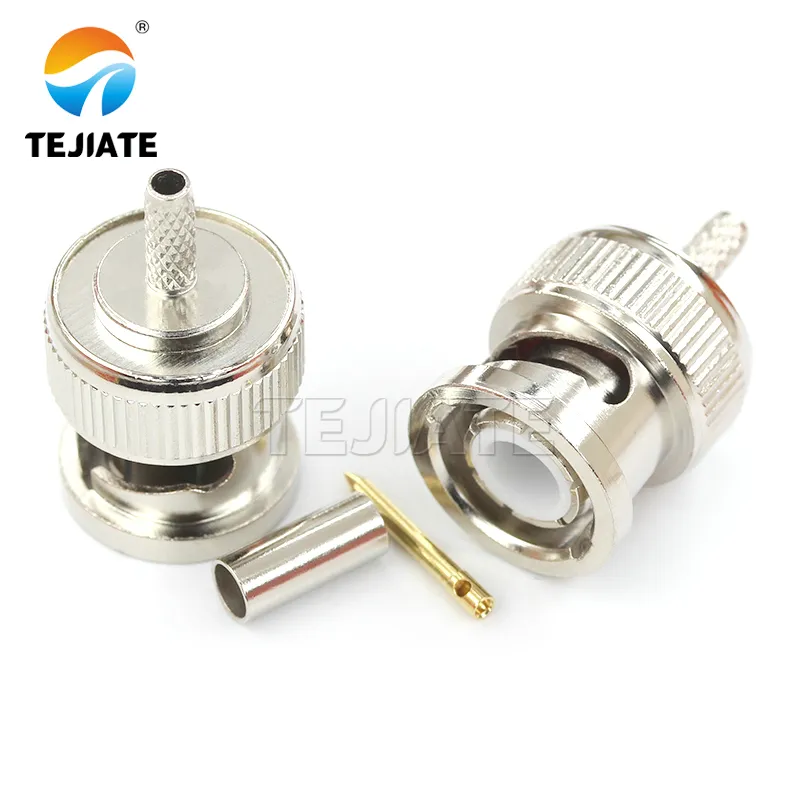
This image provides a detailed view of a BNC male connector (plug). It shows the two bayonet locking pins on the outer shell, which engage with slots on a female connector for a quick twist-lock mechanism. The center pin is clearly visible. This connector type is commonly found on cable ends and is used to connect to panel-mounted BNC jacks or instrument inputs.
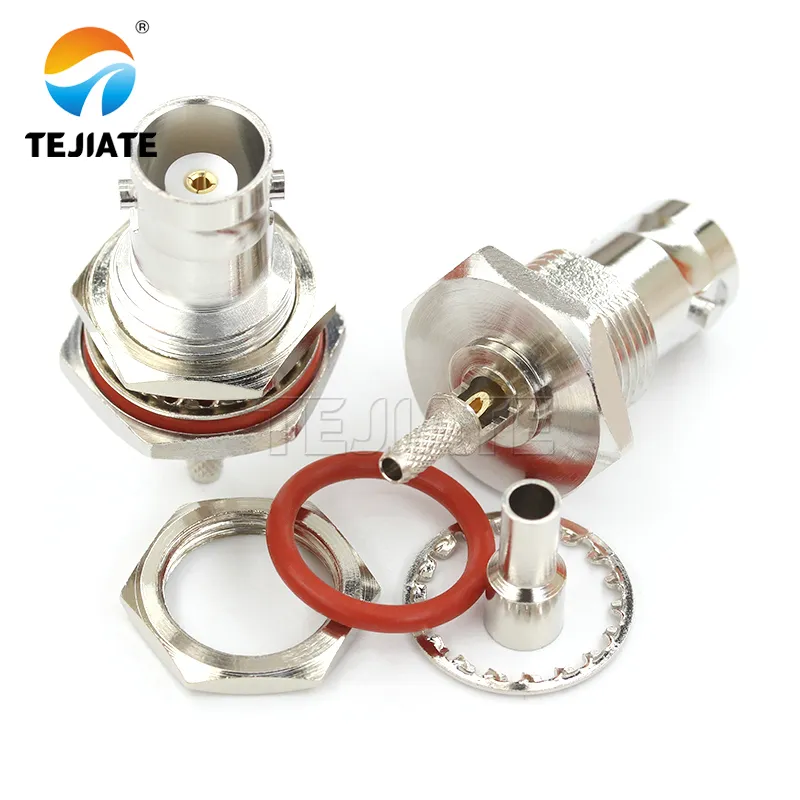
This image shows a BNC female connector (jack), typically found on instrument panels or as a bulkhead mount. It has a smooth outer shell with two slots that accept the bayonet pins of a male connector. The center socket receives the male's center pin. This configuration is common on spectrum analyzers, signal generators, and other test equipment where a secure, quick-disconnect interface is needed.
For BNC:
- Plug (male): bayonet locking pins
- Jack (female): smooth outer shell with slots
Then determine whether it’s:
- Panel mount (with mounting nut)
- Cable-end style
Visually confirm both the outer locking mechanism and the center conductor.
Don’t rely on part descriptions alone. Mislabeling happens.
Verify SMA thread + center pin/hole (and spot RP-SMA traps)
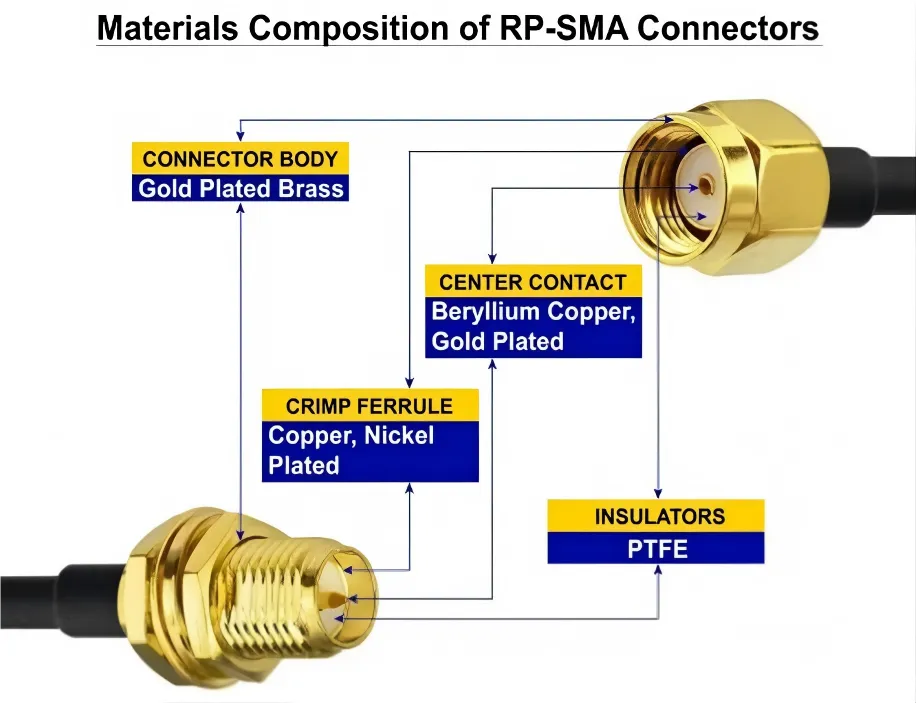
This figure illustrates the construction of RP-SMA connectors, comparing them to standard SMA. The key difference is the center conductor: a standard SMA male has a center pin, while RP-SMA male has a center socket (reversed). Similarly, standard SMA female has a center socket, while RP-SMA female has a center pin. This reversal, combined with the same thread geometry, often leads to ordering mistakes. The visual reference helps engineers and buyers distinguish between standard and reverse-polarity variants before procurement.
SMA identification requires two checks:
- Thread location (inside or outside)
- Center conductor (pin or socket)
Then there’s RP-SMA (reverse polarity), common in Wi-Fi gear. RP-SMA swaps the center conductor gender while keeping thread style similar.
That’s how you end up with connectors that “almost fit” but don’t make electrical contact.
Always verify:
- Thread type
- Center geometry
- Whether the device documentation explicitly states RP-SMA
When in doubt, physically inspect the device port.
Decide straight vs right-angle based on stress and clearance
Right-angle adapters aren’t cosmetic decisions. They’re mechanical solutions.
Choose based on:
- Clearance constraints
- Cable routing direction
- Reduction of bending stress
If space is tight, a right-angle adapter may prevent a sharp bend at the connector base. That alone can extend connector life significantly.
Which impedance and frequency specs should you require?
Match 50Ω adapters to 50Ω RF chains
If your RF chain uses 50 ohm coaxial cable, the adapter must also be 50Ω. That’s standard in wireless systems, test equipment, and most RF modules.
Check the frequency rating. A generic adapter may work fine at 500 MHz but degrade noticeably at 6 GHz.
For mixed test benches combining SMA radios and legacy instruments, planning your transitions alongside SMA adapter cable routing strategies often prevents unnecessary stacking or misalignment.
Treat 75Ω BNC parts as video tools, not RF defaults
75Ω BNC connectors are common in broadcast video chains. They are not the RF default.
If your system is truly 75Ω (for example, SDI video routing), then ensure both sides and all cables match 75Ω. If you’re crossing between 75Ω video and 50Ω RF systems, impedance matching networks may be required.
Never assume interchangeability.
What actually determines long-term reliability in a BNC to SMA adapter?
On paper, a bnc to sma adapter is rated for 50Ω, maybe a few GHz, and a certain number of mating cycles. In practice, reliability isn’t decided by the spec sheet alone. It’s decided by how the adapter is used.
Is it tightened once and left alone?
Is it supporting a hanging cable?
Is it part of a daily test setup that gets connected and disconnected fifty times a week?
Those conditions change everything.
Let’s break it down.
Plating and contact finish — not cosmetic details
Most standard adapters use:
- Brass body
- Nickel outer plating
- Gold-plated center contacts
That combination works well in controlled lab environments. Nickel provides mechanical durability. Gold reduces oxidation and keeps contact resistance stable.
Where it becomes critical is repeated mating.
Over time, contact surfaces wear. In a light-use bench environment, that may take years. In a production test rack, it can happen in months. As plating thins, repeatability degrades. Small changes in contact resistance aren’t dramatic—but they show up in sensitive measurements.
If your adapter is part of a calibration chain or frequently handled setup, don’t treat plating as a decorative feature. It’s part of the electrical interface.
For mechanical background on SMA threading and coupling design, the SMA connector overview on Wikipedia provides a concise explanation of the threaded interface and mating principles.
When the adapter becomes a lever arm
Here’s something you won’t see in most catalogs: adapters fail mechanically before they fail electrically.
Imagine this scenario:
- BNC instrument on a lower shelf
- SMA radio mounted above
- A rigid bnc to sma adapter connecting them
- A thick coax hanging off the side
That adapter is now a lever.
Every slight cable movement translates into bending force at the SMA jack. If that SMA jack is PCB-mounted, stress travels directly into solder joints. I’ve seen test modules with cracked solder pads—not because of RF overload, but because the adapter was treated like a structural bracket.
If cable weight exists, solve it mechanically. A short jumper made from RG316 coaxial cable absorbs motion before it reaches the connector.
Adapters are transitions. They are not load-bearing hardware.
Vendor tolerances — subtle but real
At lower frequencies, small dimensional differences between manufacturers rarely matter. Above a few GHz, they do.
Even if two vendors both claim 50Ω compliance, tolerances in:
- Dielectric centering
- Pin alignment
- Interface flatness
can influence return loss consistency.
If your work involves repeatable VNA measurements, mixing random adapters from multiple suppliers isn’t ideal. Consistency often matters more than nominal specification.
For most everyday RF bench work, this level of scrutiny isn’t necessary. For calibration chains, it absolutely is.
How should you install a BNC to SMA adapter without damaging equipment?
Connector damage usually happens during installation. Not during operation.
And most of the time, it’s preventable.
The two-wrench method — not optional
When tightening the SMA side of a bnc to sma adapter, torque must not transfer into the device jack.
The correct approach:
- Hold the SMA jack body steady
- Tighten the adapter nut separately
That isolates torque at the coupling interface instead of twisting the connector body.
If the SMA jack is mounted on a PCB, torque transfer can crack solder joints or lift pads. It might not fail immediately. It may fail months later after thermal cycling.
A few extra seconds during installation prevents that.
Over-tightening is as bad as under-tightening
SMA connectors are precision-threaded. They do not require brute force.
Excessive torque:
- Deforms threads
- Damages dielectric supports
- Changes contact geometry
On the other hand, insufficient tightening leads to micro-movement and unstable return loss.
Use appropriate torque tools when precision matters. For general lab use, controlled wrench-tightening—not “hand-tight and hope”—is the safe middle ground.
Protect the first bend radius
Even flexible rf coaxial cable has a minimum bend radius. The first centimeter near the connector is structurally sensitive.
Sharp bends right at the connector exit:
- Stress the crimp or solder joint
- Shift internal geometry
- Increase long-term failure risk
If routing requires a tight turn, choose a right-angle adapter or use a short flexible jumper instead of forcing the cable to bend immediately.
Mechanical discipline equals electrical stability.
How much loss does a BNC to SMA adapter actually add?
Short answer: it depends.
Longer answer: it’s small, but not zero—and it stacks.
Estimating adapter insertion loss
For planning purposes, many engineers assume:
0.1 to 0.3 dB per adapter transition
A conservative working value is 0.15 dB.
So if your path contains:
- BNC → SMA adapter
- SMA barrel
- Another SMA adapter
You may already have 0.45 dB of interface loss before counting cable.
In long cable runs, that’s minor. In short bench measurements or low-signal testing, it matters.
If you’re already budgeting cable loss carefully—especially in systems built around 50 ohm coaxial cable—don’t ignore transitions.
Interfaces are part of the RF chain.
When interfaces dominate over cable length
In compact setups, cable length might be 30 cm. At that distance, high-quality cable loss is minimal.
But if you’ve chained three adapters, the transitions may contribute more error than the cable itself.
This becomes increasingly relevant at:
- 2.4 GHz
- 5.8 GHz
- Upper microwave bands
Reflection sensitivity increases with frequency. Minor discontinuities grow more visible.
If you need to improve measurement stability, reduce adapter count before changing cable type.
Why a short RG316 jumper can improve consistency
Replacing stacked rigid transitions with a single short RG316 cable assembly often improves both mechanical and electrical behavior.
It seems counterintuitive—adding cable to improve performance—but fewer discontinuities mean fewer reflection points.
One clean BNC-to-SMA cable assembly is often better than:
Adapter → barrel → angle → device.
Especially in mixed-interface benches where mechanical alignment isn’t perfect.
A practical decision matrix for selection and verification
Before ordering, write it down. Literally.
Below is a simplified engineering matrix you can implement in Excel or procurement workflows.
BNC to SMA Adapter Planning Matrix
| Parameter | Example Value | Calculation / Rule |
|---|---|---|
| Use Case | RF bench test | Informational |
| BNC Side | Plug, 50Ω | Must match instrument |
| SMA Side | Male | Verify thread + center |
| System Impedance | 50Ω | Must match entire chain |
| Frequency (GHz) | 2.4 | Confirm rating |
| Adapter Count | 2 | Input |
| Adapter Loss (dB) | 0.30 | = Count × 0.15 |
| Cable Type | RG316 | Optional |
| Cable Length (m) | 0.5 | Input |
| Cable Loss (dB/m) | 0.5 | From datasheet |
| Cable Loss (dB) | 0.25 | Length × loss/m |
| Total Loss (dB) | 0.55 | Adapter + Cable |
| Allowed Loss (dB) | 1.0 | Design limit |
| Margin (dB) | 0.45 | Allowed − Total |
| Precision Required | General | Or Calibration |
| Result | PASS | Impedance match + Margin ≥ 0 |
The matrix forces clarity. It also exposes mistakes before hardware arrives.
Procurement teams appreciate structured inputs. Engineers appreciate avoiding rework.
Market shifts that keep BNC-to-SMA transitions relevant
RF interconnect demand continues expanding
5G infrastructure, aerospace systems, satellite communication, and IoT test platforms continue driving RF interconnect demand. Smaller radios favor SMA for space efficiency. Many installed instruments still rely on BNC.
Mixed ecosystems are not temporary.
Industry publications such as Microwave Journal regularly cover interconnect market growth and evolving connector requirements in microwave systems.
Adapters exist because ecosystems evolve at different speeds.
Material compliance and dielectric changes
Some manufacturers are introducing PFAS-free alternatives to traditional PTFE dielectric materials in SMA connectors and adapters.
That shift may influence:
- Thermal stability
- Dielectric constant consistency
- Regulatory documentation requirements
For most bench work, this won’t change daily practice. For regulated industries, it may influence sourcing decisions.
Mixed-interface benches are the norm now
Modern IoT radios, embedded modules, and compact wireless devices expose SMA ports by default.
Legacy oscilloscopes, generators, and many production fixtures still use BNC.
That means the bnc to sma adapter remains a permanent part of RF workflows—not a temporary patch.
The key question isn’t whether to use one. It’s whether you’re using the right one.
When do you need a precision BNC to SMA adapter instead of a general one?
Not every bnc to sma adapter needs to be metrology-grade. But sometimes it absolutely does.
The difference isn’t cosmetic. It’s about repeatability and specification discipline.
General-purpose adapters — good for everyday RF work
For most lab benches, field setups, and integration tasks, a standard 50Ω adapter is sufficient if:
- Frequency range is within rating
- Return loss specification is acceptable
- Mechanical tolerances are consistent
In wireless module bring-up, antenna testing, or signal generator connections, general adapters perform reliably when installed correctly and not overstressed.
If your setup already uses well-matched 50 ohm coaxial cable and you’re operating in typical ISM bands (2.4 GHz, 5.8 GHz), a high-quality commercial adapter usually meets requirements.
Overengineering isn’t necessary for every bench.
Precision adapters — when calibration and repeatability matter
The situation changes in:
- VNA calibration chains
- Reference measurement paths
- Low-signal verification
- Compliance testing
Precision adapters typically provide:
- Tighter return loss specs
- Better centering tolerances
- Documented repeatability over mating cycles
In these environments, adapter behavior must be predictable. A 0.2 dB shift between repeated connections can invalidate comparison data.
If the adapter sits between a calibrated instrument and your DUT, treat it as part of the measurement system—not as a convenience accessory.
The hidden cost of “good enough”
Using a general adapter in a precision chain doesn’t always fail dramatically. It often introduces subtle variability.
You’ll see:
- Slight amplitude drift
- Return loss variation
- Inconsistent repeated readings
Engineers sometimes compensate in software. That’s rarely the correct solution.
If the transition is part of the calibrated path, specify it accordingly.
How many adapters are too many?
There’s no universal number—but there are practical limits.
In general:
- One transition: normal
- Two transitions: acceptable
- Three or more: redesign recommended
Every interface adds:
- ~0.1–0.3 dB insertion loss
- Potential reflection
- Mechanical complexity
If your system already contains a bnc to sma adapter, avoid stacking additional unnecessary transitions.
When routing requires flexibility, replace stacks with a short RG316 coaxial cable jumper instead.
Cleaner paths produce more stable results.
Common questions engineers ask about BNC to SMA adapters
When should I use a bnc to sma adapter instead of a bnc to sma cable?
Use an adapter when:
- Ports align directly
- No strain is present
- The setup is static
Use a cable when:
- Ports are offset
- Equipment moves
- There’s cable pull risk
Adapters are compact. Cables are protective.
How do I confirm whether my BNC port is 50Ω or 75Ω?
Start with the equipment manual. Many RF instruments explicitly state port impedance.
If documentation is unclear:
- Check manufacturer specifications
- Look for labeling near the connector
- Confirm system cable impedance
If the chain is built around 50 ohm coaxial cable, assume 50Ω unless proven otherwise.
Will a bnc to sma adapter affect performance at 2.4 GHz or 5.8 GHz?
Yes—but typically modestly.
At these frequencies:
- Each interface adds measurable insertion loss
- Reflection sensitivity increases
In short cable runs, interface loss can dominate.
If measurement stability matters, minimize transition count and use quality components.
Can I use a bnc to sma adapter in calibration work?
Only if it is specified for precision use.
Calibration-grade environments require:
- Documented return loss
- Repeatable mating characteristics
- Tight mechanical tolerances
General adapters are fine for development. Calibration requires stricter control.
What installation mistake most often damages SMA connectors?
Two common causes:
- Transferring torque into the device jack
- Letting a rigid adapter support cable weight
Use the two-wrench method. Add strain relief when needed.
Connector damage is almost always mechanical, not electrical.
Final perspective: treat the adapter as part of the RF system
A bnc to sma adapter is easy to overlook because it’s small.
But it sits directly in your signal path.
It affects:
- Impedance continuity
- Measurement repeatability
- Mechanical reliability
- Long-term connector life
Select carefully. Install correctly. Minimize transitions. Support mechanically.
Do that, and the adapter becomes electrically invisible—which is exactly what you want in a well-designed RF system.
Bonfon Office Building, Longgang District, Shenzhen City, Guangdong Province, China

A China-based OEM/ODM RF communications supplier
Table of Contents
Owning your OEM/ODM/Private Label for Electronic Devices andComponents is now easier than ever.