
50 Ohm Coaxial Cable Selection and Application Guide
Feb 26,2026
This figure illustrates a basic RF system where a 50 ohm coaxial cable connects an RF module (radio) to an antenna. It emphasizes that the cable is not a neutral accessory; it contributes to insertion loss, impedance continuity, and long-term stability. Early design stages often overlook these effects, leading to later margin erosion.
In RF systems, cables are almost never the first suspect. When performance slips, engineers usually look at radios, antennas, firmware timing, or calibration data. The 50 ohm coaxial cable sitting between them tends to be treated as passive background hardware—assumed correct as long as continuity exists.
That assumption holds during early bring-up. It starts to break later.
Once systems leave the bench and enter enclosures, vehicles, rooftops, or racks, the coax becomes part of the RF network in a very real way. Loss accumulates. Impedance discontinuities show up as drift rather than failure. Measurements become sensitive to handling. None of this feels dramatic, which is exactly why cable decisions deserve more attention than they usually get.
This guide treats the 50 ohm coaxial cable as an intentional design element. We’ll place it in the RF architecture, clarify where 50 Ω is mandatory, and show how experienced teams plan cable selection, routing, and budgeting so procurement decisions don’t quietly erode link margin.
Position 50 ohm coaxial cable in your RF architecture
Map 50 Ω paths from radio front-ends to antennas and test gear
This block diagram details the typical chain from an RF IC or module, through PCB transmission line (microstrip/stripline), a short coaxial cable or pigtail, a bulkhead or panel connector, and finally to an antenna or test instrument. It highlights that every transition contributes to loss and potential impedance mismatch, and that planning the entire 50 ohm path early prevents late-stage surprises
Every RF system has an end-to-end signal path, whether or not it’s drawn explicitly. A common chain looks like this:
- RF IC or module
- PCB transmission line (microstrip or stripline)
- Short rf coaxial cable or pigtail
- Bulkhead or panel connector
- Longer feeder or rack interconnect
- Antenna or test instrument
Once the signal leaves the PCB, the coax is no longer “just a cable.” It becomes part of the RF path, shaping insertion loss, impedance continuity, and long-term stability. Treating that section as an afterthought is how late-stage surprises are born.
Experienced teams sketch the entire 50 Ω path early, even with rough lengths. That simple exercise often reveals unnecessary adapters, awkward bend points, or connector mismatches before they show up in procurement quotes or field failures.
If you need a broader structural refresher on how coax fits into RF systems overall, the overview in Coaxial Cable Ultimate Guide pairs well with the more 50-Ω-specific focus here.
Separate 50 ohm coaxial cable from 75 Ω video and CATV runs
Not all coaxial cables are interchangeable. RF systems overwhelmingly use 50 Ω. Video and CATV systems typically use 75 Ω. They may look similar, but electrically they behave very differently.
A 75 Ω section inserted into a 50 Ω RF chain rarely causes an immediate failure. Signals still pass. The problem is subtler: reflections, phase error, unstable VSWR, and measurements that change with frequency or temperature. These are the kinds of issues that escape early testing and surface only after deployment.
In mixed environments—labs, factories, broadcast facilities—explicitly separating and labeling 50 Ω RF lines from 75 Ω video runs prevents accidental substitutions during maintenance or troubleshooting. Many “mystery” RF problems trace back to this exact mix-up.
Relate 50 ohm coaxial cable to RG and LMR cable families
The 50 Ω standard spans multiple cable families rather than a single product type. Traditional RG cables (RG58, rg316 coaxial cable, RG213) coexist with lower-loss LMR variants (LMR-240, LMR-400). All target the same impedance, but differ in diameter, attenuation, flexibility, and power handling.
Instead of asking “RG or LMR,” experienced engineers start with constraints:
- How much loss can the link tolerate?
- How much space is available for routing?
- Will the cable see heat, vibration, or repeated handling?
Once those boundaries are clear, the appropriate 50 Ω family usually becomes obvious. For a deeper comparison of common RG families and where each fits, the reference guide on RG Cable Guide (2025) provides useful context without locking you into a single choice.
Decide where 50 ohm coaxial cable is non-negotiable
Keep 50 Ω impedance from the RF port all the way to the antenna
In transmit paths, impedance continuity is not optional. Any mismatch between the RF port and the antenna reflects power back toward the source. That reflected energy reduces effective radiated power and raises VSWR, sometimes enough to stress the transmitter.
Receive paths fail more quietly, but the effect is real. Noise figure degrades. Gain becomes unstable. Sensitivity varies with cable movement or connector aging.
In systems where link margin is tight—and most real systems are—maintaining 50 ohm coaxial cable and matched connectors from end to end removes an entire class of avoidable uncertainty.
Avoid mixing 50 ohm coaxial cable with 75 Ω or uncharacterized lines
Mixing impedances introduces reflection coefficients that don’t scale cleanly with length or frequency. A short 75 Ω segment might look harmless at VHF and become a serious problem at 5.8 GHz.
That unpredictability is the real risk. Engineers can budget known loss. They cannot easily budget unknown reflections that depend on phase, frequency, and connector quality.
If a section of cable cannot be positively identified as 50 Ω, it does not belong in a 50 Ω RF path.
Use 50 Ω coax as the default for RF coaxial cable assemblies
Across wireless infrastructure, IoT devices, lab instrumentation, defense hardware, and industrial RF systems, 50 Ω remains the default impedance for rf coaxial cable assemblies. This consistency simplifies sourcing, test procedures, and interchangeability.
It also explains why most RF connector families—SMA, N, TNC, MMCX—are primarily designed around 50 Ω variants, with 75 Ω versions reserved for specialized video or broadcast applications.
Choose between RG316 and other 50 Ω coaxial families
Compare RG316 coaxial cable with RG58 and LMR-240 in tight spaces
Cable choice often becomes a mechanical decision before it becomes an RF one. Diameter, flexibility, and routing freedom matter as much as attenuation.
RG316 coaxial cable stands out in compact environments. Its small outer diameter and PTFE dielectric allow it to snake through dense enclosures, tolerate higher temperatures, and survive repeated handling. By comparison, RG58 offers lower loss but quickly becomes bulky in tight layouts. LMR-240 improves attenuation further, but at the cost of stiffness.
In practice, engineers often mix these families rather than choosing one exclusively. Thin cables handle internal routing; thicker cables take over once distance and loss dominate.
Treat RG316 cable as your baseline 50 Ω pigtail and jumper
In many designs, rg316 cable becomes the default internal jumper. It’s thin enough for crowded layouts, stable across wide temperature ranges, and predictable enough for test setups that get reconfigured daily.
You’ll see it used between board-level micro ports and panel connectors, inside automotive control units, and in industrial enclosures where service access is limited. It’s rarely the lowest-loss option, but it is often the most forgiving—and forgiveness matters in real hardware.
For engineers evaluating RG316 in sourcing or OEM contexts, the detailed discussion in the RG316 coaxial cable OEM sourcing guide expands on construction, loss behavior, and common pitfalls.
Step up to larger 50 Ω cables when loss or power handling demand it
There’s a point where flexibility stops mattering and physics takes over. As frequency rises, distance increases, or transmit power climbs, thin coax simply runs out of margin.
This is where larger 50 Ω families—RG213, LMR-400, even LMR-600—become the correct tool. Their thicker conductors and improved shielding dramatically reduce attenuation and raise power-handling capability. The trade-off is obvious: size, weight, and routing difficulty.
A common and effective pattern is hybridization. Use rg316 cable or similar thin coax inside the enclosure, then transition at a bulkhead to a heavier outdoor feeder. This keeps internal layouts clean while protecting link budget where it matters most.
If you want a scenario-driven comparison across RG and LMR families, the breakdown in Best Coaxial Cables: RG & LMR Selection Guide (internal) complements this 50 Ω–focused discussion without duplicating it.
Plan loss and length limits for 50 ohm coaxial cable runs
Estimate attenuation for short and medium 50 Ω runs at key bands
Loss planning doesn’t require lab-grade precision to be useful. For early design decisions, approximate values are often enough to flag risk.
Below is a planning-level comparison for common 50 Ω cables. These are not datasheet guarantees; they reflect typical real-world assemblies.
| Frequency Band | RG316 (dB/m) | RG58 (dB/m) | LMR-400 (dB/m) |
|---|---|---|---|
| 144 MHz | ~0.4 | ~0.2 | ~0.05 |
| 433 MHz | ~0.8 | ~0.4 | ~0.1 |
| 900 MHz | ~1.3 | ~0.7 | ~0.2 |
| 2.4 GHz | ~2.5 | ~1.3 | ~0.4 |
| 5.8 GHz | ~4.5 | ~2.4 | ~0.7 |
Two practical observations tend to surprise newer engineers. First, short cables still matter at higher frequencies. Second, connector losses can rival cable losses surprisingly quickly.
For impedance fundamentals and why these losses behave the way they do, the explanation in Coaxial cable provides useful background without diving into vendor-specific claims.
Include connectors, SMA adapter cables and pigtails in your RF budget
Cable loss is only part of the story. Every transition adds uncertainty.
A conservative engineering rule that holds up well in practice is 0.1–0.3 dB per interface. That includes straight connectors, right-angle launches, bulkheads, short jumpers, and any sma adapter cable in the chain.
Micro-to-panel transitions deserve special attention. A mmcx to sma cable may be only 10–15 cm long, but it introduces two connectors and a short coax section. In dense systems, those small losses stack up faster than expected.
Ignoring connectors is how link budgets look fine on paper and fail quietly in the field.
Define practical length ranges for indoor jumpers and outdoor feeders
Rather than absolute limits, experienced teams work with practical ranges:
- Indoor jumpers
- RG316: typically ≤ 1 m
- RG58: roughly 5–10 m
- Outdoor or rack feeders
- LMR-400: often 30–50 m at GHz bands
Beyond these ranges, you’re not “wrong,” but you are committing to tighter margins and more careful validation. At that point, architectural changes—moving radios closer to antennas, adding active elements, or upgrading cable families—are usually worth revisiting.
Route 50 ohm coaxial cable cleanly inside enclosures and racks
Respect bend radius and stress limits for RG316 and larger cables
Most coax failures don’t happen in the middle of a run. They happen near the connector.
Every cable specifies a minimum bend radius, but real-world reliability improves when you stay well above that number. Tight bends compress the dielectric, shift impedance, and accelerate fatigue—especially near crimped or soldered terminations.
With rg316 coaxial cable, the temptation to over-bend is strong because it feels flexible. That flexibility hides damage until performance drifts months later.
Separate 50 Ω runs from power, digital noise and moving assemblies
Good RF routing looks boring. That’s intentional.
Keep 50 ohm coaxial cable away from AC mains, motor drives, and high-current switching paths whenever possible. Even well-shielded coax can pick up conducted noise when pressed against aggressive sources for long distances.
In moving assemblies—hinged covers, sliding racks, service loops—leave slack. A cable that moves gently will outlast one that is perfectly straight and under tension.
Use bulkhead transitions so cables don’t carry enclosure loads
Bulkhead connectors exist to protect cables, not complicate them. They transfer mechanical load to the enclosure and isolate internal wiring from external stress.
In vehicle, outdoor, and industrial systems, this single design choice often determines whether a coax lasts months or years. It also simplifies service: replace the external feeder without disturbing internal routing.
Integrate 50 ohm coaxial cable with adapter and pigtail strategies
Connect miniature ports using MMCX to SMA cable and similar pigtails
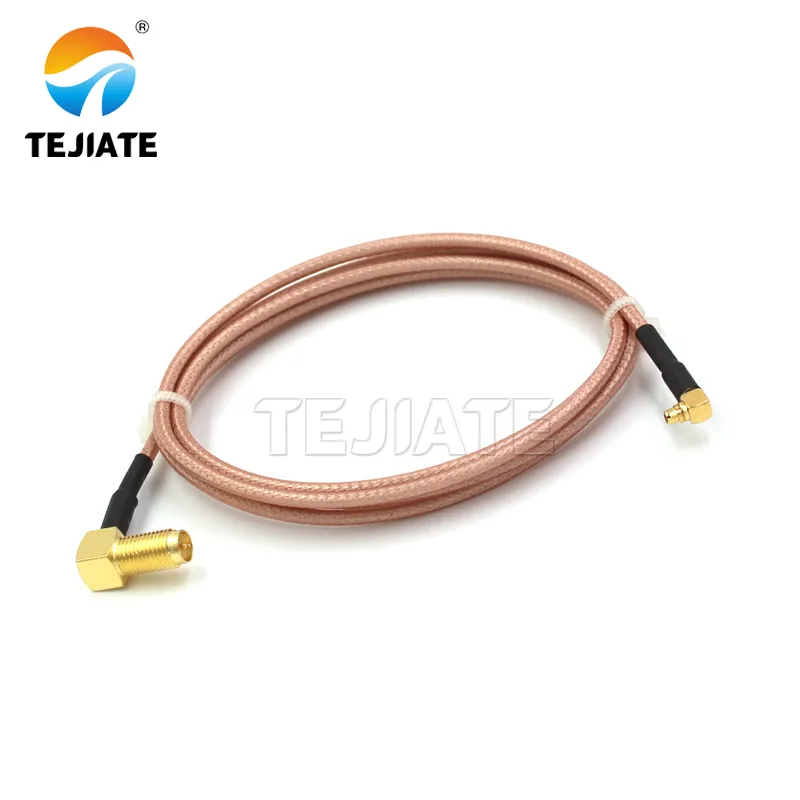
This image shows a pre-terminated MMCX to SMA cable assembly, typically built with RG316 coaxial cable. It is used to connect RF modules with miniature MMCX ports to SMA bulkheads on enclosures, protecting the module from mechanical stress. Such pigtails are common in GNSS, LTE, and Wi-Fi devices where space is limited but external antenna connections are required.
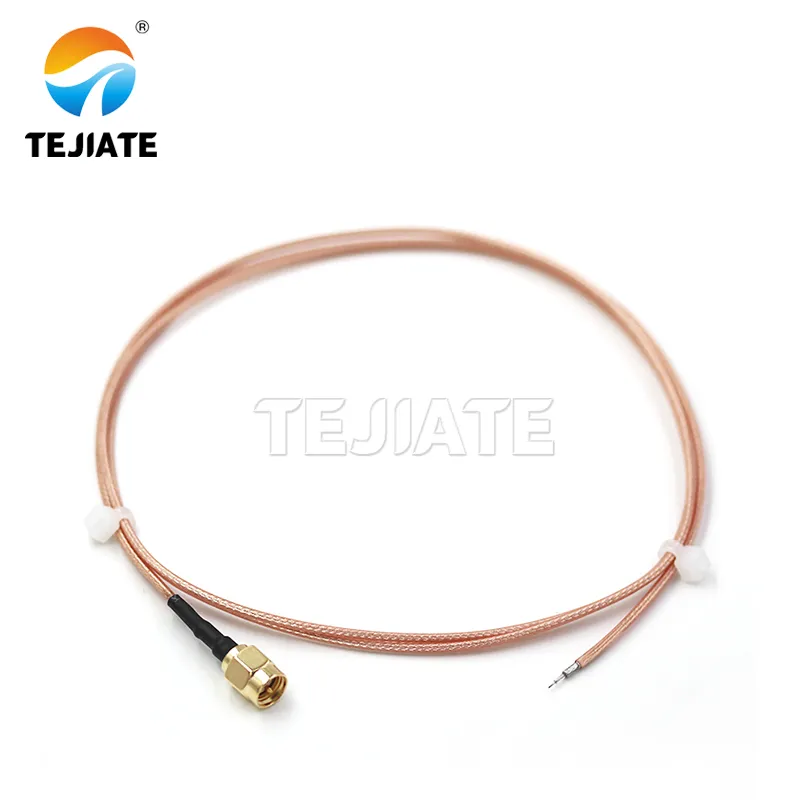
This photograph depicts a typical SMA to SMA flexible cable assembly, likely using RG316 or RG58 coaxial cable. It has SMA plugs on both ends and is used as a jumper between RF modules, antennas, or test equipment. Such assemblies provide a reliable 50 ohm connection and are available in various lengths and connector configurations (male/female, right-angle).
Modern RF modules favor compact connectors. They save space, but they are not designed for repeated mechanical stress.
The usual solution is a short mmcx to sma cable (or U.FL equivalent) that transitions from the board to a panel-mounted SMA. This approach protects the PCB, simplifies enclosure design, and keeps the rest of the system in standard 50 Ω territory.
For a connector-focused discussion of these transitions, the internal MMCX to SMA cable routing guide expands on mechanical strain, mating cycles, and RF consistency.
Use SMA adapter cable to bridge between connector families
Rigid adapters look clean in CAD. In hardware, they often cause trouble.
A short sma adapter cable provides mechanical forgiveness. It absorbs misalignment, reduces torque on connectors, and makes servicing easier—especially in test setups or mixed-legacy systems where SMA must interface with BNC, N, or TNC.
For deeper connector-level tradeoffs, the internal SMA adapter cable selection and routing guide fits naturally here.
Minimize adapter count while maintaining mechanical flexibility
The goal isn’t zero adapters. It’s controlled adapters.
Too many transitions add loss and variability. Too few can overload connectors and complicate maintenance. Good RF layouts strike a balance: minimal electrical discontinuities, with just enough flexibility to survive real handling.
Build a 50 ohm coaxial cable planning matrix
Define the key fields and formulas for your 50 Ω planning sheet
Experienced RF teams rarely rely on intuition alone. They externalize decisions into simple planning tools that make trade-offs visible. A 50 Ω coaxial cable planning matrix is one of the most practical examples.
Below is a field set that works equally well in Excel, Google Sheets, or internal tooling. None of it is theoretical—it reflects how RF paths are evaluated in real projects.
| Field | Description |
|---|---|
| Project_name | Program or product identifier |
| Application_type | IoT node / Vehicle / Base station / Lab test / Rack |
| Band_low_GHz | Lowest operating frequency |
| Band_high_GHz | Highest operating frequency |
| Max_run_length_m | Maximum expected single run |
| Cable_family | RG316 / RG58 / RG213 / LMR-240 / LMR-400 |
| Cable_loss_dB_per_m | Estimated loss at target band |
| Planned_length_m | Actual planned length |
| Cable_loss_dB | Cable_loss_dB_per_m × Planned_length_m |
| Connector_count | All connectors and adapters |
| Connector_loss_dB | Connector_count × 0.15 (adjustable) |
| Total_path_loss_dB | Cable_loss_dB + Connector_loss_dB |
| Allowed_path_loss_dB | From link budget |
| Margin_dB | Allowed − Total |
| Impedance_scheme | Strict 50 Ω / Mixed |
| Min_bend_radius_mm | Cable specification |
| Planned_min_bend_mm | Layout reality |
| Bend_margin_mm | Planned − Minimum |
| Environment | Indoor / Outdoor / Automotive / Industrial |
| Serviceability_score | 1–5 |
| Cost_score | 1–5 |
| Overall_score | Weighted result |
Run the matrix for a rooftop Wi-Fi or small-cell example
Consider a rooftop access point. Inside the enclosure, a short rg316 cable connects the radio module to a panel-mounted SMA. Outside, an LMR-400 feeder runs to the antenna. One sma adapter cable bridges a legacy connector at the rack.
When you run this configuration through the matrix, a few things usually stand out immediately:
- Connector losses rival cable losses faster than expected
- Bend margin inside the enclosure is often tighter than planned
- The weakest margin isn’t where engineers initially assumed
Catching these issues early is far cheaper than discovering them during field deployment.
Reuse the matrix as an acceptance checklist for OEM cable assemblies
Once the matrix exists, it naturally becomes an acceptance checklist. Supplier samples can be checked against planned length, loss budget, bend compliance, and connector count before volume orders are placed.
That single habit eliminates an entire class of “the cable looked fine” postmortems.
Track 50 ohm coaxial cable trends in RF and broadband markets
This photograph shows a contemporary 50 ohm coaxial cable assembly, likely using a low-loss flexible cable such as RG316 or LMR-100. The connectors are precision SMA plugs, and the cable features a durable jacket and tight braid shielding. Such assemblies are widely used in modern RF equipment, including 5G small cells, IoT gateways, and portable test setups, where space constraints and reliability are critical. The image reflects the market trend toward higher-performance, mechanically robust interconnect solutions that maintain 50 ohm integrity across the signal path.
Follow global coaxial cable market growth through 2030
Despite the growth of fiber in long-haul networks, coaxial cable demand continues to rise in RF and broadband edge applications. Market research from multiple independent firms shows steady growth driven by wireless infrastructure, industrial RF systems, and test equipment.
Most forecasts place the global coaxial cable market in the tens of billions of USD, with mid-single-digit to high-single-digit CAGR through 2030. The key driver isn’t raw bandwidth—it’s reliability, power handling, and compatibility with existing RF ecosystems.
For a neutral, non-commercial overview of where coax still fits relative to other transmission media, the background section in Coaxial cable remains a useful baseline reference.
Connect 50 Ω RF coaxial cable to RF interconnect expansion
Zooming out further, the RF interconnect market—including connectors, adapters, and cable assemblies—is expanding even faster. Higher operating frequencies, denser packaging, and modular radio architectures all increase demand for consistent 50 ohm coaxial cable assemblies.
This trend shows up clearly in defense, automotive radar, private 5G, and industrial IoT deployments, where reliability under harsh conditions matters more than raw throughput.
Watch innovations in flexible, miniaturized and rugged RF assemblies
Where the market is moving is just as important as where it is today. Thinner, more flexible, and more environmentally robust 50 Ω assemblies are increasingly favored.
Smaller connectors, tighter bend tolerance, and better shielding are no longer niche requirements—they’re baseline expectations in many programs.
Answer 50 ohm coaxial cable design and usage questions
Why do so many RF designs standardize on 50 ohm coaxial cable instead of 75 Ω?
How far can I run 50 ohm coaxial cable before loss becomes a real issue?
When should I choose RG316 coaxial cable instead of RG58 or LMR-240?
Can a single 50 ohm coaxial cable feed more than one antenna or radio?
How many adapters and jumpers are acceptable in one 50 Ω signal path?
What are the signs that a 50 ohm coaxial cable needs inspection or replacement?
Closing perspective
A 50 ohm coaxial cable rarely breaks a system outright. Instead, it quietly shapes margins, stability, and repeatability over time. That subtlety is why cable decisions deserve the same discipline as radios and antennas.
When 50 Ω paths are planned explicitly, losses budgeted honestly, and routing treated as a mechanical as well as electrical problem, RF systems age gracefully. When they’re not, engineers end up chasing ghosts.
Design the cable path once. Validate it early. Let procurement follow engineering—not the other way around.
Bonfon Office Building, Longgang District, Shenzhen City, Guangdong Province, China

A China-based OEM/ODM RF communications supplier
Table of Contents
Owning your OEM/ODM/Private Label for Electronic Devices andComponents is now easier than ever.