
50 Ohm Coaxial Cable Selection Guide
Mar 18,2026
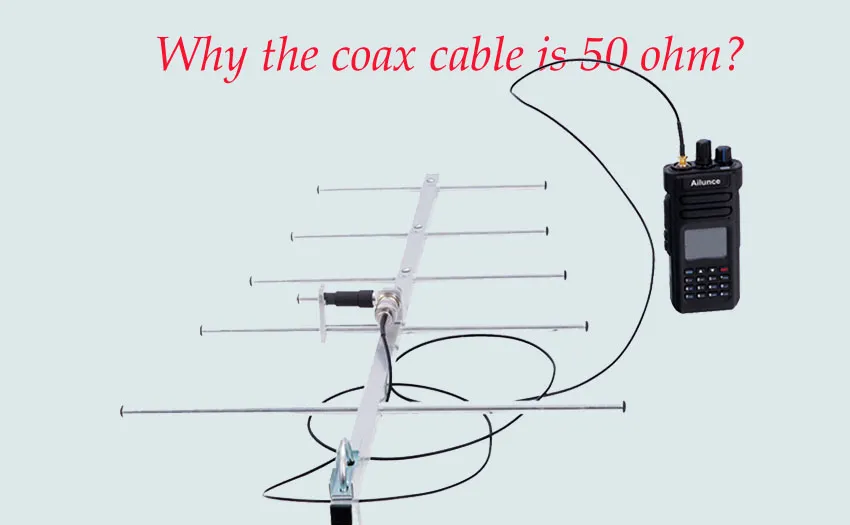
This figure illustrates the foundational concept of 50-ohm impedance in RF systems. It likely shows a simple signal chain with a radio module, a coaxial cable, and an antenna, emphasizing that all components must operate within the same 50-ohm environment. The image reinforces that when impedance remains constant throughout the path, the cable becomes electrically transparent; when mismatched, reflections and loss occur. This understanding is critical for designing stable RF links.
Why does 50 ohm coaxial cable dominate RF system design?
The problem usually doesn’t appear during the first test.
A radio module sits on the bench. Someone connects it to an antenna through a short coax jumper. The signal shows up on the analyzer and the system seems healthy. Nothing looks suspicious.
Later, the same setup moves inside a product enclosure. The antenna is mounted on the panel. The cable path becomes longer, the routing tighter, and the RF path now includes connectors, bulkheads, and sometimes adapters.
Measurements start drifting slightly. Return loss looks worse than expected. Sometimes the link margin drops a little compared to the original lab test.
At that point the investigation often focuses on antennas, firmware timing, or environmental noise. The cable between components rarely gets attention first.
Yet the entire RF signal path assumes one electrical condition: 50 ohms from source to load.
Once that assumption breaks, the cable stops behaving like an invisible link. It becomes an electrical element in the system.
That is why 50 ohm coaxial cable dominates RF hardware. It is the impedance standard that most radios, antennas, instruments, and connectors are designed around.
Not because it is mathematically perfect. Because the entire RF ecosystem adopted it decades ago and built everything around it.
Place 50-ohm cable between radios, instruments, and antennas
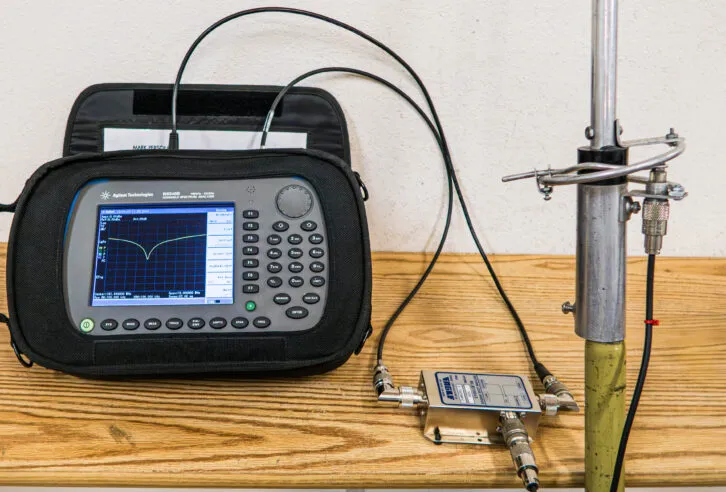
This figure depicts a typical RF signal chain: a radio module connected via a 50-ohm coaxial cable to an antenna. It emphasizes that the cable is not just a passive connector but an integral part of the transmission line. For the system to behave as designed, every segment—including connectors and adapters—must maintain the same 50-ohm impedance. This visual reinforces the importance of impedance continuity in RF design.
Look at typical RF hardware and the pattern becomes obvious.
Signal generators output into a 50-ohm environment. Spectrum analyzers expect a 50-ohm input. RF modules inside wireless devices expose ports designed for the same impedance.
Between those ports sits a coaxial cable.
Sometimes it is only 10 or 20 centimeters long. In other systems it may run across a rack or through an enclosure wall. But electrically the expectation stays the same: the cable should behave like a continuation of the transmission line.
That expectation only works if impedance remains constant.
Once impedance changes along the path, reflections appear. A portion of the RF energy travels back toward the source instead of forward toward the antenna or instrument. At lower frequencies the effect may be small enough to ignore. At microwave frequencies it becomes obvious.
Engineers therefore build the signal chain as a continuous 50-ohm environment.
Radio → coax cable → connector → antenna.
Every component participates in that same impedance system.
When the cable matches the rest of the chain, it disappears electrically. When it doesn’t, the cable becomes part of the problem.
Separate 50-ohm RF practice from 75-ohm video practice
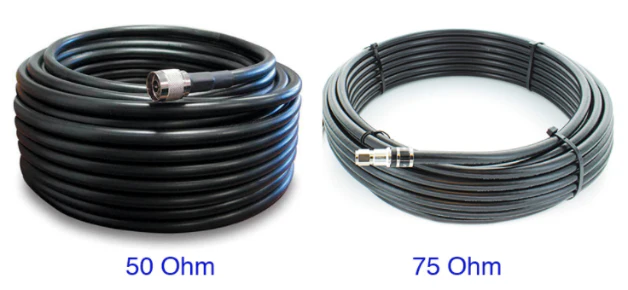
This image provides a visual comparison between 50-ohm and 75-ohm coaxial cables and connectors (likely BNC). While mechanically similar, the internal dimensions and dielectric materials differ to achieve the required characteristic impedance. The 50-ohm version is standard for RF communication and test equipment, while the 75-ohm version is common in video and broadcast systems. The figure helps engineers recognize that impedance consistency must be maintained throughout the signal path to avoid mismatch and signal degradation.
The confusing part is that coaxial cable does not belong to a single standard.
Broadcast and television infrastructure developed around 75-ohm coaxial cable instead. RG6 and RG59 are common examples used in video distribution and cable television networks.
Those cables can look very similar to RF cables. The connectors may even appear identical at first glance.
But the electrical priorities are different.
Video distribution systems needed low attenuation over long distances. RF transmission systems needed a compromise between power handling and impedance stability. Those different priorities led to two different impedance standards.
Because the connectors sometimes resemble each other, the mistake happens easily.
A technician may grab a cable from a video rack and connect it to an RF instrument. The connectors fit. The signal passes. Everything seems fine.
Only later does the measurement start to look slightly wrong.
The mismatch between 50 ohm coaxial cable and 75-ohm video cable introduces reflections along the transmission line. In some setups the effect remains small. In high-frequency systems it becomes measurable.
That is why RF labs usually keep their cable inventory separated from broadcast hardware. The difference matters once frequencies climb.
Connect 50-ohm choice to connector ecosystems like SMA and BNC
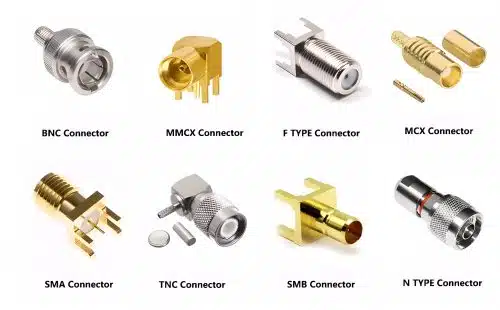
This figure likely illustrates the internal structure of SMA and BNC connectors, showing how the dimensions of the center conductor, dielectric, and outer conductor are precisely controlled to achieve 50-ohm characteristic impedance. It emphasizes that connectors are not just mechanical adapters but critical electrical elements of the transmission line. When a cable assembly is built, the cable and connectors must match the same impedance system to ensure signal integrity.
Cable impedance does not exist in isolation.
Connectors form part of the same transmission line structure.
SMA connectors, for example, are designed with a geometry that maintains a 50-ohm impedance through the mating interface. The center conductor diameter, dielectric spacing, and outer conductor shape are all chosen to keep the impedance consistent.
BNC connectors follow the same concept in most RF versions. So do N-type connectors and miniature interfaces like MMCX.
When a cable assembly is built, the cable and the connectors must match the same impedance system.
A short sma adapter cable is essentially a packaged section of 50-ohm transmission line with SMA connectors at both ends. The electrical behavior depends on the cable dielectric, the connector termination, and the mechanical precision of the assembly.
Mixed-connector assemblies follow the same rule.
A mmcx to sma cable connects a miniature board-level RF port to a larger connector used for antennas or test equipment. Although the connectors differ physically, both belong to the same 50-ohm ecosystem.
The same applies to transition assemblies such as a sma to bnc cable or bnc to sma cable. The connectors change shape, but the signal path remains inside the same impedance environment.
From a system perspective these cables are not simple accessories.
They extend the transmission line between RF devices.
If the cable, connectors, and impedance standard match, the signal path behaves predictably. If they don’t, reflections appear and performance begins to drift.
How do you decide whether 50 ohm coaxial cable is right for your link?
In most RF designs the decision is already made by the surrounding hardware.
Radios, antennas, amplifiers, and measurement equipment typically specify 50-ohm ports. Once those devices enter the design, the cable must follow the same standard.
Still, mixed environments occasionally create uncertainty.
Broadcast equipment may coexist with RF test gear. Legacy systems may combine video distribution with wireless hardware. In those situations engineers sometimes encounter both 50-ohm and 75-ohm components within the same installation.
The safest approach is to treat impedance as a system property rather than a cable attribute.
If the signal path originates from an RF transmitter or test instrument, the default assumption should be 50 ohm coaxial cable throughout the chain.
Use 50Ω for RF transmission, test, and wireless device chains
Most wireless systems follow a predictable architecture.
An RF module produces or receives the signal. The signal travels through filters, amplifiers, or measurement devices. Eventually it reaches an antenna.
Each component in that chain is designed to see a known impedance at its port.
Maintaining a continuous 50-ohm environment allows engineers to calculate power levels, insertion loss, and return loss with reasonable accuracy. Instruments can be calibrated against the same reference impedance, and modules behave according to their published specifications.
Once the impedance environment changes, those assumptions break.
The system may still function, but measurements become harder to interpret. A spectrum analyzer reading may not match expected power levels. Amplifier stages may experience small reflections that degrade stability.
For this reason RF engineers rarely experiment with impedance unless the design specifically requires it.
Consistency is more valuable than theoretical optimization.
Avoid mixing 50Ω and 75Ω parts unless the mismatch is intentional
Mechanical compatibility creates many of the mistakes.
Some connectors, especially BNC, exist in both 50-ohm and 75-ohm variants. From the outside they look almost identical.
In practice they behave differently.
The internal dielectric and center conductor dimensions determine the impedance at the connector interface. A 75-ohm BNC connector placed in a 50-ohm RF chain introduces a small but measurable mismatch.
At low frequencies the difference may appear negligible. At higher frequencies the reflections become visible on a network analyzer.
Accidental mixing often happens in shared laboratories. One department works with broadcast video hardware while another uses RF measurement equipment. Cables move between benches and the distinction slowly disappears.
The system still works, which makes the mistake easy to miss.
But the measurement accuracy gradually deteriorates.
Keeping the impedance standard consistent avoids those problems.
Decide when a dedicated transition is safer than direct mating
Occasionally two different impedance systems must interact.
Directly mating incompatible components rarely produces the best result. The mechanical connection may succeed, but the electrical mismatch remains.
A better approach is to introduce a controlled transition.
Sometimes that transition is an attenuator that absorbs reflections. Sometimes it is a carefully designed adapter. In many practical setups it becomes a short coax jumper that isolates one device from another.
A short section of rf coaxial cable can protect instrument ports from mechanical stress while maintaining a predictable impedance environment. It also allows flexible routing around racks, enclosures, or panel connectors.
In practice, many engineers prefer a cable assembly instead of a rigid adapter because the cable distributes mechanical load away from the equipment port.
The electrical goal remains the same.
Keep the signal path as close as possible to a continuous 50-ohm transmission line from the radio to the antenna.
Once that principle is respected, the cable stops being a hidden variable in the RF chain.
Which 50-ohm cable families should you compare first?
The specification sheet might say only one thing: 50 Ω.
That number alone does not narrow the decision very much.
Walk into a typical RF lab and open the cable drawer. You will find thin jumpers used inside enclosures, medium cables used for rack connections, and thicker feeder lines used when signals must travel farther. All of them belong to the same impedance class. None behave the same once installed.
Engineers usually discover this the hard way. A prototype works perfectly with a short test lead on the bench. The same hardware moves into a chassis or rack and suddenly cable routing becomes a mechanical problem instead of an electrical one.
The difference often comes down to cable families rather than impedance.
Some cables survive tight bends and high temperature. Others minimize attenuation across longer distances. Treating 50 ohm coaxial cable as a single product category hides those differences.
It is more useful to treat it as a toolbox.
One cable type for compact jumpers. Another for rack wiring. A different one when distance or power becomes the dominant constraint.
Start with RG316 for compact, high-temperature jumpers
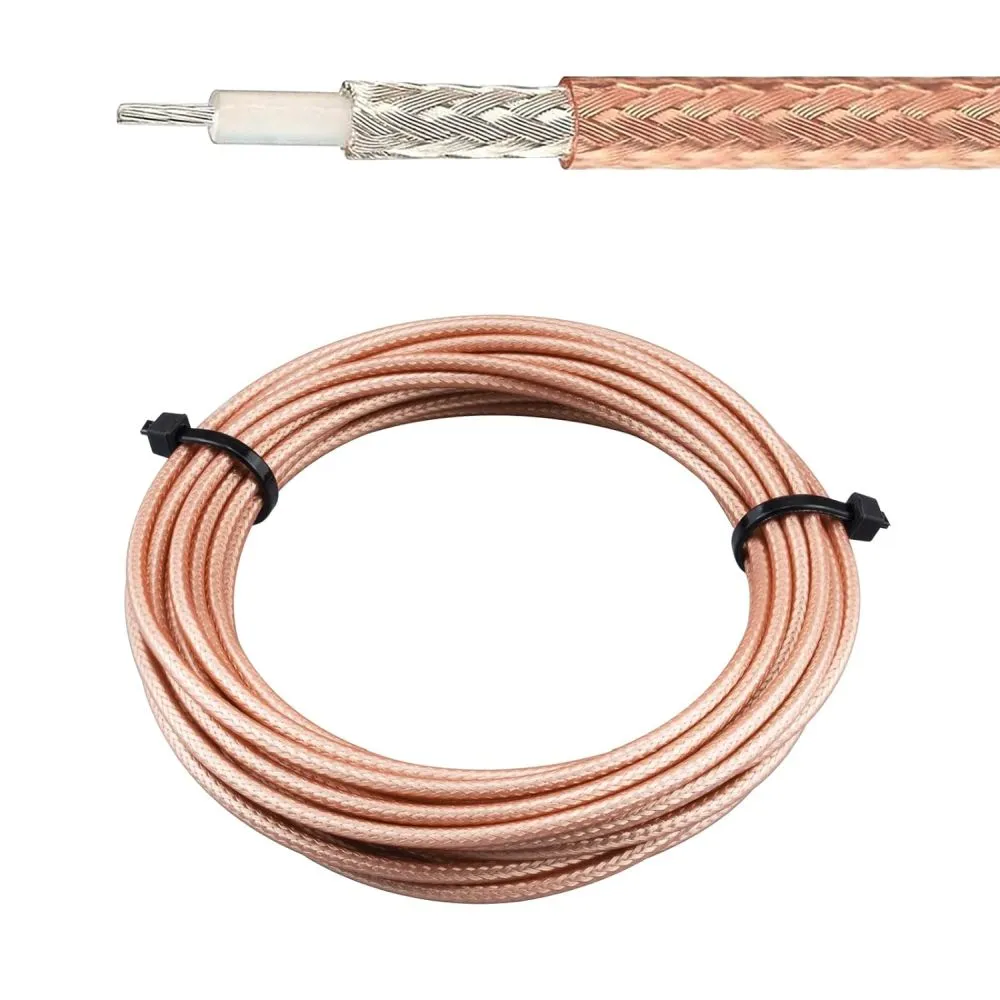
This image provides a detailed view of an RG316 coaxial cable, likely with a section of the jacket removed to reveal the inner conductor, PTFE dielectric, and braided shield. With an outer diameter of approximately 2.5 mm, RG316 is flexible and heat-resistant, making it ideal for routing inside compact enclosures. It is frequently used as short jumpers between RF modules and panel connectors, or as the core of adapter cables such as SMA to BNC assemblies where flexibility and moderate frequency performance are required.
Inside most RF devices, cables exist only because connectors cannot sit directly next to each other.
A board-level radio module might expose a tiny connector. The enclosure panel may require something more durable. The cable between them is often only a few centimeters long, but it must bend around other components and survive heat from nearby circuitry.
This is the environment where rg316 coaxial cable appears again and again.
Its outer diameter is small compared with many RF cables. That makes routing easier inside crowded housings. The PTFE-based dielectric used in many constructions also tolerates higher temperatures than standard polyethylene insulation.
Those characteristics make rg316 cable common in several situations:
• module-to-panel RF jumpers
• GNSS receiver interconnects
• compact wireless gateways
• internal antenna connections
The cable is thin enough to route through narrow spaces and flexible enough to bend without transferring excessive stress to connectors.
The trade-off is attenuation.
RG316 is not meant for long runs. Stretch the cable across several meters and the signal loss begins to dominate the RF path. That limitation is why the cable appears primarily in short assemblies rather than external feeder lines.
If you want a deeper breakdown of this cable’s mechanical and electrical traits, the article on RG316 coaxial cable as a compact RF jumper option explains where it fits into the broader cable family.
Step up to larger 50-ohm coax when distance and power matter more
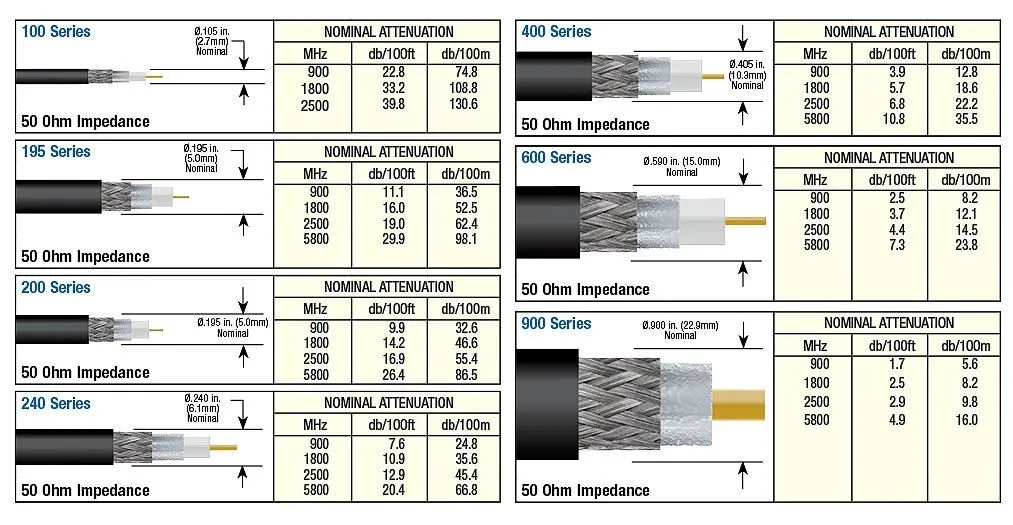
Cable diameter usually grows for a simple reason: attenuation.
Thin cables have higher resistive loss in the center conductor and shielding. That loss increases with frequency. When cable length increases, the signal level at the far end can drop more than expected.
Engineers compensate by moving to thicker coax.
Cables such as RG58 or RG213 often appear in equipment racks and mid-length interconnects. They remain flexible enough for installation but offer noticeably lower attenuation than miniature cables.
In practical systems the difference becomes visible quickly.
A 20-centimeter jumper inside an enclosure may perform perfectly with RG316. Extend that cable to several meters and the link budget begins to shrink.
This is why many RF installations separate cable roles:
• short internal jumpers
• rack-level interconnects
• longer antenna feeder lines
The impedance remains the same—still 50 ohm coaxial cable—but the physical cable family changes to match the installation.
Treat RF coaxial cable as a family, not a single product choice
Procurement teams sometimes search for “RF cable” as if it were a single category.
Engineers rarely think about it that way.
RF coaxial cable covers a broad range of constructions. Some are optimized for flexibility. Others prioritize shielding effectiveness or environmental durability. Laboratory cables often emphasize connector repeatability rather than mechanical ruggedness.
Even when impedance remains fixed at 50 ohms, the cables behave differently once they enter real hardware.
That difference explains why cable assemblies often become specialized products rather than generic components.
A sma adapter cable, for example, is essentially a short section of 50-ohm transmission line with SMA connectors already attached. Its value lies not only in the cable itself but in the precision of the connector termination.
Similarly, miniature assemblies like a mmcx to sma cable exist because compact RF modules require a transition between tiny board connectors and standard antenna interfaces.
Many of those assemblies are discussed in more detail in the guide to SMA adapter cable assemblies used in RF systems.
The cable inside the assembly may be simple, but the assembly itself solves a specific mechanical and electrical problem.
How do you estimate loss and length limits for 50-ohm runs?
RF systems rarely fail because the cable was physically connected incorrectly.
They fail because someone assumed the cable was electrically invisible.
Loss accumulates slowly. A connector here, an adapter there, another meter of cable added during installation. Each piece removes a small amount of signal power.
Eventually the link budget begins to collapse.
Engineers avoid this by treating cable attenuation as part of the design rather than an afterthought.
Use attenuation-per-meter data instead of guessing
Datasheets usually list attenuation values at several frequencies.
Those values allow engineers to estimate cable loss quickly:
Cable loss = cable length × attenuation per meter
The formula is simple, yet the step is often skipped in early prototypes. The cable seems short enough, so it gets installed without calculation.
At lower frequencies that shortcut may not matter.
At several gigahertz, however, even a few extra meters of cable can introduce several decibels of attenuation. That difference can shrink link margin or distort measurement results.
Treating attenuation as a predictable value instead of a guess removes that uncertainty.
Add connector and adapter transitions into the same budget
This figure likely shows a simple RF path with a cable, two connectors, and an adapter, with annotations indicating that each interface adds a small amount of loss (e.g., 0.1-0.3 dB). It emphasizes that when estimating total signal loss, engineers must account for both cable attenuation and connector/adapter contributions. This is especially important in test setups or systems with multiple transitions, where cumulative loss can impact link margin.
Cable attenuation rarely tells the whole story.
Each connector introduces a small insertion loss. The amount varies with connector quality and frequency, but values around 0.1–0.3 dB per interface are common.
Adapters contribute additional loss.
A cable assembly used in a test setup might include multiple interfaces:
• cable attenuation
• connector pair at each end
• one or more adapters
Those small numbers accumulate.
For example, an RF test chain built with a bnc to sma cable may include two connector transitions and one adapter before the signal even reaches the instrument.
Many engineers prefer to replace rigid adapters with flexible assemblies to reduce mechanical stress on equipment ports. The article explaining BNC to SMA cable transitions in RF test setups shows how these assemblies often replace stacked adapters on instruments.
The electrical benefit is small but measurable. The mechanical benefit is usually much larger.
How do you choose RG316 versus other 50-ohm options?
Choosing between RG316 and thicker cables rarely involves impedance.
Both maintain the same nominal 50-ohm characteristic impedance.
The decision usually depends on mechanical constraints and acceptable attenuation.
Space limitations, heat exposure, and routing complexity often push engineers toward RG316. Signal loss and cable length may push them toward larger cables.
The choice reflects the environment in which the cable must operate.
Switch away from RG316 when feeder loss becomes the real bottleneck
Extend RG316 across several meters and the disadvantages become obvious.
The cable’s small conductor produces higher attenuation compared with thicker alternatives. At higher frequencies the difference becomes significant.
Engineers usually discover this during system testing. The equipment functions perfectly on the bench but struggles to maintain signal strength after installation.
Replacing the cable with a lower-loss alternative often restores the missing link margin.
In other words, RG316 solves routing problems but not distance problems.
Standardize “short RG316 + lower-loss feeder” as a common architecture
Many RF installations quietly follow the same pattern.
Inside the enclosure, short RG316 jumpers handle routing constraints and connector transitions. Once the signal leaves the enclosure, a thicker feeder cable takes over.
This architecture solves two problems at once.
The miniature jumper keeps internal routing simple. The larger feeder preserves signal power across longer distances.
Transition assemblies like sma to bnc cable often appear at the boundary between those segments. They connect different connector ecosystems while preserving the same impedance environment.
The guide explaining SMA to BNC cable assemblies used in RF systems shows how these cables often appear between instruments and radio equipment.
Although the connectors change, the electrical rule remains unchanged.
The signal still travels through a continuous 50 ohm coaxial cable path.
How does 50-ohm coaxial cable turn into real assemblies and jumpers?
Cable datasheets describe raw transmission line.
RF systems rarely use raw cable.
What actually appears in equipment racks, test benches, and wireless devices are assembled cables—a cable with connectors already terminated, often cut to a specific length. Those assemblies are where many practical problems begin.
A cable that behaves perfectly in theory can become unreliable if the connector termination is poor, the strain relief is missing, or the routing path forces the cable to bend too sharply near the connector.
In other words, the cable itself is only half the story.
The assembly matters just as much.
Treat SMA adapter cable as a packaged 50-ohm use case
One of the simplest examples is the sma adapter cable.
Electrically, it is nothing more than a short section of 50 ohm coaxial cable with SMA connectors on both ends. Mechanically, it solves several real-world problems.
It allows equipment to connect without placing torque on delicate RF ports. It introduces flexibility where rigid adapters would create stress. It also makes routing around other hardware easier.
In many laboratories engineers prefer these short jumper cables instead of stacking multiple rigid adapters directly on instrument ports.
The cable absorbs movement, protects the connector interface, and keeps the signal path predictable.
A detailed explanation of how these assemblies are typically used in RF installations can be found in the guide on SMA adapter cable configurations in RF systems.
What appears to be a simple cable is actually a small mechanical safeguard for the entire signal chain.
Use MMCX-to-SMA and BNC-to-SMA examples to show role changes
Connector transitions often reveal how cable assemblies fit into the larger RF ecosystem.
Take a mmcx to sma cable as an example. The MMCX connector usually appears on compact RF modules or embedded wireless hardware. SMA connectors, on the other hand, are far more common for antennas and laboratory equipment.
A short cable between those two connectors solves the mechanical mismatch.
The electrical environment stays the same—still a 50 ohm coaxial cable path—but the connectors change to match the hardware on each side.
A similar situation occurs with test equipment.
Many laboratory instruments expose BNC connectors, while RF modules and antennas often use SMA. Engineers bridge that difference with assemblies like bnc to sma cable or sma to bnc cable.
These cables avoid stacking adapters and help protect instrument connectors from mechanical stress.
The role of these transitions is explained in the article discussing BNC to SMA cable assemblies used in RF measurement setups. The signal path remains the same. Only the physical interface changes.
Show how connector direction changes search behavior, not signal physics
From an engineering perspective, a sma to bnc cable and a bnc to sma cable are the same electrical concept.
Search engines treat them as separate phrases because users describe them differently depending on which device they are connecting.
The signal itself does not care about the naming order.
Both assemblies maintain the same 50-ohm transmission line between two devices. The cable, dielectric spacing, and connector geometry preserve the impedance environment.
Understanding this distinction helps explain why RF component catalogs contain so many similar-looking cable assemblies.
Each variation corresponds to a slightly different hardware configuration.
The electrical rule stays the same across all of them.
How should you route 50-ohm cable in enclosures and field systems?
Many RF reliability issues have nothing to do with impedance or attenuation.
They come from cable routing.
Installations that look clean during assembly sometimes develop problems after months of vibration, temperature changes, or maintenance activity. Cables bend repeatedly near connectors, shielding rubs against sharp edges, or heat gradually stiffens the dielectric.
These problems are rarely visible in schematics.
They appear only after the equipment enters the real world.
Protect the first bend near connectors and bulkheads
The most fragile point in many RF cables is the first bend after the connector.
If the cable bends immediately at the connector body, the internal conductors experience repeated mechanical stress. Over time the center conductor or shielding may weaken.
Engineers usually try to maintain a short straight section before the first bend.
Connector boots, strain relief sleeves, or simple cable clamps can help keep the cable from bending too sharply at that point.
This detail seems minor during installation but has a large effect on long-term reliability.
Keep RF cable away from heat, sharp edges, and noisy harnesses
Inside equipment enclosures, cables compete for space with many other components.
Power wiring, digital harnesses, cooling structures, and mechanical brackets often share the same routing area.
RF cables benefit from some separation.
Excessive heat can harden the cable jacket and dielectric. Sharp metal edges can gradually wear through shielding. Strong electromagnetic fields from switching power supplies can introduce interference if shielding becomes compromised.
Careful routing reduces those risks.
Even when the cable itself remains a 50 ohm coaxial cable, the surrounding environment can influence long-term performance.
Move mechanical load to the enclosure whenever possible
Connectors are designed for electrical contact, not structural load.
When a cable hangs freely from a panel connector, all mechanical stress transfers directly into the connector interface. Repeated movement or vibration eventually loosens the connection.
Many RF installations avoid this by anchoring cables to the enclosure.
Bulkhead connectors mounted to panels allow the enclosure to absorb mechanical load. Cable clamps or routing guides prevent cables from pulling on delicate device ports.
The result is a signal path that remains electrically stable and mechanically protected.
Small mechanical details like these often determine whether an RF cable assembly lasts months or years.
Can a planning matrix reduce wrong 50-ohm cable choices?
Large projects sometimes involve dozens of RF cables across multiple subsystems.
At that scale informal decision-making becomes risky. Different engineers may choose different cable types, lengths, or connector combinations without documenting the reasons.
A planning matrix can help organize those decisions.
Instead of selecting cables ad hoc, engineers record a few key parameters for each RF link.
Example: module-to-panel jumper
Imagine a wireless module mounted inside a small device enclosure.
The module connects to a panel-mounted SMA connector through a short RG316 jumper roughly fifteen centimeters long. The operating frequency sits in the multi-gigahertz range.
Running that scenario through a simple matrix usually reveals something interesting.
The cable attenuation remains relatively small because the length is short. Connector transitions often contribute a similar amount of loss as the cable itself.
That observation explains why connector quality and assembly consistency matter so much in miniature RF cables.
Define the matrix fields and formulas
This figure likely shows a screenshot or representation of a spreadsheet used for RF cable planning. It includes fields such as system impedance, cable family, frequency band, cable length, attenuation per meter, connector count, and estimated total loss. Such matrices help engineering teams document cable decisions, ensure consistency across projects, and serve as a reference for procurement and incoming inspection. The visual reinforces the value of structured decision-making in complex RF systems.
A practical cable planning sheet often includes fields such as:
• system impedance
• cable family
• operating frequency band
• cable length
• attenuation per meter
• connector count
• estimated connector loss
From those inputs the system designer can estimate total insertion loss:
Total loss = cable attenuation + connector loss
Additional fields may track bend radius requirements, environmental conditions, or service accessibility.
Even a simple spreadsheet helps reveal when a cable path becomes risky—either because attenuation exceeds the design margin or because the cable must bend more sharply than recommended.
Walk through a compact module-to-panel example
Consider a small wireless gateway.
The RF module sits on a circuit board inside the enclosure. The antenna connects through a panel-mounted SMA connector.
The cable between them may be a short rg316 coaxial cable jumper roughly 20 centimeters long.
In the planning matrix the entry might look like this:
Cable family: RG316
Length: 0.2 m
Attenuation: small relative to link budget
Connector count: two
The total loss becomes minimal. Mechanical routing becomes the primary concern rather than electrical attenuation.
This example illustrates why miniature cables remain useful even when they are not the lowest-loss option available.
Turn the matrix into an incoming inspection checklist
Procurement teams sometimes inherit cable assemblies without detailed engineering documentation.
Turning the planning matrix into an inspection checklist helps maintain consistency.
Incoming assemblies can be checked against a few criteria:
• cable type and impedance
• connector type and orientation
• cable length tolerance
• mechanical strain relief
• labeling and environmental rating
This approach catches problems before cables enter the system.
It also creates a documented reference for future sourcing decisions, which becomes useful when suppliers or product revisions change.
What trends are changing 50-ohm interconnect choices?
The RF cable market continues to evolve alongside wireless technology.
Higher frequencies, smaller devices, and stricter environmental regulations are all influencing how interconnects are designed and manufactured.
Although 50 ohm coaxial cable remains the dominant standard, the surrounding ecosystem continues to shift.
Track RF interconnect market growth through 2030
Wireless infrastructure, satellite communications, and test equipment continue to expand globally.
Industry analyses estimate that the RF interconnect market—including cables, connectors, and adapters—will continue growing through the end of the decade. That growth reflects the increasing number of devices relying on RF communication.
More devices mean more interconnects.
Even as wireless chips become smaller, the physical signal path between radios, antennas, and measurement equipment still requires reliable cabling.
Watch PFAS-related pressure around PTFE-based interconnect materials
Many RF cables use PTFE-based dielectric materials because of their excellent electrical stability.
Environmental regulations are beginning to place pressure on some fluorinated materials, particularly those associated with PFAS classifications.
Some connector manufacturers have already started introducing alternative materials in certain product lines.
The change is gradual, but engineers and procurement teams may see more documentation related to material compliance in the coming years.
Note that smaller, higher-frequency RF interconnects keep pushing assembly design
Wireless hardware continues moving toward higher frequencies and smaller physical dimensions.
That combination places increasing demands on cable assemblies.
Connectors shrink. Cable diameters decrease. At the same time signal integrity becomes more sensitive to tiny mechanical variations.
These trends do not eliminate the role of 50 ohm coaxial cable, but they do place more emphasis on assembly quality, connector precision, and installation practices.
In many systems the reliability of the RF path now depends less on the cable type itself and more on how the entire assembly is built and routed.
Answer common 50-ohm coaxial cable questions
Why is 50 ohm coaxial cable the default in RF systems?
Because most RF equipment—radios, antennas, amplifiers, and measurement instruments—was standardized around a 50-ohm impedance environment.
How do I tell 50Ω cable parts from 75Ω video parts?
The cable families usually differ. RF cables such as RG316 or RG58 are typically 50 ohms, while broadcast cables such as RG6 and RG59 are normally 75 ohms.
When should I choose RG316 instead of thicker cable?
RG316 works best for short jumpers inside equipment where flexibility and heat tolerance matter more than extremely low attenuation.
How long can a 50-ohm run be before loss becomes a problem?
It depends on cable type and frequency. Engineers typically calculate attenuation using datasheet values to ensure the loss fits within the system link budget.
Bonfon Office Building, Longgang District, Shenzhen City, Guangdong Province, China

A China-based OEM/ODM RF communications supplier
Table of Contents
Owning your OEM/ODM/Private Label for Electronic Devices andComponents is now easier than ever.