
A ring terminal can pass a quick pull check and still become the weak point in the circuit.
That usually happens after the terminal is already mounted: the ring hole is too large for the stud, the barrel was crimped with the wrong die, the contact face is sitting on paint or oxidation, or the wire is bent sharply right where it exits the sleeve. On the bench, the joint looks acceptable. Under current, vibration, heat, or service work, the problem shows up as a hot stud, a loose ground, a broken conductor, or a terminal that rotates after tightening.
This guide focuses on ring terminals as wire-to-stud connections. It does not treat them as a general wire connector family. The real selection work is more specific: match the wire, the stud, the terminal construction, the crimp tool, and the mounting condition before the part reaches production.
Where Do Ring Terminals Solve a Connection Problem Better Than Open Tongues?
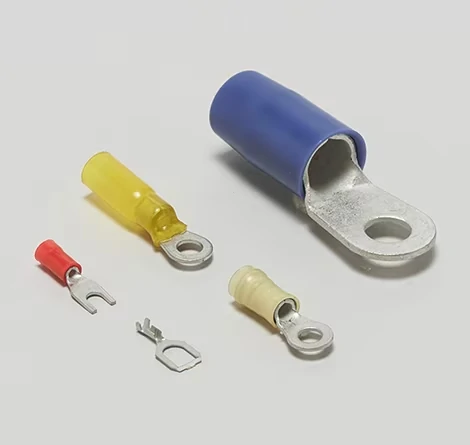
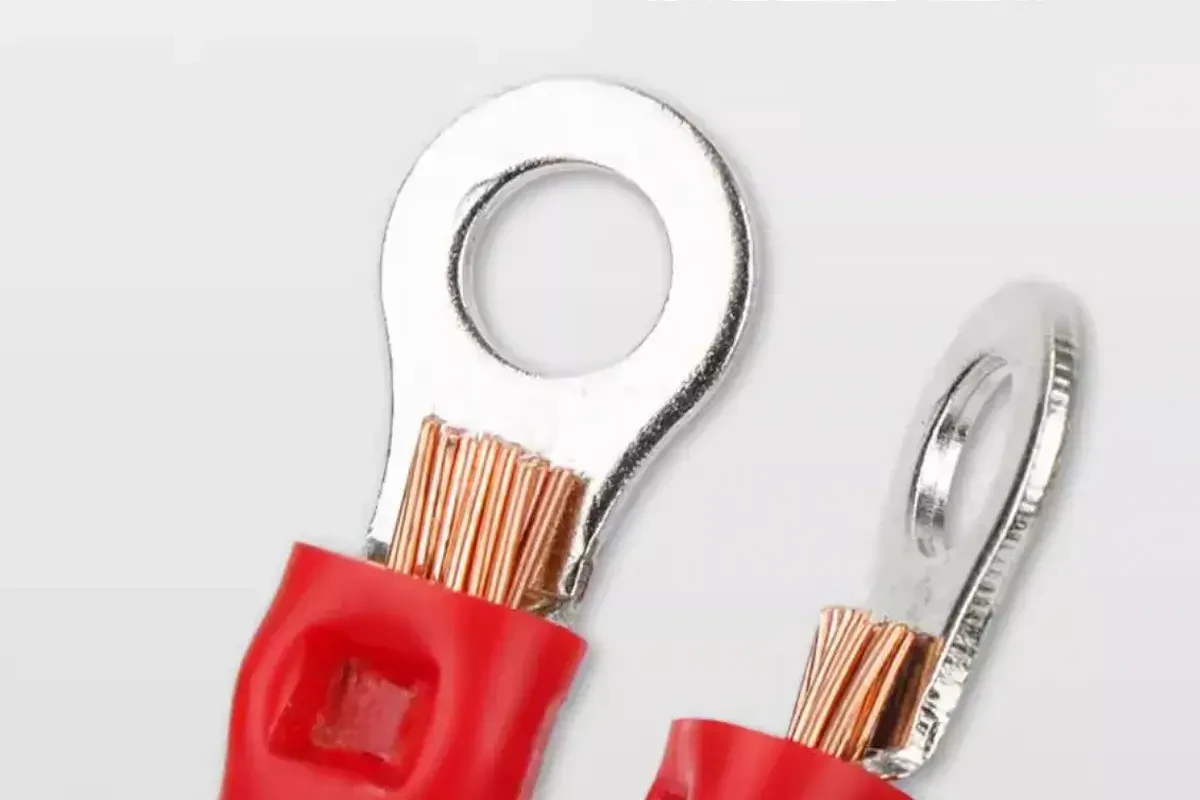
This image shows a copper ring terminal used for electrical wire connections. The ring-shaped tongue allows the terminal to be fixed securely with screws or bolts, making it suitable for automotive, industrial, and power wiring applications.
A ring terminal is most useful where the connection must stay captured under the fastener. The closed ring cannot slide out sideways after the screw or nut loosens slightly. That single feature is why ring terminal connectors are common on grounding points, battery studs, terminal blocks, power distribution posts, equipment chassis, and control panels where vibration or service movement is expected.
An open tongue terminal, such as a spade, fork, or hook terminal, can be faster to install because the screw does not always need to be fully removed. That speed is useful in some panels and service terminals. The trade-off is retention. If the screw loses clamp force, an open tongue has an easier escape path. A closed ring normally requires the fastener to be removed before the terminal can leave the stud.
That does not make a ring terminal automatically better. It makes it better for a certain kind of risk.
Use a closed ring when the fastener must be removed for disconnection
If the connection is a chassis ground, a battery accessory lead, a busbar branch, or a vibration-prone equipment stud, the closed shape is often the safer mechanical choice. The terminal remains trapped even if the joint begins to loosen. For automotive, marine, industrial, and equipment wiring, that extra retention can matter more than installation speed.
For service-heavy panels, the answer may be different. A technician may prefer a fork terminal if the terminal block is frequently opened and space is tight. But where a loose or half-seated wire could damage equipment, stop a control circuit, or create heat at the contact face, closed-ring retention is usually worth the extra assembly step.
Compare ring terminals with spade, fork, hook, and quick-disconnect terminals
The main difference is not the metal thickness or insulation color. It is how the terminal behaves after installation.
| Terminal format | Main connection point | Installation speed | Retention after loosening | Common risk |
| Ring terminal | Stud, screw, ground point | Medium | High | Wrong ring hole or poor mounting contact |
| Spade terminal | Screw terminal | Fast | Medium | Can slip out if clamp force drops |
| Fork terminal | Service screw terminal | Fast | Medium | Needs proper screw head and washer support |
| Hook terminal | Wrapped screw connection | Medium | Medium | Can deform during tightening |
| Quick disconnect | Blade/tab connection | Fast | Depends on fit | Loose mating force or wrong tab size |
For buyers comparing common wire connector formats, this is the first separation to make: removable plug-in connection, inline wire splice, or fixed wire-to-stud termination. A ring terminal belongs in the third group.
Separate small wire ring terminals from heavy cable lugs
Small wire ring terminals and heavy cable lugs are often mixed together in search results, but they are not the same sourcing problem.
A small wire ring terminal may be used on control wiring, equipment grounding, signal power leads, appliance wiring, or automotive accessory circuits. It is usually selected by AWG range, stud size, insulation style, barrel type, and crimp tool.
A heavy cable lug is selected around larger conductor size, higher current path, larger studs, thicker tongue geometry, and heavier tooling. Battery cables, inverter cables, and busbar connections usually need lug-level specifications rather than small insulated ring terminals.
If a drawing only says “ring terminal,” procurement still does not have enough information.
How Do You Match Wire Gauge and Stud Size at the Same Time?
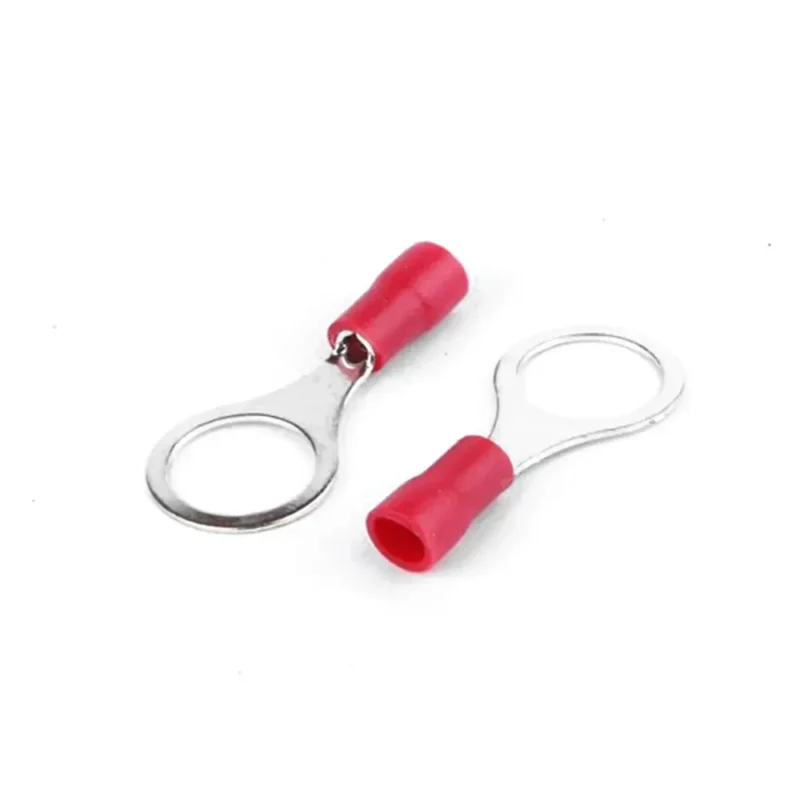
Many wrong ring terminals are ordered because one dimension looked correct.
The wire fit looked right, but the ring hole was too large. Or the stud size looked right, but the barrel did not match the conductor. Sometimes the color sleeve is used as the main clue, which is risky because color only gives a broad insulated-terminal family. It does not confirm conductor material, strand class, insulation outside diameter, hole diameter, tongue width, plating, or tool compatibility.
A good specification needs both sides of the part: the wire side and the stud side.
Read the conductor range before considering terminal color
The barrel must match the conductor, not just the nominal wire label. Confirm the AWG range, conductor cross-section, conductor material, and strand condition. Fine-stranded wire, tinned copper wire, and compacted conductors may not behave the same way in the same barrel.
If the wire has oxidation, heat damage, broken strands, or water-darkened copper, installing a new terminal does not repair the conductor. Cut back to clean wire before stripping and crimping.
Measure the stud instead of estimating it from the wrench size
Stud size should be measured at the thread diameter or taken from the equipment drawing. Do not estimate it from the nut wrench size. A nut that uses a certain wrench does not tell you the ring hole size.
Check four details before approving a ring terminal size:
| Item to check | Why it matters |
| Stud thread diameter | Confirms the real mounting size |
| Ring hole diameter | Controls clearance and contact position |
| Nut and washer arrangement | Affects clamping and contact area |
| Available mounting surface | Prevents the tongue from sitting on an edge |
Allow installation clearance without choosing an oversized ring hole
Some clearance is necessary. The ring must slide over the stud without scraping threads or forcing the tongue out of position. But excessive clearance can shift the terminal off-center, reduce the effective contact area, and make rotation easier during tightening.
There is no universal pass number for every ring terminal size chart. The acceptable clearance depends on the equipment drawing, terminal design, mounting surface, washer arrangement, and production requirement.
AWG × Stud Size Ring Terminal Selection Chart
| Terminal model | Wire gauge | Conductor material | Stud size | Ring hole diameter | Barrel inside diameter | Insulation type | Recommended die | Fit decision |
| Example A | 22–18 AWG | Copper / tinned copper | #6 | Verify by drawing | Verify by sample | Insulated | Approved cavity only | Accept / verify / reject |
| Example B | 16–14 AWG | Copper / tinned copper | #8 | Verify by drawing | Verify by sample | Nylon insulated | Approved cavity only | Accept / verify / reject |
| Example C | 12–10 AWG | Copper / tinned copper | 1/4 in | Verify by drawing | Verify by sample | Heat shrink | Approved cavity only | Accept / verify / reject |
Which Ring Terminal Construction Fits the Conductor and Environment?
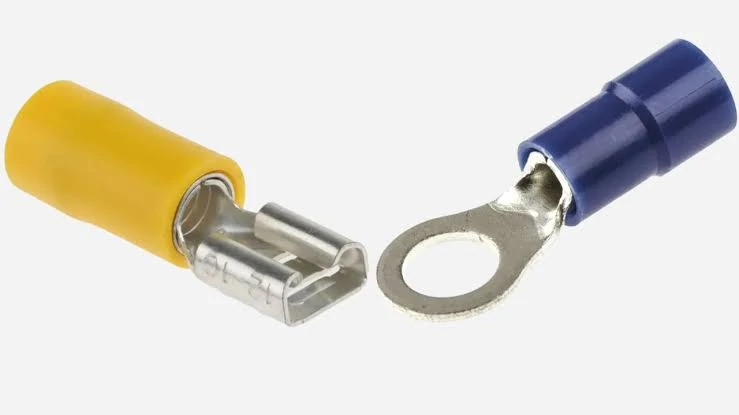
This image compares two common electrical terminal designs. Ring terminals are designed for fixed stud connections, while spade terminals are commonly used where quick installation and removal are required.
The same stud size does not mean the same terminal should be used.
A ring terminal used inside a dry control cabinet has a different job from one mounted near a battery, pump, engine bay, outdoor antenna base, or marine distribution panel. The shape may look similar, but the barrel material, plating, insulation sleeve, sealing method, and crimp response can be very different.
This is where many substitutions become risky. A buyer may see “16–14 AWG, #10 stud” and assume two parts are interchangeable. They may not be. The wire may fit, the screw may pass through the ring, and the first assembly may even pass continuity. But if the sleeve softens, the barrel cracks, the plating corrodes, or moisture enters the conductor, the connection can fail later in a way that looks like an installation problem.
Choose copper ring terminals by conductor material and plating
Copper ring terminals are common because copper has good electrical conductivity and crimps well when the barrel is designed correctly. Many electrical ring terminals use tinned copper to reduce surface oxidation and improve corrosion resistance in normal environments.
That does not mean every copper terminal suits every conductor or contact surface. The conductor material, terminal plating, stud material, washer material, and mounting surface should be compatible. In low-risk indoor equipment, this may be straightforward. In damp, salty, high-temperature, or chemically exposed locations, plating and sealing need more attention.
A bare copper terminal may look attractive for conductivity, but exposed copper can oxidize. A tinned copper terminal may be more practical for many harness and equipment builds. For high-reliability work, the correct answer should come from the drawing, supplier specification, or approved parts list, not from appearance.
Use insulated ring terminals where barrel insulation support is required
Insulated ring terminals are convenient in production because the sleeve helps protect the crimped barrel and gives some support where the wire exits the terminal. Red, blue, and yellow insulated terminals are often associated with common AWG ranges, but the color should never be the only selection method.
Check the actual wire range printed in the datasheet or packaging. Then check the insulation outside diameter. Two wires with the same AWG can have different insulation thickness. A wire may fit the conductor barrel but not sit correctly inside the insulated support area.
PVC and nylon sleeves are common, but they behave differently under heat and mechanical stress. Nylon sleeves are often used where a tougher insulation support is needed. PVC may be acceptable for less demanding environments. Neither one should be treated as automatically waterproof.
Select non insulated ring terminals for controlled insulation processes
Non insulated ring terminals are useful where the manufacturer wants full control over the insulation system. They are common inside assemblies where a separate sleeve, heat shrink tube, boot, or enclosure provides protection after crimping.
They also help when space is tight. An insulated sleeve can make the rear of the terminal larger and harder to route in dense equipment. A non insulated terminal may give a cleaner fit, especially when the harness builder already has a defined covering process.
The risk is obvious: without the sleeve, the connection needs a complete insulation plan. Leaving a non insulated barrel exposed may be acceptable on some grounded chassis points or inside protected assemblies, but it is not something to assume. The drawing should show whether the crimp area is sleeved, heat-shrunk, covered, or left open.
Reserve heat shrink ring terminals for moisture-prone wiring
Heat shrink ring terminals add a sealing step. The sleeve is heated after crimping, and adhesive-lined versions can seal around the wire insulation when properly matched and processed. They are useful in moisture-prone wiring such as trailers, outdoor equipment, marine accessories, pump wiring, and automotive areas exposed to splash.
The important word is “system.” A heat shrink ring terminal is not waterproof just because the package says heat shrink. The wire insulation outside diameter must match the sleeve range. The crimp must be correct before heating. The heating process must fully recover the sleeve without burning it. The adhesive must flow and seal around the wire jacket.
This is similar to adhesive-lined heat shrink splices, but the failure point is different. With a ring terminal, the installer also has to protect the ring-to-stud interface. A sealed barrel does not prevent corrosion at the mounting face if the stud, washer, and surface are exposed or contaminated. For inline sealing topics, see inspect adhesive-lined heat shrink seals.
Compare brazed, seamless, and seamed barrel construction when specified
Barrel construction matters most when the application has clear mechanical, vibration, or inspection requirements. A seamless barrel, brazed seam, or open/seamed construction may crimp differently under the same tool. Some designs resist splitting better. Some are easier to inspect visually. Some are acceptable only with a particular die profile.
Do not reduce the decision to “seamless is always better” or “brazed is always required.” That is too simple. The real question is whether the terminal, wire, and tool combination has been approved for the expected load, pull force, environment, and production process.
For repeat orders, keep the exact terminal construction in the purchasing file. If a supplier changes from one barrel style to another without notice, the crimp height, pull result, and visual deformation may change even when the printed wire range is the same.
How Should You Prepare and Crimp a Ring Terminal?
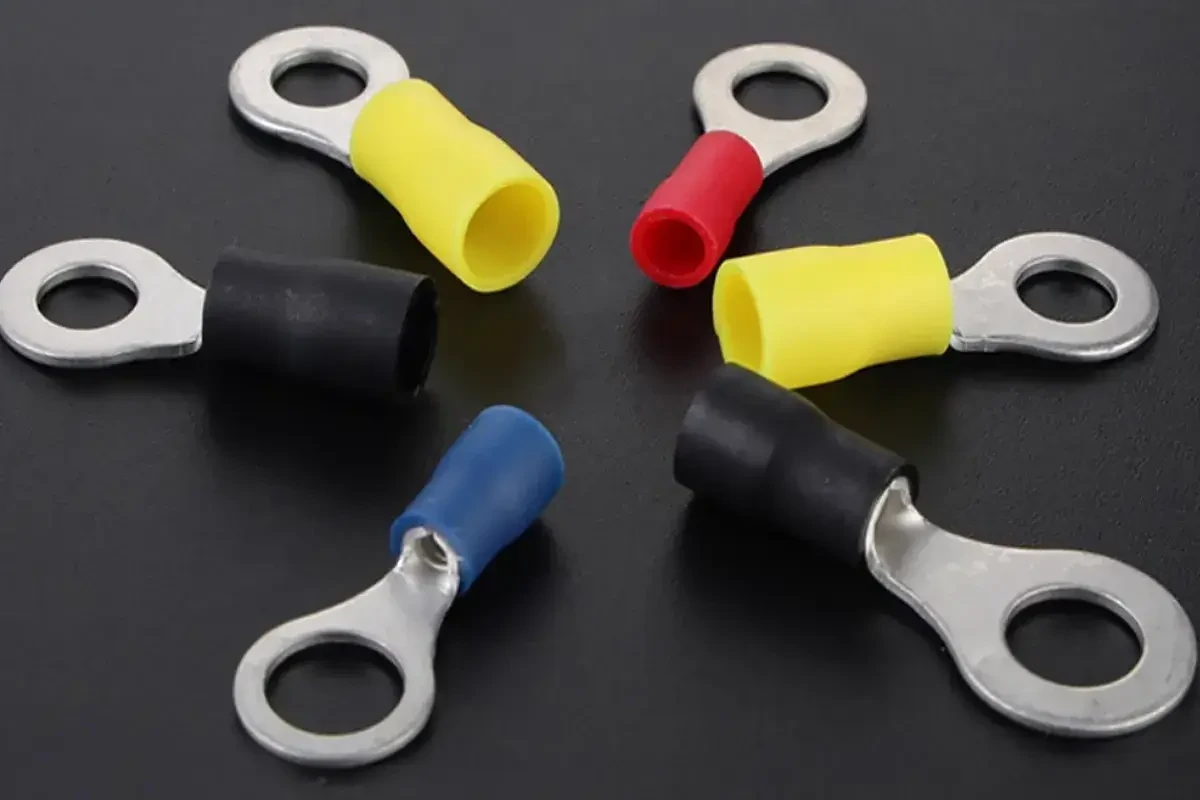
This image displays multiple insulated ring terminals used for wire crimping applications. The insulated sleeve helps protect the crimp area and provides additional support for electrical wiring assemblies.
A good crimp starts before the tool closes.
The wire condition, strip length, strand position, terminal fit, die cavity, and tool calibration all affect the final joint. A ring crimp terminal flattened with ordinary pliers may hold during a light tug, but that is not the same as a controlled crimp. The barrel needs compression that forms a stable metal-to-metal connection between conductor and terminal.
Cut back oxidized, overheated, or strand-damaged conductor
Do not crimp over bad copper. If the conductor is blackened, brittle, oil-soaked, overheated, or water-damaged, cut back to clean material. If strands are missing from previous stripping, the wire no longer matches its nominal gauge. A 14 AWG wire with damaged strands may behave like a smaller conductor inside the barrel.
This matters in repair work. Replacing only the terminal may leave the real defect inside the wire.
Strip the insulation to the specified barrel depth
Strip length should match the barrel depth and terminal design. Too short, and the conductor may not fully enter the barrel. Too long, and exposed copper may extend beyond the sleeve or create a shorting risk. Too deep, and the insulation may enter the conductor crimp area, weakening the electrical connection.
For production, strip length should be written into the work instruction. Operators should not be left to judge it by eye across different terminal families.
Insert every strand without folding conductor outside the barrel
Before crimping, confirm that every strand enters the barrel. Loose strands beside the barrel are not cosmetic defects. They reduce conductor area, create stray shorting risk, and make inspection harder.
Some terminals have an inspection window. Others require checking the conductor position at the barrel end. Either way, the goal is the same: full conductor insertion without folded strands, missing strands, or insulation trapped inside the conductor crimp.
Position the barrel in the correct die cavity and orientation
Use the approved crimp tool and die. A ratcheting crimp tool helps control the closure cycle, but the die cavity must still match the terminal. The wrong cavity can under-crimp, over-crimp, split the barrel, damage the sleeve, or leave a weak conductor grip.
Orientation also matters. Many terminals are designed to sit in the die a certain way so the compression forms correctly. If the barrel is rotated incorrectly, the crimp impression may look acceptable from one side but fail pull testing or deform the ring tongue.
For a broader look at terminal families and tooling, see select a crimp tool and terminal family.
How Can You Mount the Ring Without Creating a Loose Joint?
Crimp quality does not guarantee mounting quality.
A ring terminal has two connection zones: wire-to-barrel and ring-to-stud. The crimp can be perfect while the mounted joint is poor. That is why overheating is sometimes misdiagnosed. The operator checks the crimp, pulls the wire, and sees no issue. The real heat source is under the screw.
Clean the ring face and equipment contact surface
The ring must contact clean conductive material. Paint, oxidation, oil, thread compound, plating damage, adhesive residue, and dirt can all increase contact resistance. On grounding points, surface preparation is especially important because the chassis or panel is part of the electrical path.
Do not assume a shiny screw head means the contact face below the terminal is clean.
Seat the ring flat instead of loading it on an edge
The ring tongue should sit flat against the contact surface. If it rides on a molded plastic edge, burr, raised boss, curved surface, or wrong washer, clamp force may not spread across the terminal face. A tilted ring can loosen faster and heat more under load.
This is also where oversized ring holes cause trouble. The terminal can shift off-center and lose proper support under the washer or nut.
Tighten to the specified torque while preventing terminal rotation
Use the equipment manufacturer’s torque requirement when available. Too little torque can leave a high-resistance joint. Too much torque can damage threads, deform the terminal, crush washers, or distort the mounting surface.
Prevent terminal rotation during tightening with proper tooling and harness support. Do not hold the wire and let the barrel take the twisting force. That transfers stress directly into the crimp and conductor exit.
After tightening, route the wire so it does not bend sharply beside the barrel. The rigid barrel end is a common break point when vibration or repeated movement is allowed to concentrate there.
Why Do Ring Terminals Heat Up, Rotate, or Break Near the Barrel?
This image shows various ring terminal structures used in electrical wiring. Different designs are selected according to wire size, installation environment, mechanical requirements, and protection needs.
A failed ring terminal is not always a failed crimp.
That is the first thing to check when a customer reports heat, discoloration, intermittent power, or a loose ground. The crimp may pass a pull test, but the mounted joint may still have high resistance. The terminal may also be mechanically sound at installation, then break later because the harness was routed with no strain relief.
Diagnose excessive hole clearance and incomplete surface contact
If the ring hole is much larger than the stud, the terminal can sit off-center under the nut or washer. That reduces the useful contact area and makes rotation easier during tightening. In a low-current control circuit, the issue may stay hidden. In a higher-current path, the joint can heat because current is passing through a smaller or less stable contact area.
Also check the mounting face. A ring terminal should not sit across paint, burrs, curved surfaces, plastic edges, or damaged plating. The contact should be flat and supported.
Find loose torque, damaged threads, and unsuitable fasteners
A hot ring terminal often points to the stud interface, not the barrel. Loose torque, worn threads, soft washers, undersized screw heads, or fasteners not approved by the equipment manufacturer can all reduce clamp force.
Stacked terminals make this worse. Several ring terminals on one stud can work only if the equipment design allows it. The stack height, washer order, terminal thickness, and current path all matter. A neat-looking stack is not automatically a correct electrical joint.
Identify under-crimping, over-crimping, and the wrong die profile
Under-crimping leaves loose space between conductor and barrel. Over-crimping can cut strands, crack the barrel, or damage the insulation sleeve. A wrong die profile may create a crimp that looks strong from the outside but does not compress the conductor correctly.
Production teams should not judge crimp quality only by appearance. Visual inspection catches obvious defects, but approved pull testing and crimp-height checks are better for repeatability.
Relieve vibration and repeated bending beside the rigid barrel
Wire often breaks beside the ring terminal because that point becomes the hinge. The barrel is rigid. The wire is flexible. If the harness moves, bends, or vibrates, stress concentrates at the barrel exit.
Use clamps, ties, routing guides, or sleeving so the wire is supported before it reaches the terminal. Do not let the terminal carry the weight of the harness.
How Do You Inspect a Ring Terminal Before Energizing the Circuit?
Inspection should cover both the crimped barrel and the mounted joint. A quick continuity check is useful, but it is not enough for circuits where current, vibration, or heat matter.
Inspect conductor position, barrel deformation, and insulation support
Check for exposed strands, folded strands, missing strands, insulation trapped in the conductor crimp, cracked barrel edges, damaged sleeves, and incorrect die marks. If the terminal has an inspection window, confirm conductor position before accepting the crimp.
Check the ring hole, tongue, and mounting face for deformation
The ring tongue should not be bent, stretched, cracked, or distorted by the fastener. The hole should still match the stud and sit flat under the washer or nut. If the terminal rotates easily after tightening, treat it as a defect until the cause is found.
Verify retention with the approved pull-test requirement
Pull-test values should come from the terminal specification, customer drawing, or quality standard. Do not apply one generic number to every AWG and terminal type. The goal is to confirm the actual terminal-wire-tool combination.
Where Do Battery, Automotive, Marine, and Waterproof Ring Terminals Differ?
Battery ring terminals, automotive ring terminals, marine ring terminals, and waterproof ring terminals are not just marketing labels. Each one points to a different risk.
Battery connections need cable size, stud size, current path, heat, and mechanical support checked together. A ring terminal may connect to a battery stud, distribution post, or busbar, but it is not automatically suitable for every battery post.
Automotive wiring adds vibration, temperature swings, oil, splash, and service movement. Marine wiring adds corrosion and salt exposure. Waterproof ring terminals depend on the full installed system: adhesive sleeve, wire insulation diameter, crimp quality, heating process, and protected mounting face.
How Should Production Teams Specify and Validate Ring Terminals?
A purchase line should not say only “ring terminal, 16 AWG.” That leaves too much room for substitution.
Specify the terminal model, wire AWG, conductor material, strand class, stud size, ring hole diameter, barrel material, plating, insulation system, operating temperature, approved tool and die, strip length, crimp-height requirement, pull-test requirement, mounting torque, packaging quantity, lot traceability, and applicable standard.
FAQ
Can a ring terminal hole be slightly larger than the stud?
Yes, some clearance is needed for installation. But too much clearance can cause off-center mounting, rotation, and reduced contact area.
Can two wires be crimped into one ring terminal?
Only if the terminal is specifically designed and approved for two conductors. Do not force two wires into a single-wire barrel.
Why does a ring terminal overheat even when the wire passes a pull test?
Because the heat may come from the ring-to-stud interface: loose torque, contamination, corrosion, poor surface contact, or wrong fasteners.
Can insulated ring terminals be used on battery connections?
They can be used only when wire size, stud size, current, temperature, vibration, and environment all match the application. The insulation sleeve alone does not make the terminal battery-rated.
Should several ring terminals be stacked on the same stud?
Only if the equipment design allows it. Stack order, terminal thickness, washer arrangement, and contact area affect the joint.
Can a ring terminal be reused after removing the bolt?
It may be reinstalled if the crimp, ring, plating, and insulation are undamaged and the equipment requirement allows reuse. Do not re-crimp the same barrel.
Why does the wire break beside the ring terminal instead of inside it?
The wire usually breaks there because vibration or bending is concentrated at the rigid barrel exit. Add strain relief and improve harness routing.