
A blown high-current fuse often looks like a simple replacement job.
The trouble starts when the buyer orders only by amp rating. The old fuse says 60A, the new fuse says 60A, and both are described online as a MIDI fuse. It may still be the wrong part. The bolt hole may not match. The voltage family may be different. The holder may need another torque value. In a high-current automotive or battery distribution circuit, that is enough to create voltage drop, heat, repeat fuse opening, or a loose connection that fails later under vibration.
A MIDI fuse is best treated as a bolted electrical component, not just a labeled consumable.
How can you confirm a bolt-down fuse is MIDI before ordering it?
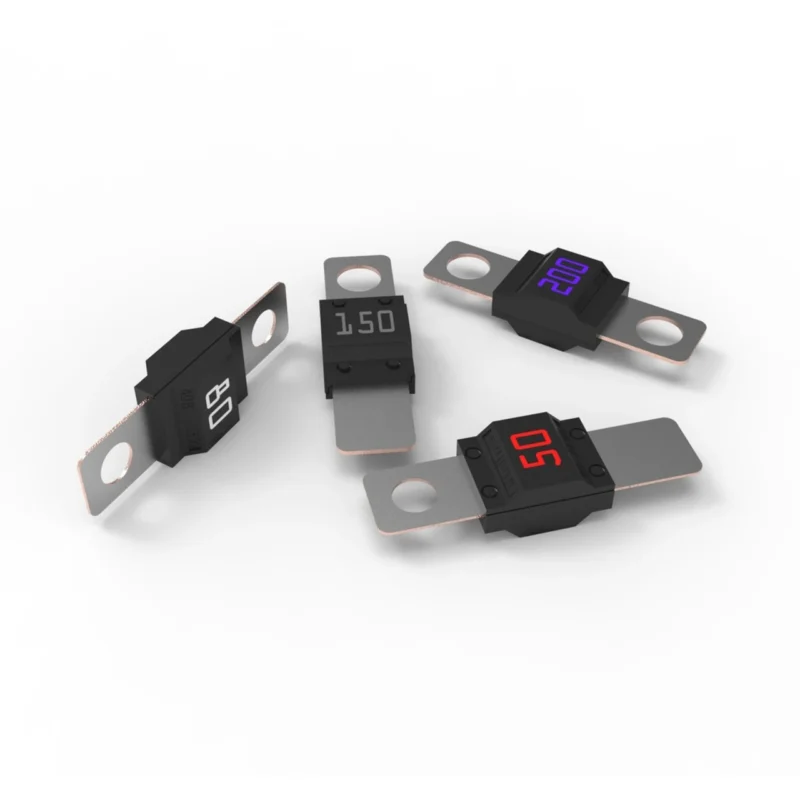
Start with the mounting architecture.
A MIDI fuse is a compact bolt-down fuse used in high-current wiring protection. It is not a plug-in blade fuse. It is also not automatically the same as a larger MEGA fuse. Before checking whether the marking says 30A, 50A, 60A, or 80A, confirm the fuse body and terminal structure.
This simple identity card prevents a common sourcing mistake: treating “MIDI bolt down fuse” as a complete specification.
MAXI and MIDI should also stay separate in the purchasing file. A MAXI fuse uses a plug-in blade interface. A MIDI fuse uses a bolted high-current connection. If your design is moving from a plug-in high-current blade fuse to a bolted fuse path, review the related MAXI fuse selection guide instead of assuming the two formats solve the same mechanical problem.
MIDI and MEGA are closer because both are bolt-down architectures, but they are still different families. Stud size, holder pitch, current range, voltage rating, terminal width, and package space all need verification.
Color can help identify the ampere value, especially in service work. It should not be used as final proof. Manufacturer color systems are useful for quick recognition, but the replacement decision still depends on geometry, current, voltage, interrupting rating, holder fit, and torque.
Which current rating protects the branch without oversizing the fuse?
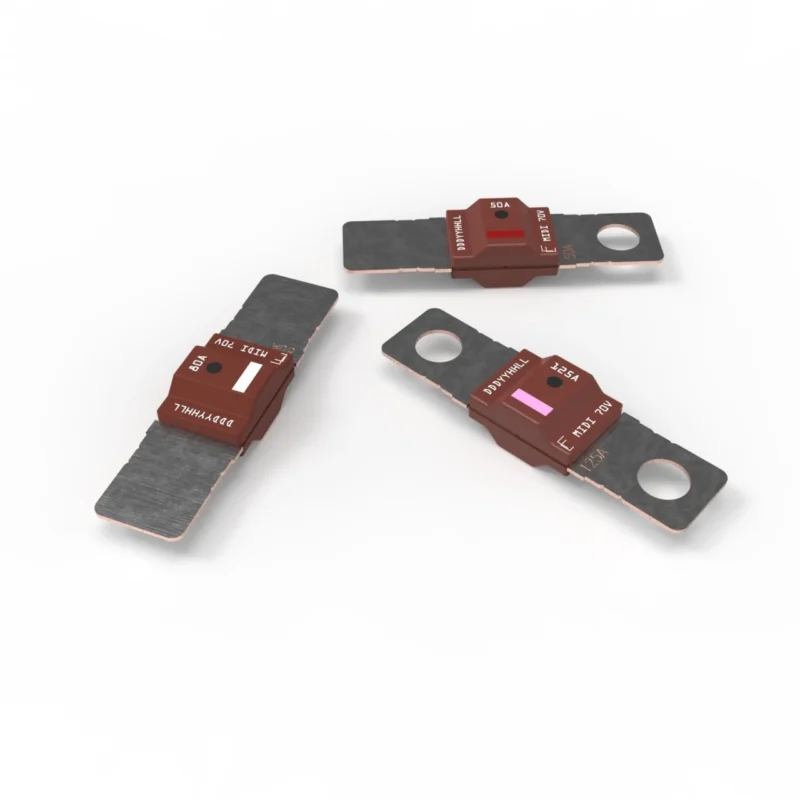
Do not begin with the failed fuse alone.
Begin with the protected branch: the load, cable, lug, holder, and expected current profile. A MIDI fuse 30A, MIDI fuse 50A, MIDI fuse 60A, or MIDI fuse 80A should be selected around the circuit it protects, not around the idea that a higher number is safer.
A fuse rating is not the same as a recommended continuous operating current for the whole circuit. A 60A fuse does not mean the branch should be designed to sit at 60A continuously without checking conductor size, ambient temperature, terminal rating, voltage drop, and holder limits.
Use this chain before approving the ampere value:
Load current → wire capability → inrush behavior → fuse curve → lug/holder rating → final MIDI rating
The key point is restraint. If the previous fuse opened, do not immediately move from 60A to 80A. First check for a short circuit, overloaded branch, damaged motor, unexpected inrush, wrong original fuse, loose terminal, corrosion, or heating at the bolted joint.
Some MIDI fuse families are time-delay designs. Littelfuse describes its 32V MIDI bolt-down fuse family as using time-delay characteristics, while its 70V MIDI High Performance series is positioned for high-inrush circuits such as fans, heaters, batteries, and starters. Those are useful clues, but the actual decision still belongs to the exact datasheet and time-current curve.
How do 32V and 70V MIDI systems change replacement compatibility?
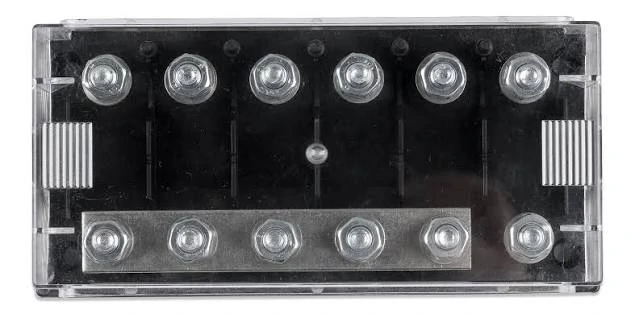
Transparent MIDI fuse holder showing internal bolt-down mounting structure and terminal connection design. The visible housing allows easier inspection of fuse positioning and electrical connection points.
Voltage family must be written into the purchasing specification.
A 60A fuse at 32V and a 60A fuse at 70V are not automatically interchangeable. They may differ in interrupting rating, body design, mounting hole format, holder system, torque requirement, and approved application range.
Current Littelfuse 32V MIDI documentation lists a 32VDC voltage rating and 2000A interrupting rating at 32VDC. Littelfuse 70V MIDI High Performance documentation lists 70VDC and 2500A at 70VDC. Eaton’s AMI family is specified as a 32VDC bolt-in automotive fuse family. These are series-level examples, not universal values for every marketplace listing. Use the selected manufacturer’s current document before release. Sources: Littelfuse 32V MIDI datasheet, Littelfuse 70V MIDI High Performance datasheet.
This matters more in 48V vehicle and battery-related systems. A fuse that is acceptable in a 12V or 24V circuit should not be carried into a higher-voltage architecture just because the ampere value matches.
For vehicle electrical-center work, this section should connect back to the wider automotive fuse box guide, because the MIDI fuse may only be one protection point inside a larger distribution path.
Why do hole diameter and spacing matter as much as the amp rating?
A bolt-down fuse fails mechanically before it ever gets the chance to protect electrically if the hole geometry is wrong.
Check the drawing. Do not rely only on a product photo. MIDI fuse dimensions can vary by series, voltage family, and mounting version. Current Littelfuse 32V MIDI designs include M5 and M6 variants, while its 70V MIDI high-performance and ISO-style products use M6 mounting formats. Some versions have one hole, some have two, and some newer holder systems support different layouts.
A fuse can appear close enough on the bench and still load the stud incorrectly after tightening. If the hole is too small, the part may not seat. If it is too large, alignment and contact area can suffer. If the spacing is wrong, the terminal can be stressed during installation.
Also keep wire-size tables in datasheets in context. A test cable size shown in a manufacturer rating table is not a universal installation wire size. The installed conductor, lug, holder, busbar, and thermal environment must be approved as a complete current path.
When should time-delay behavior be part of the circuit design?
A fuse does not respond only to a current number.
It responds to current over time. That matters in circuits where the normal operating current is modest, but the startup current is much higher for a short period. Fans, heaters, pumps, motors, battery-related loads, and starter-related circuits can all create this kind of problem.
A MIDI fuse used in this environment should not be selected by ampere marking alone. The design question is:
Can the fuse tolerate the expected inrush long enough, while still opening correctly during a real fault?
That answer comes from the exact fuse series and its time-current data.
For example, Littelfuse describes its 70V MIDI High Performance series as suitable for circuits with large inrush currents such as fans, heaters, batteries, and starters, and the same family uses time-delayed performance behavior. That does not mean every MIDI fuse is automatically safe for every motor or battery circuit. It means the time-current curve belongs in the approval process, especially when replacing a repeatedly opened fuse. Source: Littelfuse 70V MIDI High Performance datasheet.
Keep current magnitude and duration together. A short surge may be acceptable. A longer overload may not be. A repeated pulse may create more thermal stress than one isolated event.
Higher-current ratings also need care. In current Littelfuse 32V MIDI documentation, the 150A to 200A ratings are marked for short-circuit protection only in that series. That is a good warning against casual replacement logic. A buyer should not assume that a larger ampere value automatically gives more useful operating margin. Source: Littelfuse 32V MIDI datasheet.
How does tightening torque affect voltage drop and terminal heating?
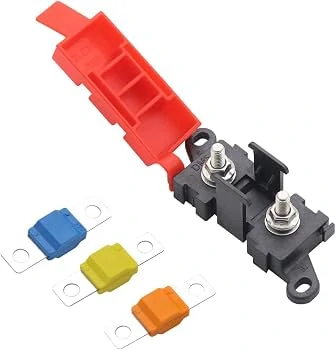
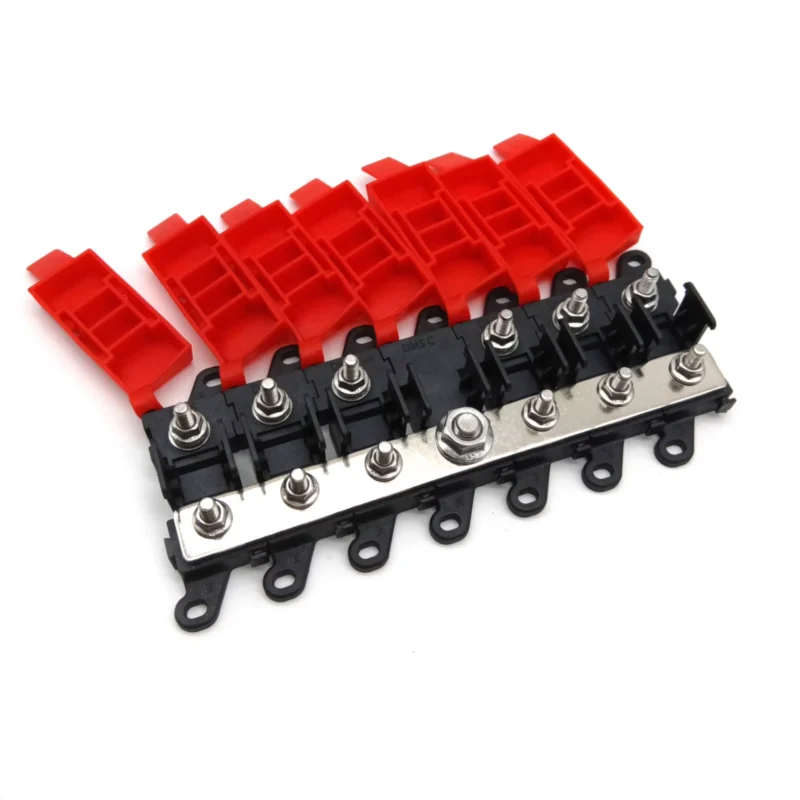
Bolt-down MIDI fuse holder with protective cover designed for secure installation in automotive, marine, and battery power distribution systems. The holder helps maintain stable electrical connections and protects the fuse assembly.
Torque is not just a mechanical note at the bottom of a datasheet.
In a MIDI fuse installation, current passes through a bolted joint:
lug → fuse terminal → stud → holder or busbar
If the joint is loose, oxidized, uneven, or assembled with the wrong hardware, contact resistance can rise. The fuse may not open because the branch current is still below its trip condition, but the terminal can become hot enough to discolor, soften surrounding plastic, or damage the holder.
That is why one universal MIDI fuse torque value should not be published as a general rule. Current manufacturer examples vary by family and hardware:
| Fuse / Series Example | Mounting Hardware | Torque Example |
| Littelfuse 32V MIDI | M5 | 4.5 ±1 N·m |
| Littelfuse 32V MIDI | M6 | 6.0 ±1 N·m |
| Littelfuse 70V MIDI High Performance | M6 | 9 ±1 N·m |
| Eaton AMI | Series-specific | Check exact datasheet / holder data |
The safest purchasing and installation instruction is simple: use the torque value from the exact fuse and holder documentation.
The heating effect can be estimated with two basic formulas:
Vdrop = I × R
Pheat = I² × R
That second formula is the uncomfortable one. At high current, a few milliohms at a poor joint can produce meaningful local heating. For example, if a bolted joint adds only 0.003 ohm at 80A, the heat at that resistance point is:
80² × 0.003 = 19.2 W
That heat is concentrated in a small metal/plastic interface. It may not look dramatic at the beginning of the test. After warm-up, vibration, or repeated load cycling, it can become the real failure point.
Inspect both sides of the bolt-down joint. Do not only look at the fuse body. Check the fuse terminal, ring lug, washer, nut, stud, busbar, plating, corrosion, and holder surface.
If the wiring side uses a ring terminal, the fuse selection should also connect to terminal preparation. A poorly crimped lug can make a correct MIDI fuse look like the problem. For that step, link the installation team to a related guide such as how to use crimp connectors rather than repeating every crimping detail inside the MIDI article.
Which wire, lug, holder, and busbar limits the real current path?
The MIDI fuse is only one part of the high-current chain.
A useful design review follows the current path from source to load:
source → cable → ring lug → holder / busbar → MIDI fuse → ring lug → load cable
The system limit is the lowest validated continuous-current component in that chain. If the fuse is rated higher than the cable, the cable becomes the risk. If the holder cannot manage the heat, the holder becomes the risk. If the lug is undersized or poorly crimped, the lug becomes the risk.
This is also where the design should decide whether a single inline holder is enough or whether the branch belongs in a larger distribution block. If several protected circuits share a feed, review a fuse block selection guide before adding separate bolt-down fuses one by one.
Modern high-current layouts are becoming more modular. Littelfuse’s 2026 MXM Series MEGA/MIDI Fuse Holder, for example, supports modular arrays combining MIDI and MEGA bolt-down fuses, M6 and M8 hardware, optional busbars, and configurations up to 120V depending on the fuse and holder combination. The practical lesson is not that every design needs a modular holder. The lesson is that MIDI selection increasingly belongs to the full power-distribution architecture: fuse part number, stud size, busbar, holder pitch, voltage family, and torque have to be designed together. Source: Littelfuse MXM Series MEGA/MIDI Fuse Holder datasheet.
A buyer requesting only “MIDI fuse 80A” leaves too many decisions to the supplier. A better note is:
MIDI bolt-down fuse, approved series or cross-reference required, current and voltage rating confirmed, M5/M6 geometry specified, holder compatibility verified, time-current data available, torque requirement included.
That turns a vague purchase into a controlled component selection.
How should MIDI and AMI naming be handled in purchasing?
MIDI and AMI are often treated as closely related names in the market.
That does not make them automatic substitutes.
An AMI fuse is commonly sold as a bolt-in automotive fuse family, often in 32VDC systems, while MIDI is also used for compact bolt-down high-current automotive protection. The overlap is real enough that buyers will see marketplace listings such as “MIDI / AMI fuse” or “AMI midi fuse.” The safe response is not to reject the overlap, but to control it.
A purchase request should not say:
MIDI / AMI 80A fuse, any type.
That wording leaves too much open. It does not define the voltage family, hole geometry, bolt size, interrupting rating, time-current behavior, holder fit, or torque requirement.
The exact part number should come before the marketplace name. Eaton AMI bolt-in automotive fuses are commonly listed as 32VDC automotive fuses in distributor data, while Littelfuse MIDI families include 32V and 70V versions depending on series. That difference alone is enough to prevent a casual substitution. Source: Eaton AMI bolt-in fuse distributor listing, Littelfuse MIDI fuse family data.
For OEM service work, separate aftermarket equivalence from engineering approval. A fuse may fit the studs and carry the same ampere marking, but the equipment manufacturer may still require an approved series or exact cross-reference.
When should MIDI be chosen instead of MEGA?
MIDI and MEGA are both bolt-down fuse architectures, but they should not be compared only by ampere range.
MIDI is generally the more compact choice. It is often used where the circuit needs high-current protection but the design still needs a smaller package, lighter hardware, and tighter power-distribution layout. MEGA is often considered when the system moves toward larger current paths, larger studs, heavier lugs, or a broader high-current distribution architecture.
Use this matrix as a first pass:
| Requirement | MIDI Direction | MEGA Direction |
| Compact packaging | Strong | Lower |
| Bolt-down connection | Yes | Yes |
| Moderate / high current | Strong | Strong |
| Very high-current architecture | Verify | Often stronger candidate |
| Smaller stud / package | Often | Usually larger |
| Existing holder ecosystem | Verify | Verify |
| Mixed fuse array | Purpose-designed only | Purpose-designed only |
Do not assume MEGA is better because it is larger. A larger fuse can add space, weight, stud requirements, holder cost, and assembly constraints without improving the actual protection if MIDI already fits the circuit.
The opposite mistake is also common: selecting MIDI only because space is tight. If the branch current, lug size, thermal margin, voltage rating, or holder ecosystem points toward MEGA, the design should make room for the correct architecture.
Mixed MIDI/MEGA layouts are possible, but they belong in designed holder systems. Littelfuse’s MXM Series, for example, supports modular high-current arrays that can combine MEGA and MIDI fuses with M6 and M8 hardware, optional busbars, and configurations up to 120V depending on the fuse and holder combination. That is not a license to improvise different fuse bodies on arbitrary studs. Source: Littelfuse MXM Series MEGA/MIDI Fuse Holder datasheet.
Validate the replacement under real load before releasing the circuit
A replacement fuse should be checked cold, loaded, and warm.
Visual fit is not enough. Continuity is not enough. A bolted high-current joint may pass a quick check and still develop heat once current flows through the branch.
Before energizing, record:
- Fuse series
- Part number
- Current rating
- Voltage rating
- Hole geometry
- Holder or busbar part number
- Required torque
- Applied torque
Then test the assembly under realistic load. Measure voltage drop across the fuse path, not only across the fuse element in isolation. Temperature should be checked at both bolted joints and at the nearby holder or busbar surface.
If the second fuse opens again, do not escalate the rating as the first response. Recheck the load, inrush, wiring, lug crimp, holder condition, corrosion, and torque. Repeat opening is evidence. Treat it like a circuit symptom, not a purchasing inconvenience.
Build the supplier specification around P/N, geometry, torque, and environment
A useful RFQ gives the supplier enough data to send the correct fuse, not just a similar-looking one.
Do not request only:
MIDI fuse 60A.
A better request is:
MIDI bolt-down fuse, approved series or qualified cross-reference, 60A, voltage rating confirmed, interrupting rating documented, M5/M6 geometry specified, holder compatibility verified, time-current data available, torque requirement included.
Incoming inspection should include the current marking, voltage family, dimensions, hole geometry, terminal condition, lot traceability, and documentation. If the terminal thickness, plating, housing material, hole size, fuse element design, production site, or approved cross-reference changes, increase verification before release.
This is especially important for buyers managing service parts or mixed supplier sources. A fuse is small, but the failure cost is not small when it sits in the main power path.
FAQ
Are MIDI and AMI fuses automatically interchangeable?
No. The names overlap in the market, but replacement still requires matching current, voltage, hole geometry, bolt spacing, interrupting rating, opening characteristic, holder compatibility, and torque requirement.
Can a 32V MIDI fuse replace a 70V MIDI fuse if both are rated 60A?
Do not assume so. Voltage rating and interrupting capability must match the actual system. A 60A marking only answers one part of the selection question.
Why does tightening torque matter on a MIDI fuse?
Because the fuse is part of a bolted electrical joint. Too little clamping force can increase resistance and heating. Too much torque can damage the fuse, terminal, stud, or holder.
Can a 100A MIDI fuse safely carry 100A continuously?
Do not determine continuous design current from the marking alone. Ambient temperature, conductor size, lug rating, holder design, time-current curve, and the exact fuse series all matter.
Why can a MIDI fuse terminal become hot even when the fuse does not open?
A loose or corroded joint can generate localized heat through P = I²R while the total branch current remains below the fuse opening threshold. Loaded voltage-drop and temperature testing can reveal this issue.
Is MIDI always better than MEGA when installation space is limited?
No. MIDI is generally more compact, but the final choice depends on current, voltage, holder availability, terminal size, stud hardware, thermal margin, and future distribution needs.
Can two MIDI fuses with the same amp rating have different mounting dimensions?
Yes. Different series may use different bolt sizes, one-hole or two-hole layouts, voltage-specific geometry, and holder requirements. Always check the outline drawing before ordering.
A MIDI fuse is a small part with a long decision chain behind it. The correct selection is not only “same amp, same shape.” It is current, voltage, geometry, opening behavior, torque, holder fit, and real-load validation working together.