
A fuse block usually fails as a sourcing decision before it fails as a part.
The drawing says “add six accessories.” The buyer orders a neat 6-way fuse block. The installer fills every position. Later, two more loads are added, one pump pulls more current than expected, and the main feed starts running warm. Nothing looks obviously wrong. Each branch has a fuse. The problem is that the block was selected by slot count, not by the full current path.
A good fuse block is not just a row of fuse clips. It is a small power-distribution system: input terminal, bus, branch fuse contacts, output terminals, cover, labels, mounting points, and sometimes a negative bus. For automotive, 12V DC, accessory wiring, commercial vehicles, and OEM equipment, the selection has to start with circuits, fuse family, shared current, and service access.
How many protected circuits should the block support?
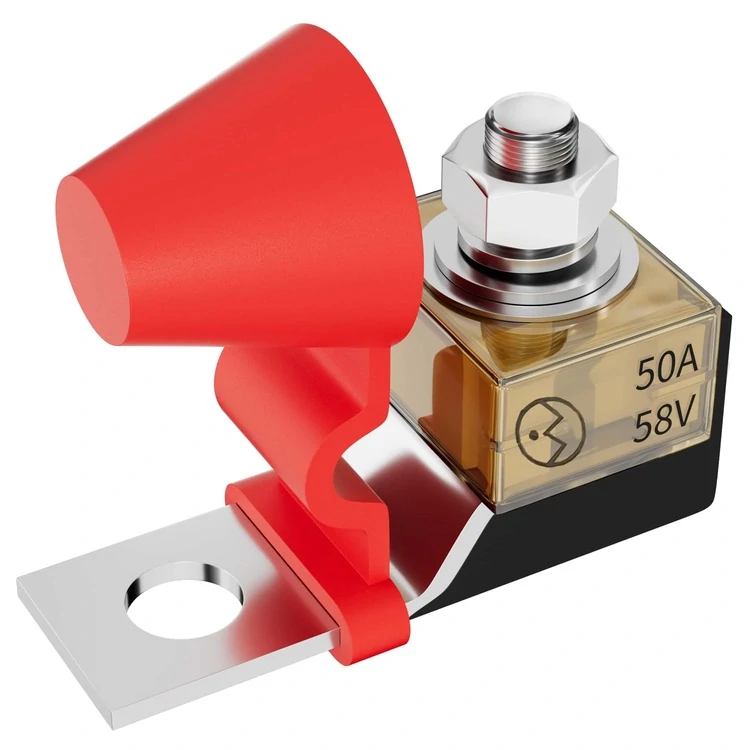
This multi-circuit automotive fuse block is designed for organized 12V accessory wiring. It supports multiple blade fuse branches, helping protect individual circuits while providing a cleaner power distribution solution for vehicles, trucks, and custom electrical installations.
Start with the loads, not the product photo.
A 6 way fuse block may be enough for a small accessory system. An 8 way fuse block gives a little planning room. A 12 way fuse block can clean up a larger harness, but it can also hide poor design if every spare position becomes an undocumented add-on later.
List the actual circuits first:
| Circuit | Load | Operating Current | Fuse Position | Active Now? | Future? |
| 1 | Radio / communication unit | 6 A | 1 | Yes | No |
| 2 | Auxiliary lighting | 12 A | 2 | Yes | No |
| 3 | Pump | 8 A | 3 | Yes | No |
| 4 | USB / accessory socket | 4 A | 4 | Yes | No |
| 5 | Controller | 2 A | 5 | Yes | No |
| 6 | Future sensor branch | TBD | 6 | No | Yes |
The useful planning rule is simple:
Required positions = Current circuits + Approved spare positions
That formula does not size the electrical bus. It only tells you how many protected branch positions the layout needs.
A common mistake is buying a larger automotive fuse block because “more positions are safer.” More positions only help when the main feed, bus rating, mounting space, branch terminal size, and service labeling also support the future circuits. Otherwise, the larger block just invites random expansion.
For a one-branch accessory, an individual holder may still be cleaner. If only one remote circuit needs protection, it is better to choose a holder when only one circuit needs protection instead of forcing everything into a central block.
Which fuse family should the block accept?
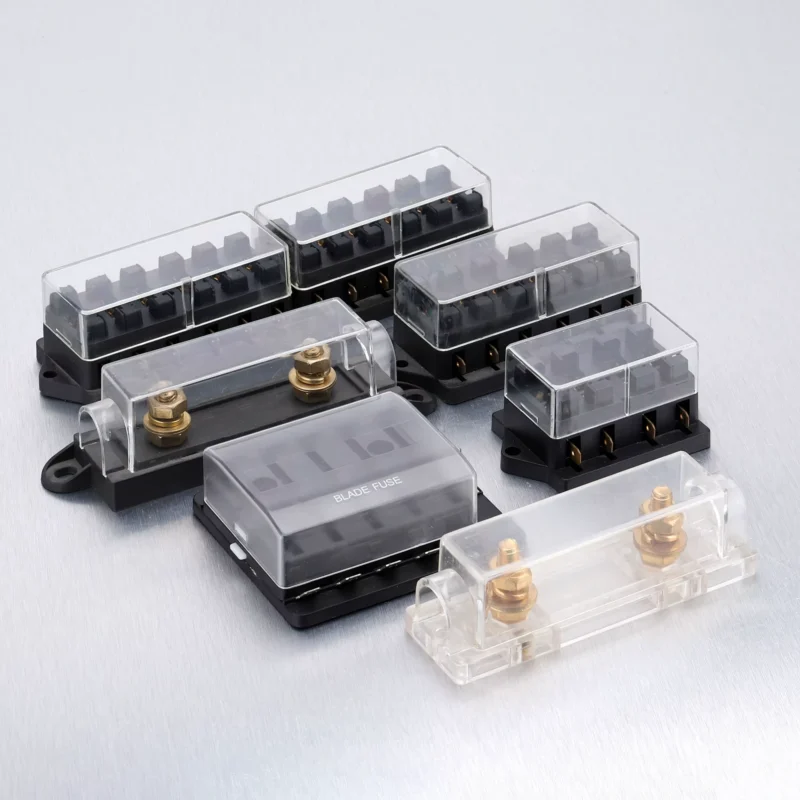
The fuse family has to be chosen before the enclosure.
A blade fuse block may accept ATO, ATC, MINI, low-profile MINI, or another defined blade format, depending on the exact product. Do not assume that every blade fuse fits every blade-style block. The plastic body, blade spacing, fuse height, cover clearance, and contact pressure all matter.
For U.S. automotive and 12V accessory work, ATO fuse block and ATC fuse block products are common because standard blade fuses are easy to source and service. MINI formats are useful when the block must stay compact. The trade-off is service handling and current range. Smaller is not automatically better.
Littelfuse, for example, lists automotive fuse block families by defined fuse formats such as ATO, MINI, MAXI, MIDI, MEGA, and related configurations, rather than treating every fuse block as one universal interface. See its overview of automotive fuse block configurations and fuse-family options.
If the design uses blade fuses, it is worth checking the blade format separately before releasing the BOM. You can verify ATO, ATC, MINI, and other blade formats before choosing the final block.
Use a short compatibility record:
| Field | Requirement |
| Fuse family | ATO / ATC / MINI / other |
| Fuse physical format | Standard blade, mini blade, etc. |
| Branch current range | Confirm per circuit |
| Block part number | Exact approved P/N |
| Fuse positions | 6 / 8 / 12 / other |
| Fuse indicator required? | Yes / No |
| Approved fuse P/Ns | List exact series |
| Mixed fuse families allowed? | Yes / No |
Avoid mixing fuse families just because different branches have different currents. The branch fuse rating should follow the load current, conductor size, fuse characteristic, and holder/block approval. Visual convenience is not a protection strategy.
How should total bus current be sized from actual loads?
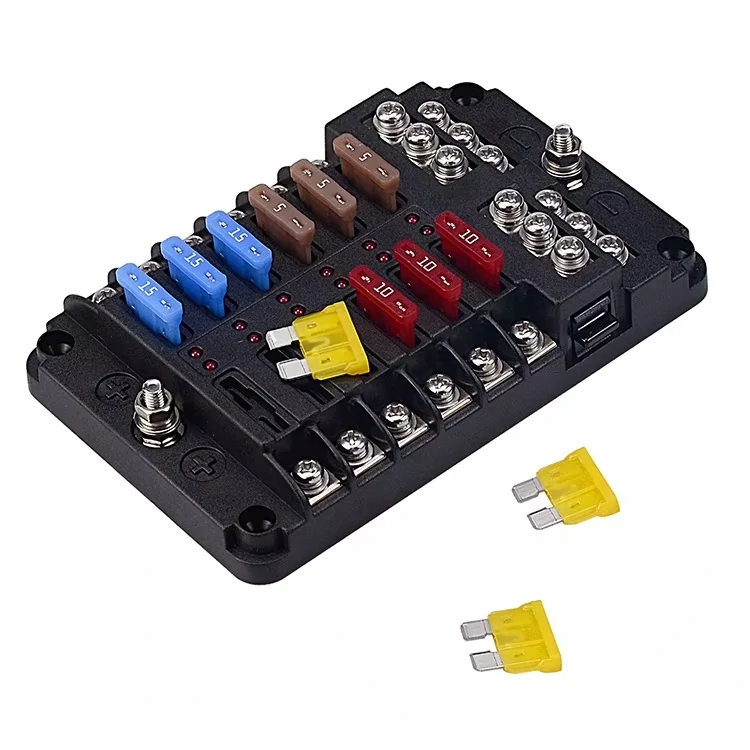
ANL fuse holders are commonly used in high-current automotive and DC power applications. Installed near the battery or power source, they help protect the main feed cable from overcurrent conditions and electrical faults.
Do not add all fuse ratings together.
That is one of the fastest ways to overspecify the main fuse or misunderstand the block. A 20 A branch fuse does not mean the connected load normally consumes 20 A. It means the branch protection is set around a permitted current limit for that circuit and conductor.
Example:
| Branch | Operating Current | Simultaneous? | Included Current |
| Radio | 6 A | Yes | 6 A |
| Auxiliary lights | 12 A | Yes | 12 A |
| Pump | 8 A | Yes | 8 A |
| USB loads | 4 A | Yes | 4 A |
| Future spare | TBD | No | 0 A |
This matters because current automotive distribution hardware is no longer just a simple row of clips. Eaton’s Series 15400 RFRM, for example, separates nominal 12/24 VDC operation, bus current, plug-in component capacity, wire limits, temperature range, and sealing requirements in its product specification; it lists 100 A per bus bar and 200 A maximum for that module family. Use it as a design example, not as a rating you can transfer to another product: automotive bus current and sealed distribution design example.
The practical takeaway is blunt: circuit count alone is not enough. A 12-position block with a weak input path may be a worse choice than a smaller block with a properly rated bus, terminal system, and feed conductor.
When should a common bus be replaced by independent inputs?
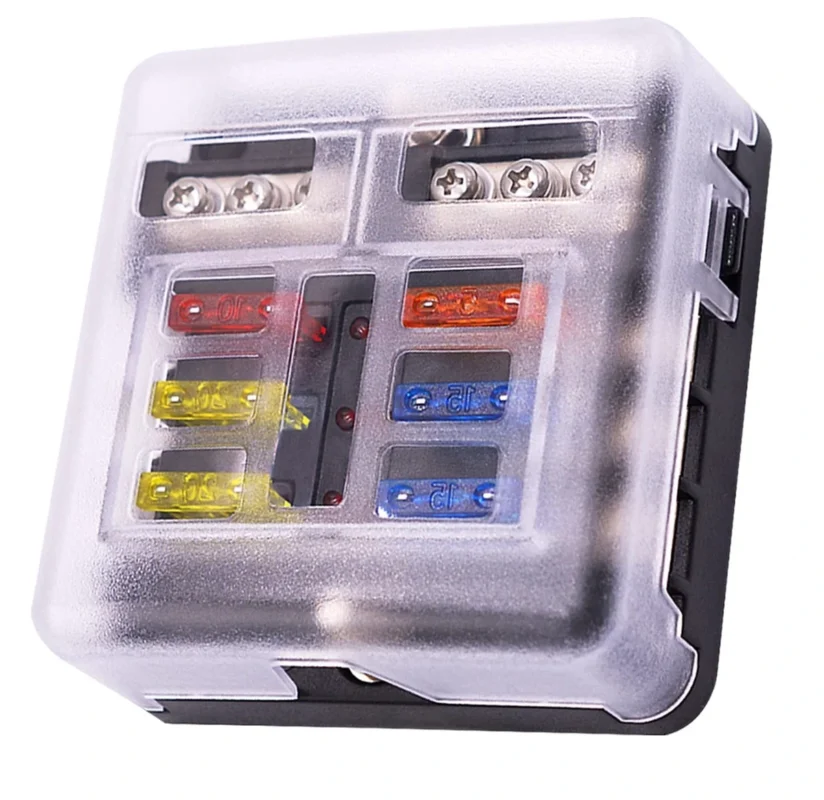
A common positive bus is useful when several branch circuits share one supply source.
The usual layout is:
Battery / source → main feed → positive bus → branch fuses → individual loads
That works well for many accessory systems: lights, radio equipment, pumps, small controllers, USB sockets, fans, and auxiliary devices. One main feed enters the block, the bus distributes power, and each branch fuse protects its own downstream conductor.
The problem starts when the circuits are not actually the same electrical group.
Use independent inputs, split buses, or separate blocks when the system has:
- Battery-direct and ignition-switched circuits
- Different voltage domains
- Separate power sources
- Redundant supplies
- Noise-sensitive control wiring
- Loads that must remain isolated for service or fault control
A fuse block with bus bar is convenient, but convenience can become a wiring mistake if every branch is forced onto the same source. A switched accessory circuit should not accidentally become live all the time just because it shares a bus with battery-direct loads.
Some blocks also include a negative or ground bus. That can make the harness cleaner, especially in insulated-return systems, fiberglass bodies, trailers, boats, and accessory panels where chassis return is not convenient. In a typical vehicle chassis-ground layout, a negative bus may be unnecessary.
Do not confuse a fused bus with an unfused fuse distribution block or power distribution block. Both may split one input into several outputs, but only the fused arrangement provides branch overcurrent protection at each output.
| Product | Distributes Power | Branch Fusing | Common Bus | Best Use |
| Individual fuse holder | One branch | Yes | No | Single accessory |
| Fuse block | Multiple branches | Yes | Often | Multi-circuit protection |
| Unfused distribution block | Multiple branches | No | Yes | Power splitting only |
| Automotive fuse panel | Multiple branches | Usually | Depends | Centralized service panel |
This is also why wording matters in the RFQ. “Fuse distribution block” can mean different things to different suppliers. If every output needs a fuse, say that directly.
How should the main feed and upstream fuse be coordinated?
Branch fuses protect branch conductors. They do not automatically protect the conductor between the power source and the fuse block.
That main feed may need its own upstream fuse or breaker, depending on the vehicle, equipment design, cable length, fault exposure, and installation rules. If the main feed shorts before the block, the branch fuses may never see the fault.
The coordination chain should be checked in order:
Source → Main fuse / breaker → Main feed conductor → Input stud → Fuse block bus → Branch fuses → Branch wires
For each point, record:
| Element | What to Confirm |
| Main fuse / breaker | Rating, voltage, interrupting capacity, mounting location |
| Main feed conductor | Wire size, insulation temperature, length, voltage drop |
| Input stud | Current rating, thread size, torque requirement |
| Bus | Continuous current capability, material, plating |
| Branch fuse | Fuse family, amp rating, voltage rating |
| Branch wire | Gauge, insulation, routing, terminal fit |
A common mistake is adding all branch fuse ratings and using that number as the main fuse size. Ten 20 A fuse positions do not automatically require a 200 A main fuse. The main protection should follow expected simultaneous current, conductor capability, and system fault requirements.
For example, if a block has ten positions but only four loads can run together, the expected load may be far below the sum of the installed fuses. The main fuse still needs enough margin for normal operation and startup current, but it should not be chosen from slot count alone.
What does a 12V fuse block need beyond a 12V label?
“12V” is a nominal system description, not a complete electrical rating.
A 12V fuse block used in a car, truck, trailer, accessory panel, or OEM control box still needs a stated maximum DC voltage rating. Many systems called 12V operate above 12.0 V during charging. Some applications may also need 24V compatibility.
Voltage rating should also be kept separate from transient protection. A fuse block does not replace TVS protection, reverse-polarity protection, load-dump protection, EMI filtering, or proper grounding design.
This is especially important for car fuse block and automotive fuse block sourcing. A seller may write “12V” in the title, but the approved voltage, branch current, bus current, cover material, and terminal system still need to be checked at product level.
Some modern automotive modules support nominal 12 VDC and 24 VDC systems, but that rating belongs only to the exact part number tested and specified by its manufacturer. Do not copy the rating to a different low-cost block because the layout looks similar.
Choose between 6-, 8-, and 12-way layouts before reserving spare circuits
Circuit count should be chosen from real loads plus realistic expansion.
A 6 way fuse block can be the right answer for a compact accessory harness. An 8 way fuse block works when there are a few active loads and one or two approved future branches. A 12 way fuse block makes sense when the system genuinely needs centralized protection for many circuits and has enough feed capacity, bus margin, mounting area, and labeling space.
| Planning Field | 6-Way | 8-Way | 12-Way |
| Current circuits | Best for small systems | Medium systems | Larger accessory panels |
| Planned future circuits | Limited | Moderate | Better expansion room |
| Mounting area | Compact | Moderate | Largest |
| Labeling need | Lower | Medium | Higher |
| Risk if poorly planned | No spare capacity | Moderate | Uncontrolled expansion |
| Best fit | Simple accessory wiring | Balanced layouts | Planned multi-circuit systems |
More positions do not mean more current. A 12-way block may still have the same input stud size or bus limitation as a smaller design. Always separate:
- Number of fuse positions
- Maximum branch current
- Total bus current
- Main feed wire size
- Negative bus capacity, if included
Leave labeling space for every active and reserved circuit. A spare fuse position without a label is not a plan; it is just an open invitation for someone to add a mystery wire later.
If the circuit is remote and only one branch needs protection, it may still be cleaner to protect a single remote accessory branch with an inline holder instead of enlarging the central block.
How should waterproofing and mounting location change the block design?
A plastic cover is not the same as waterproofing.
Before selecting a waterproof fuse block, define the installation zone first. Cabin wiring, trunk wiring, engine-bay wiring, exterior equipment, and commercial vehicle body wiring do not see the same water, dust, heat, vibration, or service conditions.
| Installation Zone | Water | Dust | Heat | Vibration | Required Protection |
| Cabin | Low | Low | Low | Low | Cover mainly for service safety |
| Trunk | Medium | Low | Low | Medium | Covered block, protected routing |
| Engine bay | Medium to high | Medium | High | High | Sealed cover, heat clearance |
| Exterior | High | High | Variable | High | Defined IP protection |
| Commercial vehicle | High | High | Medium to high | High | Sealed housing, strain relief, labeling |
If the block is mounted where water spray, mud, washdown, or condensation is expected, require an explicit ingress rating and the correct installed accessories. Eaton’s sealed RFRM design, for example, lists IP66 only with the required cover, seals, and cavity plugs, which is a useful reminder that sealing depends on the complete assembly, not the housing alone: Eaton Series 15400 RFRM.
Empty cavities are easy to overlook. So are loose covers, poorly seated gaskets, and cable entries with no strain relief. A block can be “waterproof” in the catalog and still fail in the vehicle if unused positions are left open.
Separate a fuse block from a fuse distribution block or automotive fuse panel
Use the term fuse block when branch protection is the core function.
A fuse distribution block may also distribute one input into several outputs, but the important question is whether each branch is individually fused. If the outputs are not fused, the product is a power distribution block, not a direct replacement for multi-circuit protection.
An automotive fuse panel is broader. It may include fuses, relays, labels, switches, indicators, and service covers. That can be useful for a complete accessory panel, but it also creates more specification fields.
Keep OEM automotive fuse box troubleshooting outside this article. A factory fuse box question usually means “where is the fuse for this vehicle function?” or “which OEM fuse controls this circuit?” That is different from selecting an added fuse block for new accessory wiring.
Validate bus, stud, terminal, and branch voltage drop under load
Continuity is not enough.
A fuse block can pass a basic continuity test and still run hot under load. The weak point may be a loose input stud, poor crimp, oxidized fuse contact, undersized terminal, weak spring pressure, or excessive resistance in the shared bus path.
Measure the full current path:
Main cable → input stud → bus → fuse contact → fuse → branch terminal → branch wire
Use voltage drop to locate resistance:
Vdrop = I × R
Use heating logic to understand why a terminal can overheat even when the fuse does not open:
Pheat = I² × R
That second formula matters. A branch drawing normal current can still create local heat if one connection has too much resistance.
Test with several branches operating at the same time. Single-branch testing may miss shared-bus heating and main-feed voltage drop.
Build the RFQ and incoming inspection plan around the full distribution path
A useful RFQ does not say only “100 A fuse block.”
That phrase is too vague. Does 100 A mean bus current, input current, total branch sum, maximum branch current, or upstream fuse size? Put those fields separately.
| RFQ Field | Requirement |
| Number of circuits | 6 / 8 / 12 / custom |
| Fuse family | ATO / ATC / MINI / other |
| System voltage | 12V / 24V / rated DC voltage |
| Expected simultaneous current | Calculated load |
| Bus continuous rating | Supplier-confirmed |
| Maximum branch current | Per circuit |
| Positive bus | Common / independent / split |
| Negative bus | Yes / No |
| Main input stud | Size and torque |
| Branch terminal type | Required terminal series |
| Cover required | Yes / No |
| Waterproof/IP requirement | If applicable |
| Voltage-drop limit | Project-defined |
| Temperature-rise limit | Project-defined |
| Mounting dimensions | Drawing required |
| Labels required | Yes / No |
| Spare positions | Approved quantity |
Incoming inspection should check the exact part number, fuse fit, terminal dimensions, bus configuration, cover or seal condition, continuity, and critical torque points. For higher-current or vehicle-body installations, add a risk-based loaded voltage-drop test.
If the system still uses several separate single-circuit holders, compare whether it is better to replace multiple inline holders with a centralized fuse block or keep the branches separated for service access.
FAQ
How many fuse-block positions should I choose for an accessory system?
Count the circuits required now, then add only realistic spare positions. A larger block is useful only when bus capacity, feed cable size, mounting space, labeling, and future load margin also support the expansion.
Can I add all branch fuse ratings together to determine the fuse-block bus current?
No. Fuse ratings are protection values, not normal operating current. Size the shared bus from expected simultaneous operating currents, then check the input stud, main feed, upstream protection, and temperature limits.
Does a multi-circuit fuse block still need a main upstream fuse?
Often yes. Branch fuses sit after the block input, so they may not protect the conductor between the source and the fuse block. The main feed should be protected according to the wiring architecture and applicable equipment requirements.
Is a 12V fuse block suitable only for exactly 12 volts?
No. “12V” usually describes the nominal system. Confirm the actual maximum DC voltage rating for the fuse block, branch fuses, terminals, wiring, and any integrated relays.
Is a fuse distribution block the same as an unfused power distribution block?
No. Both may split power into multiple outputs, but a true fused distribution arrangement provides branch overcurrent protection. An unfused distribution block only divides current and needs separate protection where required.
Does every automotive fuse block need a negative or ground bus?
No. A negative bus is useful when return wiring needs to be centralized. Chassis-ground systems may not require one. Decide from the wiring design, not from the product title.
Why can one fuse-block terminal overheat while the branch fuse remains intact?
The cause may be local resistance, not overcurrent. A loose stud, weak fuse contact, oxidized terminal, or poor crimp can create heat under normal current. Loaded voltage-drop and temperature checks are better than continuity alone.
Final buying guidance
Select the fuse block from the electrical path, not from the number of fuse slots.
For a clean RFQ, send the supplier the circuit count, fuse family, system voltage, expected simultaneous current, bus architecture, main feed size, branch current range, mounting environment, waterproof requirement, terminal style, cover requirement, and inspection target. That information prevents the common mismatch: a block that looks correct, accepts the fuse, and still fails the real installation.
For TEJTE-style sourcing pages, the practical message is simple: specify the block as a small distribution system, not as a plastic holder with several fuse positions.