
A glass fuse is easy to look at and easy to misread.
The transparent tube gives a quick clue, so many users pull the fuse, hold it toward the light, and decide the replacement from what they can see. That works only for the first inspection step. A clear body can show a broken element, darkening, deposits, or damaged end caps, but it cannot confirm the full electrical specification. Two glass fuses can look almost identical and still differ in opening speed, voltage rating, breaking capacity, approval, or internal element design.
How can the transparent body help identify a glass fuse without becoming the only check?
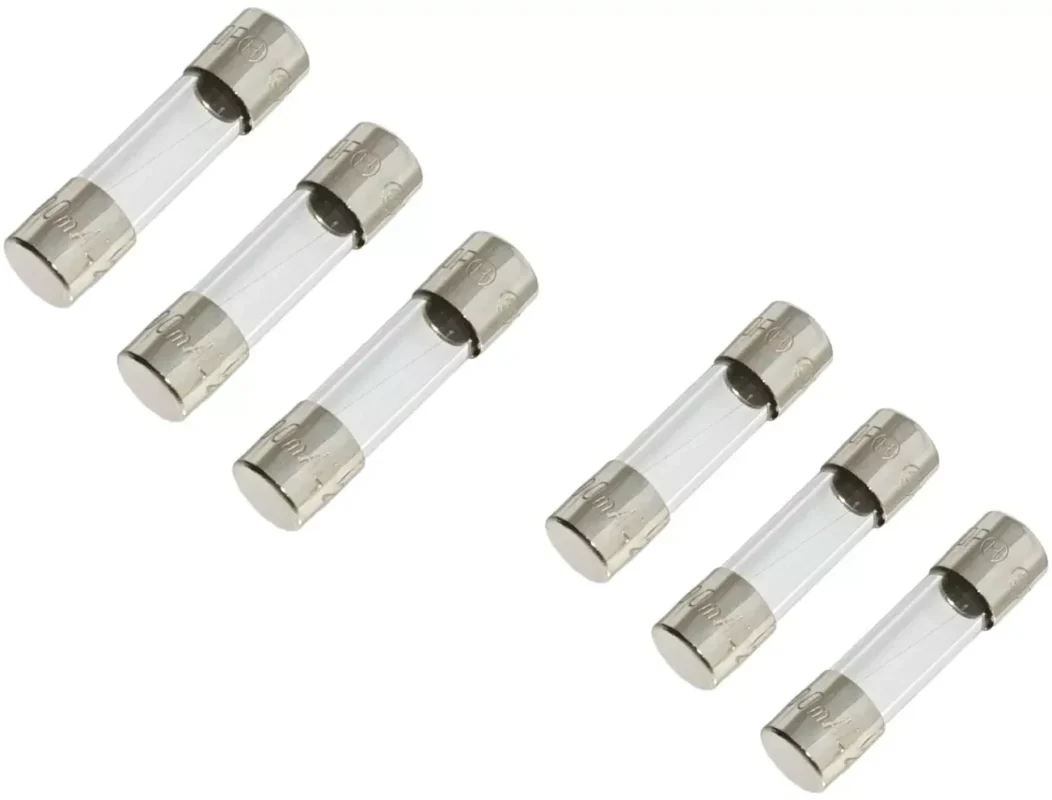
The visible element is useful. If the wire is clearly separated, the fuse has opened. If the inside of the tube is blackened or metal has deposited on the glass, the fuse likely saw a heavier fault event. If one end cap is loose, cracked, or discolored, the problem may involve heat, poor holder contact, or mechanical damage rather than only overcurrent.
That visual clue is not enough to approve a replacement.
A glass tube fuse is still a rated protection part. The body material does not tell you the current rating, voltage rating, fast-blow or time-delay behavior, or fault-current capability. This is where many maintenance mistakes start: the replacement is selected because it has the same length and the same ampere number, while the speed code or breaking capacity is ignored.
Read the end-cap markings before assuming two parts are equivalent. Record the current rating, voltage rating, speed marking, series number, manufacturer, and approval marks. If the marking is rubbed off, treat the part as unidentified until the equipment BOM, manual, or supplier drawing confirms it.
For a broader view of cartridge-format selection, you can also review the complete cartridge fuse selection process before narrowing the choice to glass construction.
This simple card prevents a common sourcing shortcut: “same glass tube, same amps, good enough.” It is not good enough unless the safety-critical fields match.
Which dimensions matter when a glass fuse has to fit an existing holder?
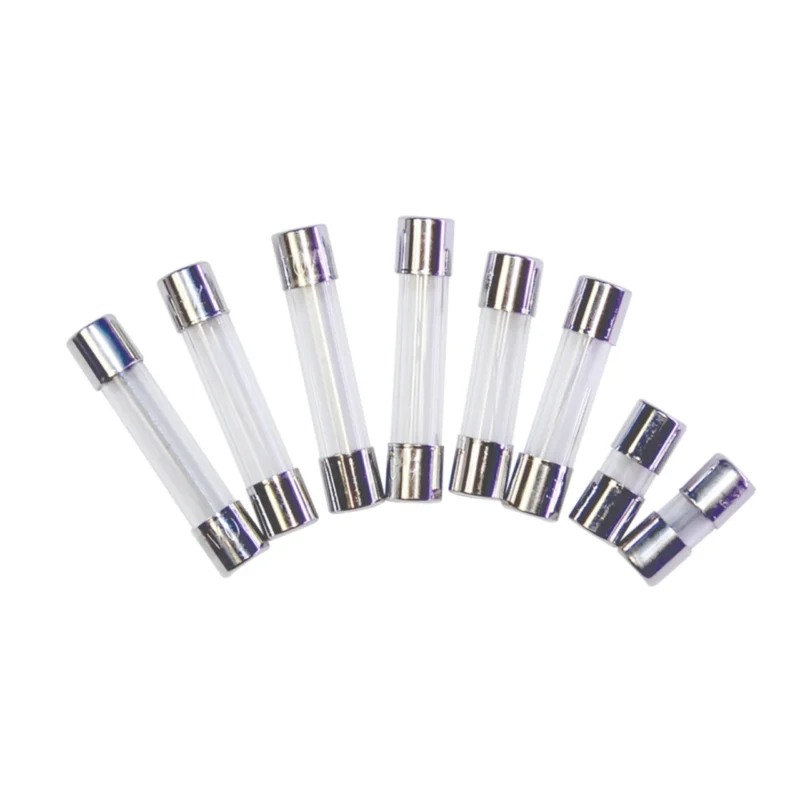
Glass fuse sizes must be checked by actual dimensions, not by casual names such as “small glass fuse” or “standard fuse.” The most common mistake is measuring only the length and forgetting the diameter, end-cap shape, and holder contact area.
For miniature equipment, a 5×20 glass fuse is common, but it is not the only cartridge format in use. Larger glass cartridge fuse sizes may appear in power supplies, appliances, test equipment, audio equipment, lighting controls, and older repair jobs. Even within the same nominal size, the electrical behavior may differ.
Measure these points separately:
- Body diameter
- Overall length
- End-cap diameter
- Contact length
- Holder clip spacing
- Whether the part is cartridge style or axial-leaded
Do not infer electrical capability from the tube size. Two 5×20 mm glass fuses may both fit the same holder while using different current ratings, voltage ratings, opening curves, breaking capacities, or agency approvals.
A fuse that is slightly loose in the holder can create heat through contact resistance. A fuse that is forced into a tight holder can damage the glass or end caps. Either case can turn a simple replacement into a repeat failure.
How should a 250V glass fuse be matched to AC and DC circuits?
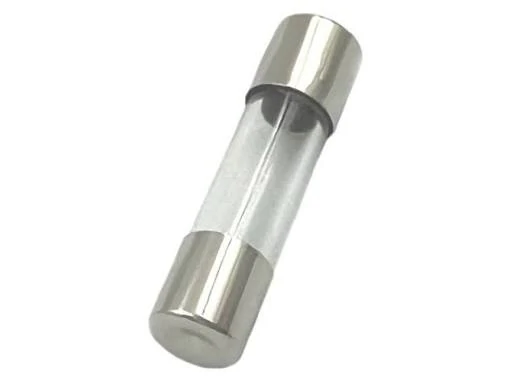
A complete guide to glass fuse selection covering fuse dimensions, current rating, voltage rating, fast-blow and time-delay characteristics, breaking capacity, replacement methods, and supplier qualification requirements.
A 250V glass fuse does not “use” 250 volts. The marking means the fuse has a voltage rating that must be suitable for the circuit it may need to interrupt. The fuse voltage rating should meet or exceed the available circuit voltage, but voltage alone does not make the part correct.
A 250 V fuse may be used in a lower-voltage circuit only when the other requirements also match: current rating, opening speed, AC/DC suitability, breaking capacity, size, approvals, and holder rating. The ampere number still has to protect the actual circuit. The speed still has to match the startup behavior. The fault-current rating still has to be suitable for the source.
AC and DC also need separate attention. Do not assume 250 VAC automatically means 250 VDC. DC interruption can be more demanding because current does not naturally cross zero. If the datasheet gives only an AC rating, confirm whether the part is acceptable for the DC application before releasing it.
Apply a Voltage Compatibility Gate
| Check | Requirement |
| Maximum circuit voltage known | Yes |
| AC or DC identified | Yes |
| Fuse voltage ≥ circuit voltage | Yes |
| AC/DC rating compatible | Yes |
| Breaking capacity checked | Yes |
| Correct fuse series confirmed | Yes |
| Approval | PASS / HOLD |
This gate is useful for procurement too. A request such as “need 250V glass fuse” is too vague for reliable sourcing. A better RFQ says: “5×20 mm glass cartridge fuse, 2 A, 250 VAC, fast-acting, specified breaking capacity, required approval, datasheet required.” The second version gives the supplier something that can be checked instead of guessed.
When should a fast-blow or time-delay glass fuse be selected?
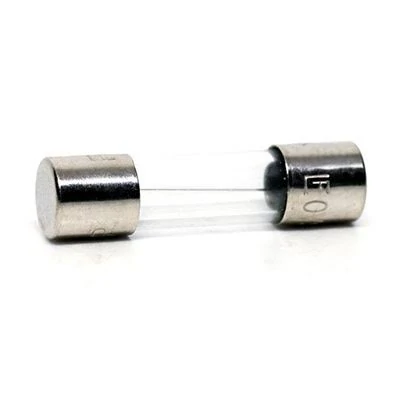
A single glass fuse example commonly used for voltage-rated circuit protection applications, showing the transparent body and metal cap structure.
The opening speed is not a minor detail printed on the cap. It changes how the circuit behaves during startup, overload, and fault conditions.
A fast blow glass fuse is used where the circuit does not need much tolerance for temporary inrush current. If the protected components are sensitive and the normal startup current is modest, fast-acting behavior can be appropriate. The fuse should open quickly when current rises beyond its intended range.
A slow blow glass fuse, also called a time delay glass fuse, is different. It is designed to tolerate short startup surges that are normal for the equipment. That does not mean it is “stronger” in a general sense. It means the opening curve is different.
Common inrush sources include transformers, motors, capacitive power supplies, and large input capacitors. If a product normally draws a short current pulse during power-on, replacing a time-delay fuse with a fast-acting part may cause nuisance opening. The opposite mistake is also risky: replacing a fast fuse with a slow one just because the old fuse keeps blowing can delay protection during a real fault.
This record is especially useful when a buyer only has a failed sample and no original BOM. The goal is not to “make the fuse stop blowing.” The goal is to confirm whether the fuse is opening because it is wrongly selected or because the circuit still has a fault.
Why can equal-looking glass fuses behave differently during a short circuit?
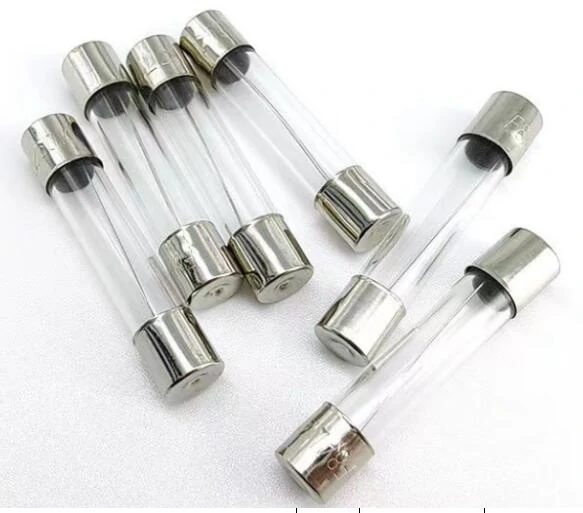
A group of glass tube fuses showing the common construction of transparent fuse bodies and metal end terminals used in electronic protection circuits.
Ampere rating and breaking capacity answer different questions.
The ampere rating relates to normal protection and overload behavior. Breaking capacity, sometimes called interrupting rating, relates to whether the fuse can safely interrupt the available fault current at the rated voltage. A small glass cartridge fuse can still be connected to a circuit with a fault current higher than the fuse can safely interrupt.
That is why equal-looking glass fuses may behave differently during a short circuit. One series may be suitable only for low-breaking-capacity applications. Another may have a different internal construction or rating. The body material alone does not define this capability.
For example, some 5×20 mm fast-acting glass-tube fuse families are explicitly listed as low breaking capacity products. That does not make them poor products. It means they must be used where the available short-circuit current is within the fuse rating.
A safe replacement must satisfy both conditions:
- It protects the circuit under normal overload conditions.
- It can interrupt the available fault current under fault conditions.
If the equipment is powered by a low-energy control circuit, the requirement may be modest. If the fuse sits near a mains input, battery pack, power supply rail, or industrial control source, the available fault current needs more serious review.
A buyer should not approve a glass fuse replacement only from “250V 2A” printed on the cap. That marking is useful, but it is not the whole specification.
How can you tell whether a glass fuse has blown when the element still looks normal?
Visual inspection is a good screening step. It is not final proof.
A glass fuse may show a clearly broken filament, a darkened tube, metal deposits, or damaged end caps. In that case, the fuse likely opened. But sometimes the element is hard to judge, especially on small glass fuses or parts with fine internal structures. A fuse can look intact and still have an open circuit.
The better check is continuity or resistance measurement. First, make sure the equipment is safely de-energized. Then remove the fuse, or at least isolate one end if the surrounding circuit could create a false reading. Test across the fuse with a multimeter.
General result:
- Low resistance or continuity: the fuse element may still be intact.
- Open circuit: the fuse has opened.
In-circuit testing can mislead you. A parallel path through a transformer winding, indicator circuit, resistor network, or connected load can make an open fuse appear conductive. If the result matters, remove the fuse and test it directly.
A blown fuse is also a symptom, not the root cause. If a newly installed glass fuse opens immediately, the circuit may still have a short, overloaded component, wrong input voltage, damaged load, or incorrect replacement fuse. Repeatedly installing higher ampere ratings is not troubleshooting. It is a way to remove protection.
How should a glass fuse replacement be qualified before installation?
A glass fuse replacement should be treated as a controlled match, not a visual match.
The same ampere number is only one field. A direct replacement should match the physical size, current rating, voltage rating, AC/DC suitability, opening characteristic, breaking capacity, required approvals, and holder compatibility. If one of those fields is unknown, the replacement is not fully confirmed.
This is also where glass-to-ceramic substitutions need caution. A ceramic fuse may be acceptable in a specific design if it satisfies all required electrical and mechanical characteristics. But it should be treated as a specification change, not a casual material swap.
The reverse substitution is even more sensitive. A glass fuse should not replace a ceramic fuse merely because it fits and has the same current and voltage marking. Ceramic-body fuses are often used where heat, fault energy, or construction requirements differ. The actual datasheet should decide the substitution, not appearance.
For a deeper material comparison, reserve that decision for a dedicated article that can compare ceramic and glass fuse construction once the page is published.
Create a Glass Fuse Replacement Equivalence Gate
A direct replacement is approved only when every field passes:
Size → Current → Voltage → AC/DC → Opening Speed → Breaking Capacity → Approvals → Holder
Any unknown safety-critical field means the part is not a confirmed direct replacement.
For procurement teams, this gate reduces repeat complaints. It also makes supplier communication cleaner. Instead of asking for “same glass fuse,” ask for the confirmed rating package and require a datasheet or series number before sample approval.
Match the fuse holder to current, voltage, heat, and service needs
The fuse holder is not just a piece of metal that keeps the glass fuse in place. It is part of the protection path.
A correct glass fuse can still run hot if the holder has weak clip pressure, oxidized contacts, poor solder joints, or a current rating below the circuit requirement. This is common in repaired equipment. The fuse itself is replaced, but the holder that caused local heating is left untouched.
Check the holder current and voltage ratings separately from the fuse. Also look at the installation style: PCB clips, PCB fuse blocks, enclosed holders, panel-mount holders, and inline holders all behave differently in service. An enclosed holder may protect the fuse from touch or contamination, but it may also trap more heat than an open clip design.
For holder-focused sourcing, it is better to use a separate guide such as Glass Fuse Holder Selection Guide, because the buying intent is different. Here, the holder is a compatibility check for the fuse replacement.
A loose holder can make a good fuse look bad. Before blaming the fuse lot, inspect the clips, solder pads, heat marks, and plastic body.
Validate startup and ambient-temperature behavior before release
Catalog ratings are measured under defined conditions. Real equipment is not always kind enough to follow those conditions.
Before approving a glass fuse for production, check the real operating current rather than only the nameplate load. Record normal RMS or DC current, startup peak current, startup duration, repetitive pulses, duty cycle, and ambient temperature around the fuse location.
A time-delay fuse may be needed if the circuit has a normal startup pulse. A higher ampere rating should not be the first fix for nuisance opening. That may hide the symptom while weakening protection.
Temperature also matters. A fuse installed near transformers, power resistors, heat sinks, or sealed enclosures may carry less current safely than the same fuse tested in a cool open-air condition. If the product runs warm, use the fuse series derating data and confirm with a physical test.
For pulse-heavy applications, It may be needed. That is not a guess from the ampere marking. It requires the actual waveform and the candidate fuse’s datasheet.
This sheet is useful for engineering release and supplier approval. It gives both sides a record of why the selected glass fuse was chosen.
Build a supplier-ready glass fuse specification
A weak RFQ creates weak quotations.
“Need a 250V glass fuse” leaves too much room for guessing. A supplier may quote a part that fits the size and current, but not the speed, breaking capacity, approval, or AC/DC requirement. The sample may work in one device and fail later in production.
A better request separates mechanical and electrical data.
Mechanical data should include diameter, length, end-cap style, cartridge or axial-lead construction, and holder type. Electrical data should include current rating, voltage rating, AC/DC condition, fast-acting or time-delay behavior, breaking capacity, operating temperature, and It where required.
Complete a Glass Fuse RFQ Form
If the old fuse has no readable marking, do not force the supplier to guess from a photo alone. Provide the equipment model, circuit position, measured size, and original BOM if available. If the application is safety-sensitive, confirm the exact series before ordering.
How should incoming glass fuse lots be screened for consistency?
Incoming inspection does not need to destroy every shipment. It does need to catch visible mistakes before the fuses enter repair kits, production lines, or customer shipments.
Start with marking and appearance. Check current marking, voltage marking, body dimensions, glass cracks, end-cap damage, element appearance, and lot identification. A glass body makes some defects easier to see, but the inspection should still follow an approved drawing or purchase specification.
Continuity testing can be used as an incoming electrical screen where appropriate. It can detect open elements or gross assembly defects. It cannot verify the opening curve, breaking capacity, certification, or long-term behavior.
Do not improvise short-circuit testing during routine IQC. Breaking-capacity and time-current tests require controlled conditions. Use supplier qualification, approved datasheets, change-control testing, and risk-based sampling instead.
Apply a Glass Fuse Lot Release Matrix
| Characteristic | Method | Sampling | Acceptance | Failure Action |
| Marking | Visual | 100% | Approved BOM | Quarantine |
| Glass body | Visual | 100% | No crack or damage | Sort |
| Dimensions | Gauge | Sample | Drawing | Hold |
| Continuity | Electrical | Defined plan | Pass | Investigate |
| Cold resistance | Meter | Risk-based | Part-number spec | Expand sample |
| Speed verification | Controlled test | Qualification/change | Datasheet | Hold |
| Documentation | Review | Lot/supplier plan | Approved records | Hold |
This matrix is especially useful when multiple similar glass fuses are stocked together. The packaging label should carry the part number, size, current, voltage, speed, and lot reference. Small fuses are easy to mix. Clear labeling prevents quiet mistakes.
FAQ
Are all 5×20 mm glass fuses interchangeable if they fit the same holder?
No. Physical fit only confirms size. Current rating, voltage rating, opening characteristic, breaking capacity, and approvals may still differ.
Can a fast-blow glass fuse replace a time-delay glass fuse with the same amp rating?
Not automatically. A time-delay fuse may be selected to tolerate normal startup current. Changing the speed can cause nuisance opening or alter protection behavior.
Can I replace a glass fuse with a ceramic fuse without changing anything else?
Only if the ceramic fuse matches all required mechanical and electrical characteristics. Treat the substitution as a specification change, not a simple material swap.
Why does breaking capacity matter on such a small glass fuse?
Because even a small fuse may need to interrupt a significant short-circuit current. The candidate fuse must safely interrupt the available fault current at the applicable voltage.
Why does a newly installed glass fuse sometimes blow immediately again?
The original fault may still be present, or the replacement may have the wrong rating, speed, or breaking capacity. Diagnose the circuit before installing higher-rated fuses.
Final practical note
A glass fuse should be selected by specification, not by appearance. The transparent tube is helpful for inspection, but the real replacement decision comes from size, current, voltage, AC/DC rating, opening speed, breaking capacity, holder fit, and supplier documentation.
For purchasing, the safest wording is specific: body size, current, voltage, fast or time-delay, breaking capacity, approval, holder type, and datasheet required. That turns a vague fuse request into a part that can be checked, sampled, and released with fewer surprises.