
LHCP Antenna for FPV Video Links
Apr 01,2026
Start with the interference problem before you choose LHCP

This figure depicts a crowded FPV flying field with several drones in the air. Visualized as overlapping circular waves labeled "RHCP," the signals from multiple pilots couple into each other's receivers. The scene illustrates that what worked in a solo bench test fails in a shared environment due to interference, not range. LHCP is introduced as a way to reduce coupling from the dominant RHCP signals.
A pilot lands after a clean bench test. Video looked stable in the garage. No noise, no breakup. Then the same setup goes into a shared field—five quads in the air, mixed channels, mixed gear—and the feed starts tearing apart in places that didn’t exist before.
Nothing obvious changed. Same VTX. Same antenna shape. Same channel plan.
What changed was the environment.
Most of the air is now filled with RHCP signals. Not just one, but many—some close, some drifting, some bouncing off metal structures nearby. The receiver is no longer picking up a single dominant signal. It’s sorting through a stack of overlapping circularly polarized energy.
That’s usually the moment LHCP even enters the conversation.
Separate solo flying from shared FPV field conditions
Flying alone hides a lot of problems.
A single link behaves predictably. Even a slightly mismatched antenna setup can appear stable if there’s no competing signal nearby. Reflections are still there, but they’re weaker relative to the main signal.
Put that same setup into a shared field, and the behavior shifts.
- Nearby pilots introduce co-channel interference
- Reflected signals become harder to ignore
- Receivers start picking up unintended polarization components
This is where polarization choice stops being theoretical.
In solo flying, LHCP rarely shows a clear advantage. In a shared field, it can become a deliberate separation strategy.
Map the aircraft side, goggles side, and ground station side separately
A common mistake is treating the FPV link as one block.
It isn’t.
There are at least three independent points that matter:
- Aircraft (VTX + antenna)
- Goggles (receiver modules + antennas)
- Ground station (if used)
Each side can be configured differently—and often is.
A pilot might run LHCP on the aircraft, but the goggles still carry RHCP antennas from a previous setup. The connectors fit. The system powers on. Video appears.
But the link is no longer aligned.
Circular polarization depends on matching rotation direction across the link. Once that breaks, signal strength drops sharply—even if everything looks physically correct.
Check when LHCP is a deliberate move instead of a wrong-order mistake
LHCP often shows up in two very different ways.
One is accidental. The pilot ordered the wrong version. Installed it anyway. It “kind of works.”
The other is intentional.
- Teams coordinating frequencies and polarization
- Pilots trying to isolate their signal in crowded sessions
- Specific environments where RHCP saturation becomes a problem
Those two scenarios look identical from the outside.
But the system logic behind them is completely different.
Why would an FPV pilot pick LHCP when RHCP is more common?
RHCP dominates most FPV setups for a reason. It’s widely available, widely compatible, and most off-the-shelf systems assume it by default.
Switching to LHCP isn’t about replacing RHCP. It’s about stepping out of its ecosystem.
Compare LHCP and RHCP in real field use, not just on paper

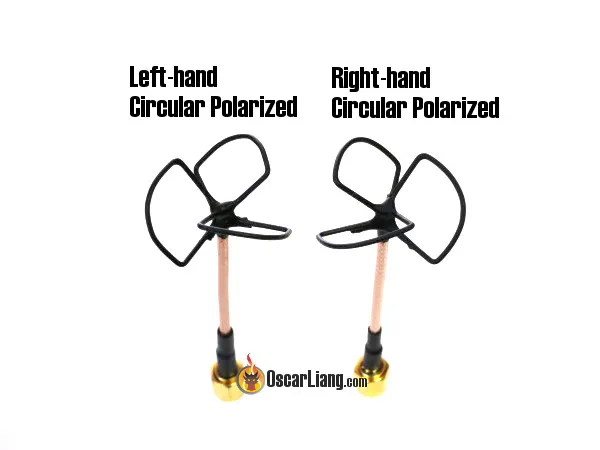
This image shows two circular polarized antennas: one labeled LHCP (left-hand) and one RHCP (right-hand). Arrows indicate opposite rotation directions. The diagram notes that theoretical gain and pattern are identical. However, in a real shared field where most pilots use RHCP, an LHCP setup experiences less coupling from surrounding signals, effectively reducing interference.
On paper, LHCP and RHCP behave symmetrically. Same gain. Same pattern. Same theoretical performance.
Field behavior breaks that symmetry.
If most pilots around you use RHCP, then:
- Their signals couple more strongly into your receiver
- Reflections tend to preserve RHCP dominance
- Your receiver sees a crowded polarization space
Switching to LHCP introduces a form of separation.
Not perfect isolation—but enough to reduce interference coupling.
Explain how polarization separation can help in crowded flying sessions
Polarization mismatch reduces signal transfer.
That’s usually seen as a problem.
In a crowded field, it can be useful.
If your system uses LHCP and most others use RHCP:
- Their signals lose strength when reaching your receiver
- Your signal remains strong within your own link
- The receiver has fewer dominant competing signals
This doesn’t eliminate interference. It reshapes it.
This aligns with how circular polarization behaves in RF systems—signal coupling depends heavily on polarization alignment, not just frequency.
Separate “less common” from “less useful”
LHCP gets dismissed mostly because it’s less common.
That’s not the same as being less effective.
In fact, its usefulness often increases when:
- RHCP becomes saturated in a local environment
- Multiple pilots operate on adjacent channels
- Signal reflections create unpredictable paths
Match LHCP across the whole link before you compare gain
It’s easy to get distracted by gain numbers, antenna shape, or brand differences.
None of that matters if polarization isn’t consistent.
Check what happens when the aircraft uses LHCP and the goggles stay RHCP

This figure illustrates a common mistake: the drone has an LHCP antenna while the goggles still carry RHCP antennas. The signal path between them is shown as broken, jagged lines, indicating high loss. Although the system may power on and show video, the link margin is severely reduced, leading to early breakup and unstable performance in flight.
This setup happens more often than expected.
A pilot upgrades the aircraft antenna to LHCP. The goggles still carry RHCP antennas from a previous setup.
Everything connects. The image appears.
But the link is compromised from the start.
- Direct signal suffers polarization mismatch loss
- Reflections behave unpredictably
- Signal margin drops earlier than expected
Decide when both ends should stay LHCP from day one
Some setups benefit from committing early.
- Team racing environments
- Fixed ground station receivers
- Known high-interference flying sites
In those cases, standardizing on LHCP across all nodes avoids mixed configurations later.
It also simplifies spares, replacements, and quick swaps during sessions.
Know when mixed polarization is a testing setup, not a deployment setup
Mixed LHCP/RHCP setups can still be useful.
Just not in flight.
They’re often used for:
- Bench testing signal behavior
- Comparing antenna performance
- Diagnosing link issues
But once the system leaves the bench, that mix becomes a liability.
A setup that survives a short indoor test doesn’t guarantee stability in open air.
This is similar to broader RF chain alignment issues discussed in TEJTE’s RF coaxial cable guide, where mechanical compatibility doesn’t always translate into reliable signal performance.
Use circular-polarization logic to judge whether LHCP really fits your system
At some point, LHCP vs RHCP stops being the right question.
The real question becomes: does circular polarization itself solve the problem you’re seeing?
Compare circularly polarized behavior with generic omni assumptions
Not every “omni” antenna behaves the same way.
Linear omni antennas radiate differently from circularly polarized ones. The interaction with reflections, obstacles, and orientation changes is completely different.
FPV systems rely heavily on circular polarization because:
- Orientation changes constantly during flight
- Reflections from terrain and structures are unavoidable
- Signal paths are rarely direct
Read axial-ratio and pattern claims only where they change the decision
Spec sheets often highlight axial ratio or radiation patterns.
Useful—but only in certain contexts.
For most FPV users, the decision impact comes down to:
- Does the antenna maintain polarization integrity under movement?
- Does it behave consistently after minor physical stress?
Check whether your video link issues are actually multipath, not range

This figure shows an FPV drone flying near a concrete building and the ground. The direct signal path is shown, along with reflected paths bouncing off surfaces. These reflected signals arrive at the receiver with slight delays, causing distortion. Circular polarization (whether LHCP or RHCP) reduces how strongly these reflections interfere with the main signal. The image helps explain that switching polarization alone won't fix all multipath issues but is part of the solution.
Many pilots assume poor video equals insufficient range.
Often, it’s not.
Multipath—signals bouncing off surfaces and arriving at slightly different times—creates distortion that looks like weak signal.
Circular polarization helps mitigate this.
But switching from LHCP to RHCP—or the reverse—won’t fix multipath alone.
If the issue is:
- Antenna placement
- Obstruction
- Mount angle
- Frame interference
Then polarization choice is only part of the system.
The rest still needs to be physically correct.
Verify connector details before you trust the polarization plan
Polarization gets most of the attention. Connectors quietly break the plan.
A surprising number of unstable FPV links trace back to something simpler than interference—wrong connector gender, wrong standard, or a chain patched together with adapters that were never meant to stay in place.
The antenna is LHCP. The system is “correct.”
But the physical connection is compromised.
Distinguish SMA from RP-SMA without depending on product photos
Photos mislead more often than they help.
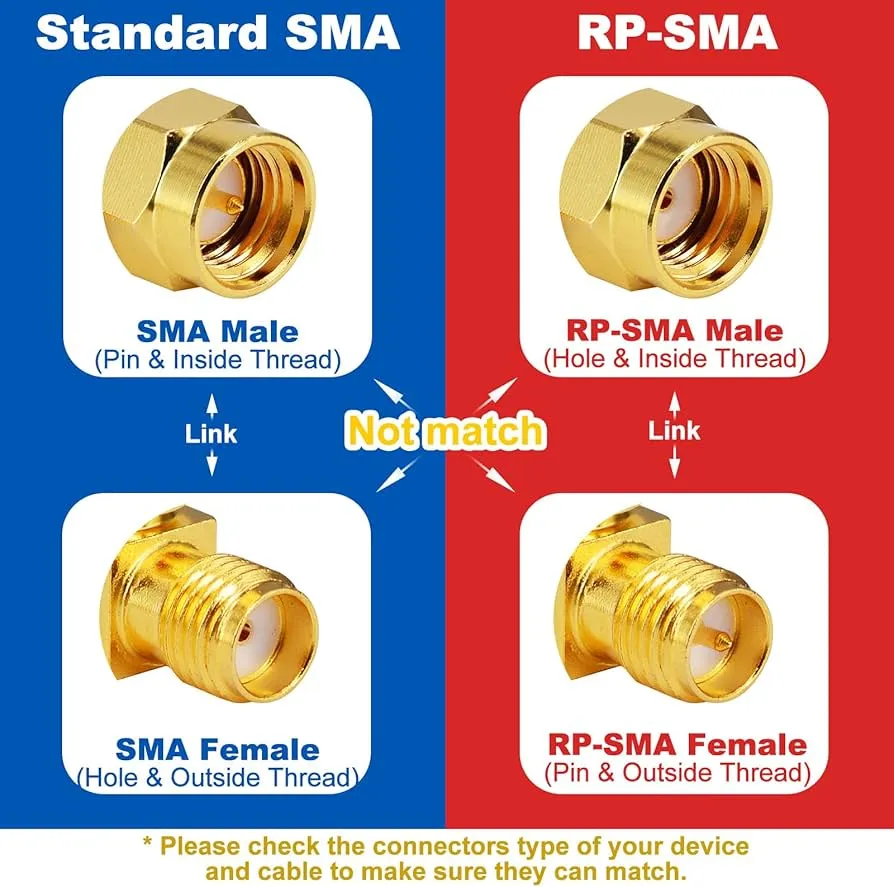
SMA and RP-SMA look almost identical at a glance. Same threads. Same size. Same mechanical feel. The difference sits inside—center pin vs socket.
That’s enough to break a purchase.
A quick rule that works better than relying on listing images:
- SMA male → center pin present
- SMA female → center socket
- RP-SMA flips that logic internally while keeping the same outer thread style
Many FPV transmitters and receivers don’t follow a universal standard. Some brands switch between SMA and RP-SMA across product lines.
So the check has to happen at the device, not on the product page.
Check pin and socket combinations on VTX, goggles, and receiver modules

This photograph shows two connector types side by side: a standard SMA male (center pin) and an RP-SMA male (center socket). Arrows point to the internal contacts. The image emphasizes that physical compatibility (threads fitting) does not guarantee electrical contact. Pilots must check both the VTX port and the antenna connector for pin/socket matching before assembly.
This is where mistakes compound.
It’s not enough to confirm one side.
A working link requires:
- Matching connector type (SMA vs RP-SMA)
- Correct gender pairing (pin to socket)
- Mechanical stability under vibration
Miss one of these, and the system still assembles—but reliability drops.
The mismatch doesn’t always show up immediately. It shows up after a few flights, after a minor crash, or after repeated tightening.
Avoid adapters that fix the thread but add mechanical risk
Adapters solve the immediate problem.
They rarely solve the system problem.
A typical chain might look like this:
- VTX → RP-SMA
- Adapter → RP-SMA to SMA
- Antenna → SMA LHCP
Now the polarization is correct. The connection fits.
But mechanically:
- The leverage on the VTX connector increases
- The stack height adds stress during crashes
- Small impacts translate directly into the RF port
Over time, that stack becomes the weakest point in the system.
Short pigtail extensions often do a better job here. They move the stress away from the device and keep the RF interface intact—something repeatedly emphasized in TEJTE’s RF adapter and cable discussions, especially around flexible assemblies versus rigid transitions.
Choose the LHCP antenna shape that matches your airframe
Two LHCP antennas can behave very differently in real use—not because of polarization, but because of geometry.
The airframe decides more than the spec sheet.
Decide when a stubby LHCP antenna makes more sense on a small quad

This image shows a small FPV drone (e.g., a whoop or toothpick class) with a short, stubby LHCP antenna mounted at the rear. The antenna does not extend beyond the frame's vertical profile, minimizing the risk of prop strikes and crash damage. The photo contrasts with taller antennas that would protrude. The caption notes that while stubby antennas may have slightly lower theoretical gain, their durability and fit make them more reliable in high-crash environments.
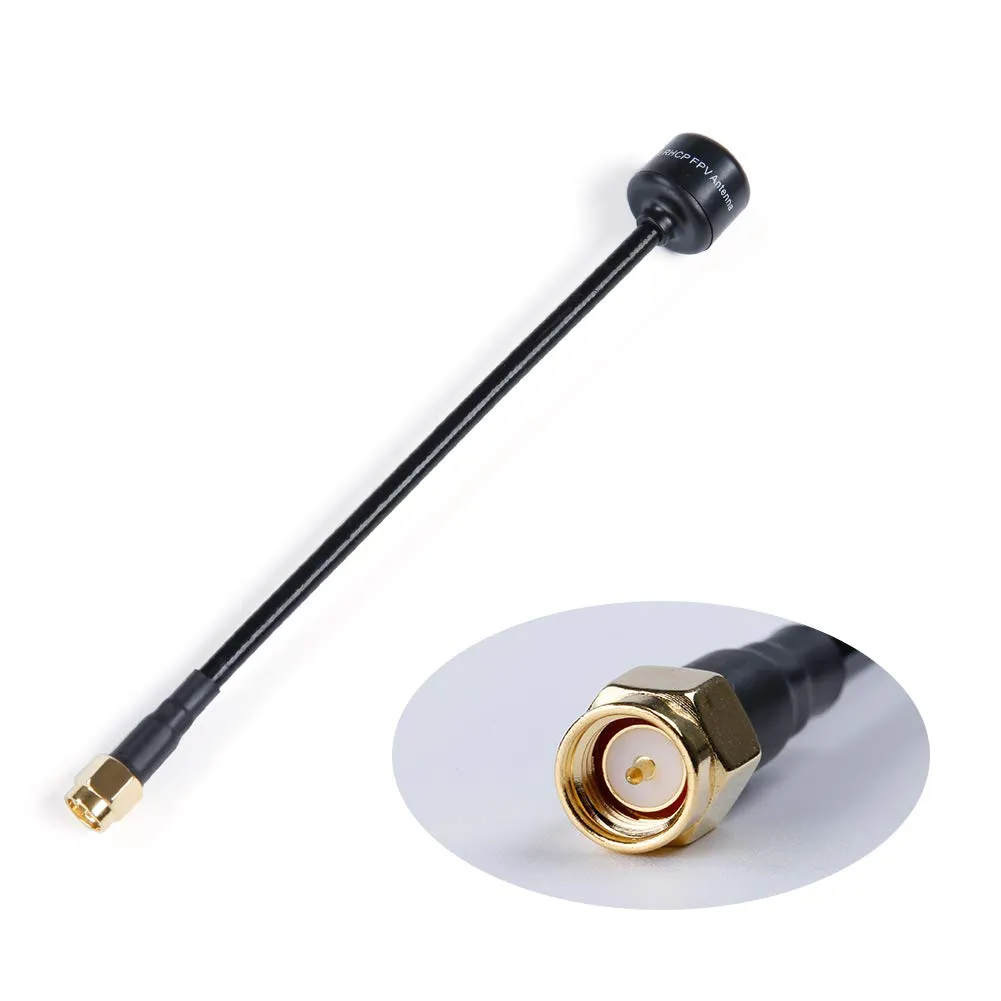
Stubby antennas get dismissed as “short range.”
That’s not the full picture.
On small FPV quads:
- Space is tight
- Propellers sit close to the antenna
- Crash frequency is high
A longer antenna may offer slightly better radiation in ideal conditions. But it also:
- Gets hit more often
- Bends or detunes after impact
- Adds leverage to the connector
Stubby LHCP antennas trade a bit of theoretical range for:
- Better survivability
- Lower mechanical stress
- More consistent performance after crashes
That trade-off tends to favor stubby designs on compact frames.
Check mount angle, prop clearance, and crash exposure before you finalize
Antenna orientation affects more than signal pattern.
It affects survival.
Key checks before committing:
- Does the antenna sit within the prop arc?
- Does it tilt into airflow or turbulence?
- Is it exposed during a typical crash direction?
A perfectly matched LHCP antenna doesn’t help if it’s the first part to break.
Mounting geometry often outweighs small differences in gain.
Use replacement frequency and field abuse as real buying inputs
FPV antennas don’t live in controlled environments.
They get hit. Bent. Replaced.
So selection becomes partly a maintenance decision.
Ask:
- How often will this antenna be replaced?
- Is it easy to swap in the field?
- Does it require tools or re-tightening adapters?
An antenna that survives longer—even with slightly lower peak performance—often delivers a more stable experience over time.
Build an LHCP pass-fail sheet before you place the order
At this point, LHCP is no longer just a “type.” It’s a system decision.
Some setups benefit from it immediately. Others gain nothing—or lose reliability.
Instead of guessing, it helps to score the fit.
Score the link logic before you score the product
Start with system alignment.
Not the antenna brand. Not the gain number.
Check:
- Is the flying environment crowded?
- Are other pilots mostly using RHCP?
- Will your entire link (aircraft + goggles) stay LHCP?
If those answers don’t support LHCP, the product choice becomes irrelevant.
Apply a red-flag check before you lock the cart
Before placing the order, run a quick elimination pass:
- Mixed LHCP/RHCP across link → flag
- SMA/RP-SMA mismatch → flag
- Adapter stack required → flag
- Fragile mounting geometry → flag
More than one flag usually means the system needs adjustment—not just a different antenna.
LHCP FPV Link Fit Matrix
| Factor | Example Input | Impact on LHCP Decision |
|---|---|---|
| Flying context | Shared field | Favors LHCP (interference separation) |
| Video system | Analog | Slight benefit from cleaner separation |
| Frequency band | 5.8GHz | Standard FPV use, neutral factor |
| Aircraft side | LHCP | Must match receiver |
| Receiver side | RHCP | Negative (mismatch loss) |
| Connector family | SMA | Neutral if matched |
| Center contact | Pin/socket mismatch | Critical failure |
| Form factor | Stubby | Better for crash-heavy use |
| Weight sensitivity | High | Favors compact antennas |
| Crash exposure | High | Favors durable designs |
| Interference concern | High | Favors LHCP |
| Recommendation | — | Use with caution / or adjust system |
Fit Score Formula
Instead of fixed numbers, think in weighted logic:
- Polarization match → highest priority
- Field interference → strong influence
- Connector correctness → non-negotiable
- Mechanical fit → often underestimated
Interpretation:
- 85–100 → LHCP is a strong system choice
- 70–84 → workable, but depends on receiver setup
- <70 → likely not worth switching from RHCP
This kind of scoring prevents over-optimizing one parameter while ignoring the rest.
Watch how LHCP is being used in newer FPV setups
A few seasons back, most pilots didn’t even ask the question. You bought RHCP because that’s what everyone around you used, and compatibility solved most problems by default.
That assumption is starting to crack—not because RHCP stopped working, but because flying conditions changed.
More pilots. Tighter frequencies. More reuse of the same fields.
In that environment, LHCP shows up less as a “better antenna” and more as a way to step sideways out of the crowd.
Not always necessary. But sometimes very effective.
Track the shift from “default RHCP” to “field-specific polarization planning”
A few years ago, most FPV setups followed the same pattern:
- RHCP antenna on drone
- RHCP on goggles
- Minimal variation
Now, setups are starting to diverge.
- Teams coordinate polarization deliberately
- Pilots adapt to local flying conditions
- Mixed environments push more experimentation
The decision is becoming contextual rather than standardized.
Follow lighter and more crash-tolerant antenna builds for compact FPV frames

This figure shows a modern LHCP antenna designed for small FPV drones. It features a low-profile, reinforced housing, minimal weight, and a short overall length. The image reflects the trend away from maximizing gain toward balancing performance with crash survival. Such antennas are often used on whoops and micro quads where every gram counts and replacement frequency is high.
At the same time, antenna design priorities are shifting.
Not toward maximum gain—but toward:
- Lower weight
- Better durability
- Cleaner mounting integration
That shift aligns with how FPV systems are actually used:
- Frequent crashes
- Tight builds
- Rapid field repairs
In that environment, consistency often beats peak performance.
LHCP fits into that trend—not as a default upgrade, but as a targeted adjustment when the system actually needs it.
Can an LHCP antenna actually clean up a crowded FPV band?
Short answer: it can help, but only if the rest of the link isn’t already compromised.
What LHCP does in a busy field is subtle. It doesn’t “block” other signals. It just weakens how strongly they couple into your receiver.
That distinction matters.
If someone is flying right next to you on a poorly spaced channel, LHCP won’t save you. The signal is simply too strong.
But in typical race or freestyle sessions—where interference is present but not overwhelming—switching polarization can reduce background noise enough to make the feed feel calmer.
Not sharper. Just more stable.
The difference often shows up in edges:
- Fewer random flickers when turning
- Less breakup when passing reflective objects
- Slightly cleaner recovery after signal dips
Those are small gains. But in FPV, small gains tend to stack.
Why does an LHCP setup pass a bench test and still fall apart in the air?
Because the bench doesn’t move.
That sounds obvious, but it hides a real issue.
On the bench:
- The antenna stays in one orientation
- The signal path is mostly direct
- There’s very little competing energy in the air
Even a mismatched system can look acceptable under those conditions.
Once the quad is airborne, things get messy.
The antenna tilts. Rotates. Gets shadowed by the frame. The signal reflects off ground, metal, even nearby pilots.
And that’s where mismatches surface.
A common one:
- LHCP antenna on the drone
- RHCP omni still on one side of the goggles
It “worked” on the bench. In the air, the link starts breathing—signal strength rising and falling with movement.

This figure illustrates a drone in a banked turn. The antenna (LHCP) is tilted relative to the goggles' antenna (RHCP). The signal path is shown as weak and broken. The image explains that on a static bench, the antennas are aligned and the link appears stable. Once airborne, the constant rotation and tilting cause the polarization mismatch to manifest as intermittent dropouts and noise. This is why field testing is essential.
Should teams standardize on LHCP or keep it flexible?
There isn’t a clean rule here.
Teams that fly together regularly tend to benefit from standardizing—not necessarily on LHCP, but on anything consistent.
If everyone runs the same polarization:
- Equipment swaps are faster
- Spare parts are predictable
- Troubleshooting gets simpler
LHCP becomes useful when the team wants separation from outside interference—especially in mixed environments where other pilots default to RHCP.
But full standardization only works if the whole system follows it.
If even one part drifts—different antennas, adapters, or connectors—the advantage fades quickly.
In less controlled groups, flexibility usually wins.
Pilots adapt per session. Some stay RHCP. Others switch based on who else is flying.
It’s less clean, but often more practical.
When does switching to LHCP not solve the problem at all?
This is where a lot of setups go sideways.
The video looks noisy, so polarization gets blamed.
But the real issue sits somewhere else.
Typical examples:
- Antenna mounted too low, blocked by the frame
- Coax line partially damaged after a crash
- Connector loosened just enough to affect contact
- Too many rigid adapters stacked together
In those cases, changing RHCP to LHCP feels like progress—but doesn’t actually fix the link.
One quick check:
If the signal drops dramatically at very short range, or improves when you touch or move the antenna, the problem is probably mechanical.
Not polarization.
Can a standard 5.8GHz antenna replace an LHCP FPV antenna?
It can connect. That’s about it.
A generic 5.8GHz antenna—especially the simple straight ones—is usually linearly polarized. It doesn’t rotate the field the way circular antennas do.
In practice, that leads to:
- More sensitivity to orientation
- Stronger multipath distortion
- Less predictable behavior during movement
You might get a usable image close in. Push the range or add reflections, and it falls apart faster than expected.
That’s why FPV systems lean heavily on circular polarization in the first place.
Not for peak distance—but for stability under motion.
Why do adapter-heavy LHCP setups fail earlier than expected?

This figure illustrates a problematic installation: a VTX port, followed by a rigid RP-SMA adapter, then another adapter, and finally an LHCP antenna. Arrows show how force from a crash travels through the stack and concentrates at the VTX connector. The image contrasts this with a direct-mount antenna or a short flexible pigtail, which absorbs stress. It emphasizes that mechanical reliability is as important as RF matching in FPV.
Because they shift the weak point into the connector.
A direct antenna mount keeps things simple. Add an adapter, maybe two, and suddenly the load path changes.
During a crash:
- The antenna becomes a lever
- Force transfers into the adapter stack
- The RF port takes the hit
Nothing may break immediately.
But over time:
- Threads loosen slightly
- Center contacts lose alignment
- Signal quality becomes inconsistent
A short flexible pigtail avoids most of that. It moves the stress away from the device instead of concentrating it.
That’s not about RF theory. It’s just mechanics.
Is LHCP still worth it on small, crash-prone drones?

This image shows a small FPV drone after a hard crash. The antenna is visibly bent, and the connector appears misaligned. The scene conveys that in high-crash environments, antenna durability often outweighs theoretical RF advantages. A stubby, reinforced LHCP design may survive where a taller, more fragile one would fail. The caption questions whether LHCP is worth it unless the antenna can withstand the abuse typical of freestyle or racing builds.

Sometimes. But it has to earn its place.
On a compact build:
- Every gram matters
- Antenna placement options are limited
- Crashes are frequent, not occasional
A longer LHCP antenna might look better on paper. In reality, it gets clipped, bent, or ripped off.
Shorter designs—stubby or reinforced—tend to survive longer, even if they give up a bit of theoretical performance.
The question shifts from “what performs best” to “what keeps performing after five crashes.”
In that context, LHCP only makes sense if:
- The interference environment actually justifies it
- The antenna can be mounted securely
- The connector isn’t being stressed constantly
Otherwise, a simpler RHCP setup—well placed and mechanically sound—often holds up better.
Where LHCP actually makes sense
LHCP isn’t a default upgrade. It’s more like a situational adjustment.
It tends to work when:
- The field is busy enough for interference to matter
- The entire link—drone to goggles—stays consistent
- The physical setup isn’t introducing its own problems
Miss one of those, and the benefit shrinks quickly.
Two pilots can run the same LHCP antenna and get completely different results.
One has a clean, aligned system.
The other just swapped a part and hoped for the best.
That difference doesn’t show up in specs. It shows up mid-flight, when the link is under pressure and there’s no margin left to hide mistakes.
Bonfon Office Building, Longgang District, Shenzhen City, Guangdong Province, China
A China-based OEM/ODM RF communications supplier
Table of Contents
Owning your OEM/ODM/Private Label for Electronic Devices andComponents is now easier than ever.
