
SMA to BNC Cable for RF Systems
Mar 23,2026
Place SMA to BNC cable inside a real RF workflow
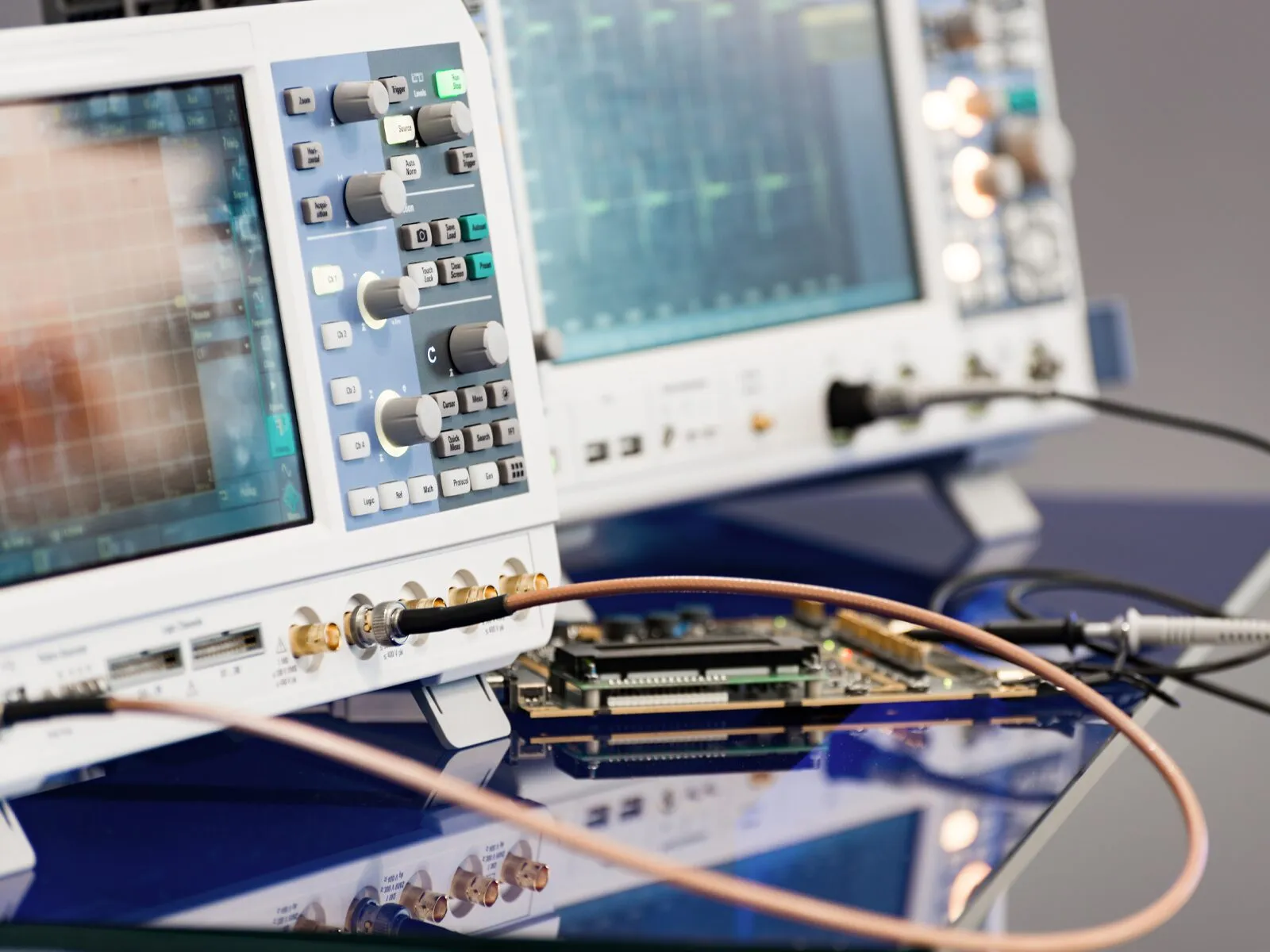
This figure illustrates a common lab scenario where a modern RF module or device with an SMA port needs to connect to an older test instrument with a BNC input. An SMA to BNC cable is shown as a short, flexible assembly linking the two. Unlike a rigid adapter, the flexible cable segment absorbs misalignment, routing stress, and vibration, protecting the connectors—especially the SMA side—from mechanical overload. The image emphasizes that this cable is not just a connector converter but an integral part of the RF signal path.
Connect SMA radios to BNC instruments, legacy gear, and bench fixtures
The connector mismatch usually appears late.
A small RF module is already powered on. Someone routes the antenna cable through the enclosure wall. The test setup is ready—spectrum analyzer on the bench, coax already lying across the table. Then the mismatch shows up.
SMA on the device.
BNC on the instrument.
This combination is not unusual. SMA connectors dominate compact RF modules, GNSS boards, cellular radios, and external antenna ports. BNC connectors, meanwhile, still occupy a large part of the measurement ecosystem. Oscilloscopes, older spectrum analyzers, signal generators, RF distribution panels, and legacy systems often keep BNC interfaces simply because they have been reliable for decades.
The transition point between those two connector ecosystems is where an sma to bnc cable becomes useful.
Instead of forcing the ports to meet directly with a rigid adapter, the cable assembly introduces a short flexible RF segment between them. Electrically it remains part of the transmission line. Mechanically it acts as a buffer that absorbs misalignment, routing stress, and vibration.
In real RF workflows that small difference matters more than it seems.
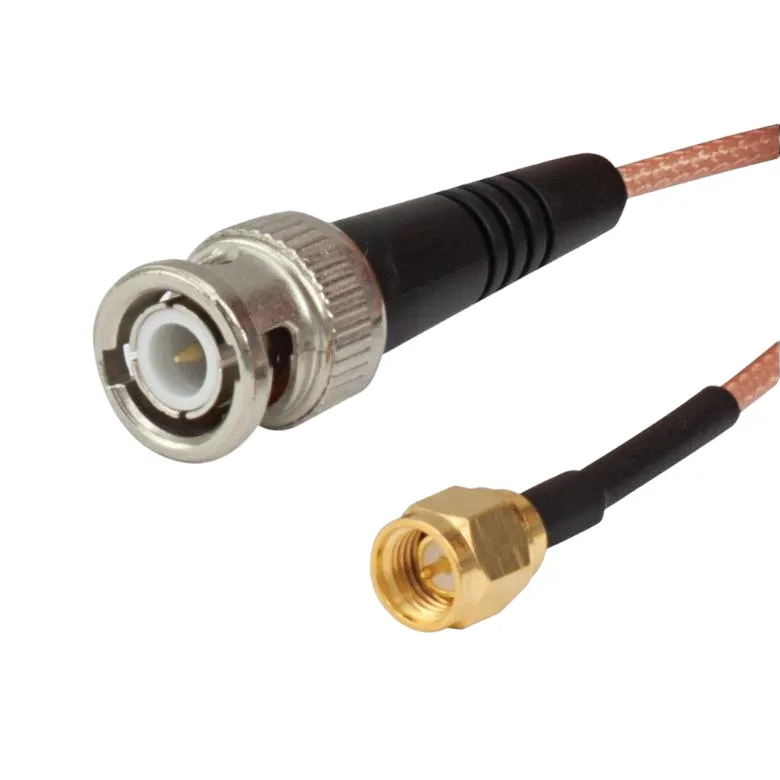
This photograph shows a completed SMA to BNC cable assembly. One end features an SMA plug (or jack, depending on configuration) for connection to compact RF modules, antennas, or devices. The other end features a BNC plug (or jack) for connection to oscilloscopes, spectrum analyzers, signal generators, or legacy test equipment. The flexible coaxial cable between them—often RG316—maintains 50-ohm impedance while allowing the assembly to accommodate misaligned ports, absorb vibration, and relieve mechanical strain. Such assemblies are essential in mixed-connector RF environments where rigid adapters would introduce stress.
A rigid sma to bnc adapter works well when two ports sit cleanly on the same axis. Many lab setups look that way in diagrams. Reality tends to look different. Ports are often recessed inside equipment panels. Devices may sit at different heights. The instrument connector might face sideways while the module port points upward. Trying to solve those layouts with rigid adapters quickly leads to stacked parts, awkward cable angles, or connectors carrying unintended mechanical load.
A short sma to bnc cable solves the same transition without turning the connector pair into a lever.
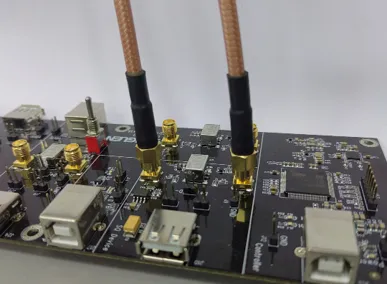
This figure conceptualizes an SMA to BNC cable as a continuous transmission line segment within an RF system. It likely shows a simplified signal path: an SMA device, the cable assembly (with its internal coaxial structure), and a BNC instrument. Annotations emphasize that the cable is not merely a mechanical adapter but an electrical element that contributes to insertion loss and impedance continuity. The image reinforces the principle that proper cable selection—including coax type and impedance matching—is essential for predictable RF performance, especially as frequency increases.
Keep the transition inside a 50-ohm path whenever the system is RF
The connector mismatch is rarely the real risk.
The larger risk sits in the impedance system behind those connectors.
Both SMA and BNC connectors exist in 50-ohm versions. In RF measurement and RF device interconnects, that 50-ohm impedance is the default environment. Radios, amplifiers, antennas, filters, and test equipment are typically designed around that standard.
BNC complicates the picture because it also appears in 75-ohm form. Video systems, broadcast equipment, and many receive-only signal paths rely on 75-ohm BNC connectors. Externally the connectors look nearly identical. The difference is hidden in the dielectric geometry and center conductor design.
That distinction is easy to overlook when someone simply tries to “connect SMA to BNC.”
In RF systems the transition should stay inside one consistent impedance environment. If the radio module, the coax cable, and the measurement equipment are all designed for 50 ohms, the sma to bnc cable must maintain that same impedance through the entire assembly—connector, cable, and termination.
Ignoring that continuity introduces a mismatch inside the transmission line. The effect might appear small during a quick bench test. Return loss degrades quietly. Reflections build up in certain frequency ranges. The problem often surfaces later when the same system runs at higher frequencies or when the measurement path becomes longer.
The underlying transmission-line physics is the same one described in the general explanation of the coaxial cable structure: impedance consistency along the signal path determines how efficiently RF energy moves between components.
A connector transition does not suspend those rules.
Treat cable assemblies as flexible transitions, not just long adapters
Cable assemblies often get treated as if they were just longer versions of adapters.
In RF work that assumption causes trouble.
A rigid adapter serves a simple role: align two connectors and keep the electrical path short. The adapter body transfers mechanical torque directly between the ports. If the ports are aligned and the system remains stationary, that approach is efficient and stable.
A sma to bnc cable solves a different class of problem.
The cable introduces flexibility into the signal path. That flexibility allows the ports to exist in different locations without transferring mechanical force directly between them. The coax inside the assembly maintains the controlled impedance while the outer jacket absorbs movement and routing stress.
That distinction becomes important in several real situations:
• equipment panels where the RF port sits behind a recessed mounting hole
• test benches where cables are frequently moved or replaced
• rack systems where instruments are mounted at different depths
• field equipment where vibration and transport are unavoidable
In those environments the cable assembly becomes part electrical component and part mechanical protection.
Trying to solve those same layouts with stacked rigid adapters often leads to unexpected failures. Connectors loosen. Threads wear faster. The SMA side—especially on small modules—can experience bending forces it was never designed to handle.
The cable version distributes that load along the flexible coax instead of concentrating it at the connector interface.
Choose cable before you decide on adapter
Use cable when the ports are offset, recessed, or panel-separated
The cleanest RF connection is a straight one.
Two connectors aligned on the same axis, tightened properly, with minimal mechanical stress. That configuration works perfectly for rigid adapters and short test setups.
Real hardware rarely cooperates.
Ports frequently sit at different heights. One connector might live on a device PCB while the other emerges from a test instrument several centimeters away. Panel-mounted connectors add another layer of separation. Sometimes the SMA port sits deep inside a product enclosure while the BNC connector on the instrument remains exposed.
In those cases a rigid adapter forces the connectors to meet physically. The cable attached afterward has to bend sharply to reach the rest of the system.
A short sma to bnc cable shifts that geometry problem away from the connectors themselves.
The SMA end attaches to the device port. The BNC end connects to the instrument. Between them, the coax cable absorbs the spatial offset. The RF signal still travels through a controlled 50 ohm coaxial cable path, but the mechanical alignment no longer depends on the connectors lining up perfectly.
This small structural change prevents a surprising number of connector failures.
Use cable when vibration, service access, or repeated handling exists
Connector durability depends on how the system moves over time.
Bench instruments might appear stationary, yet cables get swapped constantly during testing. Technicians pull cables to reroute them, unplug connectors to switch measurement paths, or reposition equipment across the workbench.
Every time that movement occurs, a rigid adapter transmits the force directly into the connector interface.
Cable assemblies break that mechanical chain.
With a sma to bnc cable, the coax segment flexes instead of the connector body. The strain shifts away from the threads and center contacts. For small SMA ports mounted on RF modules, this difference can determine whether the connector survives repeated testing cycles.
The same principle applies in transport environments.
Vehicle-mounted radios, portable measurement units, and field-deployable communication systems rarely stay perfectly still. Vibration from engines or environmental movement constantly applies small mechanical loads to cables. A flexible assembly dampens those forces before they reach the connector.
Rigid adapters cannot do that.
Avoid solving a flexible problem with stacked rigid parts
A common bench workaround involves stacking adapters.
One adapter converts SMA to another connector. A second adapter transitions to BNC. Occasionally a third adapter changes the orientation or gender. The signal path becomes a small tower of metal parts between two cables.
Electrically the system still works. RF signals pass through the connectors and the instrument displays a measurement. That apparent success hides several issues.
Each rigid transition adds insertion loss.
Each mechanical interface introduces another opportunity for loosening.
Each added centimeter increases the leverage applied to the connector threads.
Those effects accumulate quietly.
Replacing the entire stack with a single sma to bnc cable removes multiple transitions from the path. The coax segment replaces the rigid adapter chain. Loss often drops slightly. Mechanical stress drops much more.
From an engineering perspective the signal path becomes simpler.
From a sourcing perspective the assembly also becomes easier to manage. Cable assemblies can be standardized with known length, coax type, and connector orientation. Adapter stacks often vary depending on which parts happen to be available on the bench that day.
Match impedance before you match connector names
Confirm whether the BNC side is 50 ohms or 75 ohms
Connector names alone do not define the electrical environment.
This point surprises many teams during mixed RF and video system integration.
BNC connectors appear everywhere—oscilloscopes, cameras, broadcast gear, RF instruments, and laboratory equipment. Two BNC connectors may look identical but operate in different impedance systems. One is designed for 50 ohm coaxial cable paths typical of RF measurement. The other supports 75-ohm video transmission.
The mechanical threads mate perfectly in both cases.
The internal geometry does not.
When an sma to bnc cable links a 50-ohm RF device to a 75-ohm BNC interface, the mismatch becomes part of the signal path. Sometimes the system tolerates it. Sometimes the mismatch produces measurable reflections or loss at higher frequencies.
Verifying the impedance of the BNC side prevents that uncertainty.
In RF laboratories the majority of BNC connectors attached to spectrum analyzers, signal generators, and RF accessories remain 50 ohms. Video distribution hardware is where 75-ohm BNC connectors dominate.
The cable assembly should match whichever impedance the system truly uses.
Keep 50-ohm systems inside one consistent cable-and-connector path
RF transmission lines behave predictably only when their impedance remains consistent from one component to the next.
That consistency involves more than the cable itself.
The coax type, connector geometry, and adapter transitions must all belong to the same impedance family. A 50 ohm coaxial cable connected to a mismatched connector pair does not behave like a pure 50-ohm path anymore.
In short RF jumpers the effect might appear small. In measurement setups or higher-frequency systems the mismatch becomes visible.
Cable assemblies simplify the problem because the impedance can be controlled across the entire structure: coax type, SMA termination, and BNC termination all designed for the same electrical environment.
Rigid adapter stacks introduce more variables.
Add a deliberate transition when RF gear must meet video hardware
Occasionally a 50-ohm RF device must connect to a system built around 75-ohm video hardware.
Broadcast monitoring, hybrid communication systems, or specialized test equipment can create that situation. In those cases the transition should be intentional rather than accidental.
The engineer defines the impedance boundary and treats it as a known design decision. Sometimes a matching network or dedicated adapter handles the conversion. Sometimes the system tolerates the mismatch because signal levels remain high.
What matters is recognizing that the cable assembly itself does not erase the impedance difference.
An sma to bnc cable can maintain a clean RF transmission line only if the connectors and cable share the same impedance standard.
Match the cable construction before you release the assembly
Start with RG316 for compact and heat-resistant jumper builds
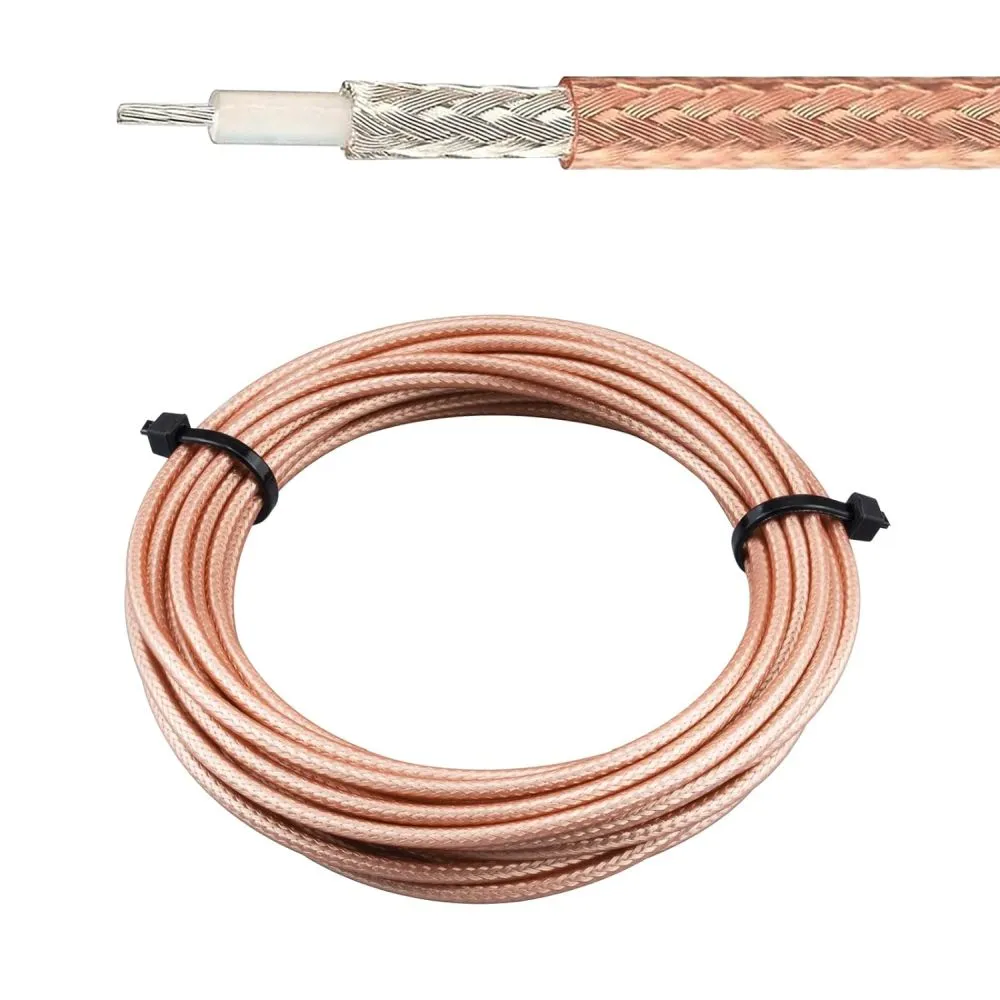
This image provides a detailed view of an RG316 coaxial cable, likely with a section of the jacket removed to reveal the inner conductor, PTFE dielectric, and braided shield. With an outer diameter of approximately 2.5 mm, RG316 is flexible and heat-resistant, making it ideal for routing inside compact enclosures. It is frequently used as short jumpers between RF modules and panel connectors, or as the core of adapter cables such as SMA to BNC assemblies where flexibility and moderate frequency performance are required.
Most short RF transition cables start from a familiar place: RG316 coaxial cable.
There is a reason that name shows up repeatedly in RF cable assemblies. RG316 sits in a practical middle ground. It is thin enough to route through tight enclosures, yet mechanically stronger than ultra-miniature coax types. The PTFE dielectric tolerates heat well, and the FEP jacket handles soldering temperatures without collapsing.
For short transition cables—especially those bridging SMA connectors on modules to BNC ports on instruments—RG316 provides a stable baseline.
Its outer diameter sits around 2.5 mm. That dimension matters more than it first appears. Connectors like SMA and BNC must clamp securely onto the cable without crushing the dielectric. RG316 fits naturally inside many standard RF connector designs, which makes termination more consistent across suppliers.
In short jumper assemblies the flexibility of RG316 also helps.
A sma to bnc cable often needs to bend immediately after leaving the connector body. Thicker cables resist that bend and push force back into the connector threads. RG316 accepts tighter routing without transmitting as much mechanical stress to the SMA interface.
This is why short RF transition leads frequently rely on RG316 even when lower-loss cables exist.
The cable is not chosen purely for electrical performance. It is chosen because the mechanical behavior suits compact RF equipment.
Engineers encountering RG316 repeatedly in transition assemblies will eventually notice the pattern. The cable family is not perfect, but it solves more problems than it creates in short flexible RF links.
A deeper explanation of how RG family cables behave in RF systems can be found in this reference on RG316 coaxial cable, which explores the trade-offs behind these compact PTFE coax types.
Move to thicker 50-ohm coax when distance or loss dominates
RG316 performs well for short connections.
It stops being ideal when the cable length grows.
Loss increases with frequency and with distance. Thin coax types generally show higher attenuation per meter compared with thicker cables. For short jumper leads—20 cm, 50 cm, even a meter—that extra loss is often negligible.
Stretch that same cable several meters and the equation changes.
A long sma to bnc cable built on RG316 begins to accumulate noticeable attenuation. High-frequency systems feel this effect first. Measurement paths can show reduced signal levels. RF transmit paths may lose margin.
When distance begins to dominate the design, thicker 50 ohm coaxial cable families become more attractive.
Cables with larger diameters typically offer lower attenuation because the dielectric spacing and conductor dimensions support better RF efficiency. The trade-off is mechanical stiffness. Larger coax cables resist bending and require larger connectors.
That trade-off forces a design decision.
Short flexible transitions often favor RG316.
Longer links often move to larger coax families.
Trying to solve a long-distance link with a thin cable just because it is convenient usually produces disappointing results later.
Lock the coax family before you finalize connector direction
Connector orientation often dominates early sourcing discussions.
Teams debate whether the SMA end should be male or female. Someone asks if the BNC side should be plug or jack. Engineers sometimes sketch connector diagrams before even deciding which coax family the cable will use.
That sequence reverses the real priorities.
The coax family defines the electrical performance and mechanical behavior of the cable assembly. Connector choice follows that decision. A cable designed around RG316 will accept different connector terminations than a thicker low-loss coax.
Selecting connectors first sometimes traps the design into a cable that does not fit the electrical requirements.
RF cable sourcing tends to run smoother when the sequence follows this order:
- choose impedance system
- choose coax family
- choose connector types
- define cable length
Once the coax family is fixed, the remaining choices fall into place naturally.
Calculate loss before the cable becomes the hidden bottleneck
Use attenuation-per-meter data instead of “it’s short so it’s fine”
Short RF jumpers often escape detailed analysis.
Engineers glance at a cable only a few tens of centimeters long and assume its contribution to the signal path will be negligible. Most of the time that assumption works out. Occasionally it hides a problem.
Coax attenuation rises rapidly with frequency.
For rg316 cable, published attenuation values illustrate the trend clearly. At moderate RF frequencies the loss remains manageable. As the frequency climbs toward the gigahertz range, attenuation per meter increases quickly.
A value around 93–95 dB per 100 meters at 1 GHz appears in many RG316 specifications. Translating that into a short jumper length makes the loss seem small—but not invisible.
A 0.5 m jumper could still introduce around 0.45 dB of cable loss depending on the exact cable build.
In measurement environments even fractions of a decibel sometimes matter.
The point is not that short cables are dangerous. The point is that guessing the loss without checking the attenuation curve occasionally leads to incorrect assumptions.
RF systems accumulate small losses gradually.
Add connector transitions into the same budget
Cable attenuation rarely acts alone.
Connector transitions also introduce small losses as RF energy passes through the interface between cable and device. SMA connectors generally maintain low insertion loss when properly manufactured. BNC connectors perform similarly within their operating frequency ranges.
Still, every connector adds a small electrical discontinuity.
A simple sma to bnc cable usually includes two connector transitions—one at each end. Each transition contributes a small amount of insertion loss and return loss. Individually the numbers look trivial.
Combined with cable attenuation they begin to matter.
In short jumper assemblies the typical rule of thumb is to treat each connector transition as roughly a few tenths of a decibel at most RF frequencies. Exact values depend on connector quality and frequency.
Adding these transitions into the same budget gives a more realistic picture of how the cable assembly behaves inside the signal path.
Ignoring them does not break the system. It simply makes the link budget slightly optimistic.
Split the rules for module jumpers, bench leads, and external runs
Not every sma to bnc cable plays the same role.
Three categories appear repeatedly in RF setups.
Module jumpers connect small RF boards to nearby connectors or antennas. These cables are usually very short—often less than half a meter. Flexibility and compact size matter more than loss.
Bench leads appear in laboratory setups linking instruments to prototypes. These cables may reach one or two meters in length and experience frequent handling. Durability and repeatability start to matter more.
External runs connect equipment across racks or enclosures. Cable length grows. Signal loss and shielding performance become more important.
Using the same cable rules for all three categories produces awkward compromises.
Module jumpers tolerate higher loss because they are short. Bench leads benefit from tougher jackets and strain relief. External runs often justify thicker coax with lower attenuation.
A good sourcing strategy treats these assemblies as separate product types even though they all carry the same connector pair.
Route the cable so the ports survive service and transport
Protect the first bend near the connector body
Cable failures rarely appear in the middle of the coax.
The weak point almost always sits near the connector.
At the moment the cable leaves the connector body, the internal conductors transition from rigid mechanical support to flexible coax. That small region absorbs most of the bending stress during installation and service.
A sma to bnc cable routed with a sharp bend immediately after the connector gradually weakens the termination. The center conductor can fatigue. Shield connections loosen. The cable jacket begins to crack over time.
Proper routing keeps the first bend gentle.
Manufacturers often specify a minimum bend radius for each coax type. Staying comfortably above that radius helps preserve both the electrical and mechanical integrity of the assembly.
This rule becomes even more important on the SMA side of the cable.
SMA connectors attached to small RF modules are rarely designed to support heavy mechanical loads. Protecting the bend near the connector helps keep that load away from the port.
Move strain to clips, bulkheads, and the enclosure wall
Mechanical strain does not disappear just because a cable is flexible.
It must still end somewhere.
In well-designed RF systems the strain transfers to structural parts of the enclosure instead of the connectors themselves. Clips, cable ties, bulkhead connectors, and mounting brackets absorb the tension before it reaches the SMA or BNC port.
This design habit prevents a common long-term failure.
Without strain relief, cable movement gradually loosens connector threads or damages solder joints on RF modules. The electrical symptoms appear later as intermittent signal loss or unstable measurements.
Routing the cable through fixed points inside the enclosure keeps the connector interface stable even when the cable outside the system moves.
Treat bench handling as part of the mechanical design
Laboratory setups rarely stay static.
Technicians reposition cables, adjust instruments, and swap connections repeatedly during testing. The environment looks controlled, but the mechanical stress on cables can exceed what many field systems experience.
A sma to bnc cable used in bench testing should tolerate that constant handling.
Flexible coax helps. Strong connector terminations help more. Good routing habits help most of all.
Cables draped across the bench edge or pulled tight between instruments inevitably suffer damage over time. Small improvements—routing cables through guides, adding slack loops, avoiding tight bends—extend the life of the assembly significantly.
RF engineers sometimes focus exclusively on electrical performance.
Mechanical survival matters just as much once the system leaves the design diagram and enters real use.
Use application cases to decide where an SMA to BNC cable actually belongs
Flexible bench links and panel transitions are where this cable earns its keep
Most sma to bnc cable assemblies appear in fairly ordinary places.
A radio board sits on the bench with an SMA port. The instrument beside it—often older lab gear—exposes BNC. The system itself might be RF, GNSS, cellular, or telemetry. The mismatch isn’t electrical; it’s simply two different connector ecosystems meeting in the same setup.
At that moment the engineer usually has two options: a rigid adapter or a short cable assembly.
The cable tends to win when the layout is not perfectly aligned. Maybe the SMA port points upward while the BNC jack on the instrument faces forward. Maybe the module sits inside a test jig and the analyzer cable approaches from the side. A rigid adapter technically solves the interface mismatch but creates a new mechanical problem—something ends up bending or twisting.
A short cable avoids that.
The coax segment absorbs the offset between the connectors. Electrically the signal path stays continuous through a rf coaxial cable section. Mechanically the connectors remain relaxed instead of fighting the geometry of the setup.
Engineers who spend time on RF benches notice this pattern quickly. Rigid adapters appear in tidy diagrams. Flexible jumpers show up in the setups that actually survive daily testing.
Panel transitions tell a similar story.
Sometimes the RF module sits inside a metal enclosure with an SMA jack mounted on the PCB. The outside of the panel, however, carries a BNC connector so technicians can access it easily. A small internal sma to bnc cable links the module to the panel connector. That short assembly becomes part of the internal RF routing rather than a simple external accessory.
It is less about connector conversion and more about how the signal physically travels inside the product.
Use rigid adapters when the layout behaves itself
Adapters still make sense in the right situation.
A sma to bnc adapter works well when the ports line up naturally and the surrounding cables are not pulling on the connection. Calibration setups, rack-mounted measurement paths, and fixed signal chains often fall into this category.
The advantage is obvious: the signal path stays extremely short. There is no extra coax segment, and the electrical transition happens immediately between the two connectors.
But the adapter assumes something about the layout—that the connectors are already aligned.
If the geometry is slightly awkward, the adapter turns the connector pair into a small lever arm. The attached cable pulls sideways, and the SMA interface on the device starts carrying mechanical load it was never designed to support.
That is the point where a cable assembly becomes the safer option.
Rigid transitions are efficient but unforgiving. Flexible assemblies tolerate real-world layouts.
Reverse-direction cables exist mostly because people search differently
Technically speaking, a sma to bnc cable and a bnc to sma cable are the same object.
RF energy does not care which connector appears first in the product description. The cable itself remains a symmetrical transmission line.
The difference shows up mostly in how engineers search for parts.
Someone working from the radio module side may look for an SMA-to-BNC lead. Someone staring at the oscilloscope port might type BNC-to-SMA instead. Both searches describe the same cable assembly viewed from opposite ends.
From a design standpoint the details that actually matter are elsewhere: impedance, coax family, cable length, and connector quality.
Build a simple cable decision sheet before purchasing
Capture the parameters that actually affect the signal path
Cable assemblies sometimes get ordered in a hurry.
A technician notices the connectors do not match and orders the first jumper that appears in a catalog. That approach works for quick prototypes, but it becomes messy once multiple projects start using the same cable type.
A simple decision sheet helps avoid that confusion.
Instead of thinking only about the connector names, the sheet records the elements that influence the RF link:
Use_case
Bench test / panel transition / rack link / legacy equipment connection
Connector_A
SMA, RP-SMA, or a panel SMA variant
Connector_B
BNC plug or jack, including whether the port is 50 Ω or 75 Ω
System_impedance
The actual impedance used by the RF path
Coax_family
Often rg316 coaxial cable, though other 50 ohm coaxial cable families appear when longer distance or lower attenuation is required
Length_m
The physical cable length
Electrical loss can be estimated quickly using the cable’s attenuation specification:
Cable_loss_dB = Length_m × Attenuation_dB_per_m
Connector transitions also contribute a small amount:
Connector_loss_dB = Connector_count × 0.15
The approximate total becomes:
Total_loss_dB = Cable_loss_dB + Connector_loss_dB
None of these calculations are complex, but writing them down keeps everyone working from the same assumptions.
Mechanical factors belong on the sheet as well.
Offset_or_recess
Whether the connectors sit in different planes
Strain_risk
Low / Medium / High
Min_bend_radius_mm
Planned_bend_radius_mm
A quick comparison between planned routing and minimum bend radius reveals whether the cable is likely to survive the installation.
Procurement teams sometimes add simple scoring fields—serviceability, cost, margin—to help compare different cable options. The numbers do not need to be perfect. They simply capture the reasoning behind the decision.
A typical module-to-instrument jumper example
Imagine a straightforward bench setup.
A radio module exposes an SMA port. The measurement instrument offers BNC. The required jumper length is roughly sixty centimeters.
RG316 works well here. The cable remains flexible and thin enough to route comfortably across the bench. The attenuation for that length stays small at typical RF frequencies, even after accounting for the connector transitions at each end.
The decision sheet would record the use case as bench testing, with moderate strain risk because cables are frequently moved during measurements.
If the same link suddenly required three meters of cable instead of sixty centimeters, the sheet might suggest moving to a lower-loss coax family rather than staying with RG316.
The cable assembly itself has not changed. Only the operating conditions have.
Writing down the assumptions helps catch that difference early.
Turning the sheet into an inspection reference
Once the cable design is defined, the same sheet can guide incoming inspection.
Instead of asking how the cable should behave, the inspection team checks whether the delivered assemblies match the specification.
Typical checks include:
• correct connector type and orientation
• correct cable length
• coax family matching the design
• visible termination quality
• jacket integrity and bend protection
Higher-frequency systems sometimes add insertion-loss verification.
Using the same document for both design and inspection removes guesswork during procurement.
Signals from the RF interconnect market
Growth in RF interconnect hardware continues
Wireless systems keep expanding into new products—vehicles, industrial equipment, small IoT devices, satellite terminals. Every one of those systems needs connectors and cable assemblies linking the RF chain together.
Industry forecasts suggest the RF interconnect sector will continue growing through the decade. Research cited by Grand View Research estimates the market could climb from roughly $33 billion in 2024 to more than $51 billion by 2030.
Those numbers reflect the quiet infrastructure behind wireless hardware.
Radios and antennas usually attract the attention, but connectors and cable assemblies move the signal between them. Even a simple sma to bnc cable sits inside that larger supply chain.
Material changes are beginning to reach connector catalogs
Another small shift is happening in connector manufacturing.
Some suppliers have started introducing PFAS-free SMA connectors and adapters as environmental regulations tighten in several regions. These changes are still early, but they signal a broader move toward alternative materials in RF interconnect hardware.
Cable assemblies will eventually follow the same direction because the connector materials define the termination design.
For sourcing teams working with long product lifecycles, watching these changes early can prevent unpleasant surprises later.
Higher frequencies expose weak cable choices quickly
RF hardware trends are also pushing cable design harder.
Modules are getting smaller. Operating frequencies keep climbing. Connector footprints shrink accordingly. All of those changes reduce the tolerance for sloppy cable choices.
A jumper that worked fine in a low-frequency system may introduce noticeable mismatch or attenuation once the design moves into higher bands. Mechanical stress also becomes more damaging as connectors shrink.
This does not make cable assemblies obsolete.
It simply means that cable routing, strain relief, and coax selection matter more than they did when frequencies were lower and connectors were larger.
Common questions engineers still ask
When should I choose a cable instead of an adapter?
Use a cable when the connectors are offset, recessed, or subject to movement. Flexible coax absorbs strain that would otherwise load the connector threads.
Rigid adapters work best when both ports align naturally and the surrounding cables do not pull on the interface.
How do I tell whether the BNC connector is 50 Ω or 75 Ω?
Documentation usually reveals the answer. RF measurement instruments almost always use 50-ohm BNC connectors, while broadcast and video equipment frequently rely on 75-ohm versions.
The impedance should match the rest of the signal path.
Which coax type appears most often in short transition cables?
What loss should a short SMA-to-BNC jumper introduce?
Loss depends on cable type, length, and frequency. For a short RG316 jumper under one meter, the combined cable attenuation and connector transitions usually stay well under a decibel in most RF test setups.
Exact values require checking the cable’s attenuation chart.
When does it make sense to replace an adapter stack with a jumper?
If multiple rigid adapters are stacked together or the connection experiences side-load from attached cables, replacing the stack with a short jumper often stabilizes the setup.
The signal path becomes simpler and the connectors experience less stress.
How can I protect the SMA connector on a small RF module?
Keep the first bend gentle and route the cable so that clips, brackets, or the enclosure absorb any pulling force. Letting the cable hang directly from the SMA port eventually damages the connector.
Small mechanical details like that tend to determine whether the RF connection remains reliable after months of use.
Bonfon Office Building, Longgang District, Shenzhen City, Guangdong Province, China

A China-based OEM/ODM RF communications supplier
Table of Contents
Owning your OEM/ODM/Private Label for Electronic Devices andComponents is now easier than ever.