
RG316 Coaxial Cable Selection & Use Guide
Mar 14,2026
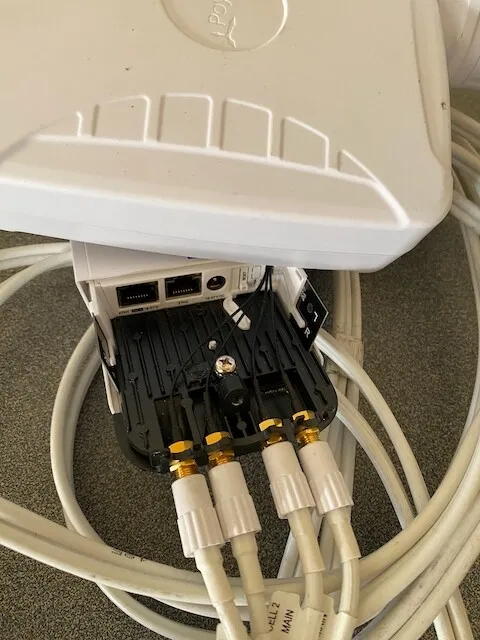
This figure illustrates a common application of RG316 coaxial cable in an RF system. A radio module inside an enclosure is connected to a panel-mounted SMA connector via a short RG316 jumper. The cable's small diameter and flexibility allow it to route easily through crowded spaces. The image emphasizes that while RG316 is often treated as a passive component, it becomes an integral part of the RF signal path once installed.
In RF design, cables rarely get much attention.
Antenna placement gets discussed. Radios get compared. Firmware timing becomes a debate. But the short cable between them? That part usually shows up late in the design.
Often it’s just described as “a short jumper.”
In many systems that jumper turns out to be RG316 coaxial cable.
You’ll find it inside wireless gateways, GNSS receivers, telemetry radios, and RF test setups. It’s thin, flexible, and easy to route through crowded enclosures. Because of that, engineers reach for RG316 almost automatically when a short RF connection is needed.
That habit usually works. But not always.
The moment a cable becomes part of the RF signal path, its electrical behavior matters. Loss, impedance continuity, and connector transitions all become part of the system budget. Even a cable only a few tens of centimeters long can influence measurement stability or link margin.
So the real question engineers end up asking isn’t what RG316 is.
It’s something more practical:
Where should RG316 actually be used inside an RF system?
This guide focuses on that decision process. The goal is simple—help engineers and procurement teams evaluate when RG316 cable makes sense and when a different 50 ohm coaxial cable might be safer.
If you want the broader context of coaxial cable families first, our overview of RF coaxial cable fundamentals explains how various RF cables fit into wireless systems.
Where does RG316 coaxial cable belong in a real RF system?
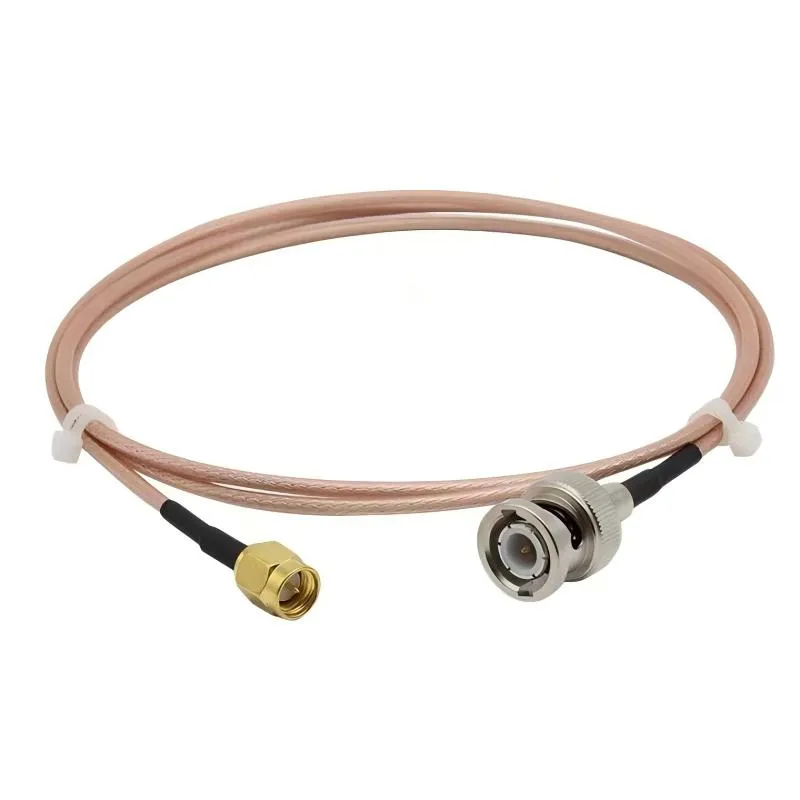
This figure maps the typical placement of RG316 coaxial cable in an RF system. It shows a signal path from an RF module (often with a miniature connector like MMCX) to a panel-mounted SMA bulkhead, with a short RG316 jumper bridging the two. The diagram reinforces that RG316 belongs to the "internal connection" category, where routing flexibility and compact size matter more than ultra-low loss.
Not all coaxial cables serve the same purpose.
Some run across rooftops between antennas and radios. Others stay entirely inside devices. The difference is important because it changes what matters most—loss, durability, or flexibility.
RG316 almost always belongs to the “internal connection” category.
It’s rarely chosen for long feeder runs. Instead, it appears where short RF transitions are required.
Once you view RG316 this way, its design choices start to make more sense.
Mapping RG316 between modules, panels, and test ports
A quick look inside most compact RF equipment reveals a familiar pattern.
The radio module sits on a PCB. The antenna connector is mounted on the enclosure wall. The two points rarely line up directly.
That gap is usually bridged by a short coax cable.
In many designs, that cable ends up being RG316 coaxial cable.
Typical roles include:
• Module to panel connection
• Short test cable for lab equipment
• Internal RF routing between boards
For example, a GNSS receiver might expose a small board connector such as MMCX. The enclosure, however, uses a bulkhead SMA connector for durability. A short RG316 jumper links the two.
The distance involved is usually small.
Most assemblies fall somewhere between:
- 10 cm
- 20 cm
- 50 cm
Once cable length approaches a meter, many engineers start reconsidering the choice.
At that point attenuation begins to matter more than routing convenience.
Bulk RG316 versus finished RF cable assemblies
Another small detail that causes confusion in purchasing discussions.
When someone orders “RG316,” they may actually be referring to two different things.
One possibility is bulk cable.
The other is assembled RF jumpers.
Bulk RG316 cable refers only to the coax itself. The specification normally covers the physical structure of the wire:
- center conductor material
- dielectric insulation
- shield braid
- outer jacket
Those materials determine the cable’s electrical behavior and environmental tolerance.
Finished cable assemblies involve additional variables.
Once connectors are attached, several new factors appear:
- connector type
- connector orientation
- cable length tolerance
- assembly quality
Anyone who has debugged RF hardware long enough has seen this situation: the cable itself is perfectly fine, but the connector termination introduces unexpected loss.
That’s why many RF teams prefer ordering qualified cable assemblies rather than assembling jumpers manually.
Why engineers continue choosing RG316
Given the wide variety of coaxial cables available today, it’s fair to ask why RG316 cable still appears so frequently.
The answer is less about absolute performance and more about practical engineering trade-offs.
Heat tolerance and routing flexibility
Two characteristics make RG316 attractive in compact RF designs.
The first is the insulation system.
RG316 typically uses PTFE dielectric material combined with an FEP outer jacket. These materials tolerate relatively high temperatures compared with common PVC cable insulation.
That matters in electronic equipment where cables may run close to power components or amplifiers.
The second advantage is mechanical flexibility.
With an outer diameter around 2.5 mm, RG316 bends easily inside enclosures. Engineers working with crowded layouts quickly appreciate that property.
Cables that are electrically excellent but mechanically stiff often become difficult to route in real hardware.
Because of these characteristics, RG316 appears frequently in devices such as:
- wireless routers
- GNSS receivers
- RF test instruments
- embedded communication modules
In these systems the cable length is short enough that attenuation remains acceptable.
The unavoidable trade-off: signal loss
Of course, no cable design is perfect.
The small diameter that makes RG316 flexible also increases attenuation.
For short internal connections this usually isn’t a concern. But as cable length grows, loss becomes more noticeable—especially above 1 GHz.
A quick comparison illustrates the relationship:
| Cable | Approx. Diameter | Typical Use |
|---|---|---|
| RG316 | ~2.5 mm | internal RF jumpers |
| RG58 | ~5 mm | medium cable runs |
| LMR-400 | ~10 mm | long feeder cables |
Each increase in diameter generally reduces attenuation but also reduces flexibility.
That trade-off explains why RG316 continues to occupy a very specific niche in RF systems.
It isn’t the lowest-loss cable available.
But for short interconnections where routing matters, it often ends up being the most practical choice.
Checking whether an RG316 specification is genuine
People who buy RF cable long enough eventually notice something slightly odd.
Two products may both arrive labeled RG316 coaxial cable, yet they do not behave exactly the same. One cable bends a little easier. Another feels stiffer near the connector. Occasionally the braid density becomes obvious once the cable is stripped for termination.
That difference does not necessarily mean the cable is incorrect.
The reason is simpler: RG numbers describe families of cable, not perfectly identical constructions.
Because of this, engineers who work with RF hardware every day rarely rely on the label alone. They look at a few physical details first. It becomes a habit.
The inspection usually takes less time than writing an email to the supplier.
The internal structure usually tells the story
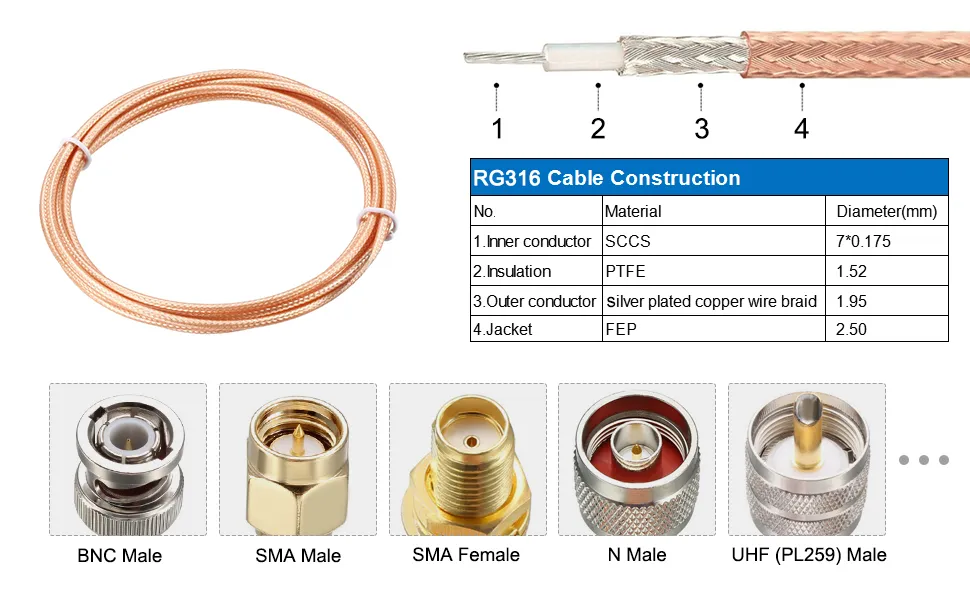
This figure illustrates the internal structure of an RG316 coaxial cable. From center to outer layer: a silver-plated copper center conductor (carries RF current), a PTFE dielectric (defines impedance and provides thermal stability), a braided copper shield (controls interference), and an FEP outer jacket (protects the cable). Understanding this construction helps engineers verify specifications and avoid substitutes with lower braid density or different materials that could affect performance.
Strip a short section of RG316 cable and the structure becomes easy to recognize.
Most variants share a similar four-layer arrangement.
| Component | Typical material | Why it matters |
|---|---|---|
| Center conductor | silver-plated copper | carries RF current |
| Dielectric | PTFE | defines impedance |
| Shield | copper braid | controls interference |
| Jacket | FEP | protects the cable |
The dielectric layer matters more than many people expect.
In coaxial cable, impedance is determined by geometry—the spacing between the inner conductor and the shield—and by the dielectric constant of the insulation. PTFE happens to be very stable across temperature changes, which is one reason it shows up in many RF cable designs.
Anyone curious about the physics behind that geometry can find a clear explanation in the Coaxial cable reference article.
Once you understand how impedance is created, the importance of consistent materials becomes obvious.
Numbers matter more than the RG label
In purchasing discussions, the RG designation sometimes receives too much attention.
Three parameters usually tell engineers far more.
Characteristic impedance
For RG316 coaxial cable, the expected value is 50 ohms.
If the impedance deviates significantly, reflections begin appearing in the RF path.
Outer diameter
Most RG316 variants sit close to 2.5 mm. That diameter makes the cable easy to route inside small enclosures.
Temperature tolerance
PTFE-based coaxial cables typically tolerate higher temperatures than PVC-insulated cables. In equipment where RF power amplifiers generate heat, this difference can matter.
Those three numbers—impedance, diameter, and temperature rating—are usually more informative than the RG designation itself.
Traceability sometimes matters more than performance
Commercial wireless devices often prioritize cost and electrical performance.
Other industries take a different view.
In aerospace, defense, and certain industrial applications, the conversation may include additional questions:
- Which manufacturing batch produced the cable?
- Are material declarations available?
- Does the supplier maintain traceability records?
None of these details improve signal transmission directly. Their purpose is reliability and compliance.
But when a production line stops because a cable specification cannot be verified, those records suddenly become very valuable.
Estimating RG316 signal loss
Cable attenuation rarely appears during early testing.
Bench setups tend to use short jumpers, and the signal path looks clean on the analyzer.
Later—after the system moves into an enclosure or field installation—the link margin occasionally looks thinner than expected.
Often the cable contributed more loss than the initial estimate suggested.
Frequency changes everything
Datasheets for RG316 coaxial cable usually show attenuation increasing with frequency.
Typical values look roughly like this:
| Frequency | Approximate loss |
|---|---|
| 100 MHz | about 0.2 dB per meter |
| 1 GHz | about 0.7 dB per meter |
| 3 GHz | about 1.2 dB per meter |
The trend is predictable. Higher frequencies experience greater loss.
Engineers who have studied Transmission line theory recognize the reasons immediately. Skin effect raises conductor resistance, and dielectric losses increase as well.
For short cables the difference may barely matter.
For longer cables—or very high frequencies—the attenuation begins to add up.
Connector transitions quietly add loss
Cables rarely operate alone. Connectors are part of the same signal path.
A typical SMA adapter cable contains two connector interfaces. Each one introduces a small amount of insertion loss.
At many frequencies, that loss sits somewhere between 0.1 and 0.3 dB per connector.
That means a short jumper may include two separate loss sources:
- cable attenuation
- connector insertion loss
In some lab setups the connectors account for more loss than the cable itself.
It is one reason measurement cables are treated carefully and rarely mixed with ordinary wiring harnesses.
Cable length expectations depend on the role
Instead of defining one universal maximum length, engineers usually think in terms of application.
Short RF coaxial cable jumpers serve several different roles.
| Application | Typical length |
|---|---|
| RF module jumper | 5–20 cm |
| test cable | 20–60 cm |
| panel connection | 30–100 cm |
When cables begin exceeding these ranges, engineers often start considering thicker cable families.
It is not a strict rule—more a pattern that appears repeatedly in practical RF systems.
Routing habits that prevent cable failures
Electrical performance often receives most of the attention during design.
Mechanical stress causes many RF cable failures later.
Interestingly, the cable rarely breaks in the middle.
Failures almost always appear near connectors.
The connector exit is the weak point
Watch an RF cable over months of use and a pattern appears.
The cable bends repeatedly where it exits the connector body. Eventually the braid weakens or the center conductor fractures.
Avoiding this problem is mostly a matter of routing.
Allow the cable to curve gradually rather than sharply bending at the connector.
Even a small change in bend radius can extend cable life significantly.
Heat and abrasion accumulate slowly
Inside electronic equipment, cables sometimes run close to:
- power amplifiers
- voltage regulators
- metal enclosure edges
The FEP jacket used on many RG316 cables provides good protection, but it cannot prevent every type of damage.
Long-term exposure to heat or friction can still degrade the cable.
Good routing practices reduce those risks.
Let the enclosure carry mechanical load
Small RF connectors are designed to maintain electrical contact, not to carry structural loads.
One common design habit helps protect them.
Whenever possible, cable clamps or bulkhead connectors should transfer mechanical stress to the enclosure itself.
This prevents the RF port from absorbing bending forces during installation or maintenance.
Miniature connectors—especially MMCX—benefit from this approach.
How RG316 usually appears in real cable assemblies
Bulk coaxial cable rarely shows up directly inside finished products.
Most of the time engineers encounter RG316 coaxial cable in the form of cable assemblies. Someone has already attached connectors, trimmed the cable to length, and built a jumper designed for a specific job.
Those assemblies tend to follow a few patterns.
Once you recognize them, the wiring inside many RF systems suddenly starts to look familiar.
SMA adapter cables are probably the most common example
Walk through a typical RF lab and you’ll likely find several short cables built with SMA connectors on both ends.
These are often referred to simply as SMA adapter cables.
Inside many of those assemblies sits RG316 cable.
There are practical reasons for this combination. SMA connectors are compact but mechanically robust. They can handle repeated mating cycles without significant wear when used correctly. RG316, meanwhile, bends easily and fits neatly between equipment ports.
Together they form a very practical jumper.
In development labs these cables often connect:
- signal generators
- spectrum analyzers
- RF development boards
The cable length is usually modest—often between 20 and 60 centimeters.
Longer cables exist, but once the length increases significantly engineers often move toward thicker RF coaxial cable types.
MMCX to SMA cables show how miniature connectors meet larger interfaces
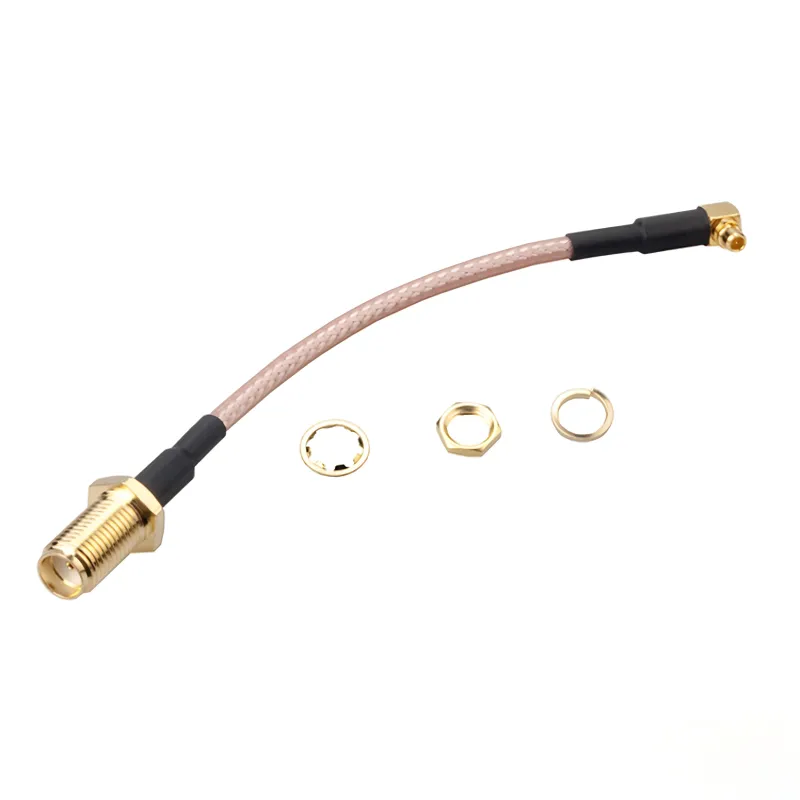
This figure shows a short MMCX to SMA cable assembly, typically constructed with RG316 coaxial cable. One end features a compact MMCX plug (for board-level connections), while the other has a standard SMA plug (for panel mounting or external antenna). The flexible RG316 section acts as a mechanical buffer, protecting the fragile MMCX interface from torque and vibration. Such pigtails are common in GNSS receivers, IoT gateways, and other compact RF devices where space is tight but reliability is required.
Another assembly appears frequently in wireless modules.
A MMCX to SMA cable.
Small RF modules sometimes use MMCX connectors because they occupy very little PCB space. The downside is that MMCX connectors are not always convenient for external cables.
SMA connectors solve that problem.
A short jumper converts the tiny board connector into a standard SMA interface mounted on the enclosure.
Many of those jumpers use RG316 coaxial cable simply because the cable diameter matches the scale of the connectors involved.
Once installed, the SMA port becomes the external connection point for antennas or test equipment.
It’s a small design detail, but it appears across many types of RF hardware—from routers to telemetry systems.
BNC transitions still appear in lab environments
Although SMA connectors dominate modern RF equipment, BNC connectors remain common in laboratory instruments.
Because of that, transition cables still appear regularly.
Two examples show up often:
- SMA to BNC cable
- BNC to SMA cable
These cables allow equipment with different connector standards to communicate without introducing large impedance mismatches.
Inside many of those assemblies sits the same familiar cable—RG316 coaxial cable.
In these situations the cable length is typically short. The goal is compatibility rather than long-distance signal transport.
Using a simple matrix to evaluate RG316 choices
As systems grow more complex, many engineering teams eventually build small decision tools to evaluate cable options.
These tools rarely look sophisticated. Often they are simple spreadsheets.
Still, they help answer a few practical questions before hardware reaches production.
Example decision matrix
| Parameter | Description |
|---|---|
| Use case | module jumper / panel lead / test cable |
| System impedance | typically 50 ohms |
| Frequency band | operating range |
| Cable length | meters |
| Attenuation | dB per meter |
| Connector count | number of transitions |
| Connector loss | estimated loss per connector |
| Total loss | cable loss + connector loss |
From those values engineers can estimate whether the cable remains acceptable for the system’s link budget.
The calculation itself is simple.
Cable attenuation roughly equals:
length × attenuation per meter
Connector loss then gets added to the result.
The exact numbers depend on the hardware involved, but the process usually reveals whether the cable is likely to introduce noticeable signal degradation.
Walking through a short jumper example
Consider a short cable connecting an RF module to a panel connector.
Typical parameters might look like this:
| Parameter | Example |
|---|---|
| Cable | RG316 |
| Length | 0.25 m |
| Frequency | 2.4 GHz |
| Attenuation | ~1 dB per meter |
| Cable loss | ~0.25 dB |
| Connectors | 2 |
| Connector loss | ~0.3 dB |
| Total loss | ~0.55 dB |
In most wireless systems that amount of attenuation is acceptable.
The numbers change quickly if the cable length increases, which is why RG316 works best in short jumper roles.
Turning the same matrix into an inspection checklist
Interestingly, the same spreadsheet can double as an incoming inspection checklist.
Procurement teams sometimes use similar fields when verifying delivered cable assemblies.
Typical inspection items include:
- cable length tolerance
- connector orientation
- impedance specification
- visible mechanical defects
The goal is simply to ensure that the cables delivered by the supplier match the assumptions used during the design phase.
Small mismatches here occasionally create difficult debugging sessions later.
Industry trends affecting RF cable assemblies
RF interconnect hardware is not standing still.
Several trends are gradually shaping how cables such as RG316 cable are used across wireless systems.
RF interconnect demand continues to grow
Wireless infrastructure continues expanding globally.
New applications—from IoT gateways to satellite communication systems—rely heavily on RF connectors and cable assemblies.
Industry analysts frequently note steady growth in the RF interconnect sector as wireless technologies expand.
Even small jumper cables remain part of that ecosystem.
The growth of compact wireless devices ensures continued demand for flexible RF coaxial cable assemblies.
Materials and environmental regulations are evolving
Another topic appearing more often in engineering discussions involves material regulations.
Many coaxial cables, including RG316, rely on PTFE and FEP insulation systems.
These materials belong to a group of fluoropolymers sometimes discussed in connection with PFAS regulations. The article on [Per- and polyfluoroalkyl substances] provides a technical overview of these materials and their regulatory context.
For most RF applications today, PTFE-based cables remain widely used. However, regulatory pressure in some regions may gradually influence how interconnect materials are described or sourced.
Engineers working in regulated industries sometimes monitor these developments closely.
Common questions engineers ask about RG316
How can I verify an RG316 specification before ordering?
At what length does RG316 attenuation become noticeable?
When should a thicker 50-ohm cable replace RG316?
What mechanical problems cause intermittent RF failures?
Can RG316 support connectors like MMCX, SMA, and BNC?
Final observations
RF systems rarely fail because of one dramatic component choice.
More often the problems appear in small details—connectors that loosen, cables that bend too sharply, or signal paths that quietly accumulate loss.
RG316 coaxial cable exists precisely in that subtle part of the system.
It is not the lowest-loss cable available, nor the most rugged. But in the right role—short RF jumpers, module connections, and compact cable assemblies—it remains one of the most practical options engineers use.
Understanding where it fits, and where it does not, is usually enough to avoid most of the problems that appear later in the field.
Bonfon Office Building, Longgang District, Shenzhen City, Guangdong Province, China

A China-based OEM/ODM RF communications supplier
Table of Contents
Owning your OEM/ODM/Private Label for Electronic Devices andComponents is now easier than ever.