
SMA Bulkhead Panel Drilling & IP67 Sealing in Practice

Dec 24,2025

Do I need an SMA bulkhead or a 2/4-hole flange for my panel?

SMA Bulkhead与Flange面板安装连接器选型概览图 / Overview of SMA Bulkhead vs Flange panel-mount connector selection.

This figure appears at the beginning of the document, following the core question: “Do I need an SMA bulkhead or a 2/4-hole flange for my panel?”. It is a conceptual comparison or scenario schematic aimed at visualizing the core differences between the two mainstream panel mounting methods (Bulkhead single-nut vs. Flange screw-fixed). The figure might use side-by-side diagrams or application scenario cartoons to show that Bulkhead connectors are suitable for scenarios like “small routers, lab instruments” where easy installation and replacement are key, while Flange connectors are better suited for environments like “vibrating poles, test rigs” that need to withstand continuous stress. This figure lays the foundation for the entire discussion, helping readers establish the initial concept of selecting based on mechanical environment, not just electrical parameters.
Mounting Style Selection Overview

When you’re building or retrofitting RF hardware, the question isn’t whether the connector fits the hole — it’s whether the mount style survives vibration, torque, and time. SMA bulkhead connectors and flange-mount types share electrical specs, but mechanically they behave like cousins, not twins.

For light-duty enclosures — small routers, lab instruments, or indoor IoT gateways — a single-nut bulkhead SMA usually does the job. It slides through a drilled hole and tightens from the front; you can replace it in seconds. But when that assembly lives on a vibrating pole or a test rig that sees daily cable swaps, a two-hole or four-hole flange is far safer. The flange spreads stress across the chassis instead of letting one nut take all the torque.

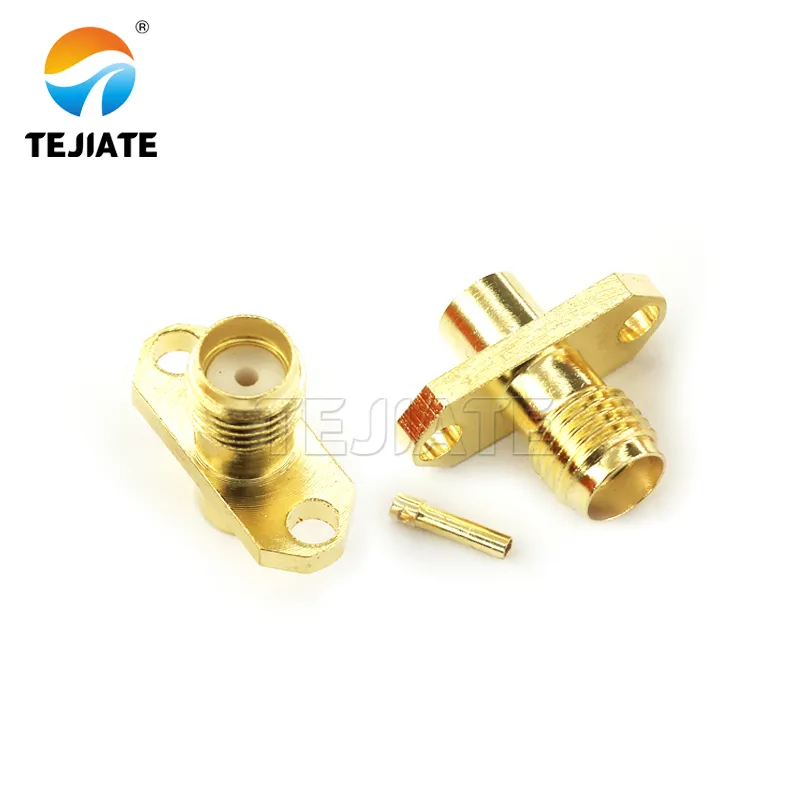
Product photo of an SMA Flange (flange-mount) connector.

These two figures are specific images showcasing the Flange connector product. They are likely product photographs or high-fidelity renderings that clearly display the key features of an SMA Flange connector: a robust housing, mounting ears (with 2 or 4 holes) for screw fixation, the interface threads, and possibly a pre-installed sealing gasket. The images aim to give users an intuitive understanding of the physical form of a Flange connector and its installation method—directly bolted to the panel with screws (as opposed to being secured from behind with a nut like a Bulkhead). This visualization helps readers connect the abstract advantages discussed earlier, such as “vibration resistance” and “even load distribution,” with the specific product form, and provides a visual reference for subsequent discussions on details like mounting hole spacing and torque.
SMA Flange Connector Product Image
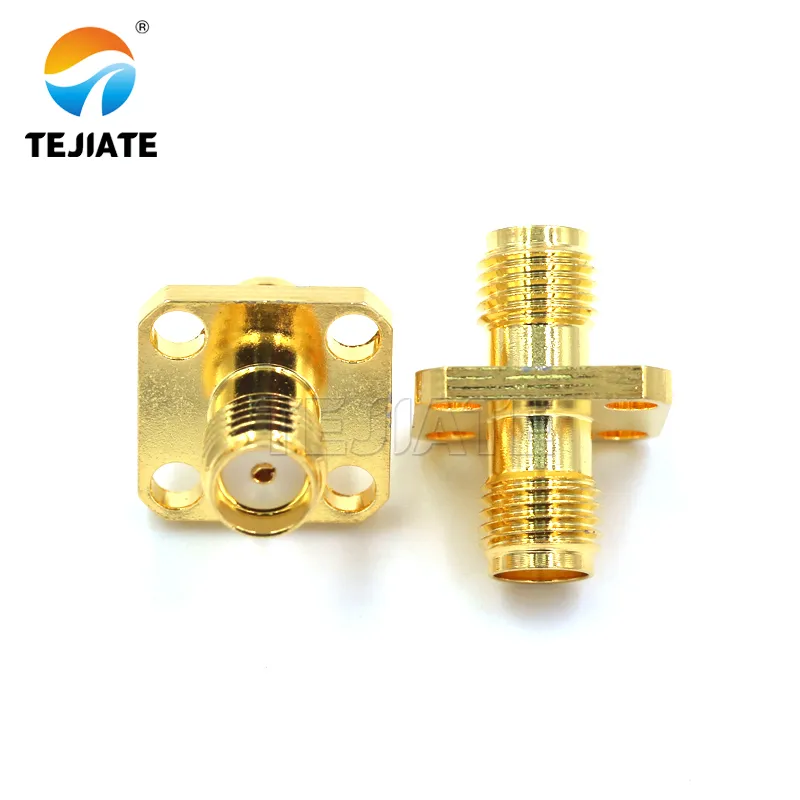
Four-hole mounting SMA flange connector product image.

This figure is the explicitly designated 4-hole SMA Flange Connector product image in the document. It is a close-up product photo that clearly displays an SMA connector designed for demanding environments. Its most prominent feature is the four symmetrically distributed mounting screw holes, which allow it to evenly distribute mechanical and electrical loads to the panel through multiple fixation points. Compared to the two-hole version, the four-hole design provides superior stability and seal retention when subjected to vibration, frequent mating cycles, or outdoor temperature cycling, effectively preventing the connector from rotating loose due to stress. The image also shows the connector's interface threads and possibly an integrated sealing gasket, visually demonstrating its suitability for scenarios requiring IP-rated protection and long-term reliability, such as outdoor access points, telecom enclosures, or industrial equipment.
4-Hole SMA Flange Connector
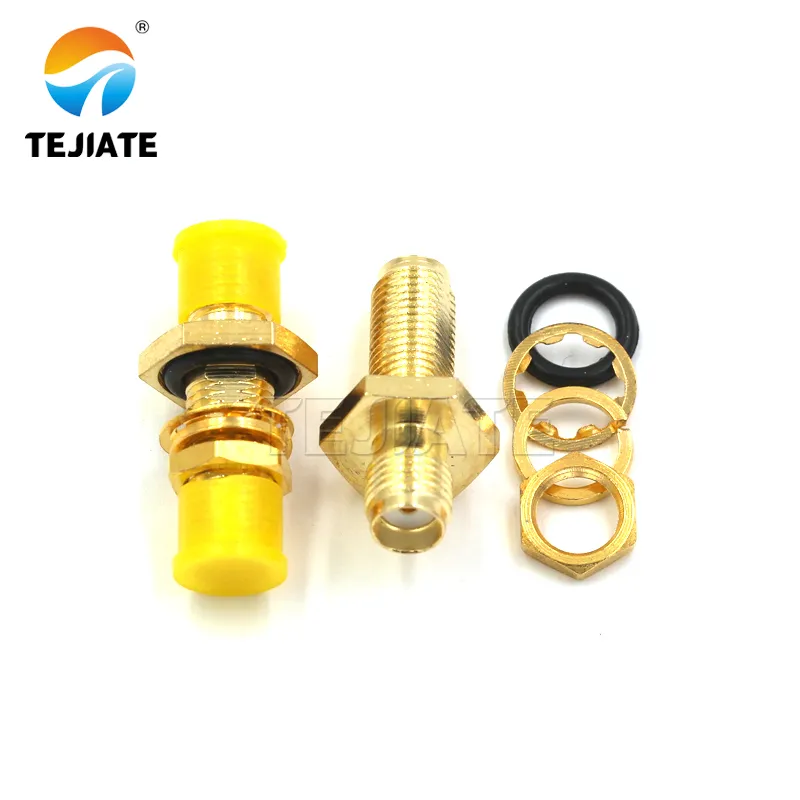
Product photo of an SMA Bulkhead (thru-panel) connector.

This figure forms a contrast with Figures 2/3, specifically showcasing the Bulkhead connector product. It is a product photograph or schematic that highlights the features of a Bulkhead connector: a body with a longer threaded sleeve, and likely includes accompanying O-ring, washer, and lock nut. The image visually demonstrates the installation principle of how this connector “passes through” a hole in the panel and is then secured from the inside with a nut. Its purpose is to help users clearly distinguish the appearance and installation logic of Bulkhead from Flange, understanding the Bulkhead’s characteristics of “quick installation” but “reliance on single-point nut torque,” providing a concrete reference for subsequent discussions on thread length calculation, sealing stack-up, and torque control.
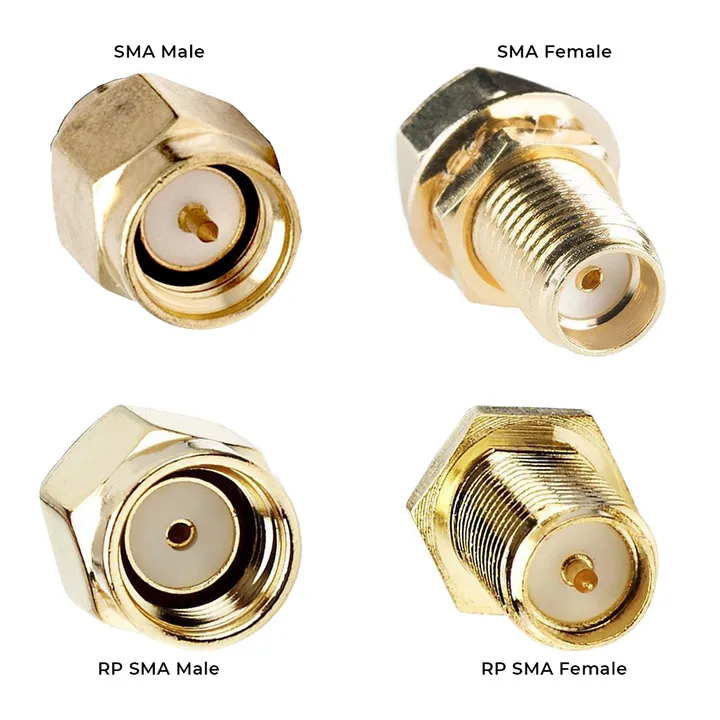
SMA Bulkhead Connector Product Image
If you’re uncertain which side your design leans toward, compare it against similar builds in TEJTE’s coaxial loss and selection overview. Projects using long feeder cables often benefit from flange mounts because of their stable grounding plane.

Vibration, torque, and mating cycles — picking the right mount

Every field engineer has tightened one connector too many times and watched return loss climb. Bulkhead SMAs can handle roughly 500 mating cycles before the PTFE starts to deform. Flange styles usually double that because the body doesn’t twist under the nut’s load.

In high-vibration sites — think vehicles or outdoor enclosures — use nylon-insert nuts or low-strength thread locker to stop gradual loosening. Over-torque is a silent killer; anything above 0.8 N·m risks crushing the dielectric. Re-torque once after the first heat cycle, then leave it. If you’re running Wi-Fi antennas through bulkheads, a mis-torqued nut can shift impedance just enough to affect link budget, even if the analyzer looks fine on the bench.

Throughput vs assembly speed in volume production

Production lines live or die by seconds. Installing a bulkhead SMA is quick — insert, washer, tighten. A 4-hole flange takes longer but prevents rotation and preserves gasket compression, which matters when you aim for IP67.

At TEJTE, we often mix both: bulkhead connectors where access is easy, flange connectors where vibration or moisture is constant. The result balances cost, assembly speed, and field reliability. If your factory’s main issue is stripped threads or crooked nuts, the switch to flange-mount hardware pays back within a few thousand units.

For deeper background on SMA body types and their tolerances, check the SMA connector basics entry — it lists exact torque and engagement specs recognized across the industry.

What hole size and edge clearance keep the panel from cracking?

A cracked panel isn’t just ugly; it breaks the RF seal. Most SMA bulkheads need a 6.4 mm ± 0.1 mm hole. Sounds simple, yet plating buildup and paint layers can shrink the effective diameter.

Keep at least 1.5× the hole size as edge clearance from any copper pour or chassis rib. For example, leave ~9.5 mm from hole edge to nearest feature. In clusters of connectors, space the centers at least 10 mm apart for wrench clearance. It feels trivial until your technician can’t tighten the inner nut.

Hole tolerance and minimum edge spacing

If you machine aluminum or stainless panels, tight tolerance is fine — ±0.05 mm holds shape. Plastic housings, on the other hand, expand under heat; give them breathing room at ±0.2 mm. Always deburr, and for soft materials, seat a flat washer to spread compression. Sharp edges invite stress cracks once torque is applied.

One small trick many field assemblers use: test one connector by hand, not with a driver. If you can’t thread it smoothly all the way by fingers, the hole is too tight or misaligned.

Metal vs plastic panel — thermal and structural differences

Metals conduct heat; plastics trap it. Over a year outdoors, a brass SMA bulkhead inside a polycarbonate wall will expand and contract at different rates. The mismatch loosens nuts, leading to moisture seepage. Re-torque every 6–12 months if you deploy gear in sun-exposed sites.

In thin aluminum cases (<1 mm), consider adding a backing plate. It stiffens the panel and maintains ground continuity — something often overlooked until EMI testing. Readers designing omnidirectional antennas can cross-reference this with the antenna gain and radiation concepts on Wikipedia for a better sense of how grounding affects field shape.

How do I size the thread for my stack-up?

Most SMA bulkhead failures start not with the connector itself but with mis-sized threads. Too short, and the nut barely grabs; too long, and your gasket never compresses, letting water creep in. The only cure is measuring each layer of the stack.

Measure panel + washer + gasket + cap stack height

In production, TEJTE engineers calculate the proper thread length using a quick formula that anyone can repeat with calipers:

L required = t_panel + t_washer + t_gasket + h_nut + a_allow

Where

  • t_panel = panel thickness (mm)
  • t_washer = flat + spring washer total (mm)
  • t_gasket = compressed O-ring height (mm)
  • h_nut = nut engagement depth (mm)
  • a_allow = safety margin (0.5–1 mm)
Parameter Symbol Typical Range (mm) Example (mm)
Panel thickness tpanel 0.5 – 3.0 2.0
Washer stack twasher 0.3 – 1.0 0.5
O-ring (compressed) tgasket 0.8 – 1.5 1.0
Nut engagement hnut 1.8 – 2.5 2.0
Allowance aallow 0.5 – 1.0 0.5

Result: L = 2.0 + 0.5 + 1.0 + 2.0 + 0.5 = 6.0 mm.

That means your connector needs at least 6 mm of usable thread. If you calculate anything above 7 mm, it’s time to spec a long-thread bulkhead or a flange SMA.

Always measure with the actual washers and gaskets from the same supplier batch. Differences of 0.3 mm between lots are common and can break your seal margin. When in doubt, reach for a go/no-go gauge instead of eyeballing.

IP67 Sealing — Cap Only or Full Sealing Stack?

Designers often assume a “waterproof cap” solves everything. In reality, IP67 sealing depends on the entire stack, not a single accessory. The cap protects the mating interface, but the leak path usually appears behind the panel — between nut, washer, and gasket.

In a properly sealed assembly, the O-ring compresses 15–25 % under torque. Less than that and it won’t seal; more than that and it deforms permanently. On aluminum panels, a 1 mm silicone ring typically needs 0.2 mm compression, achievable at hand-tight + ⅛ turn. Plastic housings need a bit less torque to avoid warping the surface.

If you’re using a waterproof cap on an indoor router that occasionally faces cleaning spray, that’s fine. But for outdoor access points, masts, or IoT gateways, you need a complete sealing stack: O-ring + flat washer + lock washer + properly sized nut. Caps alone can’t resist months of UV and thermal cycling.

O-Ring Compression and Torque Guidance

A good field trick: mark the nut with a paint line once the seal is verified in test. During maintenance, you’ll instantly see if vibration loosened it. Re-torque schedules vary — once after 24 hours of environmental soak, then annually for outdoor gear.

Another small but critical detail is material hardness. Silicone O-rings rated 60 ShA offer excellent elasticity; NBR rings survive oils but age faster under sun. Always match gasket chemistry to your environment. The TEJTE line of bulkhead SMA connectors uses a silicone gasket pre-fitted behind the washer, giving a reliable 22 % compression when torqued to 0.6 N·m — verified under salt-spray and rain tests.

When Is a Waterproof Cap Enough?

Waterproof caps work well for indoor test setups, temporary field use, or devices stored in damp areas. They’re meant to block drips and dust, not submersion. Under continuous rain or outdoor deployment, moisture travels along the threads and condenses inside. Once inside, even a few micro-drops can corrode the pin plating and shift impedance.

If the product spec calls for “IP67 when capped,” ensure the cap’s gasket compresses against the connector’s outer lip, not the knurling. A small oversight in geometry can nullify the rating. TEJTE’s long-thread SMA bulkheads are dimensioned so that when paired with their matching cap, compression reaches 0.3 mm ± 0.05 mm — enough for full ingress protection without over-stress.

SMA vs RP-SMA — How Do I Avoid Mismatches on Panel Jacks?

SMA female vs RP-SMA female polarity difference

The illustration highlights why misidentifying polarity can cause Wi-Fi/IoT connectors to fail mating.
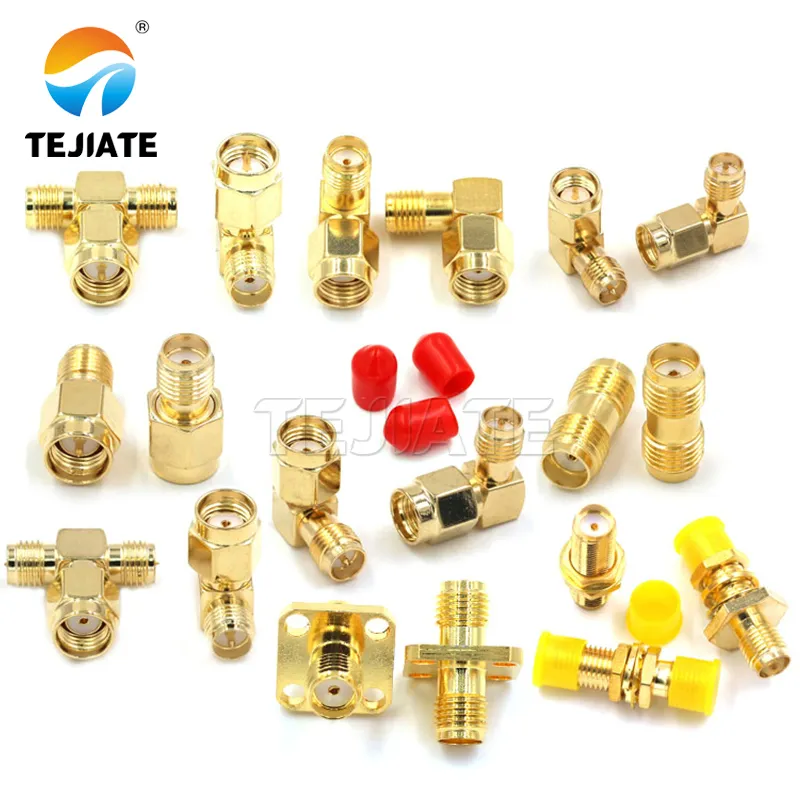
SMA vs RP-SMA Female Polarity
Even experienced installers mix them up. SMA and RP-SMA share threads (¼-36 UNEF) but swap inner gender. In other words: the connector that looks male may be electrically female.

Thread × Pin/Hole Quick ID (Device vs Antenna)

Here’s the cheat sheet technicians keep taped on their benches:
Thread Type Center Contact Typical Use
External threads + pin SMA Male Device-end, cable plug
External threads + hole RP-SMA Female Router/AP body
Internal threads + pin RP-SMA Male Antenna plug
Internal threads + hole SMA Female Panel jack / receptacle

If you can screw it together but the radio won’t pass calibration, you probably crossed genders. Adapters can save a test, but each adds ~0.1 dB insertion loss and slightly degrades VSWR. For performance-critical chains — such as 6 GHz Wi-Fi 7 links — avoid stacking adapters.

To learn detailed geometry and history, see the SMA connector basics page; for consumer-grade confusion cases, TEJTE’s own avoid RP-SMA mismatches covers practical identification photos.

Adapters: A Necessary Evil

Adapters exist for emergencies — field replacements, mixed inventories, or quick bench tests. Yet they’re a silent margin killer. Each extra interface adds return loss and phase uncertainty. When designing with RP-SMA antennas, always check continuity with a DMM before committing to mass assembly. One mismatched pair can pass mechanical inspection but fail network certification.

For compliance, never mix RP-SMA and SMA on the same enclosure without labeling. The FCC requires intentional radiators to prevent unapproved high-gain antennas; mismatching connectors violates that intent.

How Do I Pair an SMA Bulkhead with an Internal Extension Cable?

Inside the device, you often face the problem of a short RF pigtail between board and panel. This is where SMA extension cables come in — male-to-female jumpers that bridge the gap without affecting impedance when chosen wisely.

Length Options (0.1 / 0.3 / 0.5 / 1 / 2 m) and Bend Radius Rules

Always respect the cable’s bend radius — about 10 × outer diameter for RG178 or RG316. A 2 mm cable shouldn’t bend tighter than 20 mm. Excessive bending detunes the dielectric and raises loss.

Short jumpers (0.1–0.3 m) suit enclosed boards; 0.5–1 m lengths fit rack assemblies or external radio modules. For longer spans, use low-loss coax such as RG316 D or LMR-100.

For an overview of loss per length, refer back to the coaxial loss and selection overview. It lists attenuation figures across RG series and helps you calculate total dB drop at your working frequency.

Male-to-Female Extensions, Strain Relief & Routing

Route the pigtail gently, anchoring it with adhesive pads or cable ties — never let it hang from the bulkhead. Strain relief keeps the inner pin from micro-cracking under vibration. TEJTE’s pre-terminated RG178 assemblies include a 25 mm heat-shrink boot at the female end for exactly this reason.

When routing behind a panel, avoid 90° bends right at the connector ferrule; a gradual “lazy S” curve maintains impedance. For examples of secure routing and extension choices, check TEJTE’s extension length and cable routing.

What Belongs on My PO so Installation Succeeds First Time?

Even skilled buyers miss details that cause field rework. A concise order checklist prevents that. Copy and adapt the template below into your procurement sheet.
Parameter Description / Option Example Entry
Connector Type SMA / RP-SMA SMA
Gender Pin / Socket Female (receptacle)
Mount Style Bulkhead / 2-hole / 4-hole Bulkhead
Thread Length (mm) Effective thread exposed 6.0
Panel Thickness (mm) Material gauge 2.0
Waterproof Cap Yes / No Yes
Washer / Gasket Set Model / Thickness Silicone 1.0 mm
Cable Type RG178 / RG316 / LMR-100 RG316
Cable Length (m) 0.05 - 2 m 0.3
Quantity Units per order 200

PO Note Template:

“Supply TEJTE SMA bulkhead connectors, 6 mm thread, silicone gasket, with matching waterproof caps and RG316 0.3 m extension leads pre-terminated. Mounting torque 0.6 N·m. Panel thickness 2 mm.”

This level of clarity avoids the all-too-common “wrong thread length” issue that causes installers to over-tighten and crack panels.

Do Wi-Fi 7 & 6 GHz Policies Change My Mounting Choices?

Yes — subtly but meaningfully. The FCC’s expansion of the 6 GHz VLP band (2024–2025) means more portable and outdoor Wi-Fi 7 devices will use external antennas. That shift increases demand for sealed SMA and RP-SMA bulkheads that can withstand open-air exposure.

US-Wide VLP and Outdoor Implications

Under VLP rules, low-power client devices can now operate across the full 5.925–7.125 GHz range without fixed infrastructure registration. Designers are exploiting this by adding detachable antennas for better diversity. For you, that means the connector interface must hold IP67 without metal distortion — a single bad seal could invalidate compliance due to water ingress altering RF path impedance.

AFC-Enabled Standard-Power Pilots

Meanwhile, Cisco and Federated Wireless began AFC-based standard-power pilot programs in the U.S. enterprise space. Outdoor APs will broadcast at higher levels, which raises ESD and corrosion stress on panel connectors. It’s a quiet reminder that a robust panel-to-chassis ground and sealed SMA interface isn’t just mechanical — it’s regulatory.

These developments echo across product lines; TEJTE’s engineers have already revised flange mount recommendations to handle higher torque cycles for such outdoor deployments.

Frequently Asked Questions (FAQ)

What panel-hole size and edge clearance should I use for an SMA bulkhead?

Most SMA bulkheads need a 6.4 mm hole, but it’s not just about diameter — it’s about clearance. Keep 1.5× the hole size away from any copper, rib, or edge. For tight enclosures, a washer behind the nut helps distribute torque. Always check fit on a sample panel before mass drilling.

For engineers optimizing signal integrity along with mechanical layout, TEJTE’s coaxial loss and selection overview provides context on how connector alignment influences overall link performance.

How do I calculate thread length for a 2 mm aluminum panel with gasket and cap?

Let’s run the math using the Thread Length Calculator formula:

L_required = t_panel + t_washer + t_gasket + h_nut + a_allow

  • t_panel = 2.0 mm
  • t_washer = 0.5 mm
  • t_gasket = 1.0 mm
  • h_nut = 2.0 mm
  • a_allow = 0.5 mm

→ L_required = 6.0 mm

That means your SMA connector must expose at least 6 mm of usable thread. If your chosen part has only 4.5 mm, switch to a long-thread bulkhead SMA or use a 2-hole flange. For consistent fit, always verify the washer and gasket set thickness from the same batch before production.

Is a waterproof cap enough for outdoor installs, or do I need a full sealing stack?

A cap protects against splashes and light rain — but not prolonged exposure. For full IP67 sealing, combine the cap with an O-ring and washer stack. The O-ring compresses between the connector flange and panel wall, blocking moisture behind the nut — where leaks often begin.

Use the cap as your first defense, not the only one. The full sealing stack is mandatory for mast-mounted routers, weather stations, and industrial IoT devices. Without it, humidity sneaks inside and detunes the RF path over time.

How can I quickly tell SMA from RP-SMA on a panel jack to avoid returns?

Simple rule: pin = SMA male, hole = RP-SMA male — even though both have identical threads. When in doubt, compare the mating face:

  • External threads + pin → SMA male
  • Internal threads + hole → SMA female
  • External threads + hole → RP-SMA female
  • Internal threads + pin → RP-SMA male

You’ll find this confusion rampant in consumer Wi-Fi gear. TEJTE’s dedicated avoid RP-SMA mismatches article offers detailed visuals to verify each combination before assembly.

What torque and re-torque schedule keeps the bulkhead from loosening in vibration?

For most brass SMA connectors:

  • Initial torque: 0.6–0.8 N·m
  • Re-torque: after 24-hour heat soak, then annually for outdoor equipment

Mark the nut with a paint stripe once torque is verified — that’s how field technicians visually confirm stability. Don’t exceed the limit; over-tightening crushes PTFE and distorts impedance.

If the environment involves heavy vibration, pair the nut with a spring washer or nylon-insert locknut. It’s a tiny investment that prevents rework months later.

Can I route a male-to-female SMA extension behind the panel without detuning?

Yes, as long as you respect bend radius and use the right cable type. For RG178, maintain ≥20 mm radius; for RG316, ≥30 mm. Anchor the cable to relieve strain and avoid pulling on the bulkhead.

When bends are too sharp, dielectric deformation increases loss by up to 0.2 dB per curve. A simple “lazy-S” routing solves that. For step-by-step examples of routing and tie-down methods, check TEJTE’s extension length and cable routing resource.

Do Wi-Fi 7 & 6 GHz rules change my choice of bulkhead or flange for outdoor APs?

Yes — indirectly but significantly. The FCC’s VLP expansion now allows low-power outdoor 6 GHz devices to operate more flexibly, meaning more units use external SMA or RP-SMA connectors exposed to the elements.

That reality demands IP67 flange-mount SMA or long-thread bulkheads with silicone O-rings, as outlined in TEJTE’s latest connector series. Under AFC-based standard-power deployments led by Cisco and Federated Wireless, waterproof sealing and ground integrity are no longer optional — they’re part of RF compliance.

Stay aligned with updated FCC advisories to ensure your products remain both safe and certifiable.

Practical Assembly Tips from Field Experience

Every installation eventually reveals what the datasheet didn’t say. Below are small, human-tested practices gathered from TEJTE’s integration engineers:

  • Label before mounting. Once bulkheads are torqued, identifying SMA vs RP-SMA becomes nearly impossible without disassembly.
  • Avoid steel washers on aluminum panels. Galvanic corrosion sneaks up fast in humid environments; use brass or stainless.
  • Keep threads clean. Even light thread sealant or dust raises mating resistance and adds unpredictable loss.
  • Store caps lightly threaded. Over-tightening caps during storage deforms gaskets prematurely.
  • Recheck ground continuity with a multimeter before final close-up. Poor grounding equals unpredictable EMI.

These aren’t just habits — they’re low-cost insurance against repeat RMAs.

Why This Matters for Future-Proof Design

As RF systems migrate toward Wi-Fi 7, 6 GHz, and IoT industrial bands, connector reliability defines uptime. An SMA bulkhead isn’t just a mechanical part — it’s the gateway to consistent impedance and environmental protection.

TEJTE’s connectors are built with these trade-offs in mind: precision threading, torque-tested gaskets, and flange options rated for extended vibration. Whether you’re designing a 6 GHz outdoor AP or a compact embedded transceiver, the correct mounting method determines whether your product stays sealed after 100 storms or fails after one.

For a deeper understanding of how cable length and connector choice interact in link-budget calculations, revisit the coaxial loss and selection overview. You’ll see how small mechanical choices affect measurable dB loss — and why TEJTE’s attention to mechanical tolerance supports long-term signal integrity.

Closing Note & Internal Ecosystem

This article connects directly to TEJTE’s broader knowledge network:

Together, these form a structured content cluster that supports both transactional and informational intent — matching how engineers actually search and buy.

Final Word

Schematic of an IP67-rated sealed SMA bulkhead connector assembly.

This figure (titled “IP67 Rated”) is the core illustration in the section “IP67 Sealing — Cap Only or Full Sealing Stack?”. It is likely a cross-sectional or exploded view that details the complete installation components of an SMA bulkhead connector achieving IP67 waterproof and dustproof ratings. The figure clearly shows each part in sequence from outside to inside (or from the outer to inner side of the panel): the connector body, the O-ring (pressed against the outside of the panel), the panel, the washer, the lock nut, and the optional but important waterproof cap. The diagram emphasizes that the O-ring is compressed between the connector flange and the panel to form the primary seal, and the waterproof cap serves as secondary protection. This figure aims to visually educate users that true IP67 sealing is a systematic engineering task requiring the correct combination of all components with proper torque, not just screwing on a waterproof cap.
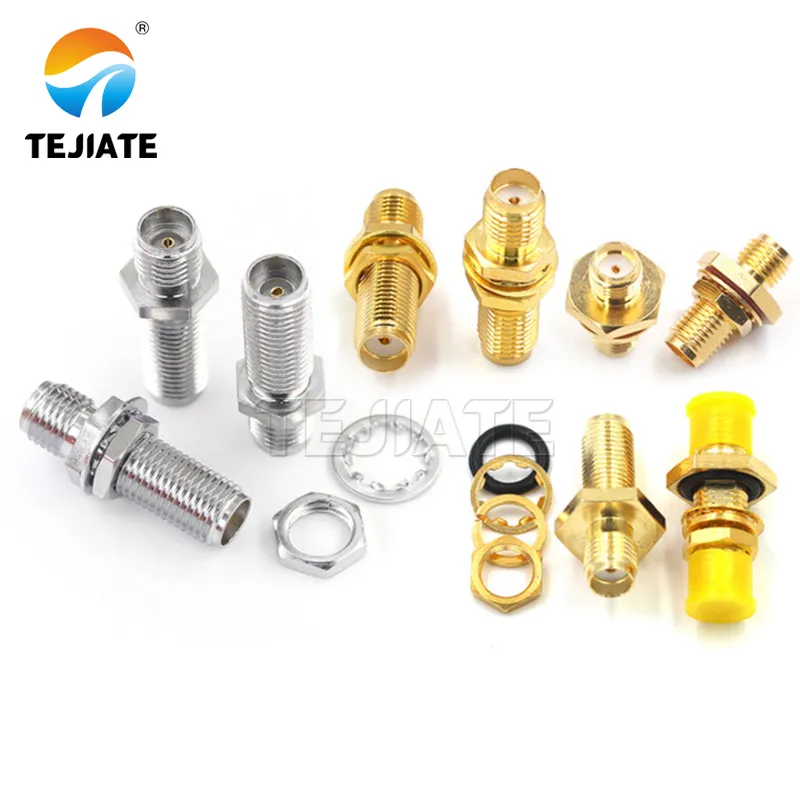
IP67 Sealed Assembly Diagram
Product series image of SMA connectors suitable for Wi-Fi 6/7.

This figure (titled “Wi-Fi 6/7 Ready”) appears in the summary and product recommendation section at the end of the document. It is a product series display image, likely presenting a variety of SMA and RP-SMA connectors offered by TEJTE that are specifically designed and tested to meet the high-frequency, low-loss requirements of Wi-Fi 6/7, particularly the 6 GHz band. The image might include an arrangement of connectors with different styles (Bulkhead, Flange), polarities, and with or without waterproof caps. The purpose of this figure is to visually communicate to readers that connector products are also evolving to meet new technical standards (like Wi-Fi 7 and 6 GHz regulations). Choosing these “future-ready” products ensures signal integrity, stable VSWR, and reliable outdoor sealing performance at higher frequency bands, thereby meeting the latest compliance and performance requirements.

Wi-Fi 6/7 Ready Connector Series

Selecting the right SMA bulkhead or flange isn’t about picking from a catalog; it’s about engineering for survival — torque, sealing, frequency, and field repair all in one decision.

If you want consistent fit and verified IP67 sealing straight out of the box, explore TEJTE’s professional SMA and RP-SMA bulkhead lineup — engineered with real production feedback, not just datasheet theory.

Every connector TEJTE ships is tested for thread integrity, O-ring compression, and insertion loss under 6 GHz.

That’s how we help you turn drawings into reliable RF hardware — one bulkhead at a time.

Bonfon Office Building, Longgang District, Shenzhen City, Guangdong Province, China

customer service