
BNC 50 Ohm vs 75 Ohm: Lab & Video Picking Guide
Nov 18,2025
Preface
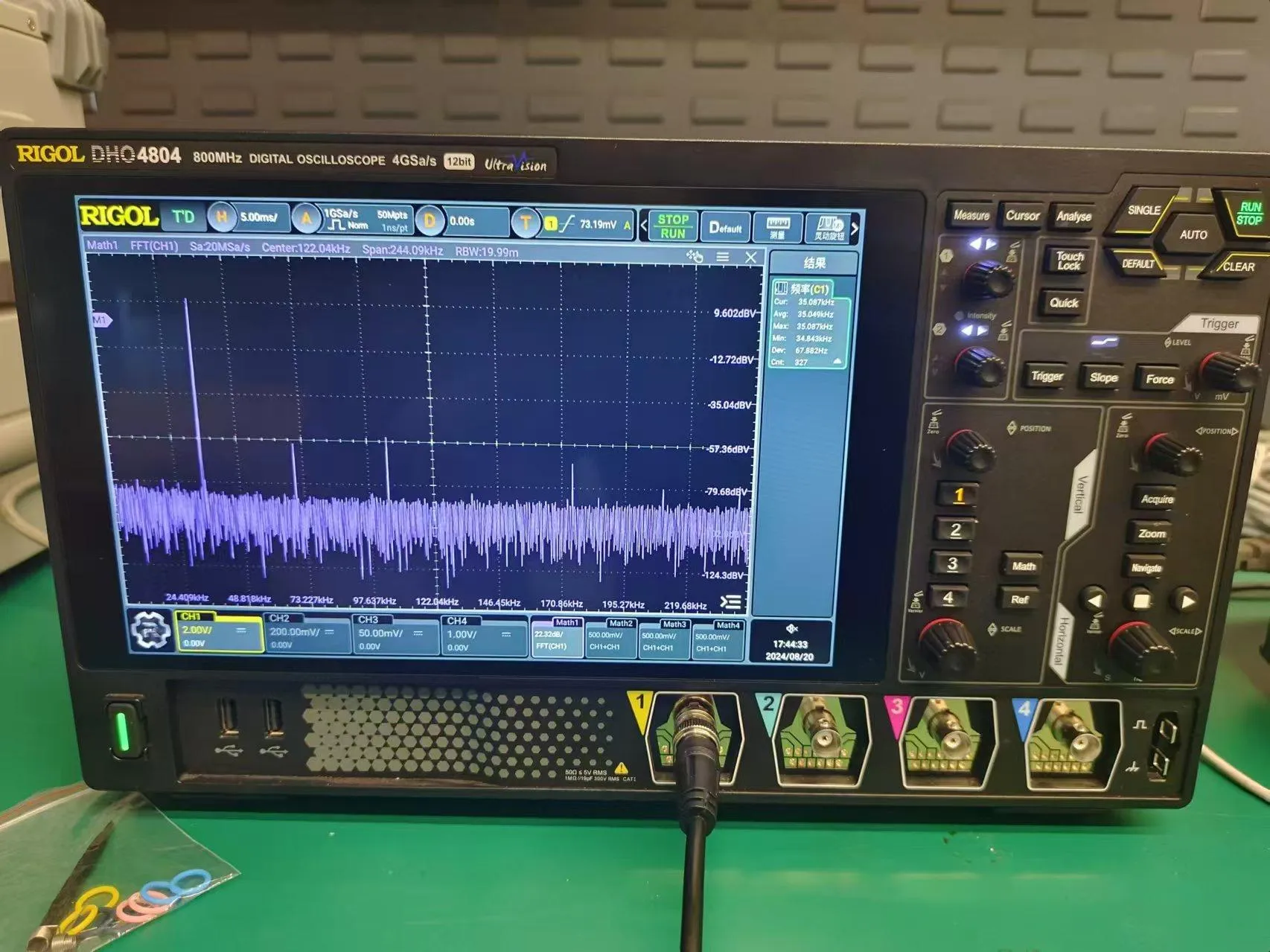
Walk into any RF bench or CCTV control room and you’ll hear a familiar question: “Is this run 50 ohm or 75 ohm?” It sounds trivial, but the wrong choice can nudge a clean waveform into ripple, or let a video feed slip into soft ghosting. Over years of building test setups and reviewing customer chains, one pattern repeats: most problems don’t come from fancy instruments—they come from the tiny interfaces in between.
TEJTE’s own connector families show how much performance hides inside those details. A 50-Ω BNC T or cross (such as the BNC-JKKK rated DC–4 GHz, 1000 V dielectric strength, and 500 mating cycles) behaves very differently from a 75-Ω CCTV BNC built for long-distance Q9 video lines. Even the plating matters; a pure copper–gold-plated inner pin keeps loss in check, while nickel-plated shells improve corrosion resistance when cables are repeatedly handled on field benches.
Whether you’re evaluating bnc 50 ohm vs 75 ohm, routing RG316 jumpers, or connecting SMA-based modules through a BNC adapter, small impedance mismatches accumulate. And with Wi-Fi 7, 5G-Advanced benches, and higher-frequency VNAs tightening allowable margins, the “good enough” mindset doesn’t hold like it once did.
This guide walks through how engineers actually decide between 50 Ω and 75 Ω BNC chains, what mixing them costs, and when a short jumper beats stacking adapters—all grounded in real specifications and field practice.
How do you decide BNC 50 Ohm vs 75 Ohm for your signal chain?
Choosing between 50-Ω and 75-Ω BNC isn’t just an impedance formality; it reflects two fundamentally different ecosystems. RF labs rely on a well-behaved 50-Ω environment because signal generators, analyzers, scopes, and terminators all assume that reference. Video and CCTV, on the other hand, use 75-Ω chains because the lower dielectric loss and geometry better support long cable runs with minimal distortion.
Before placing connectors in your chain, map the environment first—not the connector.
Map the use case: RF bench (50 Ω) vs video/CCTV (75 Ω)
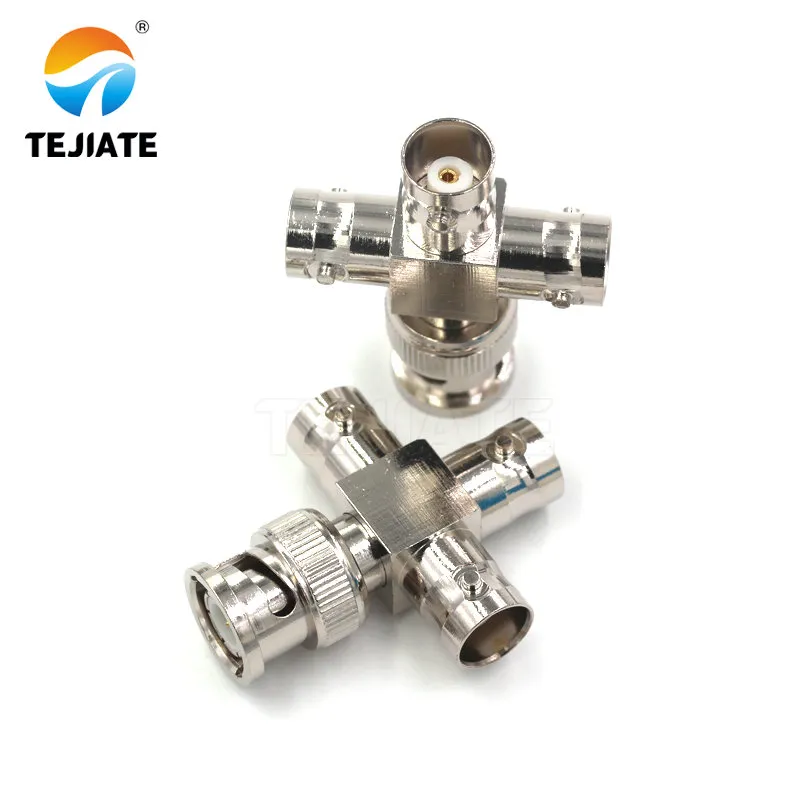
Figure is highlighted in the "Do you need a tee + terminator to loop a signal?" section. It visually presents the key component for solving signal distribution needs. Its feed-through design allows it to provide the correct terminal load for the system while monitoring the signal, making it a fundamental component for building complex test chains.
If you’re working with oscilloscopes, spectrum analyzers, power sensors, or RF modules, your home base is 50 Ω. A T-junction like TEJTE’s BNC-JKKK (DC–4 GHz, PET insulation, gold-plated inner conductor, nickel-plated shell) keeps impedance predictable even across multiple ports. These components are built for short to medium runs where reflections matter more than attenuation.
CCTV and broadcast chains flip the priority. Most cameras and DVRs expect a 75-Ω line, often using Q9-style or 75-3/75-5 video cable with field-friendly no-solder BNC connectors. These versions emphasize long-distance clarity, high insulation resistance (≥5000 MΩ), and modest bandwidth (DC–3 GHz), more than ultra-tight return-loss budgets.
One easy rule:
- RF = 50 Ω from end to end
- Video = 75 Ω from end to end
Breaking this rule isn’t harmful, but it always adds measurement uncertainty.
For readers new to coax basics, TEJTE’s RF Coaxial Cable Guide offers background without interrupting your flow.
Set a target: required return loss / SNR / bandwidth
The easiest way to choose is to think in performance targets, not connector labels.
On RF benches, you probably care about:
- Return loss (RL) better than ~18–20 dB through the chain
- Consistency across mating cycles
- Defined performance up to several GHz
Here, TEJTE’s 50 Ω parts provide predictable behavior:
- BNC-JKKK: DC–4 GHz bandwidth
- BNC-KF flange: RL ≤1.2 dB (DC–1 GHz), inner contact ≤1.5 mΩ
- Terminator BNC-50JR-0.5W: Rated 0.5 W, 500 V working voltage, 1500 V withstand
Those numbers anchor real bench performance. A matched chain maintains SNR by suppressing reflections, especially around 1–3 GHz where many instruments operate.
For video, SNR depends more on run length and cable quality. A 75-Ω chain with copper-gold-plated center pins and nickel-plated alloy shells keeps ghosting low on longer runs. Since analog video occupies relatively low frequencies, a connector rated DC–3 GHz is already over-qualified.
If your application needs both RF quality and long-distance runs, avoid splitting the difference—pick one environment and preserve it end-to-end.
Can you mix 50 Ω and 75 Ω parts without breaking measurements?
Most engineers try this at some point: a 75-Ω cable shows up in a 50-Ω bench, or the only available tee is the wrong impedance. Fortunately, mixing them rarely damages anything—the voltages involved are far below the durability of common BNC hardware (500–1500 V ratings are typical). The real penalty shows up in reflection, RL degradation, and small but cumulative mismatch loss.
In many chains, especially where adapters already multiply interfaces, that penalty becomes visible.
What mismatch really costs: reflection, mismatch loss, reading drift
Mixing 50 Ω and 75 Ω creates a reflection coefficient:
[ |\Gamma| = \left|\frac{75 – 50}{75 + 50}\right| = 0.2 ]
Which corresponds to:
- Return loss ≈ 14 dB
- VSWR ≈ 1.5:1
- Mismatch loss ≈ 0.18 dB
Those numbers might look small, but real chains include more than one interface. A single mismatched tee placed between a signal generator and a scope can introduce tiny standing-wave patterns. On mid-range VNAs or power sensors, that shows up as reading drift; on scopes, you may notice edge shape changes.
This is where good construction helps. A connector with ≤1.0 mΩ outer-conductor resistance (e.g., the BNC-KF flange) and tight mechanical tolerances can reduce extra parasitic reflections even in imperfect impedance environments.
If you’re unsure how many mismatches you’ve accumulated, TEJTE’s BNC T-Connector Tips article (internal link) explains typical stacking errors.
When a 50 to 75 Ω matching pad is mandatory (and when it’s overkill)
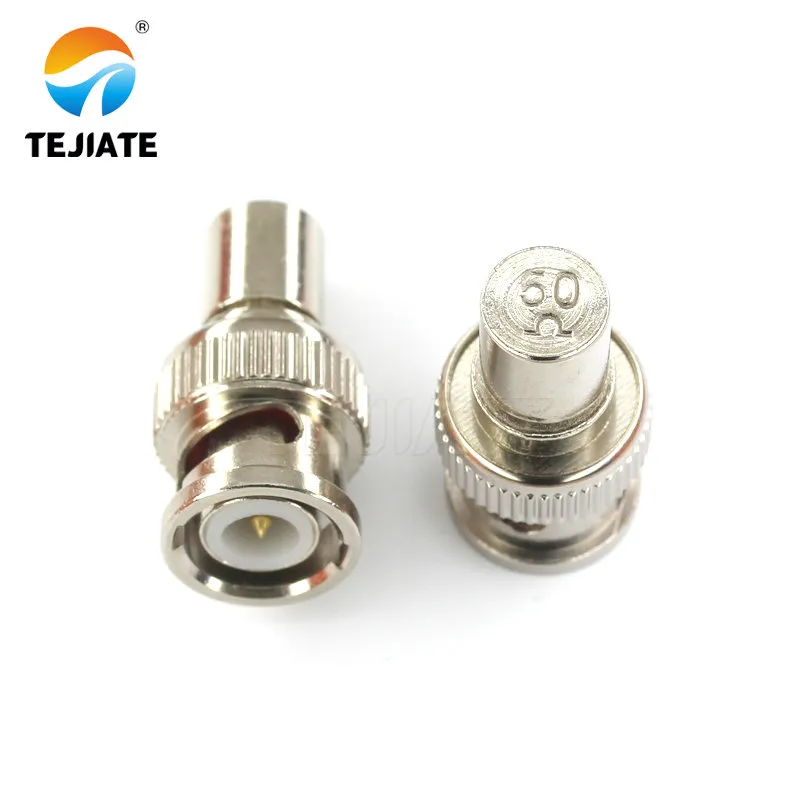
This diagram shows the product series of 50-ohm BNC terminators, such as BNC-50JR-0.5W, with 500V working voltage and PTFE dielectric, maintaining port stability in detailed RF power or noise measurements
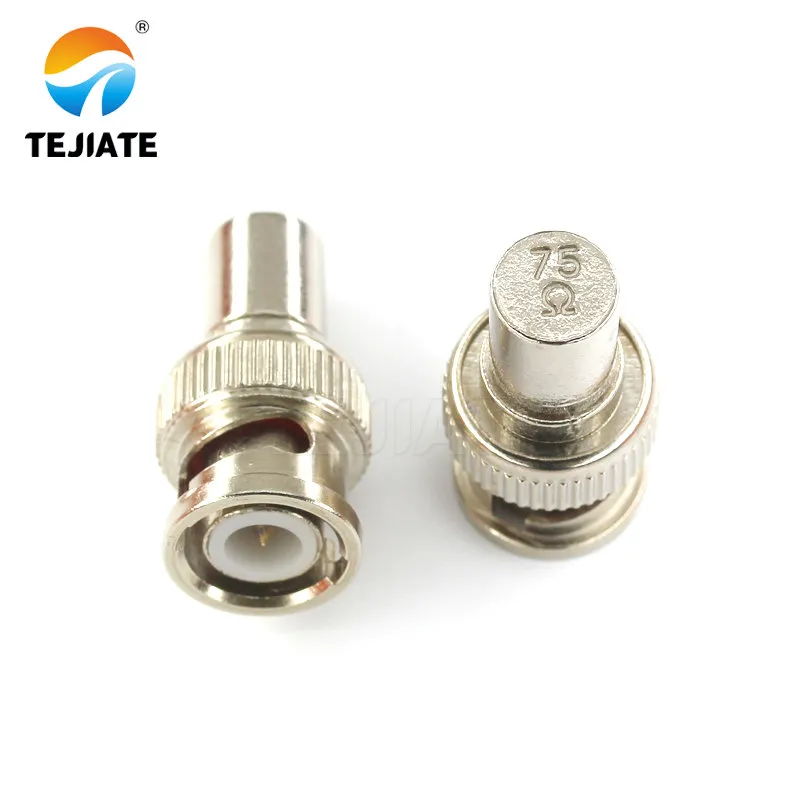
This diagram shows 75-ohm BNC terminators, such as BNC-75JR-0.5W, with 500V working voltage and ≥5000MΩ insulation resistance, providing clear signal termination for long-distance video lines
A proper matching pad is essential when:
- Measuring small-signal RF power
- Running wideband modulated signals (Wi-Fi, 5G-NR, UWB)
- Logging data on precision channels where drift matters
- Driving multiple loads with a splitter or T-connector
Pads guarantee return loss performance even when downstream devices differ. For example, a 50-Ω generator feeding a 75-Ω chain through a 50 to 75 Ω pad yields predictable RL across the operating band. That keeps measurements repeatable and protects your margin at higher frequencies.
But when is a pad unnecessary?
- CCTV runs where the source is tolerant
- Quick functional checks on non-critical signals
- Low-frequency timing lines
- Hobbyist-level video/AV mixers
In these cases, using a clean 75-Ω terminator like BNC-75JR-0.5W (500 V working, ≥5000 MΩ insulation) at the end of the line is more than adequate. Pads only add cost and insertion loss.
Will an adapter or a short jumper control reflections better?
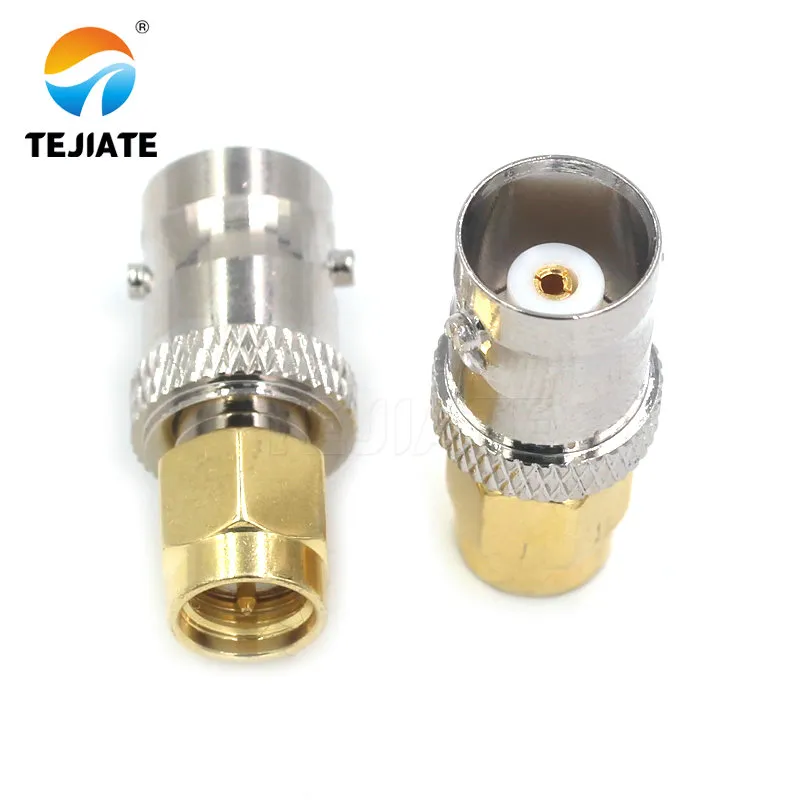
This diagram illustrates the stacked use of BNC adapters in real test benches, with each interface adding approximately 0.05-0.20dB insertion loss at 1GHz, and multiple adapters in series forming small resonant structures that affect high-frequency performance
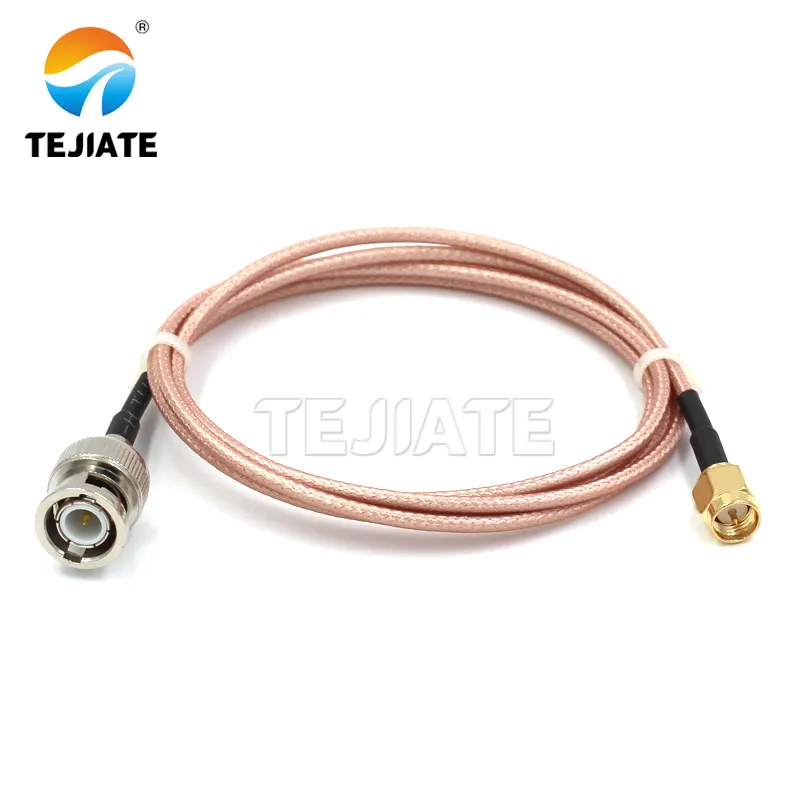
This diagram shows the advantages of using RG316 jumpers instead of multiple rigid adapters, with jumpers introducing only two interfaces while alleviating mechanical stress, especially suitable for instrument connections with limited front-panel clearance
Adapters stack up fast in real benches. You add one to solve a mismatched gender, another to clear a mechanical obstruction, and suddenly your chain has four interfaces before the cable even starts. Each contributes roughly 0.05–0.20 dB of insertion loss at 1 GHz and more at higher frequencies.
A short jumper—especially using RG316 cable—often behaves better than multiple rigid adapters. TEJTE’s blog on SMA to BNC Cable: Length & Loss notes that a 0.1–0.5 m jumper can smooth mechanical stress while keeping IL predictable.
This won’t fix an impedance mismatch, but it does limit mechanical leakage paths, prevent misalignment, and reduce micro-motion noise.
Adapter count vs interface penalty; when a 0.1–0.5 m jumper wins
Every adapter adds:
- One male–female mechanical interface
- One set of tolerances
- One transition where plating or pin alignment can vary
Two or more stacked adapters create a small resonance structure. At a few hundred MHz, this is often invisible; past 1 GHz, the effect becomes noticeable. In contrast, a short jumper introduces only two interfaces total, regardless of routing.
RG316, with its predictable loss profile and flexibility, works well here. If you’re building SMA-to-BNC transitions, replacing two adapters with a jumper can cut the “interface penalty” in half.
In instruments with front-panel clearance issues, a short jumper can also reduce torque stress on connectors—especially those rated for ~500 mating cycles, such as TEJTE’s BNC-JKKK and many 50 Ω flanged types.
Right-angle relief vs straight path in tight panels
Right-angle BNCs are tempting in compact racks, but they do introduce slightly higher IL and minor changes in VSWR. For most setups, the difference is small; the real benefit is mechanical. RA connectors relieve strain on devices whose panels sit close to adjacent ports, handles, or enclosures.
When should you choose RA?
- When the straight connector physically cannot clear the panel
- When strain relief matters more than marginal IL
- When repeated handling would torque a straight connector sideways
A well-built RA with nickel-plated brass shells and gold-plated copper pins (common in your TEJTE 75-Ω no-solder models) performs reliably as long as you stay within its intended frequency range.
How do you identify BNC gender & impedance correctly on instruments?
Read the shell, not just the pin; scope/analyzer ports checklist
Many people glance only at the center pin to judge gender, but BNC tolerances are tight enough that relying on one feature can deceive you. Instead, inspect the bayonet shell and lock-ring geometry; those details rarely change even after heavy wear. Some test instruments mark impedance directly on the panel—“50 Ω” engraved beside the jack—but others leave it implicit.
A practical checklist that works well across oscilloscopes, VNAs, spectrum analyzers, and generators:
- Look for printed or etched impedance near the port (often “50Ω”).
- Confirm the shell style; RF gear almost always uses 50-Ω geometry with precision-machined brass or nickel-plated alloy, similar to TEJTE’s 50-Ω flanged BNC (DC–3 GHz, ≤1.5 mΩ inner resistance).
- Check adapter stacks before assuming the port’s native type.
- Verify the terminator—a 0.5 W terminator stamped “50Ω” or “75Ω” can be a giveaway.
- Cross-check the manual or rear-panel labeling when ports behave unexpectedly.
Instruments with SMA primary connectors and BNC auxiliary ports (common in mixed-domain analyzers) complicate things further. In those cases, treat each BNC as a convenience interface rather than a precision path unless confirmed otherwise. For more background on connector identification patterns, TEJTE’s What Is SMA Connector? blog offers context on how port standards evolved.
Quick field tests: labeling, continuity, and “do no harm” steps
If you inherit a setup with no documentation, quick field tests can save hours.
- Continuity check (non-powered)
Use a handheld multimeter to confirm pin continuity through any existing adapters. This won’t tell you impedance but reveals if a gender-changer or coupler is hiding in plain sight.
- Termination reaction
Attach a known-good 50 Ω terminator such as a TEJTE BNC-50JR-0.5W (500 V working voltage, PTFE insulation). Many analyzers slightly change their displayed status or noise floor when terminated correctly.
- Low-power reflectometer/VNA sweep
A sweep from 1–200 MHz will expose large impedance mismatches instantly. A 75-Ω port accidentally placed in a 50-Ω bench will show a consistent RL ~14 dB, revealing the issue without risking damage.
- Visual inspection
Check plating wear. Gold-plated copper pins (common in TEJTE’s no-solder CCTV BNCs) look different from nickel-plated pins used in many RF lab parts.
These quick tests follow the “do no harm” principle—no high power, no assumptions, and no irreversible steps before confirming what you’re dealing with.
What recent RF & wireless updates change your margin assumptions?
The last few years pushed RF margins tighter across every domain. Wi-Fi 7 widened channels; 5G-Advanced increased mid-band frequencies; VNAs became more precise; and even affordable bench equipment now exposes mismatch effects once hidden in the noise. If you’re choosing between bnc 50 ohm vs 75 ohm, these ecosystem changes indirectly affect how strict your return-loss and IL budgets must be.
Even if your connectors are only rated to DC–4 GHz (like the BNC-JKKK cross) or DC–3 GHz (like many 75-Ω BNC loads), the broader system landscape raises expectations on the rest of the chain.
Wi-Fi 7 certification & 802.11be finalization to wider channels, tighter return-loss needs
Wi-Fi 7 (IEEE 802.11be) pushes channel bandwidth significantly wider, emphasizing clean transitions and minimizing reflection. As modulation complexity increases, your front-end measurement paths—especially those involving adapters or tees—need better linearity and reduced ripple. Even if you’re not measuring in the 6 GHz band directly, a sloppy intermediate BNC interface can distort envelope metrics.
That’s where construction quality matters. A connector with ≥5000 MΩ insulation resistance, precise brass machining, and tight bayonet engagement behaves more consistently when measuring modulated Wi-Fi waveforms. TEJTE’s flanged 50 Ω BNC (with ≤1.2 dB RL from DC–1 GHz) is one example of how mechanical precision translates to cleaner RF boundaries.
5G-Advanced (3GPP Release 18 frozen Jun 2024) to stricter high-freq benches
5G-Advanced brings new mid-band and FR2 testing requirements. Even when your signal path uses BNC only as a transition (for example, SMA to BNC to scope), any mismatch in that chain affects EVM readings or burst envelope captures. The need for a consistent 50-Ω baseline becomes stronger than ever.
With many instruments now supporting higher sample rates, a BNC T with 500 mating-cycle durability (like TEJTE’s BNC-JKKK) helps ensure that mechanical wear doesn’t drift your measurement conditions over time.
Engineers testing early 5G-Advanced chipsets often standardize short RG316 jumpers to avoid excessive adapter stacking—a practice reinforced in TEJTE’s SMA to BNC Cable: Length & Loss article.
New VNAs/extenders (up to 250 GHz) & 54 GHz mid-range VNAs to fewer interfaces, cleaner 50-Ω chains
Modern VNAs and extenders operate at frequencies where even tiny mechanical transitions matter. While BNC isn’t used directly at 50–250 GHz, it often sits at the front end of lower-frequency channels or supports control signaling paths. The industry trend toward minimizing interfaces applies everywhere: fewer adapters, shorter runs, and tighter 50-Ω control.
A BNC connector with consistent dimensions—like a nickel-plated brass shell paired with gold-plated inner contacts—reduces geometric drift over repeated cycles. This is one of the subtle reasons why well-machined 50-Ω BNC hardware remains relevant even as RF systems advance far beyond BNC’s native bandwidth.
How do you spec a 50-Ω BNC chain for lab repeatability?
A repeatable 50-Ω chain starts with the basics: clean connectors, stable terminators, known-length cables, and minimal variation in mechanical interfaces. But consistency also comes from choosing parts that maintain electrical characteristics across time—not just when they’re new.
Many TEJTE 50-Ω BNC parts illustrate this principle:
- Dielectric strength: 1000–1500 V (plenty of safety margin on RF benches)
- Contact resistance: inner ≤1–2 mΩ, outer ≤1 mΩ
- Insulation resistance: ≥5000 MΩ
- Frequency coverage: DC–3 GHz or DC–4 GHz depending on the model
- Plating: copper–gold inner pin, nickel-plated outer shell for stability
These details matter when you rely on the chain day after day.
Terminators, T-connectors, couplers: where each belongs
A reliable 50-Ω chain typically includes:
- 50-Ω terminators for unused instrument ports
- T-connectors (like BNC-JKKK) for distribution or monitoring points
- Feed-through couplers for extending or panel-mount transitions
- Straight vs right-angle variants depending on panel clearance
- SMA to BNC transitions when mixing connector families
Terminators such as BNC-50JR-0.5W (500 V rating, PTFE dielectric) maintain port stability, especially on detailed RF power or noise measurements. T-connectors distribute signals but require careful termination on any unused branch to avoid RL degradation. Panel-mount types (e.g., BNC-KF, ≤1.5 mΩ inner resistance) ensure that enclosure transitions don’t add unmodeled loss.
When these components share consistent metallurgy and machining tolerances, measurement repeatability improves dramatically.
How do you spec a 75-Ω BNC chain for video clarity?
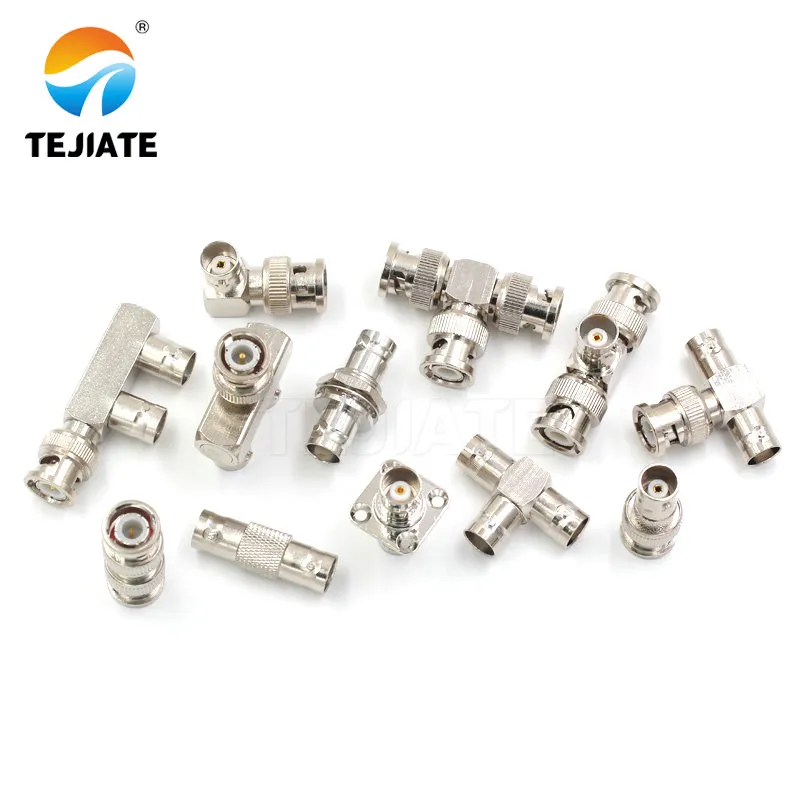
This diagram highlights the key role of 75-ohm BNC adapters in video chains, using gold-plated copper pins and nickel-plated alloy shells, with DC-3GHz bandwidth and low contact resistance ensuring clarity in long-distance video transmission
A well-behaved 75-Ω video path behaves very differently from a precision 50-Ω RF bench, even though the connectors look similar. Where RF engineers chase return loss at several gigahertz, CCTV and broadcast technicians watch for soft ghosting, rolling shadows, and color fringing—artifacts usually triggered by poor termination or long-run attenuation. The right choice of 75 Ω BNC connectors, cable grade, and termination improves clarity far more than any camera-side gain adjustment.
TEJTE’s 75-Ω BNC families give a sense of the construction required for stable video: DC–3 GHz bandwidth, ≥5000 MΩ insulation resistance, 1500 V withstand, and low contact resistance (inner ≤2 mΩ). Those numbers matter because long coax runs magnify even tiny mismatches.
Camera/DVR/monitor runs; field terminations to avoid ghosting
Most CCTV cameras output baseband analog video over 75-3 或 75-5 coax, where dielectric consistency affects image stability far more than RF-grade return-loss tables. A connector with a gold-plated copper pin, like TEJTE’s no-solder CCTV BNC, reduces oxidation over time and ensures that the signal’s low-frequency components arrive intact.
Ghosting often appears when installers mix 50-Ω hardware into what should be a pure 75-Ω chain, or when they reuse worn connectors whose plating has thinned. A mismatch of 50 Ω to 75 Ω reflects part of the signal back toward the camera, causing faint duplicates of bright edges. This becomes more obvious on long runs—20 meters, 50 meters, or beyond.
A few practical lessons that show up repeatedly on installations:
- Avoid stacking adapters; each adds small parasitics.
- Use connectors with nickel-plated alloy shells to prevent field corrosion.
- Prefer compression or high-quality no-solder BNCs for outdoor work.
- Keep an eye out for a faint “75Ω” stamp on terminators—many installers overlook them.
If you want a quick refresher on coax performance in video and RF domains, TEJTE’s Coaxial Cable Guide is a good companion reference.
Long-run tips: connector quality, bend radius, and routing
Analog video tolerates minor high-frequency ripple but absolutely hates capacitive deformation from sharp bends. Even a well-built 75-Ω terminator (such as TEJTE’s BNC-75JR-0.5W, 500 V rated, PTFE dielectric) can’t rescue a cable with repeated tight-bend damage.
A few habits keep long runs clean:
- Maintain a bend radius of 10× the cable diameter.
- Avoid crushing the coax when running through conduits.
- Keep power lines separated by several inches to reduce inductive noise.
- Use connectors rated for 1500 V withstand and ≥5000 MΩ insulation to survive damp environments.
- Replace any BNC showing loosened bayonets—wobble equals instability.
A well-routed 75-Ω line nearly always gives better clarity than any software filter on the DVR.
Estimate mismatch & loss before you buy
Even a simple chain—source to adapter to cable to load—collects small penalties that add up. Engineers who compare bnc 50 ohm vs 75 ohm often underestimate how quickly mismatch loss and insertion loss compound when they pass through multiple transitions. A quick model helps you decide whether a matching pad, different adapter, or a short RG316 cable jumper is worth adding.
Below is a practical information asset built for real-world decision-making. It uses your input parameters—impedances, frequency, interface count, and known cable attenuation—to estimate the signal integrity budget before you place an order.
Inputs: Z0_chain (50/75 Ω), ZL_device (50/75 Ω), frequency (MHz/GHz), interfaces_count, cable_length (m), cable_loss_dB_per_m @f
User inputs for calculation:
- Z0_chain: characteristic impedance of your cable path (50 or 75 Ω)
- ZL_device: load/device impedance (50 or 75 Ω)
- frequency: operating point (MHz / GHz)
- interfaces_count: number of adapters, tees, couplers, flange transitions
- cable_length: length of coax in meters
- cable_loss_dB_per_m: attenuation of the chosen cable at the operating frequency
A TEJTE RG316 jumper, for example, sits around 0.4–0.5 dB/m at 1 GHz, but stiffer video-grade 75-Ω cables may measure lower at the same frequency.
Outputs: |Γ|, ReturnLoss(dB), VSWR, MismatchLoss(dB), IL_total(dB), Pass/Warn/Fail
The model outputs:
- |Γ| – reflection coefficient
- Return Loss (dB) – how much ripple the mismatch creates
- VSWR – stability roughness indicator
- Mismatch Loss (dB) – power lost due to impedance discontinuity
- IL_total (dB) – total attenuation = cable loss + interface loss
- Pass/Warn/Fail – coarse classification over your frequency range
This lets you judge whether the chain can support sensitive RF captures, or if it’s better suited to robust analog video work.
Calculation formula:
Reflection Coefficient
[ |\Gamma| = \left|\frac{Z_L – Z_0}{Z_L + Z_0}\right| ]
For a 50 to 75 Ω mix:
[ |\Gamma| = 0.2 ]
Return Loss
[ RL = -20 \log_{10}(|\Gamma|) ]
For 50 to 75 Ω:
[ RL \approx 14,\text{dB} ]
VSWR
[ VSWR = \frac{1 + |\Gamma|}{1 – |\Gamma|} ]
For 50 to 75 Ω:
[ VSWR \approx 1.5:1 ]
Mismatch Loss
[ ML = -10 \log_{10}(1 – |\Gamma|^2) ]
For 50 to 75 Ω:
[ ML \approx 0.18,\text{dB} ]
Total Insertion Loss
[ IL_{total} \approx cable_loss + N_{if} \times IL_{per_if} ]
Typical interface loss:
- 0.05–0.20 dB @ 1 GHz
- Scales roughly with frequency
Even a well-machined part—like TEJTE’s BNC-KF flange (≤1.5 mΩ inner contact resistance)—adds small, predictable parasitics. Calculating the total budget beforehand keeps surprises away.
How do you order with zero RMA risk?
Most RMAs in coaxial chains are not caused by defective parts, but by incomplete path descriptions. A connector may meet every published spec and still be “wrong” when it arrives simply because the original request failed to capture gender, impedance, mating direction, or panel geometry. To avoid avoidable returns—and to ensure your bnc 50 ohm vs 75 ohm decisions hold in the final build—start with a written chain description.
List each segment from source to transitions to cable to load, including the connector gender on both ends, the expected impedance, and any right-angle or panel constraints. This is especially important when mixing SMA, BNC, and custom flanged interfaces. TEJTE’s product families include variants with gold-plated copper pins, nickel-plated brass shells, PTFE insulation, and 500–1500 V dielectric strength, so picking the right one is a matter of clarity, not luck.
A short chain description resolves almost all ordering ambiguity:
“Signal generator (SMA-F) to SMA-to-BNC-M adapter to 0.3 m 50 ohm BNC cable to BNC-F scope input; straight connectors OK; 50 Ω end-to-end; bench use.”
With that much detail, suppliers can match exact geometry and impedance without guessing.
A final best practice: keep a standard checklist similar to what TEJTE uses internally in its BNC Connector Selection articles—just a few lines noting gender, impedance, power, frequency, and geometry.
Write the path (source to load), list Z0 and gender, add RA/straight & length fallback
The easiest way to eliminate surprises is to document the path exactly as it will be used. Begin with the source port, identify its connector type and gender, then follow the chain until the load. Mark any transitions that need right-angle relief or special clearances. Include fallback lengths for coax, such as offering 0.2 m or 0.5 m RG316 options if routing is uncertain.
Example of a highly reliable order note:
- Source: VNA port 1, BNC-F, 50 Ω
- Transition: BNC-M to BNC-M adapter OR 0.3 m RG316 jumper
- Cable: 50-Ω coax, PTFE dielectric, rated DC–4 GHz
- Destination: Panel mount BNC-KF flange (≤1.5 mΩ inner resistance)
Capturing this once prevents days of back-and-forth messages.
Compliance notes: RoHS/REACH docs, serialization for QA
Many labs—especially those supporting aerospace, medical, or communications—need compliance documentation to complete a purchase. TEJTE’s BNC families support RoHS materials, high insulation resistance (≥5000 MΩ), and high-voltage withstand ratings that are often required for technical files.
If your organization logs every component, consider requesting:
- Serial labeling or batch stamping
- Material documents (RoHS/REACH)
- Dielectric test data
- Photos or mechanical drawings for enclosure verification
Most suppliers can provide these at order time, and documenting them upfront prevents any RMA claims rooted in compliance misunderstanding.
FAQ
Will mixing a 75-Ω BNC lead into a 50-Ω bench damage equipment?
Is a single adapter worse than a 0.3 m jumper for accuracy?
Why does my video feed look fine with 50-Ω gear but my scope readings drift?
How can I quickly tell whether a BNC run is 50 Ω or 75 Ω?
When should I choose a right-angle BNC adapter?
What’s a safe rule for cabling when testing Wi-Fi 7 or 5G-Advanced?
Can I standardize one inventory that covers both lab and CCTV?
Bonfon Office Building, Longgang District, Shenzhen City, Guangdong Province, China

A China-based OEM/ODM RF communications supplier
Table of Contents
Owning your OEM/ODM/Private Label for Electronic Devices andComponents is now easier than ever.