
SMA to UHF Adapter Guide: Types, Gender & Ham Radio Tips
Sep 12,2025
Introduction
Every radio operator eventually runs into the same challenge: how do you link compact SMA connectors with the bulkier UHF series? The most common piece you’ll see is the sma male to uhf female adapter, yet that’s far from the only combination you might need. Depending on the equipment, sometimes the reverse works better, and in other cases a short coax jumper outperforms a rigid block. Getting this choice right can mean the difference between a solid, low-loss connection and a setup plagued by weak joints or cracked ports.
From experience, one of the easiest mistakes is overlooking stress on the SMA jack. A heavy PL-259 hanging directly off a small radio can act like a lever, gradually loosening the board-mounted connector. Using the right adapter—or even better, a short pigtail—prevents those issues before they show up.
TEJTE’s adapters are designed with gold-plated contacts for stable conductivity, nickel-plated shells for corrosion resistance, and reinforced legs that extend service life. This combination keeps them reliable through years of daily use. You’ll often find them in ham radio stations, panel feed-throughs, scanner setups, and equipment retrofits. With inventory ready and custom builds available, choosing the right fit for your project doesn’t have to be complicated.
1) What Is an SMA to UHF Adapter?

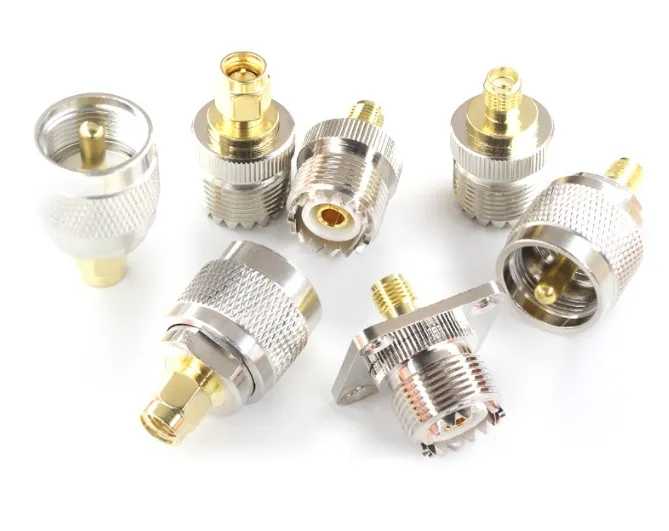
This image shows a solid, typically metallic, SMA to UHF block adapter. One end is an SMA connector (male or female based on context), the other end is a UHF connector (SO-239 or PL-259). This adapter type is compact and suitable for scenarios with ample space and requiring a direct, rigid connection, but may transfer mechanical stress to the device port.
An SMA to UHF adapter is nothing more than a coaxial interface transition. It doesn’t convert digital signals, alter frequency bands, or magically improve performance. What it really does is simple: it lets the SMA family of connectors mate with the larger UHF series (SO-239/PL-259) so your system stays compatible.
Rigid adapters are the go-to choice for many hobbyists because they’re small, inexpensive, and easy to keep in a toolbox. But there’s a catch. By locking two connectors directly together, all the mechanical stress travels into the SMA port. On a sturdy chassis this might not be a big deal, but on a handheld SDR or a lightweight radio, it can be the fastest way to damage the jack.
That’s why engineers often recommend using a pigtail jumper instead of a solid block. It’s just a short coax assembly with SMA on one side and UHF on the other. The flexible cable absorbs vibration, bends neatly around corners, and reduces torque on the device. If you’ve ever had to replace a cracked SMA port, you’ll understand why this little precaution is worth it.
In TEJTE’s RF adapter cable selection, you’ll find both block-style adapters and SMA-to-UHF jumpers, plus other transitions such as SMA-to-BNC. Each serves the same purpose—bridging two connector types—but in practice, the right choice depends on how your gear is mounted and how often you plan to connect and disconnect.
2) Identify Genders & Naming (Avoid Mistakes)
Ordering the wrong adapter often comes down to one detail: gender terminology. It sounds straightforward, but mix-ups are common, especially when SMA and UHF naming systems overlap. The key is to focus on the center conductor.
- SMA connectors

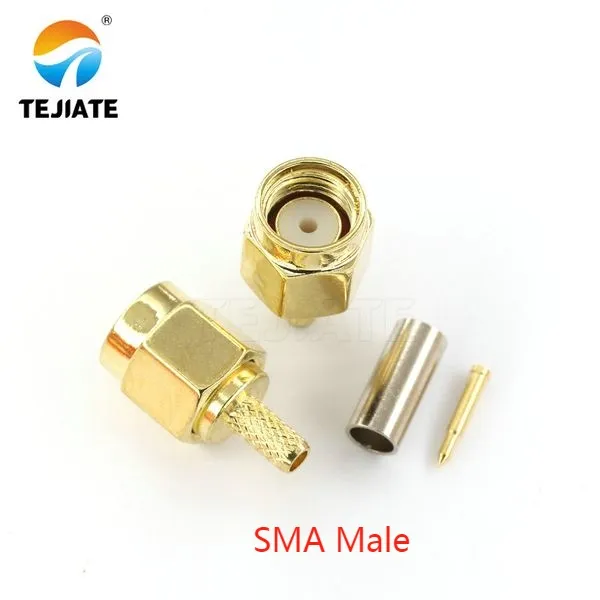
This image clearly shows the structure of an SMA male connector, highlighting its center pin, which is the key feature for identifying an SMA male and distinguishing it from a female (socket).
- SMA male: has a center pin.

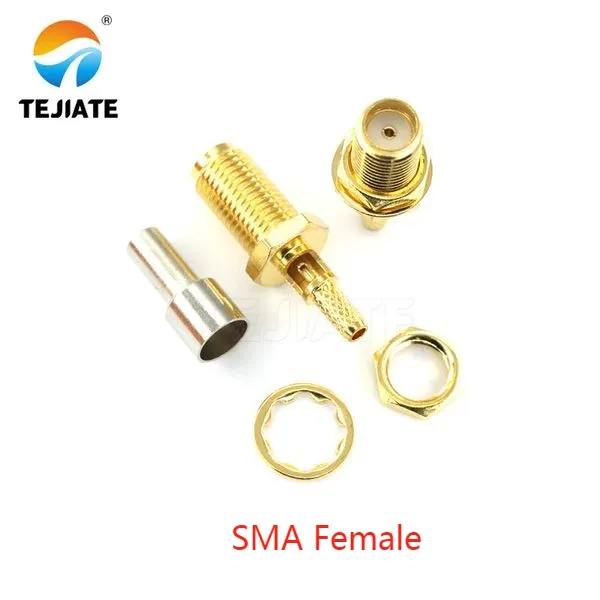
This image clearly shows the structure of an SMA female connector, highlighting its center socket (receptacle), which is the key feature for identifying an SMA female and distinguishing it from a male (pin).
- SMA female: has a receptacle (socket).
- UHF connectors

This image shows the structure of a UHF male connector (standard name PL-259), characterized by a center pin and threads for mating with a UHF female (SO-239) connector.
- PL-259 = UHF male, with a pin.

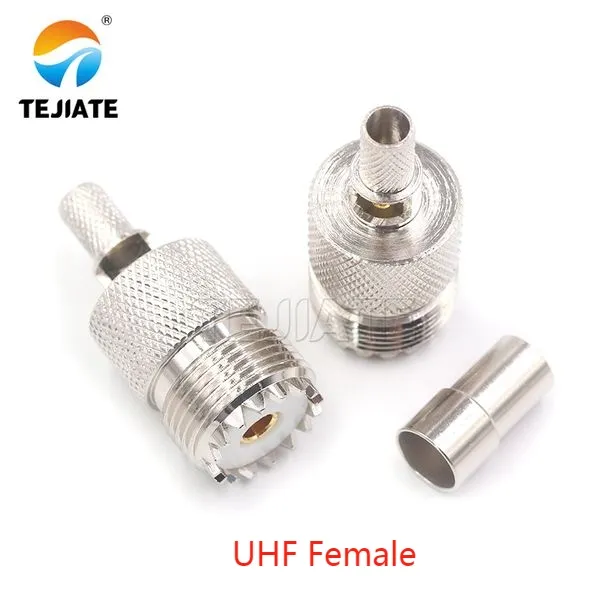
This image shows the structure of a UHF female connector (standard name SO-239), characterized by a center socket (to receive the PL-259 center pin) and an internal threaded hole (for mating with the PL-259's threads).
- SO-239 = UHF female, with a socket.
In practice, panel jacks almost always use SO-239, while cable ends typically terminate in PL-259. So, if you’re connecting a handheld SDR with an SMA female output to a ham-radio feedline, the correct match is a sma female to uhf male adapter (PL-259). On the other hand, if your device has an SMA male port, then you need a sma male to so239 adapter.
One practical tip: always double-check photos or diagrams before buying. A quick glance can save you from returning a part that doesn’t fit. TEJTE makes this easier by showing both ends clearly in its RF connector catalog, so you can match the physical pin and socket rather than relying only on the product title. That small habit prevents the common confusion between a sma female to so239 adapter and its inverse counterpart.
3) Common Conversions
3.1 SMA-Male to UHF-Female (SO-239)
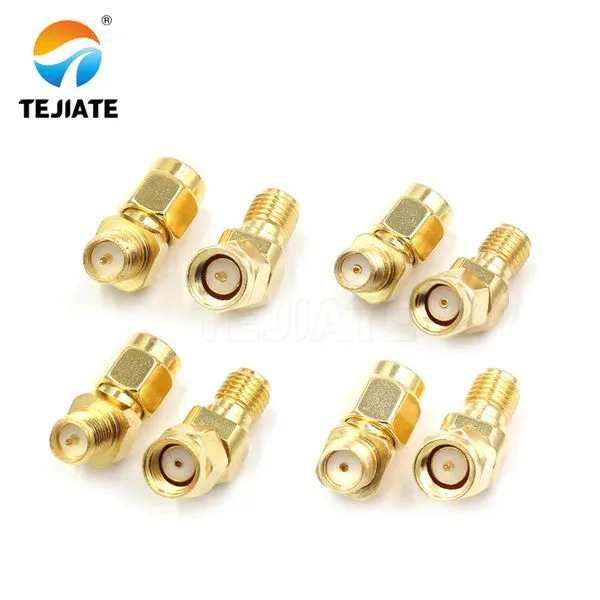
The sma male to uhf female adapter is probably the one you’ll run into most often. It’s commonly used to connect handheld radios or compact SDRs to base antennas with SO-239 sockets. Straight versions are simple and efficient, while right-angle adapters help when space is tight or the feedline must drop down immediately. Some extended-body designs also exist, giving extra clearance when ports are recessed behind a chassis.
From experience, if your device sits flush against other equipment, a 90-degree adapter makes cable routing far cleaner. Just remember that right-angle bodies can slightly raise VSWR at higher frequencies, though for HF or VHF ham radio use, the difference is hardly noticeable. TEJTE discusses this trade-off further in its coaxial cable guide, where adapter geometry and signal integrity are compared.
3.2 SMA-Female to UHF-Male (PL-259)

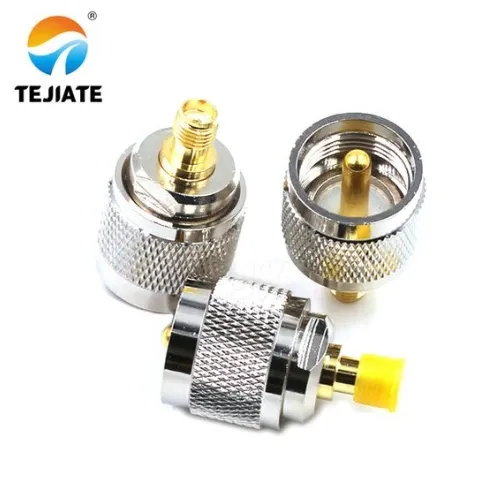
This image shows a specific adapter product: one end is an SMA female interface (internal socket), the other end is a UHF male (PL-259) interface (with center pin and threads). Used to connect devices with SMA female ports (e.g., many SDRs, portable analyzers) to cables terminated with PL-259.
The sma female to uhf male adapter is another high-demand piece. It allows SMA-female devices—portable analyzers, SDR dongles, or radios—to link directly to PL-259 terminated cables. Many ham operators use this setup in base stations because PL-259 is still common in legacy coax systems.
One point to keep in mind: PL-259 connectors are heavy. If you twist one directly onto a fragile SMA port, you may stress the solder joint or even break the jack from the board. A safer option in such cases is a short coax jumper. For durability, TEJTE also offers sma female to pl259 adapter versions with reinforced build quality, designed to handle daily use without loosening over time.
3.3 UHF-Male (PL-259) to SMA-Female

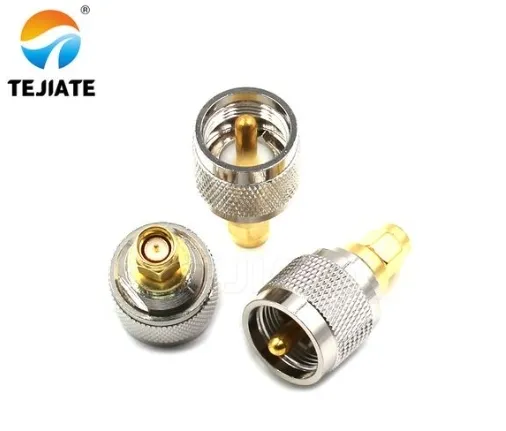
This image shows a specific adapter product: one end is a UHF male (PL-259) interface (with center pin and threads), the other end is an SMA female interface (internal socket). Used to connect cables terminated with PL-259 to devices with SMA female ports. Note the weight of the PL-259 end may cause stress on ports of small devices.
Sometimes the signal path goes in the other direction. If your feedline ends in PL-259 but your new receiver or analyzer uses SMA, a uhf male to sma female adapter bridges the gap. Mechanically it’s simple, but the risk is leverage: a PL-259 hanging from a tiny SDR stick can act like a lever arm.
One practical fix is to choose a compact uhf male (pl-259) to sma female rf adapter, or better yet, use a jumper cable to relieve strain. TEJTE’s SMA connector guide explains why connector robustness matters, and why lightweight devices benefit from flexible pigtails instead of solid blocks.
3.4 SMA-Male to PL-259 / SMA-Female to SO-239

This image shows a less common but existing adapter type: SMA male (pin) to UHF male/PL-259 (pin). The naming of such adapters can be confusing, requiring careful verification based on diagrams or pin/socket structure.
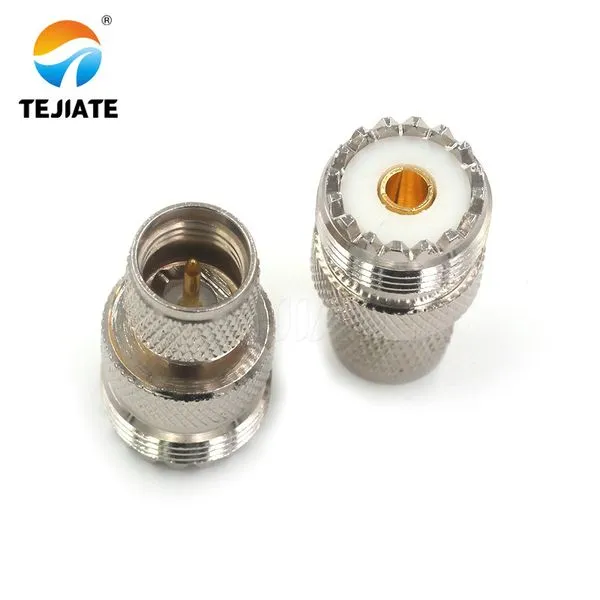
Catalog shorthand often causes confusion. A sma male to pl259 adapter is simply a block that joins an SMA male pin to a PL-259 plug. Conversely, an sma female to so239 adapter links an SMA socket to an SO-239 jack. Both are valid, but product names vary among suppliers, which is why verifying with photos or diagrams is a good habit.
TEJTE reduces this guesswork by providing clear connector visuals in its RF connector product listings. Matching by pin and socket orientation—not just titles—ensures you get the correct adapter the first time.
4) Mini-UHF vs UHF (Don’t Mix Them Up)

This image serves as a visual reference to help users identify standard UHF connectors (SO-239/PL-259), emphasizing their relatively large size and coarse thread characteristics, for comparison with the subsequent Mini-UHF.
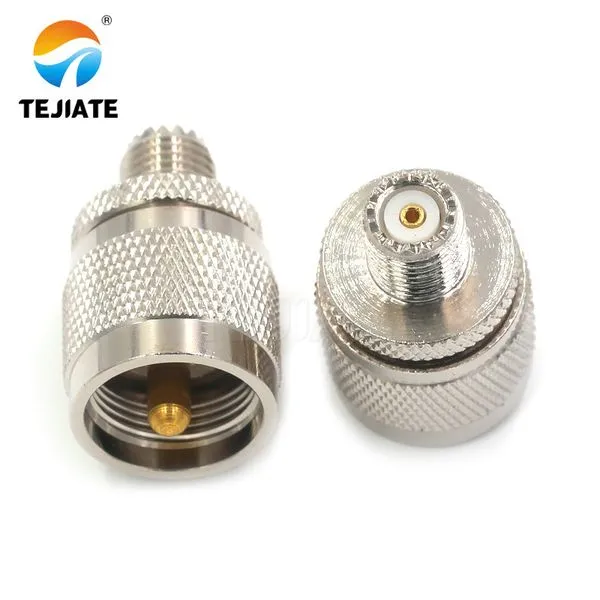
This image serves as a visual reference to help users identify Mini-UHF connectors, emphasizing their significantly smaller size compared to standard UHF and different coupling method (push-and-twist vs. threaded), preventing users from mistakenly ordering incompatible adapters.
A surprisingly common mistake is ordering a Mini-UHF part when you actually need full-size UHF. At first glance, they look similar, but the differences are critical. Mini-UHF was designed for compact mobile radios, so it’s noticeably smaller and uses a push-and-twist coupling, not the coarse threading of the classic SO-239/PL-259.
If your radio or coax specifies SO-239, a mini uhf male to sma female adapter simply won’t mate. Likewise, an sma male to mini uhf female adapter is a specialty item, useful for mobile setups but not a substitute for UHF. Many first-time buyers only realize this after the connector refuses to thread on—a mistake that could’ve been avoided by double-checking the part description.
A practical tip: if you’re unsure, measure the diameter of the connector opening. Mini-UHF jacks are roughly 30% smaller than SO-239, so the difference is easy to spot once you know what to look for. For a broader comparison of connector families and their locking mechanisms, TEJTE’s SMA vs BNC vs N-Type guide provides useful context on how size and frequency range influence the choice of adapters.
5) Cable Jumpers & Pigtails

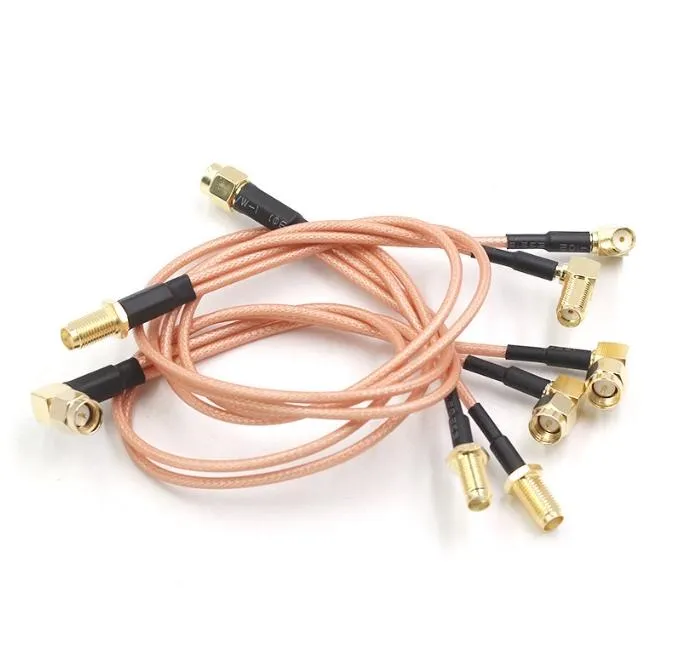
This image shows an alternative solution to rigid adapters: an SMA connector on one end, a UHF connector (likely SO-239 or PL-259 depending on model) on the other, connected by a flexible coaxial cable. This jumper absorbs mechanical stress and vibration, protects device ports, and offers routing flexibility.

Rigid adapters solve many quick connection needs, but they’re not always the safest option. Picture this: a transceiver mounted inside a tight metal case. Forcing a block adapter between the SMA port and a PL-259 feedline can put sideways pressure on the board-mounted jack, and over time, that stress can crack solder joints.
This is where a short jumper cable makes life easier. A 3ft cable jumper pigtail uhf so239 female pl259 to sma male plug moves the stress point away from the device, absorbing vibration and bending smoothly around corners. It’s not just about mechanical safety—it also improves flexibility when routing cables in racks, mobile setups, or outdoor housings.
Another bonus is waterproofing. With a pigtail, you can seal the coax-to-coax joint with tape or heat-shrink several inches away from the radio body, protecting sensitive electronics from moisture intrusion. That simple step is often overlooked, yet it makes a huge difference in long-term reliability for outdoor stations.
TEJTE keeps standard jumper lengths in stock, ranging from 6 inches to several feet, and also supports custom assemblies when special lengths or connector mixes are required. If you’re weighing a block adapter versus a jumper, the rule of thumb is simple: when weight, torque, or vibration is part of the equation, cables usually win. For a deeper dive into how coax length affects attenuation, check TEJTE’s understanding RF cables guide.
6) RF Considerations (Impedance, Bandwidth, Fewer Joints)
Both SMA and UHF (SO-239/PL-259) connectors are widely used in 50-ohm systems, but they don’t behave the same way at higher frequencies. SMA, with its precise threading and compact geometry, comfortably handles signals into the multi-GHz range. UHF, on the other hand, was created decades ago for audio and low-RF use, so while it works fine for HF and VHF bands, performance begins to slip above ~300 MHz.
Each extra adapter you add introduces a small penalty. A single sma to uhf connector may only bring about 0.1 dB insertion loss at 500 MHz, which sounds negligible. But if you stack two or three together, those fractions add up quickly, and suddenly you’ve lost half a decibel or more. At higher frequencies, long-bodied adapters or right-angle designs can also slightly worsen VSWR.
From practical experience, fewer joints usually means fewer headaches. If you know you’ll need multiple transitions, consider replacing them with a purpose-built SMA-to-SO239 jumper cable. Not only does it reduce insertion loss, it also lowers the chances of mismatch and improves durability under repeated use.
For readers who want a deeper technical perspective, TEJTE’s RF coaxial cable guide breaks down impedance matching and attenuation in detail. It’s a solid reference if you’re planning longer runs or trying to minimize loss in higher-frequency applications.
7) Buying Checklist
When it comes to selecting the right sma to uhf antenna adapter or jumper, rushing the purchase often leads to ordering the wrong part. A quick checklist can save both time and frustration:
- Identify connector genders clearly – Is your device SMA male or female? Is the other end PL-259 or SO-239?
- Confirm direction – Always match pin-to-socket correctly. For example, an SDR with an SMA female output requires a sma female to uhf male adapter (PL-259), while an SMA male device will need a sma male to so239 adapter.
- Orientation matters – Straight adapters work when space is open. If equipment is stacked close together, a right-angle adapter keeps cables from bending too sharply.
- Think about stress relief – Heavy PL-259 plugs can strain delicate SMA ports. In those cases, swap a rigid block for a 3ft jumper cable.
- Check build quality – Look for gold-plated contacts and nickel-plated shells to resist corrosion, and reinforced structures that withstand repeated use.
- Consider material and finish – Higher-grade brass or stainless designs last longer in field environments.
- Buy smart – Sometimes a kit of multiple sma adapters is more cost-effective than piecing together singles, especially if you operate in different setups.
If you’re debating whether to stick with UHF or switch to other connector families, TEJTE’s SMA vs BNC vs N-Type comparison offers a clear breakdown of trade-offs in size, frequency range, and locking styles.
8) FAQs
Q1: What’s the difference between SMA-male to SO-239 and SMA-female to PL-259?
Both create an SMA to UHF link, but they serve opposite ends. An sma male to so239 adapter connects a male-pin SMA device to an SO-239 panel jack, while an sma female to uhf male adapter (PL-259) is meant for SMA-female gear linking into a PL-259 cable. Mixing them up is one of the most common ordering mistakes.
Q2: How do I choose a UHF-male (PL-259) to SMA-female adapter?
Check your feedline first. If your coax ends in a PL-259 plug and your device has an SMA male pin, then a uhf male to sma female adapter is the correct choice. To avoid stress on smaller devices like SDR dongles, many operators prefer using a short jumper cable instead of a rigid block.
Q3: Are right-angle adapters worse at higher frequencies?
Slightly, yes. A uhf so239 female to sma male right angle 90-degree rf adapter coax cable can introduce small capacitance changes, raising VSWR once you go above ~1 GHz. For HF and VHF ham use, this effect is negligible, but if you’re working with UHF or microwave bands, consider sticking with straight adapters.
Q4: When should I choose a pigtail jumper instead of a block adapter?
Whenever there’s risk of torque or vibration. A 3ft cable jumper pigtail uhf so239 female pl259 to sma male plug takes the weight off the device’s SMA jack and adds flexibility in tight spaces. Outdoor setups also benefit since you can waterproof the junction away from the radio body.
Q5: Can Mini-UHF substitute for standard UHF?
No. Mini-UHF and UHF differ in size and coupling method. If your equipment specifies SO-239, you need the real thing. A mini uhf male to sma female adapter or sma male to mini uhf female adapter will only fit Mini-UHF ports, not full-size UHF.
For more guidance on connector standards and best practices, TEJTE’s RF coaxial cable guide covers impedance, attenuation, and why matching matters for reliable performance.
Conclusion
Selecting the right SMA to UHF adapter isn’t just about convenience—it directly affects the performance and reliability of your RF setup. Start by confirming genders (SMA male or female, PL-259 or SO-239), then decide whether a straight block, right-angle body, or flexible pigtail jumper makes the most sense for your situation. The fewer adapters you chain together, the lower your insertion loss and the cleaner your signal path.
TEJTE’s adapters are built with gold-plated contacts, nickel-plated shells, and reinforced legs, which means they stay reliable under daily use in both lab and field conditions. Whether you’re working on a ham station, retrofitting older gear, or extending a panel feed-through, making the right adapter choice ensures consistent performance. For more context on cable selection and matching, see TEJTE’s comprehensive RF cable guide.
Data Table: Common SMA to UHF Adapter Types & Uses
| Adapter Type | Ends | Typical Use Case | Notes |
|---|---|---|---|
| SMA male to UHF female (SO-239) | Pin to Socket | Handhelds to SO-239 base antennas | Straight or right-angle |
| SMA female to UHF male (PL-259) | Socket to Pin | SDRs or radios into PL-259 feedlines | Avoid torque on SMA jacks |
| UHF male (PL-259) to SMA female | Pin to Socket | Legacy coax into SMA receivers | Use jumper for strain relief |
| SMA male to PL-259 | Pin to Pin | Direct handheld-to-feedline connection | Check clearance before use |
| SMA female to SO-239 | Socket to Socket | SMA-female gear to SO-239 panels | Common in ham shacks |
| Mini-UHF to SMA | Small twist-lock to SMA | Mobile radios, compact setups | Not interchangeable with UHF |
Final Wrap-Up
In RF design, it’s often the smallest pieces that decide whether a system runs smoothly or struggles with noise and dropouts. The right sma to uhf connector bridges older UHF-based gear with modern SMA systems, ensuring compatibility without compromising signal integrity. Avoiding gender confusion, reducing adapter chains, and knowing when to switch to a coax jumper are habits that protect both your equipment and your signal quality.
With stock available and custom assemblies supported, TEJTE makes it easy to find the exact solution you need—whether that’s a straightforward sma male to so239 adapter or a tailored jumper cable designed for rugged outdoor use. Ground your choices in real parameters, proven materials, and thoughtful design, and you’ll achieve what every RF engineer wants: low loss, high reliability, and long service life.
For more practical RF tips and connector insights, explore TEJTE’s RF connector resources and blog library, where guides cover everything from SMA basics to coaxial cable attenuation.
Bonfon Office Building, Longgang District, Shenzhen City, Guangdong Province, China
A China-based OEM/ODM RF communications supplier
Table of Contents
Owning your OEM/ODM/Private Label for Electronic Devices andComponents is now easier than ever.
