
SMA Bulkhead & Flange Connectors: Length, Panel Fit, IP Seal

Sep 04,2025

Introduction

Exploded view of an SMA bulkhead connector assembly with threaded barrel, nut, washer, and O-ring

This image focuses exclusively on the SMA bulkhead (feed-through) connector type. It provides a detailed breakdown of its key components: the central threaded barrel, the hex nut, the washer, and the critical silicone O-ring. The illustration demonstrates the mounting sequence—the barrel is inserted through the panel hole from the inside, and the nut is tightened from the outside, compressing the O-ring against the panel to create a secure and weatherproof seal. This highlights the simplicity and effectiveness of the bulkhead mounting method for bringing RF signals through an enclosure wall.
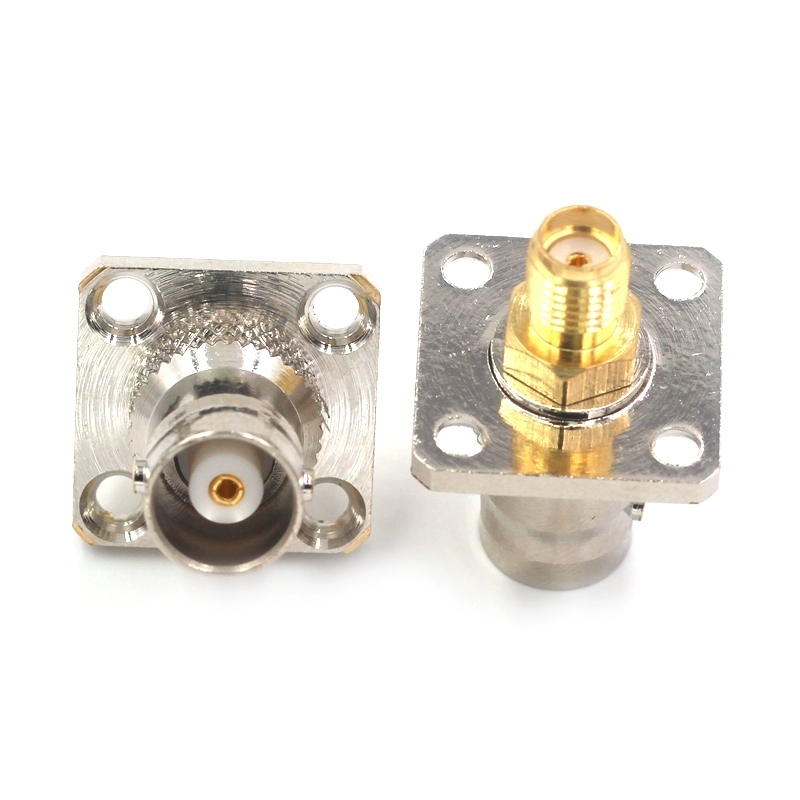
SMA Bulkhead Connector Assembly and Mounting

Designing an RF enclosure isn’t only about picking the right antenna—it’s also about how the signal escapes the box. That’s where SMA bulkhead connectors and SMA flange connectors come in. They look similar on a datasheet, but in practice they solve different mechanical challenges. Bulkhead styles rely on a threaded barrel pulled through the panel, while flange versions fasten flush with screws.

The tricky part is making sure the thread length matches panel thickness, that the O-ring seals correctly for IP ratings, and that you’ve chosen the right body style and plating for the environment. In this guide, we’ll walk through definitions, gender codes, length selection, sealing tips, and RF trade-offs. Along the way, you’ll find quick reference tables and buying advice to help you avoid high VSWR or a leaky housing.

1) What Is an SMA Bulkhead / Flange Connector?

SMA flange mount connector with a 4-hole square pattern being secured to a panel with screws

This image illustrates the alternative mounting method using an SMA flange connector. Instead of a threaded nut, this type features a solid base (here shown with a 4-hole square pattern) that is bolted directly onto the panel surface using screws. This provides a much larger contact area and distributes mechanical stress, vibration, and mating torque more evenly across the panel. It is the superior choice for heavier connectors, frequent disconnections, or applications where the panel material is too thin or fragile to withstand the compression force of a bulkhead nut.

SMA Flange Mount Connector Installation

An SMA bulkhead connector is essentially a feed-through device. Its barrel passes through a wall or chassis and locks with a nut, often backed by a washer and O-ring to hold pressure. The purpose is simple: bring an RF signal from the inside of a board or module to the outside world without compromising shielding or signal quality.

By contrast, an SMA flange connector doesn’t rely on a nut. Instead, it has a rectangular or diamond-shaped base with two or four screw holes. This base bolts against the panel, distributing stress more evenly. Both styles serve the same end—secure, low-loss RF access—but they differ in mounting stability and space requirements.

It’s worth stressing that these are not interchangeable with a basic SMA adapter or a short adapter cable (pigtail). Adapters simply bridge two existing connectors, while bulkhead and flange mounts integrate into the equipment itself. That’s why they’re found on Wi-Fi routers, outdoor IoT gateways, weather-sealed base stations, and custom test fixtures.

Take TEJTE’s SMA-KE bulkhead series as an example: gold-plated brass housings, PTFE dielectric, silicone O-ring included. Specs run from DC up to 6 GHz, with insertion loss under 0.15 dB at 6 GHz—enough margin for lab setups as well as telecom gear deployed outside.

2) Identify Genders & Industry Codes (Avoid Buying Wrong)

Anyone who has ever ordered SMA parts in bulk knows the frustration: boxes arrive, and suddenly half the connectors don’t mate because the gender was misread. The simplest fix is to master a quick visual check:

  • SMA male → external threads with a solid center pin.
  • SMA female → internal threads with a hollow receptacle.

From there, industry shorthand adds another layer:

  • KKY → commonly used for bulkhead styles.
  • KF, KFD, KWFD → mark 2-hole or 4-hole flange mounts.
  • JJ / KK / JK / KJ → shorthand gender notation:
    • JJ = male–male
    • KK = female–female
    • JK = jack–plug
    • KJ = plug–jack

Once gender is sorted, the decision shifts to body orientation and materials. Do you go with a straight barrel or a right angle sma adapter style? Brass with gold plating works well for most indoor gear, while stainless steel with nickel plating is the safer bet in corrosive or outdoor environments.

Take TEJTE’s SMA-KWE right-angle bulkhead connectors as a case in point. They’re available with 11 mm, 17 mm, and 23 mm thread barrels, tested to ≤5 mΩ contact resistance and ≥5000 MΩ insulation resistance. In practice, this means you aren’t just picking gender—you’re weighing orientation, plating, and long-term durability.

3) Thread Length vs Panel Thickness (Choosing the Right Fit)

Diagram showing SMA bulkhead thread length matching different panel thicknesses

This image is a key reference tool, providing a visual guide to correlate SMA bulkhead connector thread length with the thickness of the mounting panel. It helps designers and installers avoid common mistakes like choosing a thread that is too short (cannot secure properly) or too long (wastes space, may cause instability), ensuring a mechanically robust and reliable installation.

Matching Thread Length to Panel Thickness

One of the easiest ways to ruin a build is to choose the wrong sma bulkhead length. Too short and you can’t get the nut and washer to bite; too long and you’ll end up with wasted space or a connector that wobbles under stress.

Here’s the simple breakdown:

  • 8–11 mm threads → work best for 1–2 mm thin aluminum or plastic walls.
  • 13–17 mm threads → handle general enclosures with 2–4 mm steel or ABS panels.
  • 21–26 mm threads → reserved for thick steel walls or reinforced housings where the connector must pass through 5–8 mm of material.

TEJTE’s catalog illustrates these options clearly. For instance:

  • SMA-KE (straight bulkhead) → 8 mm or 11 mm threads, compact fit for PCB-based modules.
  • SMA-KWE (right-angle bulkhead) → 17 mm or 23 mm thread lengths, perfect for AP housings.
  • Extended bulkhead versions → 26.5 mm overall body with a 21 mm threaded section, designed for industrial panels or double-wall chassis.

Thread vs Panel Thickness Reference Table

Thread Length (mm) Typical Panel Thickness (mm) Recommended Use Case Example Part
8–11 1–2 Thin aluminum / ABS enclosures SMA-KE-8
13–15 2–3 Wi-Fi routers, IoT boxes SMA-KE-13
17 3–4 Access points, steel panels SMA-KWE-17
21–23 4–6 Industrial control housings SMA-KWE-21
26 6–8 Double-wall outdoor cabinets SMA-KE-26.5
Don’t forget to account for nut and washer thickness (≈2 mm) and O-ring compression (~0.5–1 mm). A safe rule of thumb: always allow at least 2–3 mm of thread exposed beyond the panel for proper nut engagement.

4) Flange Options (2-Hole vs 4-Hole)

SMA connector with a 2-hole diamond-shaped flange for compact mounting

This image showcases a 2-hole diamond flange type SMA connector. This design is characterized by its smaller footprint and asymmetrical (diamond) hole pattern, making it suitable for applications where space is extremely limited, such as compact IoT gateways or handheld devices, while still providing a more secure mounting than a simple bulkhead nut in thin panels.

2-Hole Diamond Flange SMA Connector
SMA connector with a robust 4-hole square flange for high-stability mounting

This image highlights a 4-hole square flange SMA connector. This variant offers superior mechanical stability and torque resistance due to its symmetrical screw pattern and larger base area. It is the preferred choice for demanding applications like outdoor telecom base stations, access points, or any environment subject to vibration or frequent mating cycles, where a bulkhead mount might be insufficient.
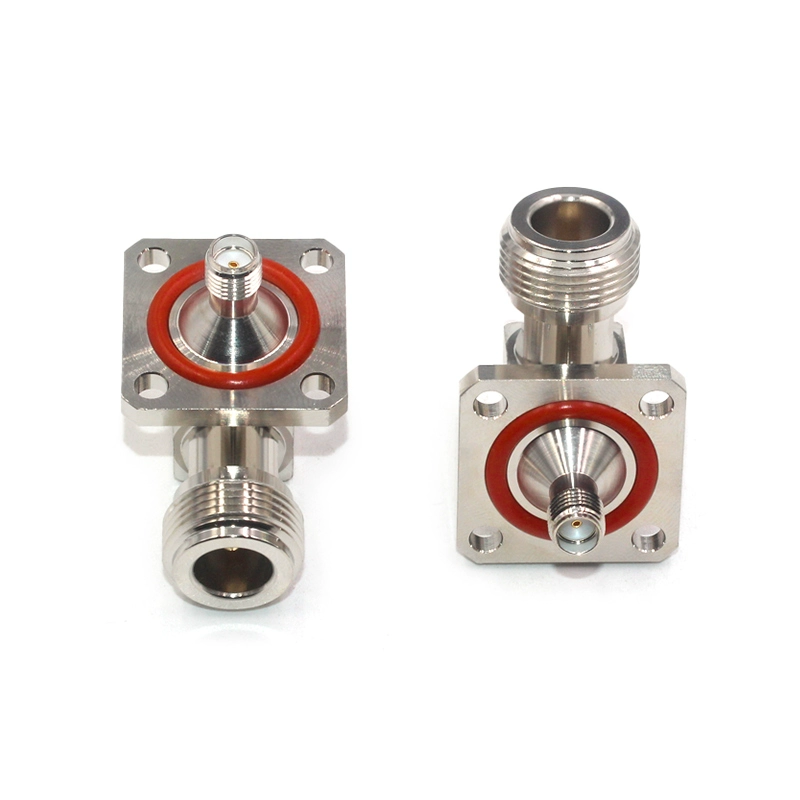
4-Hole Square Flange SMA Connector

When reliability is more important than compactness, sma flange connectors become the smarter choice. Rather than relying on a single nut, flange mounts use screws to secure the connector firmly to the panel.

Two main options exist:

  • 2-hole diamond flange → slim footprint, great for compact IoT gateways where space is at a premium.
  • 4-hole square flange → stronger, distributes torque evenly, and withstands repeated mating cycles in outdoor telecom gear.

TEJTE’s flange SMA connectors (KF / KFD series) feature gold-plated brass shells, PTFE dielectric, beryllium bronze contacts, and silicone O-rings. Lab tests show they can endure over 500 mating cycles while maintaining VSWR ≤1.20 up to 6 GHz—critical for test fixtures and base stations alike.

2-Hole vs 4-Hole Comparison

Flange Type Size & Hole Pattern Torque Resistance Typical Applications
2-hole Diamond, smaller gap Moderate Compact IoT, handheld gear
4-hole Square, symmetric High Base stations, outdoor APs

Choose flange over bulkhead if:

  • The panel material is too thin or soft to hold a nut.
  • The system will be exposed to vibration (vehicles, outdoor poles).
  • You need high repeatability for test and maintenance environments.

5) IP Sealing & Outdoor Use (O-Ring, Torque & Tolerances)

Cross-section detail showing O-ring compression and sealing in an SMA bulkhead connector

This image provides an internal view of the sealing mechanism critical for outdoor or harsh environment use. It clearly shows the position of the silicone O-ring and how it compresses (typically 20-30%) between the connector body, panel surface, and nut/washer to form a reliable IP67-rated seal against moisture and dust ingress. Understanding this compression is key to achieving a weatherproof installation.

IP Sealing Mechanism with O-Ring

Sealing an SMA connector outdoors isn’t just about closing the hole—it’s about maintaining IP65–IP67 protection under rain, salt fog, and daily thermal cycling.

Key parameters to check:

  • O-ring compression → Aim for 20–30%. TEJTE’s bulkheads include silicone 6146 O-rings rated for –65 °C to +165 °C and resistant to UV.
  • Torque → For brass body connectors, tighten panel nuts to 0.6–0.8 N·m. Stainless steel versions may allow up to 1.0 N·m. Always apply torque gradually to prevent warping.
  • Panel hole tolerance → ±0.1 mm is recommended. Too loose means the O-ring won’t bite, too tight risks damaging plating or insulation.
  • Material selection → Brass + gold plating works indoors. For harsh coastal environments, stainless steel SMA bulkheads significantly extend service life.

Sealing & Outdoor Performance Table

Feature Typical Value / Spec Note
O-ring material Silicone rubber (6146) -65 °C to +165 °C, UV resistant
O-ring compression 20–30 % Prevents leaks without overstress
Panel nut torque 0.6–0.8 N·m (brass) Even tightening required
Panel hole tolerance ±0.1 mm Ensures correct sealing
Outdoor cable routing Drip loop required Stops water ingress via coax jacket
For outdoor APs or cabinets, always route coax downward with a drip loop. Combined with proper O-ring compression and torque, this ensures the connector maintains its IP rating even under long-term weather exposure.

6) RF Considerations: Impedance, Frequency, VSWR & Loss

Every sma panel mount connector is designed with one thing in mind: maintaining the 50 Ω impedance standard. Deviating from this, such as mixing a 75 Ω connector in the chain, may still pass a low-frequency signal but quickly creates reflections and standing waves at higher bands.

Frequency range is equally important. TEJTE’s bulkhead and flange SMA connectors are specified from DC to 6 GHz, with insertion loss staying under 0.15 dB at 6 GHz. Whether used in a Wi-Fi router, LTE module, or a 5G IoT gateway, these tolerances ensure system stability.

Right-angle bulkheads are practical in cramped housings, but engineers should remember that any bend disturbs the field slightly. At frequencies above 10 GHz, that can push VSWR higher than desired. Below 6 GHz, however, the effect is minimal.

Another golden rule: avoid unnecessary connector chains. Every extra adapter adds loss and mismatch. Keeping transitions short and direct not only preserves return loss but also prevents cumulative VSWR that could detune sensitive radios.

Performance Snapshot

Parameter Typical Value TEJTE Spec Example
Impedance 50 Ω 50 Ω ± 2 Ω
Frequency Range DC - 6 GHz DC - 6 GHz
Insertion Loss ≤ 0.15 dB @ 6 GHz ≤ 0.15 dB
VSWR ≤ 1.20 ≤ 1.20
Insertion Cycles 500+ 500+ cycles

7) When to Use a Cable Instead (Pigtails)

A direct sma bulkhead or sma flange mount isn’t always the smartest choice. If your design faces vibration, panel flex, or repeated handling, a short coax pigtail often delivers better reliability. It takes the stress off rigid connectors and gives the assembly more tolerance.

Engineers typically turn to a few common cable types:

A particularly popular option is the ufl to sma adapter cable. It acts as a stress reliever, bridging a fragile U.FL pad on the module to a sturdy SMA connector on the chassis. In practice, this simple jumper can extend module lifespan by preventing pad lift or solder cracks during installation.

One typical setup looks like this: U.FL on the module → RG178 pigtail → SMA bulkhead at the panel wall. With this arrangement, delicate PCB traces stay protected, while the enclosure still offers a robust external interface.

Cable Loss Reference (at 2.4 GHz)

Cable Type Loss (dB/m) Loss (dB/6") Notes
RG178 ~1.6 ~0.20 Flexible, good for short runs
RG316 ~1.1 ~0.14 Lower loss, slightly stiffer
1.13 mm ~2.0 ~0.25 Ultra-thin, fragile jacket
0.81 mm ~2.6 ~0.32 For ultra-compact devices
Rule of thumb: keep pigtails under 15–20 cm (6–8″) whenever possible. Even at 2.4 GHz, a few extra centimeters can shave off range or sensitivity. Field engineers often say, “shorter is always safer” when it comes to RF jumpers.

8) Buying Checklist & Quick Matrix

With so many variations of SMA bulkhead and flange types, the smartest way to avoid mistakes is to follow a simple checklist. Skipping even one item can mean reordering parts or dealing with poor fit.

  1. Connector interface – Always double-check SMA male vs. female before checkout.
  2. Mounting style – Decide whether you need a bulkhead or a flange.
  3. Thread length – Match carefully to panel thickness; a few millimeters make all the difference.
  4. Orientation – Straight or right-angle, depending on clearance.
  5. Material & finish – Brass with gold plating works for most uses; stainless steel is better outdoors.
  6. Sealing hardware – Confirm the O-ring, gasket, and nut are included.
  7. Accessories – Consider washers, lock nuts, or anti-vibration parts.
  8. Quantity – Single units are fine for repair; for projects, look for sma connector adapter sets to cover multiple scenarios in one purchase.

Quick Selection Matrix

Structure Thread Length Orientation O-Ring Flange Type Example Application
Bulkhead 11 mm Straight Yes Thin plastic router case
Bulkhead 17 mm Right-angle Yes Wi-Fi AP in steel housing
Bulkhead 21 mm Straight Yes Industrial automation cabinet
Flange Straight Yes 2-hole Compact IoT gateway
Flange Straight Yes 4-hole Outdoor telecom base station
This quick matrix cuts out guesswork. Just match your panel thickness, orientation, and environment, and the right connector almost chooses itself. For engineers who prototype often, having a small stock of SMA connector adapter sets can save hours—no more waiting for the right part to arrive when a project is already on the bench.

9) FAQs

How do I choose bulkhead thread length for my panel?

Start by measuring the total panel thickness at the mounting point. Add roughly 2 mm for washer and nut and 0.5–1 mm for O-ring compression. For example, a 2 mm aluminum housing plus hardware needs at least a 13 mm thread to achieve proper bite. TEJTE offers SMA bulkheads in 8, 11, 17, and 21 mm threads, so you can match thickness without guesswork.

Flange vs. bulkhead: which is more durable?

Bulkhead mounts are compact and easy to install, making them ideal for routers and indoor devices. Flange mounts, especially the 4-hole square type, resist torque and vibration much better. If your design will be outdoors or subject to frequent cable mating, flange connectors are the safer bet.

Do SMA and RP-SMA adapters affect signal in panel-mount use?

Yes, every adapter introduces some mismatch and insertion loss. High-quality SMA adapters keep this under 0.15 dB at 6 GHz, which is usually negligible for short links. But cascading multiple adapters can raise VSWR and reduce link reliability, so it’s best to keep adapter use to a minimum.

Can I directly adapt SMA to Ethernet/RJ45?

No. An SMA carries analog RF signals, while RJ45 is a digital Ethernet interface. They are not mechanically or electrically compatible. If you see products labeled SMA to Ethernet adapter or “SMA to RJ45 adapter”, they are in fact converter modules with active electronics. Always confirm you’re buying a true converter, not just a passive piece of metal.

When should I choose stainless steel over brass for outdoor use?

Brass with gold plating is cost-effective and works well indoors. But in coastal areas or corrosive industrial environments, brass corrodes quickly. Stainless steel SMA bulkheads resist rust and maintain seal integrity far longer, even if they cost a bit more upfront.

Can SMA bulkheads be reused after 500 cycles?

Most SMA connectors are rated for ≥500 mating cycles. After that, the plating on the center contact may wear, and VSWR performance can drift. For lab setups where connectors are swapped daily, consider rotating parts or using test-grade adapters.

What torque tool should I use for SMA panel nuts?

For brass bulkheads, a torque wrench calibrated to 0.6–0.8 N·m is ideal. Using pliers or over-tightening risks deforming the panel and damaging the O-ring. Always tighten gradually and evenly.

Conclusion

Choosing the right SMA bulkhead or flange mount connector comes down to a few fundamentals: match thread length to panel thickness, ensure proper O-ring sealing, and pick materials suited for the environment. A 2 mm router chassis may only need an 11 mm brass bulkhead, while a thick outdoor cabinet might demand a 21 mm stainless steel flange with 4-hole mounting.

For indoor test benches or consumer routers, short-thread brass bulkheads keep costs down without sacrificing RF performance. For outdoor telecom, upgrading to stainless steel with silicone O-rings pays dividends in reliability. And when stress or vibration is unavoidable, inserting a short RG178 or RG316 pigtail can save PCB pads from premature failure.

The bottom line is simple:

  • Define structure (bulkhead vs. flange).
  • Check thread length against your panel.
  • Verify sealing and plating for your environment.
  • Limit adapter cascades to preserve VSWR.

Follow these steps, and your SMA panel mounts will stay IP-rated, low-loss, and dependable—whether on a Wi-Fi router, an IoT sensor, or a 5G base station.

Bonfon Office Building, Longgang District, Shenzhen City, Guangdong Province, China

customer service